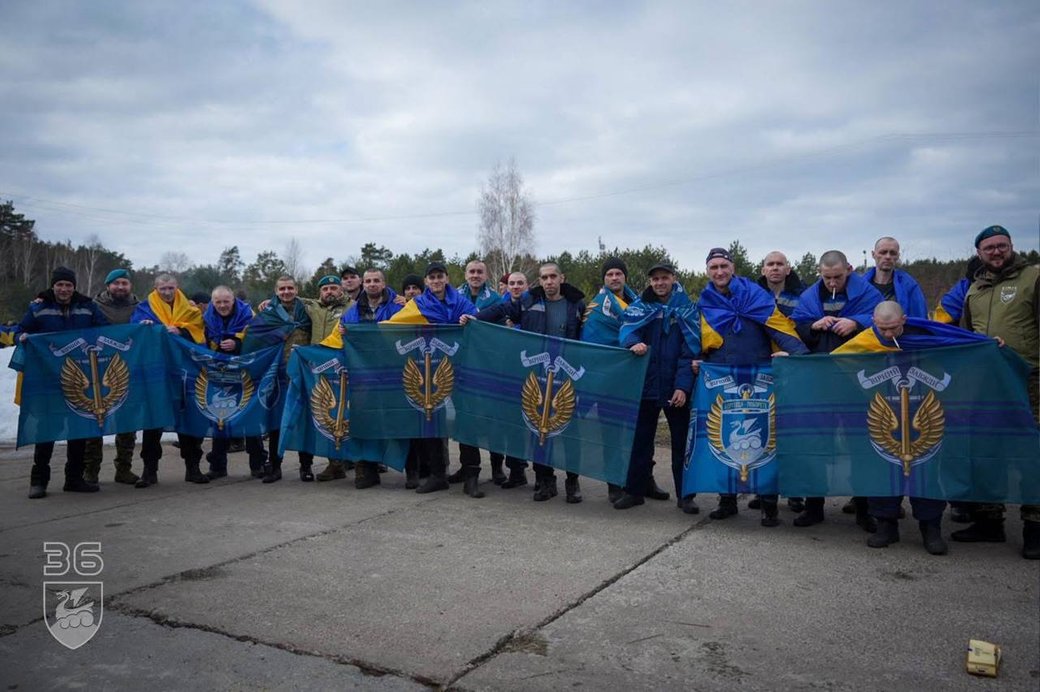
Serhiy Shikun, a 36-year-old soldier, was returned from Russian captivity to his community in the Zhytomyr region

Source: Suspilne
Author: Olena Slobodenyuk

During the prisoner exchange on March 6, 36-year-old soldier Serhiy Shikun from the village of Hordiivka in the Romanivska community was returned to Ukraine from Russian captivity. Serhiy was taken prisoner while carrying out a combat mission in the Donetsk region in August 2024. The soldier’s mother and wife told Suspilne that over the past year and a half, they had lost hope, as Serhiy had been nominated for exchange several times during that period but was never actually exchanged. During the exchange on March 6, the women said they weren’t holding out any false hope, so the news of Serhiy’s return from captivity took them by surprise. Lyudmila and Natalia say they were so happy that they couldn’t contain their emotions—they shouted, laughed, and cried with joy.
I read that message three times because I couldn’t believe
it myself Serhiy’s wife, Natalia, works as a saleswoman at a store in the village of Hordiivka. Around noon on March 6, she received a notification in the “Diya” app. Natalia says she couldn’t believe what she read, so she reread the message three times before finally realizing that her husband had indeed been released from Russian captivity. After that, she received a call from the Coordination Headquarters, where they confirmed that Serhiy had been included in the prisoner exchange.

“I was overwhelmed by a flood of emotions. I screamed so loudly that people ran out of the store. I even thought I must have gone crazy. Only someone who has walked our path—a path of hope and disappointment, where, exchange after exchange, they promise to bring back a loved one but never do—can understand this. These disappointments are very exhausting, so we decided that we would do everything we could here to get Serhiy back; and we would also pray and hope—but without false hopes, so as not to be disappointed again. That’s exactly why this news came as such an incredibly joyful shock to our entire family,” Natalia said.

The first person she called was Serhiy’s mother, Lyudmila, who also didn’t believe what she was hearing at first. According to Natalia, it was impossible to tell whether her mother-in-law was crying, laughing, screaming, or doing all of those things at once.

The news of her son’s return was so unexpected that Lyudmila initially thought she had simply misunderstood her daughter-in-law.

“My joy is immeasurable and indescribable. As soon as Natasha called me, I called all my relatives to tell them that Sergei had been exchanged. And then I walked around thinking: Did I do something wrong by calling everyone…? Did Natasha really tell me that my son had been returned? I thought: Maybe I misunderstood, maybe I’m losing my mind? It didn’t immediately sink in that it was true. It wasn’t until later, after I spoke with my son, that I realized I hadn’t even felt such immense joy when I gave birth to him as I did when I heard that Serhiy had been released from captivity and returned home. “Never in my life have I been as happy as I was when my child finally returned from hell,” said Lyudmila Shikun.

Her eldest daughter
found confirmation that Serhiy was being held captive Serhiy was born in Hordiivka, graduated from the local school, and earned a degree as a lathe operator at Berdychiv Vocational and Technical School No. 1. He then worked at various manufacturing facilities. Immediately before his mobilization in November 2023, he was working as a shift supervisor at one of the woodworking plants in the Romanivska community.

According to Natalia, after mobilization, her husband underwent several months of training and preparation in various regions of Ukraine. Serhiy was then assigned to the 150th Separate Mechanized Brigade and sent to the Donetsk sector.

Natalia says she stayed in constant contact with her husband—they called and texted each other whenever possible. Around 5:00 p.m. on August 2, 2024, Serhiy told Natalia he was heading out on a mission, promising to call her in two hours. She never received that call.

“On August 3, I started sounding the alarm: I contacted the wives of his comrades-in-arms, as well as Serhiy’s comrades themselves. A week later, we filed a report with the police. Later, we received a notification that Serhiy was considered missing. On August 10, our children—specifically, our eldest daughter—found a video on one of the restricted Russian channels that featured Serhiy. Sometime around August 12–13, this video had already been shared on our Ukrainian channels. We recognized Serhiy immediately—he looked haggard and exhausted. In fact, from the very first days, both sides confirmed that my husband was being held captive. We received official notification of this in January 2025,” said Natalia Shikun.

One video and one letter in over a year and a half of captivity
During Serhiy’s more than one and a half years in captivity, the family received only one video and one letter from him.

“That video was sent to me, his wife, while Serhiy was being held captive in the occupied territories of Ukraine. He was there until January 2025. Then he was taken to Russia—Serhiy was held in one of the pretrial detention centers in the Orenburg region. Later, we received one short letter—in it, Serhiy wrote that he was alive, that they were fed three times a day, that they had the opportunity to bathe and do laundry, and that he was eagerly awaiting our reunion. In August 2025, Serhiy was added to the list for the 1,000-for-1,000 prisoner exchange. Around that time, photos of him began appearing more frequently on Russian TV channels. “The Russians were saying something along the lines of the Ukrainian side not wanting to take these guys back. We were really hoping, but Serhiy wasn’t returned then,” says Natalia.

Lyudmila Shikun explained that she was able to learn more about Serhiy’s condition from his comrade-in-arms, who had been exchanged earlier.

“We now know that Serhiy reached out to three guys who were with him and had been released earlier, asking them to find us and tell us about him. One of these young men—Ruslan from Kyiv—actually tracked us down. He and Serhiy had been together for half a year, right from the first days of their captivity. There was a moment when Ruslan paused and said, ‘Wait, maybe I’m telling you about the wrong Serhiy?’ Because he’d already had an experience where he found the parents of one guy, told them about him, and it turned out it wasn’t the right guy. During a conversation with my daughter-in-law, Ruslan clarified that he was telling us about the Serhiy who collects antique coins and loves “Berdychev beer.” And we immediately realized that he was talking about our Serhiy. “We’re truly grateful to Ruslan because he told us so much in such detail about my son’s emotional and physical condition,” said Lyudmila.

According to her, while Serhiy was in captivity, the family reached out to every possible agency and organization.

“At the beginning of this journey, we had just one small notice, half a sheet of school paper, but now my daughter-in-law has a whole bag weighing about 3 kilograms filled with all kinds of documents. We documented everything and kept copies of everything. My son’s wife did a tremendous amount of work—she went everywhere and reached out to everyone—the SBU, the Ministry of Defense, and Human Rights Commissioner Lubinets. She never gave up and knocked on every door, whether she was supposed to or not. Everyone already knew her by her first and middle names; sometimes they even called her, to put it mildly, “crazy,” but she paid no attention and did everything she could to get Serhiy back home as soon as possible,” said Lyudmyla Shikun.

Return to Ukraine
On March 6, around 4:00 p.m., Natalia picked up the phone and heard her husband’s voice.

“Hi, Pin, how are you?” Serhiy asked.

“That’s what he calls me—Pin. I was waiting for a call from the border, but my husband called me from the medical facility where they’d been taken. I was incredibly happy. It was comforting that his voice sounded cheerful—Serhiy was glad to be back and wanted to come home. If he could, he’d even skip rehab. We stayed in touch all day—first we talked, and then we texted back and forth almost until morning. At the same time, we watched videos with the family from the border, where those who’d been exchanged were taken. “Our youngest daughter—8-year-old Valeria—was the first to spot Serhiy in those videos. She said, ‘Why are there so many of them here?’ but she recognized her dad,” says Natalia.

Lyudmila said that Serhiy returned very thin, having lost about a third of his usual weight.

“From the 90 kilograms we remember him weighing, he’s lost weight to somewhere around 60-something kilograms. His arms and legs hurt, and he’s developed a lot of health problems, but, thank God, he’s not maimed and can still walk on his own. We’re taking care of him—as long as he comes home. All that time he was in captivity, I prayed and asked God to protect him and strengthen him both physically and mentally. When I finally heard his voice, I felt relieved—my son spoke calmly and seemed composed. Before that, I’d been very worried about his emotional and mental state, because this was captivity, after all. I was afraid they would break him down there. But when I heard my son’s voice and how calmly he was speaking, my heart felt lighter, because yes, it was him—my Sirozhka, the one I know. Now we’re eagerly awaiting the end of quarantine so we can see each other in person,” said Serhiy’s mother.

I asked if he’d managed to keep his coin
collection Serhiy’s wife says she’s only ever seen him in a positive light.

“We’ve been married for nine years, and we have four children—two born during our marriage and two from a previous marriage—but we truly consider all of them our own. Serhiy is a good person and a very kind husband. He’s calm, well-balanced, has no bad habits, and is a great family man—he’s always been caring and understanding. “His children were his top priority, and he was always in a hurry to get home to them,” Natalia said.

According to her, everyone in the village knows that Sergey’s greatest passion is collecting antique coins.

“Like his father, Serhiy is interested in history and ancient artifacts, particularly coins. His one and only—and greatest—hobby is searching for and collecting these coins. Even right after being released from captivity, after asking about his family, the first thing he did was ask if all his dinars were still there. Our youngest son, who is 7, is also showing an interest in this field now—his teachers at school say he’ll probably become a historian. They say that when they look at him, they see Serhiy. Right now, my children, my parents, and our entire family are waiting for the moment when we can finally meet Serhiy in person,” said Natalia.

Lyudmila Shikun says she, too, can’t wait to see her son and hopes for the swiftest possible return home of all Ukrainian prisoners of war so that their loved ones can embrace them.

“We had such high hopes when another prisoner exchange was announced, and it was so hard to bear when my son wasn’t on the list of those who returned again. It was very hard to go through the body exchanges, because we knew that our boys were being returned—including those who hadn’t survived captivity. I admit that at times we completely lost hope—we felt resentment toward the Coordination Headquarters, toward our other institutions, and toward the whole world in general. It was all because of our powerlessness—because it was so painful, and we didn’t know how or whom else to appeal to so that our son would finally be returned. Now I want to thank everyone who is working to bring our children home. Now we’re all waiting together for our fellow villagers, whom we also know have been held captive by Russia for several years. “When my son returned, I began to live again—I hope that everyone who is waiting will experience these emotions as soon as possible,” said Lyudmila Shikun.

This is an automatic translation generated by DeepL.