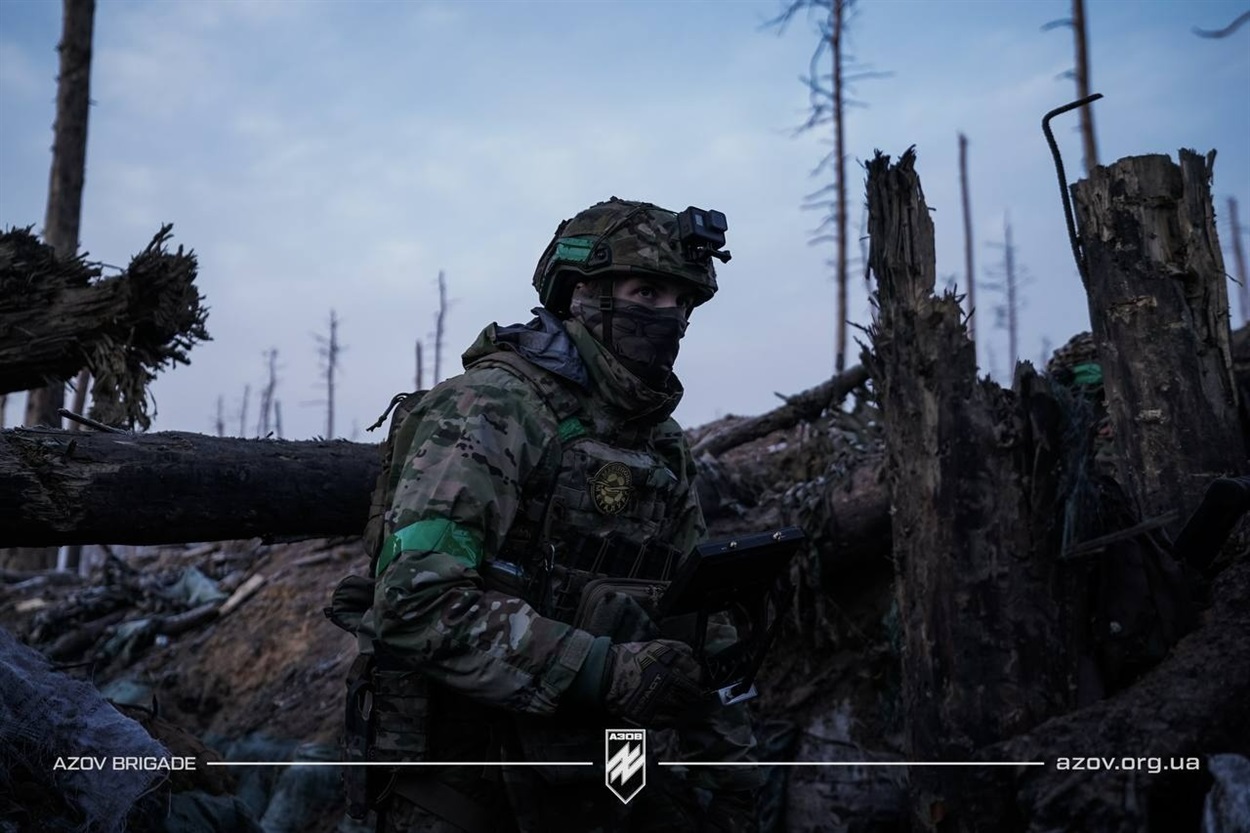
“Belya” saved the life of a friend who had been shot at by an enemy tank. His girlfriend and comrades are waiting for him to return from captivity.
Source: Svoi.City
Author: Hanna KURTSANOVSKA
A kind and sensitive person with whom there’s always something to talk
about Margarita and Bohdan have known each other for 12 years, ever since school—they were in parallel classes. One day, the boy messaged her on social media and asked for help with his homework. A few months passed, and Bohdan messaged Margarita again; from then on, they started talking more often. She says they’ve always had plenty to talk about because Bohdan is a very interesting person. He’s also kind and sensitive.
“It wasn’t until four months into our friendship that we went out for a walk together for the first time. And eventually, we went from being friends to being in love,” Margarita shared.
After ninth grade, Bogdan enrolled in the Mariupol Electromechanical Technical School, while Margarita continued her studies at school. Their relationship continued, but after she graduated, they went their separate ways.
An acquaintance that grew into a strong male friendship
During this period, the young man became passionate about various sports: Thai boxing, kickboxing, and mixed martial arts. At one of the training sessions, Bohdan met Mykyta. Very soon, the two would serve together in the Azov Regiment.
“We met at a training session. I was twenty-one at the time, and Bohdan was sixteen. Despite his young age, he was physically strong—it’s in his genes. Bogdan stood out from other young athletes because of his strong character; he always saw sparring sessions through to the end and never accepted defeat. When we started spending more time together, I immediately saw his potential,” recalls Mykyta “Kometa.”
While at “Azov,” Mykyta began to notice other character traits in his comrade. It’s his straightforwardness: “Belya” always tells the truth to your face, no matter what it is.
“And then there’s his resilience and stubbornness. He likes to stand his ground no matter what. He’s fair and wants everything to be done honestly. “Belya” doesn’t say much, but he gets a lot done. He’s the kind of person you can trust. He’ll never let you down; he’ll always have your back. Bohdan is a friend who’s stood the test of time. You can always count on his support,” says Mykyta.
His comrade “Stok” shares the same opinion. The fighter served alongside “Belya.”
“He’s from Mariupol, just like me; we have many mutual friends, and we’re part of the same soccer community. So we knew each other indirectly before joining ‘Azov,’ but we got to know each other better in the infantry and during the war. “Belya” is the most open-hearted person you’ll ever meet, a true fighting force and a comrade-in-arms who’s always there to pull you through, always ready to help, and always willing to do anything for his friends, comrades, family, and the cause. “He’s completely loyal to his beliefs and his ideals,” noted “Stok.”
Two weeks alone in a stranger’s apartment
In 2018, Bohdan and Margarita’s paths crossed again. And this time for the long haul, she says.
“We had matured; we both knew what we wanted from life. We developed a serious relationship and eventually moved in together. All in all, we’ve known each other for 12 years, 900 days of which Bogdan has spent in Russian captivity,” said Margarita.
Ten days before the war broke out, the couple moved into a new rented apartment on the first floor. Margarita didn’t even have time to unpack more than half of her belongings; they were still sitting in boxes.
“On February 22, Bogdan left for his unit, but we would see each other again later. On the morning of the first day of the invasion, I bought some drinking water. I remember it clearly—it was raining outside, and loud explosions were already ringing out. For the first two weeks, I lived in the hallway with my cat. I had a small supply of food, grains, and other essentials. As long as there was a signal, we’d text or call Bogdan, but in early March, the Russians destroyed the cell tower. And then there was a media blackout, interrupted only by gunfire, explosions, and incoming shells,” Margarita shared.
Two backpacks, a cat in a carrier, a bag of groceries, and a bottle of water
The scariest moment for Margarita was when a Russian plane dropped an aerial bomb on a neighboring street. After that, bombs fell nearby twice more that night.
“On March 8, my sister knocked on my door. She hadn’t been to our place before; she only knew the courtyard and the floor. My sister ran around looking for me in all the building entrances, knocking on every door. On the very first day, she had gone with her daughter to our mom’s place, which was about a 25-minute walk from our rented apartment if you took the shortcut.
My sister stopped by her own place first, then returned to our mom’s that same day. As for me, I started packing my things. I took just the essentials—I figured I’d be staying at my mom’s for 3–4 days
. And, of course, I took the cat with me in her carrier, along with food and litter for her. Then I asked my sister which route she had taken. She said she’d taken a detour because the shortcut was dangerous. While March 8 had been more or less quiet, the next day, when I was getting ready to go to my mom’s, there was almost constant shelling. On March 10, my sister stopped by again and brought me some food. She took some of my things to lighten my load. My sister left, and I started gathering everything together: a large backpack on my back, a sleeping pad and a blanket strapped to it, a small one in front, a bag over my shoulder, a cat in a carrier in one hand, and in the other—a bag with the food I had left and a five-liter water bottle. “I took everything because both food and drinking water were in short supply,” she recalls.
It was very difficult for Margarita to get around. It was already lunchtime, and she hadn’t eaten anything since the night before. She had almost no strength left. Over the course of two weeks, she had lost a significant amount of weight, and her muscles had begun to atrophy little by little. Ten steps—and she’d stop; another ten—and she’d rest again. Explosions could be heard nearby, and shells were flying overhead.
We were just a few minutes away from my mom’s house when heavy shelling began. I dropped the bag of food and quickly ran to the basement
. “Once things had calmed down a bit, I went back and gathered everything up. It took me over an hour to finally reach my family. Thankfully, I met some kind people along the way who helped me carry the heavy items part of the way,” Margarita said.
An Unexpected Encounter in the Basement
For the next two weeks, she lived in the basement with her family and her mother’s neighbors—a spacious but cold and damp space.
“On March 12, my sister’s husband came to visit us; like my Bogdan, he’s in the military. He was with his comrades and brought us food. I asked if he’d seen Bohdan, and he said no. A few minutes later, another soldier walked into the basement. My mom hugged him. I stepped closer—and it was him. It was both a shock and a joy at the same time. And Bohdan didn’t expect to see me here; he wasn’t entirely sure that I was here with my family. The last information he had, when he still had a signal, was that I was at our rented apartment. But that day, Bohdan was driving his friend “Kometa’s” family to a safe place and decided to stop by the basement where my mom was for a few minutes,” the young woman recalls of the events of that day.
They talked for a bit and hugged. That was their last meeting. On March 24, Margarita and her family left Mariupol—traveling via Berdiansk to Zaporizhzhia. Bogdan, along with his comrades, stayed behind to fight the Russian occupiers.
According to “Stok,” a fellow soldier, the defense at “Beli” held because Bogdan was always able to provide cover for the guys in his unit and help the wounded. It’s no exaggeration to say that when Bohdan was at the positions, his comrades felt more confident.
“He was the kind of person who constantly helped the locals, getting them out from under shelling, out of their homes, pulling them out of basements, and leading them to safe places. “Belya” gave his rations to civilians without a second thought. Without hesitation, he went to pick up our comrade’s family to take them to the other end of the city,” said “Stok.”
“Belya” asked how I had made it to besieged Mariupol, and I replied, “I’m the guy who came down to you from heaven.”
When the full-scale war began, “Kometa” was on the Svitlodarsk arc. “Belya” wrote to his comrade at the time, saying he was happy for him.
“Fate has decreed that I’m on the Svitlodarsk Arc and not in Mariupol. Because it’s hell over there—they’re doomed, but they’ll fight the Russians to the very end,” “Comet” recalls from his correspondence with his comrade.
“Belya” was relieved that Mykyta was relatively safe. And when news broke of the special air operation at the Azovstal steel plant, “Kometa” immediately volunteered to fly there.
“I remember when I flew into Mariupol on a transport helicopter; at first, we went to headquarters with the other volunteers—that’s where they assigned us. I immediately said I wanted to be with ‘Belya.’ That night, I headed to the outermost staging area, and in the morning I was supposed to be taken to Bogdan. But in the morning, ‘Belya’ came to us. “He was covered in his comrade’s blood and was shouting that they urgently needed a driver to evacuate the wounded man from the position,” “Kometa” recounted.
Nikita greeted Bogdan, and Bogdan greeted him back automatically. A few seconds later, he slowly turned around, his eyes wide with shock, and started yelling, “How did you end up here? That’s impossible.”
“I still can’t forget the look on his face. He was so shocked when he saw me. He couldn’t believe it for a while. It was the biggest prank of my life. I’d even prepared a line just for this moment. When ‘Belya’ asked how I’d managed to get into besieged Mariupol, I replied, ‘I’m the guy who came down to you from heaven.’ Bogdan was impressed,” Nikita shared.
Of course, he was very happy to see me, but then he said I was an idiot and that now, like all of them, I was doomed to die, and that I shouldn’t have done that—flown into Mariupol, which the Russians had surrounded
. “Comet” says that in battle, “Belya” proved himself to the fullest; in those hellish conditions, he did everything possible and impossible. Bogdan was a strong pillar of support for his comrades in Mariupol.
“He said we had no other choice. He understood very well what awaited us all, so we had to do everything to the best of our ability while we still had the strength. That we had to buy time for the whole country,” he recounted his comrade’s words.
“Comet” also recalled a funny incident.
“He said, ‘Buddy, since you’re already here, here you go’—and handed me the keys and the vehicle registration. “I evacuated your family, but our car got destroyed, so I had to take your ‘Lada,’” Nikita said.
The two comrades spent two days together, helping the guys at their positions and evacuating the wounded. On March 27, “Belya” and “Kometa” were sent in different directions. On March 30, Mykyta was wounded in combat with enemy infantry when a shell fired from a hand-held anti-tank grenade launcher flew in and exploded nearby.
At “Kometa,” a doctor diagnosed him with a severe traumatic brain injury, and the hospital at “Azovstal” was unable to help him. So he and other soldiers who needed urgent surgery were evacuated by helicopter to Dnipro.
“I received the last message from ‘Beli’ while I was already in the hospital. Bogdan wrote that he was glad to have a comrade like me. He asked me to look after his loved ones—Ella and Maya, the wife and daughter of his comrade Igor ‘Kozatsky.’ And he has no regrets—he did what he had to do. He hopes that was enough. He said goodbye to me, writing, ‘See you soon,’”—Nikita recounted.
“Kil” is waiting for “Belya” to return from captivity so he can thank him for saving his life
. Bogdan is a man with a big heart who will help under any circumstances. Even when there’s a high risk of being killed by the enemy. Proof of this is the story told by his comrade “Kil.” He, in particular, is grateful to “Belya” for saving his life in hellish Mariupol.
The men met in the spring of 2021 when they headed to the National Guard of Ukraine Training Center in Zolochiv. There, the soldiers were undergoing training to become squad leaders. “Kil” says they hit it off right away. They trained together constantly and helped each other with their studies. After returning to Mariupol, they continued to maintain a friendly relationship. According to him, “Belya” always presented himself in a positive light, looked out for his comrades, and was always someone you could turn to for help.
“With the outbreak of full-scale war, given that we were serving in different units, it seemed impossible that our paths would cross. But it happened. On March 23, an enemy tank wounded me in the stomach. I told another comrade who was nearby to run and ask the guys to help pull me out. Another tank drove up to the one that had wounded me, and they both began destroying everything around me,” the soldier shared his harrowing memories.
The first thing “Kil” heard after that was “Beli’s” voice shouting his call sign, trying to find his comrade. “Kil” raised his head and saw Bogdan approaching him amid the explosions and flying debris.
“I gave another signal with my hand; he spotted me amid the pile of concrete and ran over. He said he’d definitely get me out. And he did—‘Belya’ picked me up and carried me to the rear.
The shelling never stopped, and he had to carry me through the explosions of tank shells. He risked his own life to save mine
, carrying me nearly 500 meters across open terrain. During the evacuation, Bohdan was always by my side. We talked and dreamed about how we’d spend our time after the war. To me, my friend “Belya” is a model of loyalty, courage, and heroism; I’m infinitely grateful to him for saving my life,” says “Kil.”
“Kometa” and “Kil” never crossed paths during their years of service in “Azov.” Nor did they during the Russian offensive on the city. The guys met after their treatment and rehabilitation, when they returned to active duty. As they recalled the events at the start of the invasion, it turned out that they both knew “Belya.”
“Stok” says he’s eagerly waiting for Bohdan to be released as soon as possible. “Kometa” wants to hug the friend with whom he defended his native Mariupol. “Kil” dreams of “Belya” returning home while he’s still alive—and of thanking him for saving his life.
Margarita, back home, continues to fight for her beloved’s return—she regularly attends “Don’t Be Silent! Captivity Kills!” in her city, participates in car rallies, and uses social media to remind people of the heroic defense of Mariupol and the captured soldiers of the Mariupol garrison.
Author: Hanna KURTSANOVSKA
A kind and sensitive person with whom there’s always something to talk
about Margarita and Bohdan have known each other for 12 years, ever since school—they were in parallel classes. One day, the boy messaged her on social media and asked for help with his homework. A few months passed, and Bohdan messaged Margarita again; from then on, they started talking more often. She says they’ve always had plenty to talk about because Bohdan is a very interesting person. He’s also kind and sensitive.
“It wasn’t until four months into our friendship that we went out for a walk together for the first time. And eventually, we went from being friends to being in love,” Margarita shared.
After ninth grade, Bogdan enrolled in the Mariupol Electromechanical Technical School, while Margarita continued her studies at school. Their relationship continued, but after she graduated, they went their separate ways.
An acquaintance that grew into a strong male friendship
During this period, the young man became passionate about various sports: Thai boxing, kickboxing, and mixed martial arts. At one of the training sessions, Bohdan met Mykyta. Very soon, the two would serve together in the Azov Regiment.
“We met at a training session. I was twenty-one at the time, and Bohdan was sixteen. Despite his young age, he was physically strong—it’s in his genes. Bogdan stood out from other young athletes because of his strong character; he always saw sparring sessions through to the end and never accepted defeat. When we started spending more time together, I immediately saw his potential,” recalls Mykyta “Kometa.”
While at “Azov,” Mykyta began to notice other character traits in his comrade. It’s his straightforwardness: “Belya” always tells the truth to your face, no matter what it is.
“And then there’s his resilience and stubbornness. He likes to stand his ground no matter what. He’s fair and wants everything to be done honestly. “Belya” doesn’t say much, but he gets a lot done. He’s the kind of person you can trust. He’ll never let you down; he’ll always have your back. Bohdan is a friend who’s stood the test of time. You can always count on his support,” says Mykyta.
His comrade “Stok” shares the same opinion. The fighter served alongside “Belya.”
“He’s from Mariupol, just like me; we have many mutual friends, and we’re part of the same soccer community. So we knew each other indirectly before joining ‘Azov,’ but we got to know each other better in the infantry and during the war. “Belya” is the most open-hearted person you’ll ever meet, a true fighting force and a comrade-in-arms who’s always there to pull you through, always ready to help, and always willing to do anything for his friends, comrades, family, and the cause. “He’s completely loyal to his beliefs and his ideals,” noted “Stok.”
Two weeks alone in a stranger’s apartment
In 2018, Bohdan and Margarita’s paths crossed again. And this time for the long haul, she says.
“We had matured; we both knew what we wanted from life. We developed a serious relationship and eventually moved in together. All in all, we’ve known each other for 12 years, 900 days of which Bogdan has spent in Russian captivity,” said Margarita.
Ten days before the war broke out, the couple moved into a new rented apartment on the first floor. Margarita didn’t even have time to unpack more than half of her belongings; they were still sitting in boxes.
“On February 22, Bogdan left for his unit, but we would see each other again later. On the morning of the first day of the invasion, I bought some drinking water. I remember it clearly—it was raining outside, and loud explosions were already ringing out. For the first two weeks, I lived in the hallway with my cat. I had a small supply of food, grains, and other essentials. As long as there was a signal, we’d text or call Bogdan, but in early March, the Russians destroyed the cell tower. And then there was a media blackout, interrupted only by gunfire, explosions, and incoming shells,” Margarita shared.
Two backpacks, a cat in a carrier, a bag of groceries, and a bottle of water
The scariest moment for Margarita was when a Russian plane dropped an aerial bomb on a neighboring street. After that, bombs fell nearby twice more that night.
“On March 8, my sister knocked on my door. She hadn’t been to our place before; she only knew the courtyard and the floor. My sister ran around looking for me in all the building entrances, knocking on every door. On the very first day, she had gone with her daughter to our mom’s place, which was about a 25-minute walk from our rented apartment if you took the shortcut.
My sister stopped by her own place first, then returned to our mom’s that same day. As for me, I started packing my things. I took just the essentials—I figured I’d be staying at my mom’s for 3–4 days
. And, of course, I took the cat with me in her carrier, along with food and litter for her. Then I asked my sister which route she had taken. She said she’d taken a detour because the shortcut was dangerous. While March 8 had been more or less quiet, the next day, when I was getting ready to go to my mom’s, there was almost constant shelling. On March 10, my sister stopped by again and brought me some food. She took some of my things to lighten my load. My sister left, and I started gathering everything together: a large backpack on my back, a sleeping pad and a blanket strapped to it, a small one in front, a bag over my shoulder, a cat in a carrier in one hand, and in the other—a bag with the food I had left and a five-liter water bottle. “I took everything because both food and drinking water were in short supply,” she recalls.
It was very difficult for Margarita to get around. It was already lunchtime, and she hadn’t eaten anything since the night before. She had almost no strength left. Over the course of two weeks, she had lost a significant amount of weight, and her muscles had begun to atrophy little by little. Ten steps—and she’d stop; another ten—and she’d rest again. Explosions could be heard nearby, and shells were flying overhead.
We were just a few minutes away from my mom’s house when heavy shelling began. I dropped the bag of food and quickly ran to the basement
. “Once things had calmed down a bit, I went back and gathered everything up. It took me over an hour to finally reach my family. Thankfully, I met some kind people along the way who helped me carry the heavy items part of the way,” Margarita said.
An Unexpected Encounter in the Basement
For the next two weeks, she lived in the basement with her family and her mother’s neighbors—a spacious but cold and damp space.
“On March 12, my sister’s husband came to visit us; like my Bogdan, he’s in the military. He was with his comrades and brought us food. I asked if he’d seen Bohdan, and he said no. A few minutes later, another soldier walked into the basement. My mom hugged him. I stepped closer—and it was him. It was both a shock and a joy at the same time. And Bohdan didn’t expect to see me here; he wasn’t entirely sure that I was here with my family. The last information he had, when he still had a signal, was that I was at our rented apartment. But that day, Bohdan was driving his friend “Kometa’s” family to a safe place and decided to stop by the basement where my mom was for a few minutes,” the young woman recalls of the events of that day.
They talked for a bit and hugged. That was their last meeting. On March 24, Margarita and her family left Mariupol—traveling via Berdiansk to Zaporizhzhia. Bogdan, along with his comrades, stayed behind to fight the Russian occupiers.
According to “Stok,” a fellow soldier, the defense at “Beli” held because Bogdan was always able to provide cover for the guys in his unit and help the wounded. It’s no exaggeration to say that when Bohdan was at the positions, his comrades felt more confident.
“He was the kind of person who constantly helped the locals, getting them out from under shelling, out of their homes, pulling them out of basements, and leading them to safe places. “Belya” gave his rations to civilians without a second thought. Without hesitation, he went to pick up our comrade’s family to take them to the other end of the city,” said “Stok.”
“Belya” asked how I had made it to besieged Mariupol, and I replied, “I’m the guy who came down to you from heaven.”
When the full-scale war began, “Kometa” was on the Svitlodarsk arc. “Belya” wrote to his comrade at the time, saying he was happy for him.
“Fate has decreed that I’m on the Svitlodarsk Arc and not in Mariupol. Because it’s hell over there—they’re doomed, but they’ll fight the Russians to the very end,” “Comet” recalls from his correspondence with his comrade.
“Belya” was relieved that Mykyta was relatively safe. And when news broke of the special air operation at the Azovstal steel plant, “Kometa” immediately volunteered to fly there.
“I remember when I flew into Mariupol on a transport helicopter; at first, we went to headquarters with the other volunteers—that’s where they assigned us. I immediately said I wanted to be with ‘Belya.’ That night, I headed to the outermost staging area, and in the morning I was supposed to be taken to Bogdan. But in the morning, ‘Belya’ came to us. “He was covered in his comrade’s blood and was shouting that they urgently needed a driver to evacuate the wounded man from the position,” “Kometa” recounted.
Nikita greeted Bogdan, and Bogdan greeted him back automatically. A few seconds later, he slowly turned around, his eyes wide with shock, and started yelling, “How did you end up here? That’s impossible.”
“I still can’t forget the look on his face. He was so shocked when he saw me. He couldn’t believe it for a while. It was the biggest prank of my life. I’d even prepared a line just for this moment. When ‘Belya’ asked how I’d managed to get into besieged Mariupol, I replied, ‘I’m the guy who came down to you from heaven.’ Bogdan was impressed,” Nikita shared.
Of course, he was very happy to see me, but then he said I was an idiot and that now, like all of them, I was doomed to die, and that I shouldn’t have done that—flown into Mariupol, which the Russians had surrounded
. “Comet” says that in battle, “Belya” proved himself to the fullest; in those hellish conditions, he did everything possible and impossible. Bogdan was a strong pillar of support for his comrades in Mariupol.
“He said we had no other choice. He understood very well what awaited us all, so we had to do everything to the best of our ability while we still had the strength. That we had to buy time for the whole country,” he recounted his comrade’s words.
“Comet” also recalled a funny incident.
“He said, ‘Buddy, since you’re already here, here you go’—and handed me the keys and the vehicle registration. “I evacuated your family, but our car got destroyed, so I had to take your ‘Lada,’” Nikita said.
The two comrades spent two days together, helping the guys at their positions and evacuating the wounded. On March 27, “Belya” and “Kometa” were sent in different directions. On March 30, Mykyta was wounded in combat with enemy infantry when a shell fired from a hand-held anti-tank grenade launcher flew in and exploded nearby.
At “Kometa,” a doctor diagnosed him with a severe traumatic brain injury, and the hospital at “Azovstal” was unable to help him. So he and other soldiers who needed urgent surgery were evacuated by helicopter to Dnipro.
“I received the last message from ‘Beli’ while I was already in the hospital. Bogdan wrote that he was glad to have a comrade like me. He asked me to look after his loved ones—Ella and Maya, the wife and daughter of his comrade Igor ‘Kozatsky.’ And he has no regrets—he did what he had to do. He hopes that was enough. He said goodbye to me, writing, ‘See you soon,’”—Nikita recounted.
“Kil” is waiting for “Belya” to return from captivity so he can thank him for saving his life
. Bogdan is a man with a big heart who will help under any circumstances. Even when there’s a high risk of being killed by the enemy. Proof of this is the story told by his comrade “Kil.” He, in particular, is grateful to “Belya” for saving his life in hellish Mariupol.
The men met in the spring of 2021 when they headed to the National Guard of Ukraine Training Center in Zolochiv. There, the soldiers were undergoing training to become squad leaders. “Kil” says they hit it off right away. They trained together constantly and helped each other with their studies. After returning to Mariupol, they continued to maintain a friendly relationship. According to him, “Belya” always presented himself in a positive light, looked out for his comrades, and was always someone you could turn to for help.
“With the outbreak of full-scale war, given that we were serving in different units, it seemed impossible that our paths would cross. But it happened. On March 23, an enemy tank wounded me in the stomach. I told another comrade who was nearby to run and ask the guys to help pull me out. Another tank drove up to the one that had wounded me, and they both began destroying everything around me,” the soldier shared his harrowing memories.
The first thing “Kil” heard after that was “Beli’s” voice shouting his call sign, trying to find his comrade. “Kil” raised his head and saw Bogdan approaching him amid the explosions and flying debris.
“I gave another signal with my hand; he spotted me amid the pile of concrete and ran over. He said he’d definitely get me out. And he did—‘Belya’ picked me up and carried me to the rear.
The shelling never stopped, and he had to carry me through the explosions of tank shells. He risked his own life to save mine
, carrying me nearly 500 meters across open terrain. During the evacuation, Bohdan was always by my side. We talked and dreamed about how we’d spend our time after the war. To me, my friend “Belya” is a model of loyalty, courage, and heroism; I’m infinitely grateful to him for saving my life,” says “Kil.”
“Kometa” and “Kil” never crossed paths during their years of service in “Azov.” Nor did they during the Russian offensive on the city. The guys met after their treatment and rehabilitation, when they returned to active duty. As they recalled the events at the start of the invasion, it turned out that they both knew “Belya.”
“Stok” says he’s eagerly waiting for Bohdan to be released as soon as possible. “Kometa” wants to hug the friend with whom he defended his native Mariupol. “Kil” dreams of “Belya” returning home while he’s still alive—and of thanking him for saving his life.
Margarita, back home, continues to fight for her beloved’s return—she regularly attends “Don’t Be Silent! Captivity Kills!” in her city, participates in car rallies, and uses social media to remind people of the heroic defense of Mariupol and the captured soldiers of the Mariupol garrison.
This is an automatic translation generated by DeepL.