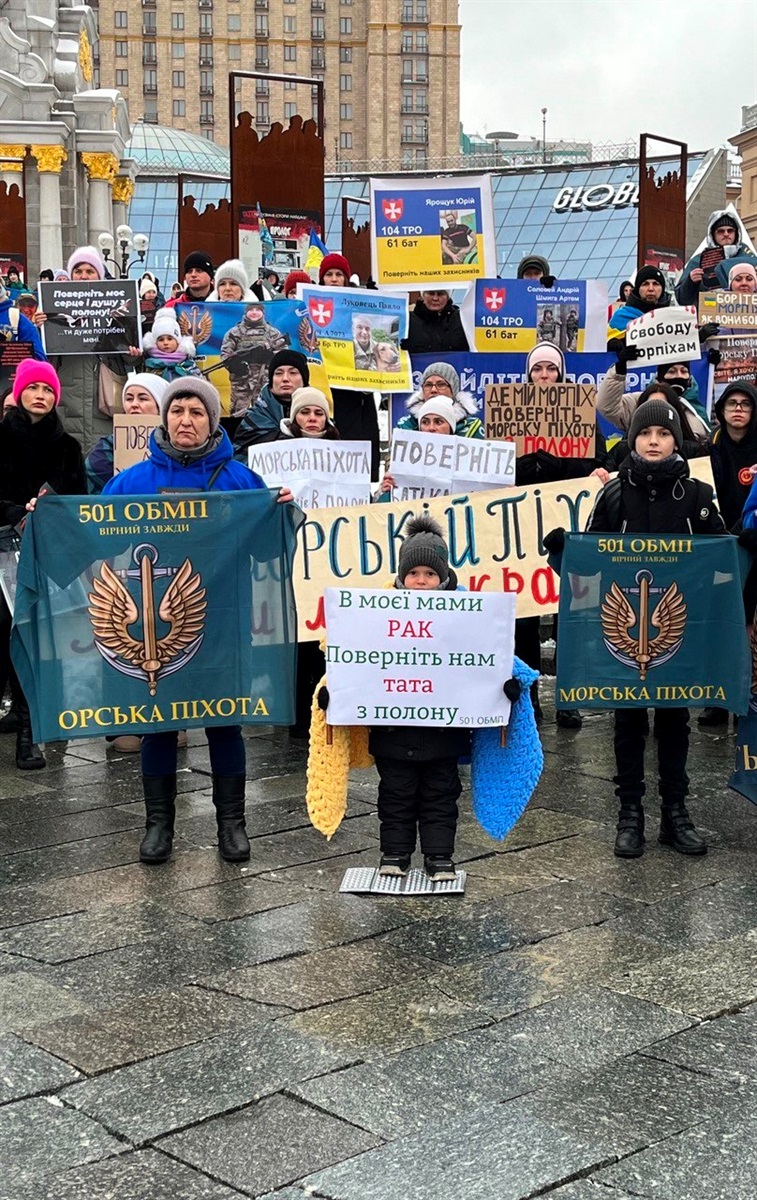
5-year-old Artem Nechaev is waiting for his father to be released from captivity. His mother has cancer, and his aunt is taking care of him.

Source: Svoi.City
Author: Hanna KURTSANOVSKA

Svoi spoke with Maria. She says she is now a mother of many children, as she is caring for four children—two nephews and her two own children. The family lives in a rented apartment in Kyiv. They moved here from the currently occupied Melitopol in the fall of 2022 to work on securing her brother’s release from captivity and to help his wife with her medical treatment.

They followed the news from Mariupol while under occupation
Oleg Nechaev is now 33 years old. In 2020, he signed a contract with the Armed Forces of Ukraine. He served as a driver near Berdiansk in Military Unit A 1965, 36th Brigade, 501st Battalion.

“Shortly after my brother enlisted, our family moved from Melitopol to Berdiansk to be closer to him. We rented an apartment there. Our youngest son, Artemchik, was only one year old at the time. Our oldest son, Daniil, is ten now; he was six then. He’s from Oleksandra’s first marriage, but my brother loved him like his own son.”

Maria says her brother didn’t talk much about his service. And so neither she nor his wife knew exactly where Oleg was at the time of the full-scale invasion.

“We were very scared because Melitopol had already been under occupation from the very first days. There was a lot of military equipment—I’d never seen so much before. And planes heading toward Mariupol. We tried to leave the city several times, but we couldn’t. We were following the news from Mariupol. Then communication was cut off, and we didn’t know what had happened to Oleg or if he was still alive. Our mom, me, and Oleksandra were beside ourselves with worry. My brother’s wife was especially distressed because Oleg was the family’s breadwinner, and they lived in a rented apartment. And I think Alexandra didn’t know how or where she would live with the children from now on. Although we always told her that we wouldn’t abandon her and the children, and that everything would be all right.”

Due to the stress, my sister-in-law developed cancer
When news of his captivity broke, my brother’s wife became extremely stressed: she lost interest in everything, even the children; she withdrew into herself and refused to eat. It got to the point where Maria and her husband started scolding her, saying, “What are you doing? You have to eat, or you’ll starve to death,” but the sight of food alone made her feel nauseous. That’s when they decided things couldn’t go on like this and took Oleksandra to the hospital. There, she underwent a full examination, and the MRI report stated, “Requires consultation with an oncologist.”

“That’s how we found out that Oleksandra had cancer. I’m sure that all her worries about her husband took a toll on her health—the stress ‘manifested’ itself in this way. Over time, she got worse and worse. Oleksandra was admitted to one of the hospitals in Melitopol. They began running various tests and taking samples to check for tumor markers. At first, they couldn’t pinpoint the disease; the doctors were torn between lung cancer and breast cancer. They also discovered a spinal fracture in Oleksandra. She was bedridden, and the cancer had already metastasized. But we desperately needed to get her “back on her feet,” because her serious condition prevented us from leaving the occupied territory. Oleksandra underwent eight courses of chemotherapy and received ibandronic acid infusions to help her spine heal. She also needed to wear a special corset, but we were never able to find one.”

The four-day
drive from Melitopol to Kyiv Maria recalls that the doctor had given her brother’s wife virtually no chance of survival at the time, but a miracle happened. Oleksandra underwent chemotherapy and lost her hair. She also endured numerous injections to combat nausea. And she began to eat little by little. Her spine healed, and Oleksandra began to move around on her own.

Maria’s family and her brother were only able to leave Melitopol in September, on the eve of the so-called “referendum.”

“We planned to leave via Zaporizhzhia. We got permission from the military command post—by that time, you couldn’t leave without that piece of paper. We pretended we were going to Zaporizhzhia for medical treatment. But at the checkpoint near Vasylivka, they wouldn’t let my husband through. There were people in military uniforms with “DPR” insignia; they said that mobilization was underway in Ukraine and that men under 35 weren’t being allowed to leave. I was traveling with my children and husband in our car, while my brother’s wife, her sons, and my mother were in another. They let my brother’s wife through because she was going to the hospital, but they didn’t let us through. So we went back home, rested a bit, and that same evening set off through Crimea. By 2:00 a.m., we had passed through the checkpoint at Chongar, and then began the long journey across all of Russia, Latvia, Lithuania, and Poland. On the fifth day, we finally reached Ukraine. Since then, we’ve all been living together in Kyiv.”

The Diagnosis: Breast
Cancer Once in the capital, Oleksandra immediately sought out specialists. The treatment proved ineffective—the cancer had metastasized to all her bones. In the summer of 2023, doctors told her she had between 6 months and 3 years left to live, depending on her treatment.

“She has been at the Kyiv Cancer Center since November 2022. That’s where she’s receiving treatment. Oleksandra takes medication on a regular basis to slow the spread of the metastases. There, she receives constant IV drips to prevent her bones from breaking and keep them strong, as well as hormone and pain medication, and she undergoes periodic examinations. She has Group I, Subgroup B disability status, meaning she requires lifelong care. We purchase some of the medications ourselves. We also pay for the examinations out of our own pocket. For example, we’ve had histological samples taken from the metastases several times. Some tests are done for free, and some medications are provided for free as well. You could say it’s a 50-50 split.”

During the conversation, Maria mentioned that after moving from Melitopol, during one of her first meetings at the Coordination Headquarters for the Treatment of Prisoners of War, she told the head of the Main Intelligence Directorate, Kirill Budanov, and the head of the Security Service of Ukraine, Vasyl Malyuk, about her sick daughter-in-law. And she received help. This concerned Oleksandra’s test results, which had to be sent for analysis to a clinic in Germany; of course, this cost a considerable amount of money, which the displaced family simply did not have. But thanks to that meeting, everything was done free of charge. Ultimately, it was the test results from the European clinic that confirmed Oleksandra’s breast cancer.

She Won the Court Case—Her Brother Is Not a Deserter
While her daughter-in-law was undergoing treatment, Maria was suing the military unit where Oleg had been serving at the time of the full-scale invasion. The issue was that the 501st Separate Marine Battalion was suspected of voluntarily surrendering.

“At first, I reached out to the Coordination Headquarters and the Office of the Human Rights Commissioner, explaining my situation in hopes of getting my brother back as soon as possible. I showed them the correspondence I had with Oleg, as well as posts on social media. I submitted all this evidence to the State Bureau of Investigations. I went to the SBI for questioning along with Oleksandra. I reached out to many people, but all of it was to no avail. We were told that no one considered the young men deserters, that everything would be fine, but in the end, a criminal case was opened after all. And, of course, we didn’t receive any financial support, even though we desperately needed it at the time. After all, we need the money for my daughter-in-law’s treatment.”

The trial lasted three months. And Maria won the case.

“First, my brother was following his commander’s orders. Second, the forces in Mariupol were unequal; the Russian army was far larger than our boys in terms of both weapons and personnel. Some family members also had correspondence in which the soldiers wrote that they had no ammunition and nothing to eat. Of course, we submitted all of this to the investigator as evidence. Moreover, our relatives were at the Illich Plant, where there was no bunker. All charges against my brother and his comrades have been dropped. Only two people from the entire battalion were found guilty; one of them is Konstantin Bezsmertny, the head of the rear logistics service. After we won the case, we began receiving financial support from the state. This money goes toward supporting my brother’s children and paying for his wife’s medical treatment.”

Now I am a mother
of many children In April 2023, Maria officially took her brother’s children into her care. This was the advice of a doctor who predicted that Oleksandra had no more than three years to live.

“Because the oldest, Danylo—as I’ve already said—isn’t my biological son, and they could have taken him to a boarding school, since according to the documents, he’s not related to me at all. That’s how I became a mother of many children: my own children—Konstantin, 11, and Eva, 7—and my brother’s sons—Daniil, 10, and Artem, 5. Needless to say, it’s hard—emotionally, financially, and physically. Not a single month goes by without one of the children getting sick; we’re practically always in and out of hospitals.”

Maria still finds time to attend rallies in support of prisoners of war. They take place every Sunday in Kyiv and various cities across the country. Daniil and Artem go with her.

No matter the weather—whether it’s snow or rain, it doesn’t matter. Maria regularly attends meetings with representatives of the Coordination Headquarters and the Human Rights Commissioner; she has even met with the nuncio, the Pope’s permanent diplomatic representative in Ukraine. But so far, all of this has been to no avail.

Oleg Nechaev has been in captivity for 22 months. His family has never received a letter from him, nor has there been a phone call. The Marine also knows nothing about his family—whether his wife and sons have left the occupied territory. And he knows nothing about Oleksandra’s illness either.

“The only thing we know comes from one of the released men, who was freed on December 31, 2022: my brother could have been exchanged last year, but on the morning of the 11th, 11 people were taken out of the cell, and Oleg was left behind. Where is my brother now? I don’t know! What’s his health like? I don’t know that either! Of course, all these events have taken a toll on my health as well. I cry a lot. I’ve never cried as much in my life as I have over the past two years. I’ve been seeing a psychologist for almost two years—he was assigned to me free of charge—and I’m very grateful to him for his constant support. I recently had surgery. I also have serious hormonal issues due to constant stress. My mom was in the hospital, too; she underwent a very complicated head surgery. She lives separately from us with her brother, who has a Group II disability; my family rents an apartment for them. I don’t know why my brother and I have such a bitter fate. Our life was wonderful before the full-scale invasion. My family had our own house with a pool. Every weekend we’d get together, grill kebabs, and my brother would come visit us with his family. But now I can’t afford almost anything because we live in a rented apartment; the children are growing up and getting sick, and we need money for my daughter-in-law’s treatment.”

I want my brother to have time to see his wife
Oleksandra Nechaeva is continuing her treatment. She complains of pain in her ribs—the latest scan showed that the metastasis had spread there—and pain in her pelvis. She spends most of her time lying down. In March, she’ll have a bone scan to see if the metastases have spread further or not. Alexandra is also receiving injections in her abdomen.

“You know, we’re taking care of Alexandra as best we can because we really want my brother to be able to see her before it’s too late. I don’t know, though, how we’re going to tell him about this—about her illness. Every evening I look at a photo of my brother and then at my little nephew; Artem looks so much like his father. I want our family to finally be reunited. We haven’t lost hope; we’re waiting and believing that their reunion will happen very soon. I want my brother to be able to see his wife while she’s still alive, to be by her side during this difficult time for her, and for our government to do everything in its power to ensure his swift return. I’d like to appeal to people and ask them to come out and support the families of prisoners of war, because our loved ones were fighting there for all of us. That’s why we must be their voice here—shouting out and reminding society of them.”

This is an automatic translation generated by DeepL.