From Maternity Leave to “Terrorist”: How a Russian Court Convicted Viktoria Tkachenko, a Soldier with the “Aidar” Battalion, for Her Service in the Unit
Source: Grati
Author: Tetiana Kozak
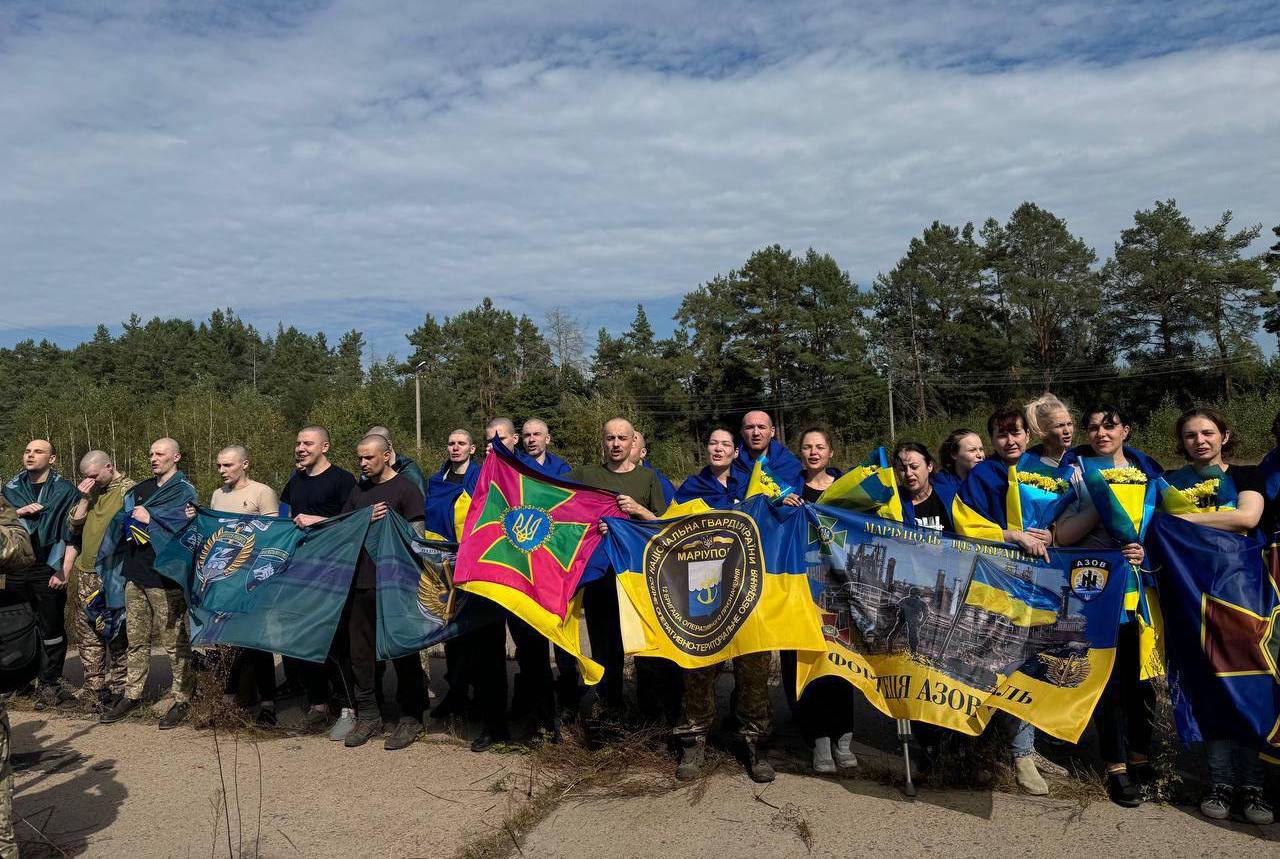
On September 13, 2024, a prisoner exchange took place. Among the 23 women—both military personnel and civilians—who were returned from Russian captivity at that time was 30-year-old Viktoria Tkachenko, a medic with the “Aidar” assault battalion.
In violation of the Geneva Conventions, the Southern Military District Court in Rostov-on-Don convicted the prisoner of war for serving in the “Aidar” battalion, which Russia considers a terrorist organization. “Graty” followed the progress of this case in court, but at the time knew little about Tkachenko herself.
In a conversation with “Graty” four months after her return, Viktoria Tkachenko recounted her detention at her home in Novoaydar, Luhansk Oblast; her time in the Luhansk torture chambers of the MGB (Ministry of State Security); the detention centers in Luhansk and Rostov, her sentencing, and her transfer to a penal colony in Samara in a conversation with “Grati” four months after her return from captivity. Now we can tell her story.
The Russian Prosecution
On May 2, 2023, a panel of judges at the Southern Military District Court in Rostov-on-Don, presided over by Guren Dovlatbekyan, began hearing the case of Viktoria Tkachenko, a resident of the village of Novoaydar in the Luhansk region. Russian authorities accused her of terrorism for serving in the 24th Separate Assault Battalion “Aidar” from 2017 to 2020. She was detained after the start of the full-scale invasion, when Novoaydar came under occupation.
“Viktoria Volodymyrivna Tkachenko (…) committed an intentional crime against public safety,” declared Russian prosecutor Sergey Aidinov as he read the indictment against her at this hearing.
The “Aidar” battalion was formed by volunteers in May 2014 in response to Russian aggression. It achieved significant successes in the Luhansk region during the ATO. In particular, in June 2014, the battalion’s fighters liberated the strategically important city of Shchastya, where a thermal power plant is located; in July, they participated in the liberation of Rubizhne, Sievierodonetsk, and Lysychansk—which had been seized by pro-Russian militants in May—and subsequently in the battles for Luhansk Airport.
In June 2014, during the fighting for the village of Metalist near Luhansk, a female fighter from the “Zorya” battalion—commanded by Igor Plotnitsky, one of the leaders of the “LPR” group—was taken prisoner Nadiya Savchenko, an officer of the “Aidar” battalion, was taken prisoner by militants of the “Zorya” battalion, commanded by one of the leaders of the “LNR” group, Igor Plotnitsky. She was illegally taken to Russia and sentenced to 22 years in prison on fabricated charges of murdering two journalists from Russian state television. Savchenko was successfully returned in 2016 as part of an exchange for Russian soldiers whom the Ukrainian Armed Forces had captured in the Luhansk region.
Russian units of the “LPR” group are implicated in war crimes, particularly against members of the Aidar Battalion. In Finland, Vojislav Torden, one of the commanders of the “Rusich” group—which was then part of the “Zorya” battalion—was convicted of ambushing and killing 22 Ukrainian servicemen.
The 24th Separate Assault Battalion of the Ukrainian Armed Forces, which continues to fight Russian troops today, was formed on the basis of the “Aidar” battalion in early 2015.
Serhiy Melnichuk was the first commander of “Aidar.” During the Maidan protests in 2013–2014, he was a member of the Self-Defense Forces. In the October 2014 elections, Melnichuk was elected to parliament as a candidate for Oleg Lyashko’s Radical Party.
In January 2015, Melnichuk—who continued to consider himself the battalion commander despite the appointment of a new commander—declared that “Aidar” had been disbanded and called for a protest outside the Ministry of Defense. The protests lasted several days. Following this, Melnichuk was expelled from the party.
In May 2015, the Ukrainian Prosecutor General’s Office conducted an investigation into Melnichuk, who was accused of banditry, robbery, torture, kidnapping, hooliganism, and assaulting law enforcement officers. According to investigators, he led a gang composed of “Aidar” volunteers. The MP denied any involvement. In July 2016, former Aidar members—officers Valentin Lykholit and Igor Radchenko—were arrested on suspicion of organized crime and other offenses. Melnichuk then accused his former comrades of organizing robberies against civilians in the Luhansk region. They, in turn, accused him of orchestrating the case against them.
Despite the complicated history with some members of “Aidar,” the battalion has never been banned in Ukraine or designated as involved in terrorism, and its fighters have repeatedly been awarded state honors for bravery in battle.
According to Russian propaganda—which was echoed by prosecutor Sergei Aidinov in a Russian military court—beginning in June 2014, “Aidar” occupied part of the territory of the “Luhansk People’s Republic” and participated in combat operations to destabilize the activities of the “LPR” authorities and with the aim of “suppressing the general will of the population and forcing the citizens of the Luhansk People’s Republic to renounce their declaration of self-determination, which was adopted as a result of their free will.”
The prosecutor then described how and when Viktoria Tkachenko joined the battalion: in 2017, she signed a five-year contract at a training center in Poltava. She did so for allegedly selfish motives: “for the sake of a monthly stipend, benefits, social payments, etc.” In April of that same year, after completing her training, she arrived at the “Aidar” battalion’s base in Novoluhanske, Donetsk Oblast, and began her service. Thus, she allegedly took direct part in “the armed aggression against the Luhansk People’s Republic by Ukrainian armed formations.”
Viktoria Tkachenko’s military ID fell into the hands of Russian investigators; it listed all her positions: she began her service as a private in the role of a radio operator; for four months in 2017, she served as a line supervisor—a specialist who ensures the proper functioning of communications equipment and monitors its operational readiness— then, until early February 2018, she held the position of senior telephone operator and grenade launcher operator, and two months later was promoted to sniper. She then served as a squad leader until June 2019, and from 2019 to 2020, she held the position of weapons crew leader—a group of service members responsible for maintaining specific weapons. In November 2020, she went on maternity leave from her position as a combat medic.
“In other words, she did not voluntarily cease her participation in the activities of the terrorist group known as the 24th Separate Assault Battalion ‘Aidar,’” emphasized Prosecutor Aidinov.
The prosecution refers to “Aidar” as a terrorist organization, and the Russian investigation classified Tkachenko’s service in the battalion as participation in such a terrorist organization under Part 2 of Article 205.4 of the Criminal Code of the Russian Federation. Under this article, the woman faced a sentence of five to ten years in prison at that time. In late April 2023, Russia toughened penalties for terrorism: defendants could be sentenced to ten to fifteen years in prison under this article.
The court asked Tkachenko whether she agreed with the charges. She replied that she did not admit guilt.
The soldier explained that she had signed a contract not with “Aidar,” but specifically with the Armed Forces of Ukraine: she joined the military to work at a military registration and enlistment office, but there was a shortage of personnel in the units, so she was assigned to “Aidar.” She had no opportunity to choose her unit. At that time, the battalion was no longer a volunteer unit but was part of the Armed Forces of Ukraine. Tkachenko insisted that she was merely a clerk, and that the entries in her military ID regarding her positions were only there because there was no official position for a clerk on the staff, so she was “shuffled between different roles.” According to the captive, she essentially filled out logs, wrote performance reviews, processed documents, and helped draft leave requests; she did not carry a weapon and did not fight. In 2020, she left the service to raise her daughter.
“I’m not going to say what I actually did, because if [they] found out the truth, it would have been even worse,” says Viktoria Tkachenko in a conversation with “Graty” after her release from captivity.
She emphasizes that she did not leave the army and is still a service member.
“And the trials—they were such a farce!” recalls Viktoria Tkachenko.
Manipulation of Evidence
The trials of arbitrarily detained Ukrainian civilians and prisoners of war are part of a coordinated Russian policy aimed at justifying the aggression against Ukraine and suppressing Ukrainian resistance under occupation. Ukrainian human rights defenders reached this conclusion after analyzing more than 600 court cases against Ukrainians in the Russian Federation and in the occupied territories.
Since 2014, Russian authorities—followed by state propaganda—have been spreading claims, in particular, that Ukrainian volunteer battalions are terrorists. Russian and occupation courts have issued corresponding rulings to lend additional legitimacy to such claims, which have no basis in reality.
The leadership of the “LPR” group, as well as the “DPR,” declared the Ukrainian “Aidar” battalion a terrorist organization as early as 2016. Russia did so later, after it illegally recognized the occupied Luhansk and Donetsk regions as its own territories in October 2022.
The FSB added “Aidar” to its list of terrorist organizations in late December 2023. The basis for this was another verdict by the Southern District Military Court dated September 25, 2023, which took effect two months later. According to information on the Rostov court’s website, this was a case heard by a panel of three judges presided over by Alexander Generalov concerning Lyubov Selina, who was charged with participating in a terrorist group. The text of the verdict itself is not available on the court’s website, but a month before it was announced, the defendant’s name appeared on the list of terrorists on the Rosfinmonitoring website. According to that list, Lyubov Selina, born in 1985, is from Starobilsk in the Luhansk region. Victoria Tkachenko, who was held at Pretrial Detention Center No. 1 in Rostov-on-Don at that time along with other women from “Aidar,” says that Selina was not with them and that they did not know each other during their service.
Tkachenko’s trial began earlier, so prosecutor Sergei Aidinov sought to prove not only that she had served in “Aidar,” but also that the battalion was allegedly involved in terrorist activities.
Before the hearing on August 17, 2023, the prosecutor provided the materials to Tkachenko’s defense attorney for review. A conversation then took place in which Aidinov informed Tkachenko that the evidence he would present at this hearing did not directly concern her.
— Please review this: I will be providing additional materials regarding “Aidar.” There are crimes described there. The defendant has no connection to this; it’s basically about the organization, just so you’re aware that I’ll also have video materials regarding ‘Aidar’ on the disk in the case file. At the beginning—this is a crime that Hennadiy Moskal, who served as head of the Luhansk Regional Civil-Military Administration from March to July 2015, uncovered as governor of the Luhansk region, involving international documents…
— In Ukrainian?
— There’s more there. And from the online sources I gathered—it’s all in electronic form, duplicated on the disk and included as well.
— Are you giving me a copy?
— No, no, I won’t give it to you. My own access is limited.
— Is paper expensive?
— It’s not about the paper; it’s that I’d have to request such a large volume to have it printed.
Turning to Tkachenko, the prosecutor reiterates that this does not concern her. She replied:
— I understand, in general.
— Yes, in general, regarding what “Aidar” was all about.
— I understand. It’s just that, you see, I didn’t join until 2017.
— I know, I know. Right, you joined after “Aidar” had already been incorporated into the Armed Forces of Ukraine.
Among the evidence that Aidinov submitted to the court were five reports by the UN High Commissioner for Human Rights on the situation in Ukraine covering various periods from 2014 to 2017, from which the prosecutor read aloud at the hearing the sections concerning allegations of human rights violations, sexual harassment, and other criminal offenses against individual members of the “Aidar” battalion.
He also found information about the violations in a September 8, 2014, statement by the human rights organization Amnesty International calling for an investigation into crimes committed by the Ukrainian volunteer “Aidar” battalion.
At that time, human rights activists appealed to the Ukrainian authorities, demanding that they bring the situation under control and “prevent a recurrence of the lawlessness that prevailed in areas controlled by separatists.”
The organization also received a response from law enforcement and military authorities in Sievierodonetsk. In response, they reported that they had opened 38 criminal cases regarding crimes allegedly committed by members of the “Aidar” battalion, primarily involving incidents of looting. This information was forwarded to the Ministry of Internal Affairs and the Ministry of Defense. As noted in the statement, a “high-ranking military official” in the area told Amnesty International that, after receiving his reports, the Ministry of Defense had dispatched two commissions to investigate the “Aidar” battalion.
Aydinov, ignoring the human rights activists’ statement regarding crimes committed by the occupiers, read aloud in detail the testimonies included in the statement from people who claimed to have suffered as a result of the battalion’s actions.
As further evidence of the “Aidar” battalion’s involvement in terrorist activities, according to the Russian authorities, the prosecutor cited a public appeal in June 2015 to law enforcement agencies by the then-head of the military-civil administration of Luhansk Oblast, Hennadiy Moskal, containing a list of 65 crimes allegedly committed by people associated with former battalion commander Serhiy Melnychuk.
Moskal, however, noted that, as a rule, the crimes he reported were committed by individuals who had received unregistered weapons from Melnichuk, wore “Aidar” armbands, but were not officially listed as members of the battalion. Nevertheless, Prosecutor Aidinov unequivocally stated in court that “Aidar” fighters were involved in all of these “general criminal offenses.”
After his appointment as regional governor in March 2015—a position he left in July 2015—Moskal had previously reported on problems with the battalion in the region. However, he also reported on a meeting with the leadership and fighters of the “Aidar” battalion, during which they reached an understanding regarding the need for a thorough investigation into alleged crimes committed by Ukrainian military personnel and, if confirmed, punishment for those crimes.
In addition, Aidinov provided the court with printouts of screenshots from online sources containing information about “Aidar” and articles about the battalion’s fighters in Russian and Ukrainian media. In particular, this included a news story from the Russian publication “Gazeta.ru” about how Aidar fighters picketed the Ukrainian Ministry of Defense building on January 30, 2015, in response to statements by Melnichuk and press secretary Yulia Yevdokimova regarding the disbandment of the battalion. The prosecutor also submitted to the court a reprint of the OSCE report dated August 21, 2014, which mentions incidents of abuse involving the “Aidar” battalion; a news report from “LNR” representatives dated September 25, 2014, claiming that “Aidar” soldiers had allegedly looted humanitarian aid intended for Luhansk, and screenshots of media reports on the “65 instances of crimes” reported by Moskal. Aydinov noted in court at the time that he had found a news report stating that, in response to a statement by the head of the Luhansk Regional Administration, the Ukrainian Ministry of Defense had ordered an internal investigation into the “Aidar” battalion, but he had not found any information regarding the results of that investigation.
“I will explain to the court that various websites have essentially published the same information. This is due to the fact that these circumstances received widespread publicity, and to the fact that members of the ‘Aidar’ battalion are implicated in committing, in particular, a series of general criminal offenses related, among other things, to the terrorization of the local population. This is a well-known fact that took place and gained publicity not only on the Russian-language internet but also on the Ukrainian-language internet,” the Russian prosecutor emphasized.
He also provided the court with the December 13, 2017, verdict of the Zhovtnevy District Court of Kharkiv—now the Novobavarsky District Court of Kharkiv—regarding a former fighter of the “Aidar” battalion, who was found guilty of robbing and kidnapping three residents of the Luhansk region as part of a gang.
At another hearing held on September 4, 2023, Prosecutor Aidinov submitted to the court the 2017 investigative materials from the “LNR” group, specifically those related to the case against Serhiy Melnychuk regarding the alleged formation of a terrorist organization. He noted that following Russia’s annexation of the territories controlled by the group, this case had been reclassified under a similar provision of the Criminal Code of the Russian Federation—Parts 1 and 2 of Article 205.4 of the Criminal Code of the Russian Federation. Serhiy Aidinov also included the decision of the so-called “DPR” Supreme Court dated April 21, 2016, banning “Aidar” and designating it as a terrorist organization, along with seven verdicts handed down by the “LPR” Supreme Court against “Aidar” fighters accused of participating in a terrorist group.
“This concerns the assessment of this unit’s activities specifically during the period when the ‘DPR’ and ‘LPR’ had not yet joined the Russian Federation, and [demonstrates] how the relevant entities assessed the activities of this unit,” Aidinov explained.
In addition to this evidence, the prosecutor provided video footage “which also attests to the commission by members of the ‘Aidar’ volunteer territorial battalion of general criminal offenses, including those against the civilian population, including those related to terrorism.” The footage included a segment featuring Moskal and his list, as well as a video about the trial of an Aidar battalion member in Kharkiv. The court reviewed these and other videos in fast-forward during the hearing on September 4, 2023. They also reviewed several reports from Ukrainian media outlets detailing the battalion’s achievements during the ATO. Aidinov called this Ukrainian propaganda and noted that he was showing the video “simply to provide an outside perspective.”
At subsequent hearings, the court heard testimony from expert Maxim Vaskov, a professor in the Department of Foreign History and International Relations at the Institute of History and International Relations of Southern Federal University—a Russian university formed by the merger of two universities in Taganrog and Rostov-on-Don. This man had also served as an expert witness in court cases involving other Aidar members; in particular, he testified in the cases of Volodymyr Linnik, who was convicted in December 2023, and Denys Muryga, who was convicted in June 2023. In Rostov-on-Don, he is known for his criticism of opposition journalists and activists. In court, he was introduced as an “expert on Ukraine.”
He was supposed to discuss the activities of the “Aidar” regiment, but for twenty minutes, as Viktoria Tkachenko recalls, he spoke about the “Azov” regiment and its symbols. When the judge gave the floor to the defendant, she pointed out to Vaskov that he was talking about the wrong unit.
“And he says, well, like, you all have the same nationalist ideology. I say, no, it’s not the same; you’re wrong. And he says, ‘No, you’re the one who’s wrong; I know because I’ve studied this topic,’” says Tkachenko.
She speculates that the expert got confused because members of Azov and Aidar were being tried in Rostov during the same period, and there were many cases, including group trials.
In general, Tkachenko recalls, even Judge Dovlatbekyan often got confused and told her that she was from “Azov.” She had to correct him all the time:
“I’d say, ‘No, Tkachenko is from ‘Aidar.’”
Among the evidence, the prosecution examined the “Aidar” Telegram channel. In August 2023, a video was posted there showing a smoke-filled bridge across the Kerch Strait. On that day, media outlets reported explosions in that area.
“The bridge will collapse, or it’s time to pack your bags,” the post accompanying the video read.
According to Tkachenko, after that hearing, the Russian prosecutor’s office began gathering information about “Aidar’s” involvement in terrorist acts on the bridge, and this episode was added to her case.
“And I said, ‘But how? I was already in pretrial detention at that time; I was already a prisoner. I physically couldn’t have done that. No one answered me, but the judge gave the go-ahead to include this episode in my case. So the Crimean Bridge—that’s me, too,” says Tkachenko.
She adds that this episode was added by a different prosecutor—not Serhiy Aidinov. The change occurred because Aidinov focused on prosecuting high-profile cases, particularly those involving the large “Aidar” and “Azov” groups. Tkachenko says he was promoted.
Detained after a fellow soldier’s
testimony At one of the hearings, the court, at the defense’s request, summoned Viktoria’s parents—Yulia and Volodymyr Tkachenko.
The parents testified that at first they did not know their daughter was serving in “Aidar,” and once they found out, they said, Viktoria was an administrative clerk in the unit and had not done anything illegal.
For Tkachenko, this was the first time she had seen her family since her arrest. The next day, Victoria’s attorney was able to arrange a half-hour visit for them at the pretrial detention center. They have not seen each other since.
The prosecution’s witnesses did not appear in court. The prosecutor reported that they had signed statements indicating they would not participate in the hearings in person and requested that the testimony they had provided during the investigation be read aloud, noting that they fully agreed with it.
Two witnesses—residents of Novoaydar, two men whom Tkachenko did not know personally, but she knows that in 2014, after Ukrainian forces prevented pro-Russian separatists from gaining a foothold in their village, they left for Russia and returned only when Novoaydar was already under Russian occupation in 2022. They did not say anything against Tkachenko, but testified that they had suffered at the hands of “terrorists from Aidar” in 2014 because of their support for the so-called referendum.
There was another prosecution witness—a former “Aidar” fighter who was Tkachenko’s subordinate. He was a driver who often drove her on official business. Victoria is convinced that the case against her was built on his testimony, and that it was because of him that she was detained.
“I was on maternity leave. My daughter was one year and four months old. When full-scale hostilities began, it was already impossible to leave because I was in the Luhansk region, and we were among the very first to be overrun. (…) At first, no one there bothered me at all; everything seemed normal. But then, all of a sudden, a minibus pulled up, along with three cars and 12 men in balaclavas carrying automatic rifles, and they just took me away,” says Tkachenko.
These men gave her the name of the driver from “Aidar” and made it clear that they had come on his tip.
Tkachenko was detained on May 17, 2022.
The driver had been detained earlier. Viktoria believes he was persuaded to cooperate with the promise of a shorter prison sentence. But in the end, the so-called Luhansk Supreme Court sentenced him to 7 years—instead of the minimum 10-year term under the Criminal Code that was in effect in occupied Luhansk Oblast prior to its illegal annexation by the Russian Federation—on the same charges as those against Tkachenko.
“There was simply no way to resist anymore, because [the driver] had told them everything about what I was actually doing. As for me—my official titles were one thing, but in reality I was the political officer; I was in constant communication, monitoring the cameras, and making adjustments—in other words, I did a lot. They considered me very dangerous, thinking I knew so much and was capable of so much. And there were also records of courses with foreign instructors where I’d taken medical training. A sniper—that’s what they feared most of all. For them, it was, well, honestly, I don’t know, like a red rag,” says Tkachenko.
After her arrest, she spent two and a half months in the torture chamber of the MGB (Ministry of State Security) in Luhansk, and when she was finally forced to sign the investigation documents, she was transferred to the Luhansk pretrial detention center.
At the MGB, she was tortured and beaten; she was subjected to electric shocks.
“It’s called the ‘call to Zelenskyy.’ The term ‘tapik’ is the colloquial name for the Soviet military field telephone TA-57; there are testimonies from many prisoners that the Russians used this device for electric shock torture. [An MGB officer] says, ‘Call Vova, ask him to come get you,’” Tkachenko recalls, adding that she was treated brutally because she refused to cooperate during the first month after her arrest.
“When I finally realized that there was no point in resisting—because [my colleague] had told them everything there, embellishing it—they even took some kind of statement from him—and when they brought me to the investigator, they just handed me the documents and said, ‘Sign this.’ Everything was already prepared; everything was written out. They didn’t even ask me anything like that,” she recalls. “When they were transporting me to the pretrial detention center, I was completely pale, like a corpse, and it took another six months for that color to fade.”
The woman adds that she’s proud she didn’t turn anyone in herself.
“Even when they demanded I turn someone in, you know what I did? I named the 200 who had died. The ones I knew were already gone—people you couldn’t possibly make any worse off,” says Tkachenko.
While the detainee was held in the Luhansk pretrial detention center, the court continued to extend her detention. Although Tkachenko insisted on having her pretrial detention changed to house arrest because she had a small child, her requests were denied, citing the severity of the alleged crime. She filed appeals and was repeatedly denied. The local attorney who represented her in court at the time pressured her to plead guilty and agreed that the court should keep her in custody.
The indictment was finalized in January 2023. On April 14, 2023, Tkachenko was transferred to Rostov, where the trial on the merits began.
“[At the Rostov pretrial detention center] they already knew that the ‘sniper’ was coming; they were already waiting for her. They beat me severely. I was in solitary confinement for over a month. As if I were dangerous,” Tkachenko says.
After that, she was transferred to a cell with other female prisoners from “Aidar” and “Azov,” where there were also civilians who were being tried in the Rostov court.
“When they came into our cell wearing balaclavas, they would constantly say to us, ‘Come on, you European civilians.’ They constantly called us that,” recalls Tkachenko.
The trial lasted until the end of 2023—eight hearings.
During her closing statement, Tkachenko stated that she admitted to serving in “Aidar.” But she did not agree that she personally committed any terrorist acts. She asked to be returned to her family, to her child, who should not have to grow up alone.
“And this is unfair, because I was on maternity leave; I wasn’t taken from the battlefield, and I wasn’t in the active phase of the war because I was on maternity leave at that time. And it makes no sense to try me for something I didn’t do,” she recalls telling the judges.
The prosecutor had sought a sentence of six and a half years in a general-regime penal colony for the soldier, but the verdict was more lenient: five years in a penal settlement. It was handed down on December 12, 2023.
“When I was already on my way to court and knew that the verdict would be handed down today, I just knew I’d get five years. I mean, it was this gesture from Russia—that they’re such a great country, and that they treat women with, like, ‘mercy,’” says Viktoria.
She didn’t file an appeal because she understood it wouldn’t change anything.
The First Woman in a Special Penitentiary
After the verdict, Tkachenko was sent to a penal colony: first to Voronezh, 570 kilometers north of Rostov-on-Don, then 1,000 kilometers west—to Samara, a three-hour drive from the border with Kazakhstan, and Togliatti, a city in the Samara Region on the banks of the Volga River.
“I was in Samara for two weeks, then they took me to a penal colony-settlement [in Togliatti]. When they brought me there, they immediately took me to the warden’s office; he was, to put it mildly, in shock. He knew (they had called him while I was being transported) that I was a terrorist. He said, ‘You understand that people with charges like that don’t serve time here; you won’t be serving time here; we’ll file “disciplinary violations” against you so they’ll change your security classification.(…) That’s why I was constantly in solitary confinement at this prison,” Tkachenko recounts.
Next came the hearing on changing my detention regime, which ruled in favor of the prison administration. Tkachenko filed an appeal, but it was denied. She then filed a cassation appeal. She knew she wouldn’t win, but she tried to stall for time.
“The FSB agents said I was like a terrorist, like a Ukrainian—the only one in the entire Samara region; there aren’t even any men [Ukrainians facing the same charges] there. I knew what would happen to me if I ended up in that prison. There—the wives, mistresses, children, mothers, and grandmothers of these guys, the FSB agents, the ‘defenders’—they’re also incarcerated in that prison. And I just knew how rough it would be for me there,” says Tkachenko. “It really was rough—being in a general population cell, and when everyone treats you negatively, it’s very hard emotionally.”
While the hearings were ongoing, Tkachenko was held at Pretrial Detention Center No. 4 in Togliatti. She was alone in her cell.
“I was held, you know, in a special section of the prison corridor—that’s what it was called—the ‘special section,’ where very dangerous [criminals] were held. [Only] men, two to a cell. They had sentences of 20, 25, and 30 years. Serious [people] were there—you know, the big shots. When they took me into that cell, evening was falling, and they were shouting back and forth through the [closed] doors. And that’s when they found out there was a Ukrainian “terrorist” there. And every evening they’d call me over and ask me things. They’d say, “You’re the first woman in the history of this prison to be held in solitary confinement! You’re something else!” “They were also in such shock—more so than I was—when I was on that special diet,” Tkachenko recalls.
While the detainee was awaiting her appeal, she was suddenly sent on to another detention facility. They woke me up in the middle of the night and told me to get ready. Before leaving the pretrial detention center, they took my photo.
“‘Where am I going?’—‘We don’t know; it’s a special transfer.’ I was alone in the “funnel”—that is, the police van—and they were taking me to Kazan. I found out we were in Kazan only after they brought me to the ITT—the temporary detention center. I was there for two days, and only then was I put on a ‘Stolypin’—named after Pyotr Stolypin, a minister in Tsarist Russia who converted freight train cars to transport Russian settlers to Siberia, and later—and even now—such cars were used to transport prisoners; it’s a prison car. And from that moment on, they began transporting me for an exchange. Well, I didn’t know that [at the time],” says Tkachenko.
The Journey to the Exchange
The train journey lasted a week. Along the way, other prisoners were picked up for the exchange, although no one had warned them about it. The final stop was in Moscow. There, Tkachenko and two other prisoners—Viktor Ivchuk, the head of the Mariupol hospital, and Natalia Prydatchenko from “Azov”—were transferred to a police van that already contained the Kremlin’s captive, Leniye Umerova. They were then taken to the Bryansk region—this was the final stage before the exchange.
Tkachenko recalls how, at the detention center in the Bryansk region, they were led in with bags over their heads. Lenie Umerova also spoke about this. Inside the facility, doctors examined them, told them to wash up, and issued them prison uniforms. Tkachenko and Prydatchenko were then placed in the same cell, where there was another woman from the “Aidar” battalion. Two days later, more women were brought into their cell—civilians from the occupied Luhansk region. Tkachenko heard from them that an exchange was going to take place.
“We went to sleep, and then they woke us up. We looked out the window, and it was still pitch black. They were already giving us tea and some kind of porridge, but we didn’t understand what was going on! We looked out the window, and there were two white buses. Journalists were already standing there, and only then—only then did it really [become clear that this was the exchange]. We hadn’t slept a wink; we didn’t even sit down for a second—we were waiting: when, when, when?! “They started leading us out around 11 a.m.,” says Viktoria.
She and the other prisoners were lined up facing the wall, and they began roll call.
“And they called my last name first! And I’m standing there, tears already streaming down my face, and I realize that out of all of us—half a hundred people—I’m the first on this list because it’s in alphabetical order by last name. I realize how much work had been done, how many people were involved, and that I really am first. I’m crying; I’m overcome with emotion. And that was the moment when I truly realized that I was going home,” recalls Tkachenko.
The exchange took place on September 13, 2023. At that time, 49 Ukrainians returned to Ukraine, including 15 Azov fighters and 13 marines from the Mariupol garrison, Viktor Ivchuk, commander of the Mariupol military hospital, and 23 female prisoners of war and civilian captives.
“I was walking in front, shouting, ‘We’re home, we’re in Ukraine!’ And I led my whole ‘army’ behind me. I said, ‘Girls, my women’s battalion, let’s go!’” Tkachenko recalls those first moments of freedom.
After rehabilitation, Viktoria Tkachenko returned to the military; she says that for her, it’s more than just a job—it’s her family. She is currently serving as a combat medic on one of the front lines.
Victoria is now proud of herself for not breaking down while in captivity.
“I see the world differently now; I have a wealth of experience to share,” she says, confident that she will now be able to better support her fellow prisoners. “Because I’ve been through more, and because I’ve become much stronger mentally.”
Although Victoria wants to forget the horrors of captivity, she hasn’t forgotten the women with whom she shared a cell in the pretrial detention centers in Luhansk and Rostov-on-Don. They are Victoria Kletchenko from the Kherson region and Daria Safonova from Luhansk. Both are Ukrainian civilians who were abducted and sentenced to 10 years in prison for espionage. “They should be home,” says Tkachenko, emphasizing that she waits for them every day.
This article was prepared with the support of the International Renaissance Foundation. The views expressed in this article are those of the authors and do not necessarily reflect the position of the International Renaissance Foundation.
Author: Tetiana Kozak
On September 13, 2024, a prisoner exchange took place. Among the 23 women—both military personnel and civilians—who were returned from Russian captivity at that time was 30-year-old Viktoria Tkachenko, a medic with the “Aidar” assault battalion.
In violation of the Geneva Conventions, the Southern Military District Court in Rostov-on-Don convicted the prisoner of war for serving in the “Aidar” battalion, which Russia considers a terrorist organization. “Graty” followed the progress of this case in court, but at the time knew little about Tkachenko herself.
In a conversation with “Graty” four months after her return, Viktoria Tkachenko recounted her detention at her home in Novoaydar, Luhansk Oblast; her time in the Luhansk torture chambers of the MGB (Ministry of State Security); the detention centers in Luhansk and Rostov, her sentencing, and her transfer to a penal colony in Samara in a conversation with “Grati” four months after her return from captivity. Now we can tell her story.
The Russian Prosecution
On May 2, 2023, a panel of judges at the Southern Military District Court in Rostov-on-Don, presided over by Guren Dovlatbekyan, began hearing the case of Viktoria Tkachenko, a resident of the village of Novoaydar in the Luhansk region. Russian authorities accused her of terrorism for serving in the 24th Separate Assault Battalion “Aidar” from 2017 to 2020. She was detained after the start of the full-scale invasion, when Novoaydar came under occupation.
“Viktoria Volodymyrivna Tkachenko (…) committed an intentional crime against public safety,” declared Russian prosecutor Sergey Aidinov as he read the indictment against her at this hearing.
The “Aidar” battalion was formed by volunteers in May 2014 in response to Russian aggression. It achieved significant successes in the Luhansk region during the ATO. In particular, in June 2014, the battalion’s fighters liberated the strategically important city of Shchastya, where a thermal power plant is located; in July, they participated in the liberation of Rubizhne, Sievierodonetsk, and Lysychansk—which had been seized by pro-Russian militants in May—and subsequently in the battles for Luhansk Airport.
In June 2014, during the fighting for the village of Metalist near Luhansk, a female fighter from the “Zorya” battalion—commanded by Igor Plotnitsky, one of the leaders of the “LPR” group—was taken prisoner Nadiya Savchenko, an officer of the “Aidar” battalion, was taken prisoner by militants of the “Zorya” battalion, commanded by one of the leaders of the “LNR” group, Igor Plotnitsky. She was illegally taken to Russia and sentenced to 22 years in prison on fabricated charges of murdering two journalists from Russian state television. Savchenko was successfully returned in 2016 as part of an exchange for Russian soldiers whom the Ukrainian Armed Forces had captured in the Luhansk region.
Russian units of the “LPR” group are implicated in war crimes, particularly against members of the Aidar Battalion. In Finland, Vojislav Torden, one of the commanders of the “Rusich” group—which was then part of the “Zorya” battalion—was convicted of ambushing and killing 22 Ukrainian servicemen.
The 24th Separate Assault Battalion of the Ukrainian Armed Forces, which continues to fight Russian troops today, was formed on the basis of the “Aidar” battalion in early 2015.
Serhiy Melnichuk was the first commander of “Aidar.” During the Maidan protests in 2013–2014, he was a member of the Self-Defense Forces. In the October 2014 elections, Melnichuk was elected to parliament as a candidate for Oleg Lyashko’s Radical Party.
In January 2015, Melnichuk—who continued to consider himself the battalion commander despite the appointment of a new commander—declared that “Aidar” had been disbanded and called for a protest outside the Ministry of Defense. The protests lasted several days. Following this, Melnichuk was expelled from the party.
In May 2015, the Ukrainian Prosecutor General’s Office conducted an investigation into Melnichuk, who was accused of banditry, robbery, torture, kidnapping, hooliganism, and assaulting law enforcement officers. According to investigators, he led a gang composed of “Aidar” volunteers. The MP denied any involvement. In July 2016, former Aidar members—officers Valentin Lykholit and Igor Radchenko—were arrested on suspicion of organized crime and other offenses. Melnichuk then accused his former comrades of organizing robberies against civilians in the Luhansk region. They, in turn, accused him of orchestrating the case against them.
Despite the complicated history with some members of “Aidar,” the battalion has never been banned in Ukraine or designated as involved in terrorism, and its fighters have repeatedly been awarded state honors for bravery in battle.
According to Russian propaganda—which was echoed by prosecutor Sergei Aidinov in a Russian military court—beginning in June 2014, “Aidar” occupied part of the territory of the “Luhansk People’s Republic” and participated in combat operations to destabilize the activities of the “LPR” authorities and with the aim of “suppressing the general will of the population and forcing the citizens of the Luhansk People’s Republic to renounce their declaration of self-determination, which was adopted as a result of their free will.”
The prosecutor then described how and when Viktoria Tkachenko joined the battalion: in 2017, she signed a five-year contract at a training center in Poltava. She did so for allegedly selfish motives: “for the sake of a monthly stipend, benefits, social payments, etc.” In April of that same year, after completing her training, she arrived at the “Aidar” battalion’s base in Novoluhanske, Donetsk Oblast, and began her service. Thus, she allegedly took direct part in “the armed aggression against the Luhansk People’s Republic by Ukrainian armed formations.”
Viktoria Tkachenko’s military ID fell into the hands of Russian investigators; it listed all her positions: she began her service as a private in the role of a radio operator; for four months in 2017, she served as a line supervisor—a specialist who ensures the proper functioning of communications equipment and monitors its operational readiness— then, until early February 2018, she held the position of senior telephone operator and grenade launcher operator, and two months later was promoted to sniper. She then served as a squad leader until June 2019, and from 2019 to 2020, she held the position of weapons crew leader—a group of service members responsible for maintaining specific weapons. In November 2020, she went on maternity leave from her position as a combat medic.
“In other words, she did not voluntarily cease her participation in the activities of the terrorist group known as the 24th Separate Assault Battalion ‘Aidar,’” emphasized Prosecutor Aidinov.
The prosecution refers to “Aidar” as a terrorist organization, and the Russian investigation classified Tkachenko’s service in the battalion as participation in such a terrorist organization under Part 2 of Article 205.4 of the Criminal Code of the Russian Federation. Under this article, the woman faced a sentence of five to ten years in prison at that time. In late April 2023, Russia toughened penalties for terrorism: defendants could be sentenced to ten to fifteen years in prison under this article.
The court asked Tkachenko whether she agreed with the charges. She replied that she did not admit guilt.
The soldier explained that she had signed a contract not with “Aidar,” but specifically with the Armed Forces of Ukraine: she joined the military to work at a military registration and enlistment office, but there was a shortage of personnel in the units, so she was assigned to “Aidar.” She had no opportunity to choose her unit. At that time, the battalion was no longer a volunteer unit but was part of the Armed Forces of Ukraine. Tkachenko insisted that she was merely a clerk, and that the entries in her military ID regarding her positions were only there because there was no official position for a clerk on the staff, so she was “shuffled between different roles.” According to the captive, she essentially filled out logs, wrote performance reviews, processed documents, and helped draft leave requests; she did not carry a weapon and did not fight. In 2020, she left the service to raise her daughter.
“I’m not going to say what I actually did, because if [they] found out the truth, it would have been even worse,” says Viktoria Tkachenko in a conversation with “Graty” after her release from captivity.
She emphasizes that she did not leave the army and is still a service member.
“And the trials—they were such a farce!” recalls Viktoria Tkachenko.
Manipulation of Evidence
The trials of arbitrarily detained Ukrainian civilians and prisoners of war are part of a coordinated Russian policy aimed at justifying the aggression against Ukraine and suppressing Ukrainian resistance under occupation. Ukrainian human rights defenders reached this conclusion after analyzing more than 600 court cases against Ukrainians in the Russian Federation and in the occupied territories.
Since 2014, Russian authorities—followed by state propaganda—have been spreading claims, in particular, that Ukrainian volunteer battalions are terrorists. Russian and occupation courts have issued corresponding rulings to lend additional legitimacy to such claims, which have no basis in reality.
The leadership of the “LPR” group, as well as the “DPR,” declared the Ukrainian “Aidar” battalion a terrorist organization as early as 2016. Russia did so later, after it illegally recognized the occupied Luhansk and Donetsk regions as its own territories in October 2022.
The FSB added “Aidar” to its list of terrorist organizations in late December 2023. The basis for this was another verdict by the Southern District Military Court dated September 25, 2023, which took effect two months later. According to information on the Rostov court’s website, this was a case heard by a panel of three judges presided over by Alexander Generalov concerning Lyubov Selina, who was charged with participating in a terrorist group. The text of the verdict itself is not available on the court’s website, but a month before it was announced, the defendant’s name appeared on the list of terrorists on the Rosfinmonitoring website. According to that list, Lyubov Selina, born in 1985, is from Starobilsk in the Luhansk region. Victoria Tkachenko, who was held at Pretrial Detention Center No. 1 in Rostov-on-Don at that time along with other women from “Aidar,” says that Selina was not with them and that they did not know each other during their service.
Tkachenko’s trial began earlier, so prosecutor Sergei Aidinov sought to prove not only that she had served in “Aidar,” but also that the battalion was allegedly involved in terrorist activities.
Before the hearing on August 17, 2023, the prosecutor provided the materials to Tkachenko’s defense attorney for review. A conversation then took place in which Aidinov informed Tkachenko that the evidence he would present at this hearing did not directly concern her.
— Please review this: I will be providing additional materials regarding “Aidar.” There are crimes described there. The defendant has no connection to this; it’s basically about the organization, just so you’re aware that I’ll also have video materials regarding ‘Aidar’ on the disk in the case file. At the beginning—this is a crime that Hennadiy Moskal, who served as head of the Luhansk Regional Civil-Military Administration from March to July 2015, uncovered as governor of the Luhansk region, involving international documents…
— In Ukrainian?
— There’s more there. And from the online sources I gathered—it’s all in electronic form, duplicated on the disk and included as well.
— Are you giving me a copy?
— No, no, I won’t give it to you. My own access is limited.
— Is paper expensive?
— It’s not about the paper; it’s that I’d have to request such a large volume to have it printed.
Turning to Tkachenko, the prosecutor reiterates that this does not concern her. She replied:
— I understand, in general.
— Yes, in general, regarding what “Aidar” was all about.
— I understand. It’s just that, you see, I didn’t join until 2017.
— I know, I know. Right, you joined after “Aidar” had already been incorporated into the Armed Forces of Ukraine.
Among the evidence that Aidinov submitted to the court were five reports by the UN High Commissioner for Human Rights on the situation in Ukraine covering various periods from 2014 to 2017, from which the prosecutor read aloud at the hearing the sections concerning allegations of human rights violations, sexual harassment, and other criminal offenses against individual members of the “Aidar” battalion.
He also found information about the violations in a September 8, 2014, statement by the human rights organization Amnesty International calling for an investigation into crimes committed by the Ukrainian volunteer “Aidar” battalion.
At that time, human rights activists appealed to the Ukrainian authorities, demanding that they bring the situation under control and “prevent a recurrence of the lawlessness that prevailed in areas controlled by separatists.”
The organization also received a response from law enforcement and military authorities in Sievierodonetsk. In response, they reported that they had opened 38 criminal cases regarding crimes allegedly committed by members of the “Aidar” battalion, primarily involving incidents of looting. This information was forwarded to the Ministry of Internal Affairs and the Ministry of Defense. As noted in the statement, a “high-ranking military official” in the area told Amnesty International that, after receiving his reports, the Ministry of Defense had dispatched two commissions to investigate the “Aidar” battalion.
Aydinov, ignoring the human rights activists’ statement regarding crimes committed by the occupiers, read aloud in detail the testimonies included in the statement from people who claimed to have suffered as a result of the battalion’s actions.
As further evidence of the “Aidar” battalion’s involvement in terrorist activities, according to the Russian authorities, the prosecutor cited a public appeal in June 2015 to law enforcement agencies by the then-head of the military-civil administration of Luhansk Oblast, Hennadiy Moskal, containing a list of 65 crimes allegedly committed by people associated with former battalion commander Serhiy Melnychuk.
Moskal, however, noted that, as a rule, the crimes he reported were committed by individuals who had received unregistered weapons from Melnichuk, wore “Aidar” armbands, but were not officially listed as members of the battalion. Nevertheless, Prosecutor Aidinov unequivocally stated in court that “Aidar” fighters were involved in all of these “general criminal offenses.”
After his appointment as regional governor in March 2015—a position he left in July 2015—Moskal had previously reported on problems with the battalion in the region. However, he also reported on a meeting with the leadership and fighters of the “Aidar” battalion, during which they reached an understanding regarding the need for a thorough investigation into alleged crimes committed by Ukrainian military personnel and, if confirmed, punishment for those crimes.
In addition, Aidinov provided the court with printouts of screenshots from online sources containing information about “Aidar” and articles about the battalion’s fighters in Russian and Ukrainian media. In particular, this included a news story from the Russian publication “Gazeta.ru” about how Aidar fighters picketed the Ukrainian Ministry of Defense building on January 30, 2015, in response to statements by Melnichuk and press secretary Yulia Yevdokimova regarding the disbandment of the battalion. The prosecutor also submitted to the court a reprint of the OSCE report dated August 21, 2014, which mentions incidents of abuse involving the “Aidar” battalion; a news report from “LNR” representatives dated September 25, 2014, claiming that “Aidar” soldiers had allegedly looted humanitarian aid intended for Luhansk, and screenshots of media reports on the “65 instances of crimes” reported by Moskal. Aydinov noted in court at the time that he had found a news report stating that, in response to a statement by the head of the Luhansk Regional Administration, the Ukrainian Ministry of Defense had ordered an internal investigation into the “Aidar” battalion, but he had not found any information regarding the results of that investigation.
“I will explain to the court that various websites have essentially published the same information. This is due to the fact that these circumstances received widespread publicity, and to the fact that members of the ‘Aidar’ battalion are implicated in committing, in particular, a series of general criminal offenses related, among other things, to the terrorization of the local population. This is a well-known fact that took place and gained publicity not only on the Russian-language internet but also on the Ukrainian-language internet,” the Russian prosecutor emphasized.
He also provided the court with the December 13, 2017, verdict of the Zhovtnevy District Court of Kharkiv—now the Novobavarsky District Court of Kharkiv—regarding a former fighter of the “Aidar” battalion, who was found guilty of robbing and kidnapping three residents of the Luhansk region as part of a gang.
At another hearing held on September 4, 2023, Prosecutor Aidinov submitted to the court the 2017 investigative materials from the “LNR” group, specifically those related to the case against Serhiy Melnychuk regarding the alleged formation of a terrorist organization. He noted that following Russia’s annexation of the territories controlled by the group, this case had been reclassified under a similar provision of the Criminal Code of the Russian Federation—Parts 1 and 2 of Article 205.4 of the Criminal Code of the Russian Federation. Serhiy Aidinov also included the decision of the so-called “DPR” Supreme Court dated April 21, 2016, banning “Aidar” and designating it as a terrorist organization, along with seven verdicts handed down by the “LPR” Supreme Court against “Aidar” fighters accused of participating in a terrorist group.
“This concerns the assessment of this unit’s activities specifically during the period when the ‘DPR’ and ‘LPR’ had not yet joined the Russian Federation, and [demonstrates] how the relevant entities assessed the activities of this unit,” Aidinov explained.
In addition to this evidence, the prosecutor provided video footage “which also attests to the commission by members of the ‘Aidar’ volunteer territorial battalion of general criminal offenses, including those against the civilian population, including those related to terrorism.” The footage included a segment featuring Moskal and his list, as well as a video about the trial of an Aidar battalion member in Kharkiv. The court reviewed these and other videos in fast-forward during the hearing on September 4, 2023. They also reviewed several reports from Ukrainian media outlets detailing the battalion’s achievements during the ATO. Aidinov called this Ukrainian propaganda and noted that he was showing the video “simply to provide an outside perspective.”
At subsequent hearings, the court heard testimony from expert Maxim Vaskov, a professor in the Department of Foreign History and International Relations at the Institute of History and International Relations of Southern Federal University—a Russian university formed by the merger of two universities in Taganrog and Rostov-on-Don. This man had also served as an expert witness in court cases involving other Aidar members; in particular, he testified in the cases of Volodymyr Linnik, who was convicted in December 2023, and Denys Muryga, who was convicted in June 2023. In Rostov-on-Don, he is known for his criticism of opposition journalists and activists. In court, he was introduced as an “expert on Ukraine.”
He was supposed to discuss the activities of the “Aidar” regiment, but for twenty minutes, as Viktoria Tkachenko recalls, he spoke about the “Azov” regiment and its symbols. When the judge gave the floor to the defendant, she pointed out to Vaskov that he was talking about the wrong unit.
“And he says, well, like, you all have the same nationalist ideology. I say, no, it’s not the same; you’re wrong. And he says, ‘No, you’re the one who’s wrong; I know because I’ve studied this topic,’” says Tkachenko.
She speculates that the expert got confused because members of Azov and Aidar were being tried in Rostov during the same period, and there were many cases, including group trials.
In general, Tkachenko recalls, even Judge Dovlatbekyan often got confused and told her that she was from “Azov.” She had to correct him all the time:
“I’d say, ‘No, Tkachenko is from ‘Aidar.’”
Among the evidence, the prosecution examined the “Aidar” Telegram channel. In August 2023, a video was posted there showing a smoke-filled bridge across the Kerch Strait. On that day, media outlets reported explosions in that area.
“The bridge will collapse, or it’s time to pack your bags,” the post accompanying the video read.
According to Tkachenko, after that hearing, the Russian prosecutor’s office began gathering information about “Aidar’s” involvement in terrorist acts on the bridge, and this episode was added to her case.
“And I said, ‘But how? I was already in pretrial detention at that time; I was already a prisoner. I physically couldn’t have done that. No one answered me, but the judge gave the go-ahead to include this episode in my case. So the Crimean Bridge—that’s me, too,” says Tkachenko.
She adds that this episode was added by a different prosecutor—not Serhiy Aidinov. The change occurred because Aidinov focused on prosecuting high-profile cases, particularly those involving the large “Aidar” and “Azov” groups. Tkachenko says he was promoted.
Detained after a fellow soldier’s
testimony At one of the hearings, the court, at the defense’s request, summoned Viktoria’s parents—Yulia and Volodymyr Tkachenko.
The parents testified that at first they did not know their daughter was serving in “Aidar,” and once they found out, they said, Viktoria was an administrative clerk in the unit and had not done anything illegal.
For Tkachenko, this was the first time she had seen her family since her arrest. The next day, Victoria’s attorney was able to arrange a half-hour visit for them at the pretrial detention center. They have not seen each other since.
The prosecution’s witnesses did not appear in court. The prosecutor reported that they had signed statements indicating they would not participate in the hearings in person and requested that the testimony they had provided during the investigation be read aloud, noting that they fully agreed with it.
Two witnesses—residents of Novoaydar, two men whom Tkachenko did not know personally, but she knows that in 2014, after Ukrainian forces prevented pro-Russian separatists from gaining a foothold in their village, they left for Russia and returned only when Novoaydar was already under Russian occupation in 2022. They did not say anything against Tkachenko, but testified that they had suffered at the hands of “terrorists from Aidar” in 2014 because of their support for the so-called referendum.
There was another prosecution witness—a former “Aidar” fighter who was Tkachenko’s subordinate. He was a driver who often drove her on official business. Victoria is convinced that the case against her was built on his testimony, and that it was because of him that she was detained.
“I was on maternity leave. My daughter was one year and four months old. When full-scale hostilities began, it was already impossible to leave because I was in the Luhansk region, and we were among the very first to be overrun. (…) At first, no one there bothered me at all; everything seemed normal. But then, all of a sudden, a minibus pulled up, along with three cars and 12 men in balaclavas carrying automatic rifles, and they just took me away,” says Tkachenko.
These men gave her the name of the driver from “Aidar” and made it clear that they had come on his tip.
Tkachenko was detained on May 17, 2022.
The driver had been detained earlier. Viktoria believes he was persuaded to cooperate with the promise of a shorter prison sentence. But in the end, the so-called Luhansk Supreme Court sentenced him to 7 years—instead of the minimum 10-year term under the Criminal Code that was in effect in occupied Luhansk Oblast prior to its illegal annexation by the Russian Federation—on the same charges as those against Tkachenko.
“There was simply no way to resist anymore, because [the driver] had told them everything about what I was actually doing. As for me—my official titles were one thing, but in reality I was the political officer; I was in constant communication, monitoring the cameras, and making adjustments—in other words, I did a lot. They considered me very dangerous, thinking I knew so much and was capable of so much. And there were also records of courses with foreign instructors where I’d taken medical training. A sniper—that’s what they feared most of all. For them, it was, well, honestly, I don’t know, like a red rag,” says Tkachenko.
After her arrest, she spent two and a half months in the torture chamber of the MGB (Ministry of State Security) in Luhansk, and when she was finally forced to sign the investigation documents, she was transferred to the Luhansk pretrial detention center.
At the MGB, she was tortured and beaten; she was subjected to electric shocks.
“It’s called the ‘call to Zelenskyy.’ The term ‘tapik’ is the colloquial name for the Soviet military field telephone TA-57; there are testimonies from many prisoners that the Russians used this device for electric shock torture. [An MGB officer] says, ‘Call Vova, ask him to come get you,’” Tkachenko recalls, adding that she was treated brutally because she refused to cooperate during the first month after her arrest.
“When I finally realized that there was no point in resisting—because [my colleague] had told them everything there, embellishing it—they even took some kind of statement from him—and when they brought me to the investigator, they just handed me the documents and said, ‘Sign this.’ Everything was already prepared; everything was written out. They didn’t even ask me anything like that,” she recalls. “When they were transporting me to the pretrial detention center, I was completely pale, like a corpse, and it took another six months for that color to fade.”
The woman adds that she’s proud she didn’t turn anyone in herself.
“Even when they demanded I turn someone in, you know what I did? I named the 200 who had died. The ones I knew were already gone—people you couldn’t possibly make any worse off,” says Tkachenko.
While the detainee was held in the Luhansk pretrial detention center, the court continued to extend her detention. Although Tkachenko insisted on having her pretrial detention changed to house arrest because she had a small child, her requests were denied, citing the severity of the alleged crime. She filed appeals and was repeatedly denied. The local attorney who represented her in court at the time pressured her to plead guilty and agreed that the court should keep her in custody.
The indictment was finalized in January 2023. On April 14, 2023, Tkachenko was transferred to Rostov, where the trial on the merits began.
“[At the Rostov pretrial detention center] they already knew that the ‘sniper’ was coming; they were already waiting for her. They beat me severely. I was in solitary confinement for over a month. As if I were dangerous,” Tkachenko says.
After that, she was transferred to a cell with other female prisoners from “Aidar” and “Azov,” where there were also civilians who were being tried in the Rostov court.
“When they came into our cell wearing balaclavas, they would constantly say to us, ‘Come on, you European civilians.’ They constantly called us that,” recalls Tkachenko.
The trial lasted until the end of 2023—eight hearings.
During her closing statement, Tkachenko stated that she admitted to serving in “Aidar.” But she did not agree that she personally committed any terrorist acts. She asked to be returned to her family, to her child, who should not have to grow up alone.
“And this is unfair, because I was on maternity leave; I wasn’t taken from the battlefield, and I wasn’t in the active phase of the war because I was on maternity leave at that time. And it makes no sense to try me for something I didn’t do,” she recalls telling the judges.
The prosecutor had sought a sentence of six and a half years in a general-regime penal colony for the soldier, but the verdict was more lenient: five years in a penal settlement. It was handed down on December 12, 2023.
“When I was already on my way to court and knew that the verdict would be handed down today, I just knew I’d get five years. I mean, it was this gesture from Russia—that they’re such a great country, and that they treat women with, like, ‘mercy,’” says Viktoria.
She didn’t file an appeal because she understood it wouldn’t change anything.
The First Woman in a Special Penitentiary
After the verdict, Tkachenko was sent to a penal colony: first to Voronezh, 570 kilometers north of Rostov-on-Don, then 1,000 kilometers west—to Samara, a three-hour drive from the border with Kazakhstan, and Togliatti, a city in the Samara Region on the banks of the Volga River.
“I was in Samara for two weeks, then they took me to a penal colony-settlement [in Togliatti]. When they brought me there, they immediately took me to the warden’s office; he was, to put it mildly, in shock. He knew (they had called him while I was being transported) that I was a terrorist. He said, ‘You understand that people with charges like that don’t serve time here; you won’t be serving time here; we’ll file “disciplinary violations” against you so they’ll change your security classification.(…) That’s why I was constantly in solitary confinement at this prison,” Tkachenko recounts.
Next came the hearing on changing my detention regime, which ruled in favor of the prison administration. Tkachenko filed an appeal, but it was denied. She then filed a cassation appeal. She knew she wouldn’t win, but she tried to stall for time.
“The FSB agents said I was like a terrorist, like a Ukrainian—the only one in the entire Samara region; there aren’t even any men [Ukrainians facing the same charges] there. I knew what would happen to me if I ended up in that prison. There—the wives, mistresses, children, mothers, and grandmothers of these guys, the FSB agents, the ‘defenders’—they’re also incarcerated in that prison. And I just knew how rough it would be for me there,” says Tkachenko. “It really was rough—being in a general population cell, and when everyone treats you negatively, it’s very hard emotionally.”
While the hearings were ongoing, Tkachenko was held at Pretrial Detention Center No. 4 in Togliatti. She was alone in her cell.
“I was held, you know, in a special section of the prison corridor—that’s what it was called—the ‘special section,’ where very dangerous [criminals] were held. [Only] men, two to a cell. They had sentences of 20, 25, and 30 years. Serious [people] were there—you know, the big shots. When they took me into that cell, evening was falling, and they were shouting back and forth through the [closed] doors. And that’s when they found out there was a Ukrainian “terrorist” there. And every evening they’d call me over and ask me things. They’d say, “You’re the first woman in the history of this prison to be held in solitary confinement! You’re something else!” “They were also in such shock—more so than I was—when I was on that special diet,” Tkachenko recalls.
While the detainee was awaiting her appeal, she was suddenly sent on to another detention facility. They woke me up in the middle of the night and told me to get ready. Before leaving the pretrial detention center, they took my photo.
“‘Where am I going?’—‘We don’t know; it’s a special transfer.’ I was alone in the “funnel”—that is, the police van—and they were taking me to Kazan. I found out we were in Kazan only after they brought me to the ITT—the temporary detention center. I was there for two days, and only then was I put on a ‘Stolypin’—named after Pyotr Stolypin, a minister in Tsarist Russia who converted freight train cars to transport Russian settlers to Siberia, and later—and even now—such cars were used to transport prisoners; it’s a prison car. And from that moment on, they began transporting me for an exchange. Well, I didn’t know that [at the time],” says Tkachenko.
The Journey to the Exchange
The train journey lasted a week. Along the way, other prisoners were picked up for the exchange, although no one had warned them about it. The final stop was in Moscow. There, Tkachenko and two other prisoners—Viktor Ivchuk, the head of the Mariupol hospital, and Natalia Prydatchenko from “Azov”—were transferred to a police van that already contained the Kremlin’s captive, Leniye Umerova. They were then taken to the Bryansk region—this was the final stage before the exchange.
Tkachenko recalls how, at the detention center in the Bryansk region, they were led in with bags over their heads. Lenie Umerova also spoke about this. Inside the facility, doctors examined them, told them to wash up, and issued them prison uniforms. Tkachenko and Prydatchenko were then placed in the same cell, where there was another woman from the “Aidar” battalion. Two days later, more women were brought into their cell—civilians from the occupied Luhansk region. Tkachenko heard from them that an exchange was going to take place.
“We went to sleep, and then they woke us up. We looked out the window, and it was still pitch black. They were already giving us tea and some kind of porridge, but we didn’t understand what was going on! We looked out the window, and there were two white buses. Journalists were already standing there, and only then—only then did it really [become clear that this was the exchange]. We hadn’t slept a wink; we didn’t even sit down for a second—we were waiting: when, when, when?! “They started leading us out around 11 a.m.,” says Viktoria.
She and the other prisoners were lined up facing the wall, and they began roll call.
“And they called my last name first! And I’m standing there, tears already streaming down my face, and I realize that out of all of us—half a hundred people—I’m the first on this list because it’s in alphabetical order by last name. I realize how much work had been done, how many people were involved, and that I really am first. I’m crying; I’m overcome with emotion. And that was the moment when I truly realized that I was going home,” recalls Tkachenko.
The exchange took place on September 13, 2023. At that time, 49 Ukrainians returned to Ukraine, including 15 Azov fighters and 13 marines from the Mariupol garrison, Viktor Ivchuk, commander of the Mariupol military hospital, and 23 female prisoners of war and civilian captives.
“I was walking in front, shouting, ‘We’re home, we’re in Ukraine!’ And I led my whole ‘army’ behind me. I said, ‘Girls, my women’s battalion, let’s go!’” Tkachenko recalls those first moments of freedom.
After rehabilitation, Viktoria Tkachenko returned to the military; she says that for her, it’s more than just a job—it’s her family. She is currently serving as a combat medic on one of the front lines.
Victoria is now proud of herself for not breaking down while in captivity.
“I see the world differently now; I have a wealth of experience to share,” she says, confident that she will now be able to better support her fellow prisoners. “Because I’ve been through more, and because I’ve become much stronger mentally.”
Although Victoria wants to forget the horrors of captivity, she hasn’t forgotten the women with whom she shared a cell in the pretrial detention centers in Luhansk and Rostov-on-Don. They are Victoria Kletchenko from the Kherson region and Daria Safonova from Luhansk. Both are Ukrainian civilians who were abducted and sentenced to 10 years in prison for espionage. “They should be home,” says Tkachenko, emphasizing that she waits for them every day.
This article was prepared with the support of the International Renaissance Foundation. The views expressed in this article are those of the authors and do not necessarily reflect the position of the International Renaissance Foundation.
This is an automatic translation generated by DeepL.