"The gangrene will set in, and he'll die on his own": How Russians Tortured a Captured Ukrainian for Six Days
Source: Slidstvo Info
Authors: Lyubomyra Remazhevska, Vasyl Bidun
Serhiy from Rudnya in the Kyiv region managed to help Ukrainian troops destroy Russian convoys for three weeks before he was taken prisoner
The village of Rudnya in the Kyiv region is located 25 kilometers from Brovary. Throughout March, it was under occupation—Russian troops entered the village on March 9 and did not leave Rudnia until 20 days later, when they retreated from the region. Seven kilometers from Rudnia lies the village of Bohdanivka, where the Russians, specifically the 15th Separate Motorized Rifle Brigade, took up positions in the school and abused the local population: they tortured, killed, and raped people. Prisoners from surrounding villages were also brought to the Bohdanivka school. So it was here that Serhiy was brought from Rudnia.
Journalists from “Slidstvo.Info” traveled to Rudnia and recorded the story of Serhiy Mykolayenko, who spent six days in Russian captivity.
“THEY ENTERED THE VILLAGE, SO WE FLEW; WE DIDN’T EVEN FINISH DIGGING THE GRAVE AT THE CEMETERY”
On the way to Serhiy’s house, we notice the aftermath of Russian shelling. Residents of Rudnia say the Russians entered the village by accident while on their way to Bohdanivka. And they mostly fired at random. However, even this coincidence gave the occupiers an opportunity to “terrorize” the local population—some were even evicted from their homes so the Russians could take them over; they confiscated phones and valuables and looted the houses.
Serhiy Mykolayenko now gets around on crutches. To talk with us, his wife carries pillows out of their old house onto the street and places them on a broken bed. It’s clear that he’s already gotten used to the crutches, but walking is still difficult for him—he’s hampered by a fracture that didn’t heal properly and a large scar from a wound on his leg. He jokes that once he recovers, he’ll start running and join the Armed Forces—to kill Russian soldiers.
Serhiy enlisted in the Rudnya Territorial Defense on the first day of Russia’s full-scale invasion of Ukraine. At that time, a total of 12 people from the village—which has a population of nearly 2,000—had joined its ranks. So as soon as Russian troops approached the neighboring villages, he began assisting the Armed Forces of Ukraine and directing their fire at enemy columns. Together with his friends, he filmed the Russians’ movements and sent their locations to the military.
Before the full-scale invasion, he enjoyed hunting and taking care of his dogs
Serhiy also recounts how the Russians shot local residents in the village.
“Vova was riding his moped to Shevchenkove when he was shot. A neighbor further along the edge of the village was working as a security guard at a summer cottage. He went out to see what all the noise was about—they shot him on the spot,” he recalls.
The man says that the Russians shot at every car they came across on the road, and recalls that his neighbor also ran into a Russian convoy but managed to escape through the village streets.
During the occupation, a couple who had been shot—they were fleeing from Bohdanivka and had accidentally driven into Rudnia—was buried here.
“They ran over the car they’d shot at. It’s a shame—the young man was just a boy, and the girl too. And the husband. The husband is alive now; I don’t know how he’ll get through all this. The woman was shot,” he says.
When the young man and woman killed by the Russians were being buried in the cemetery, the men had to hide because the occupiers entered the village that very day.
“They entered the village, so we fled—we didn’t even finish digging the grave at the cemetery. Our cemetery is right in the center of the village. And then, after they left, we had already buried the girl and the young man. I think those were Sasha and Katya,” says Serhiy.
According to him, a total of five people were shot in Rudnia. He also recalls that his friend—Roman, a hunter from the neighboring village of Shevchenkove—was killed in the village of Mokrets because of the occupiers.
“His dog ran up to me in the forest, let me pet her, and then ran off. At the time, I thought it must be a sign that I’d hear some news about him. And then I found out that he had been killed,” the man says.
Like Roman, who was killed in the neighboring village of Mokrets, Serhiy passed on information about the movements of enemy convoys.
“In the morning, during the day, I didn’t sleep at night—my wife was sleeping, and I was already in the next village. I was giving our side updates on where and what was happening. I almost got caught myself—I was sitting right there by the road, and a vehicle drove three meters past me. I was hiding behind a stump; I don’t know how they didn’t notice that little stump—I just don’t know. Otherwise, I would’ve been caught earlier,” he says.
But not everyone supported what he was doing.
“Everyone asked, ‘Why did you go? Why are you doing this? Who’s asking you to go there? ‘What am I supposed to do, just sit here and wait for them to come?’ I say. ‘They’re coming into people’s homes and shooting them—it’s all happening. Am I supposed to wait until they kill me in my own home or what?’” he exclaims indignantly.
And he says that’s exactly why he didn’t hide, but went to help the Ukrainian military: “Why should I just sit around and wait for them to come to my house and kill me, or come and abuse my wife? In Bobryk, there was a woman’s niece, right? They raped her right there in Bobryk. They did whatever they wanted.”
“THEY TOOK US INTO A ROOM WHERE THE BODIES OF THE KILLED LYED AND SAID, ‘SMELL THE 200s’”
On March 24, Serhiy and his comrades from the Armed Forces were setting up a dugout in the forest near the village. And that’s exactly where the Russians intercepted him—a few days earlier, Ukrainian soldiers had blown up a Russian armored personnel carrier, and the occupiers had begun searching for them, combing through the forest.
“We went to cut some branches and were dragging them toward a pit. I was walking in front, and my comrade was walking behind me. He didn’t cross the road—there’s an old road behind us—but I crossed; there were about 10 meters left… I look up and see one Russian coming from one side and another—a Buryat—from the other. I think, ‘Well, where am I supposed to go?’ The one with the assault rifle is coming toward me, and I’m… well, what can I do? I turned around, immediately signaled to him, threw this Christmas tree on the ground, and headed this way. “He pointed his automatic rifle at me, waving it, like, ‘Go over there,’” he recalls.
Thanks to this, his comrade didn’t fall into Russian captivity, but the Russians shot Serhiy in the right leg and opened fire.
“They ran up, dragged me away—we had a cache there, an RPG, grenades, all sorts of things. I was lying there, thinking, ‘What can I come up with?’” the man says.
He explained his presence in the forest to the Russians by saying he was helping a local old man chop firewood in exchange for a loaf of bread, and that he didn’t know what was in the dugout or who was there. However, the occupiers didn’t really listen to him; they started shouting that he was a Nazi and tried to tie Serhiy up.
“They started tying me up, put a tourniquet on me, beat me, and held a knife to my throat. This Buryat guy sat on me and hit me on the head with the butt of his rifle; I had a bruise right here,” the man says, pointing.
He managed to toss his phone aside by stuffing it into his jacket, so the Russians couldn’t get any evidence of his collaboration with the military.
“Otherwise, they would have shot me on the spot,” the former captive is certain.
Serhiy shows a photo of his injury before surgery
Next, Serhiy was forced to climb onto a Russian vehicle, had a hat pulled over his head so he couldn’t see anything, and was taken out of the village.
“You wonder—where are they taking me? Well, I’ll probably see where they’re taking me. Either Bohdanivka or (Velyka) Dymerka. We drove for a long, long, long time; they took me somewhere—with the hat on, I didn’t understand where or what was going on,” Serhiy shares.
They brought him to some kind of room and stitched up the wound on his leg—which was filled with shrapnel and sand. Later, they carried Serhiy into a room where the bodies of the dead were lying and told him, “Sniff the two-hundreds.” An hour later, they moved him to a classroom, where he lay for several days. It wasn’t until the second day that he was able to carefully push the cap away from his eyes and found a child’s diary on the floor. He says he no longer remembers the name written in it, but he saw that the diary belonged to one of the third-grade students at the school in Bohdanivka. That’s how he finally realized where he was.
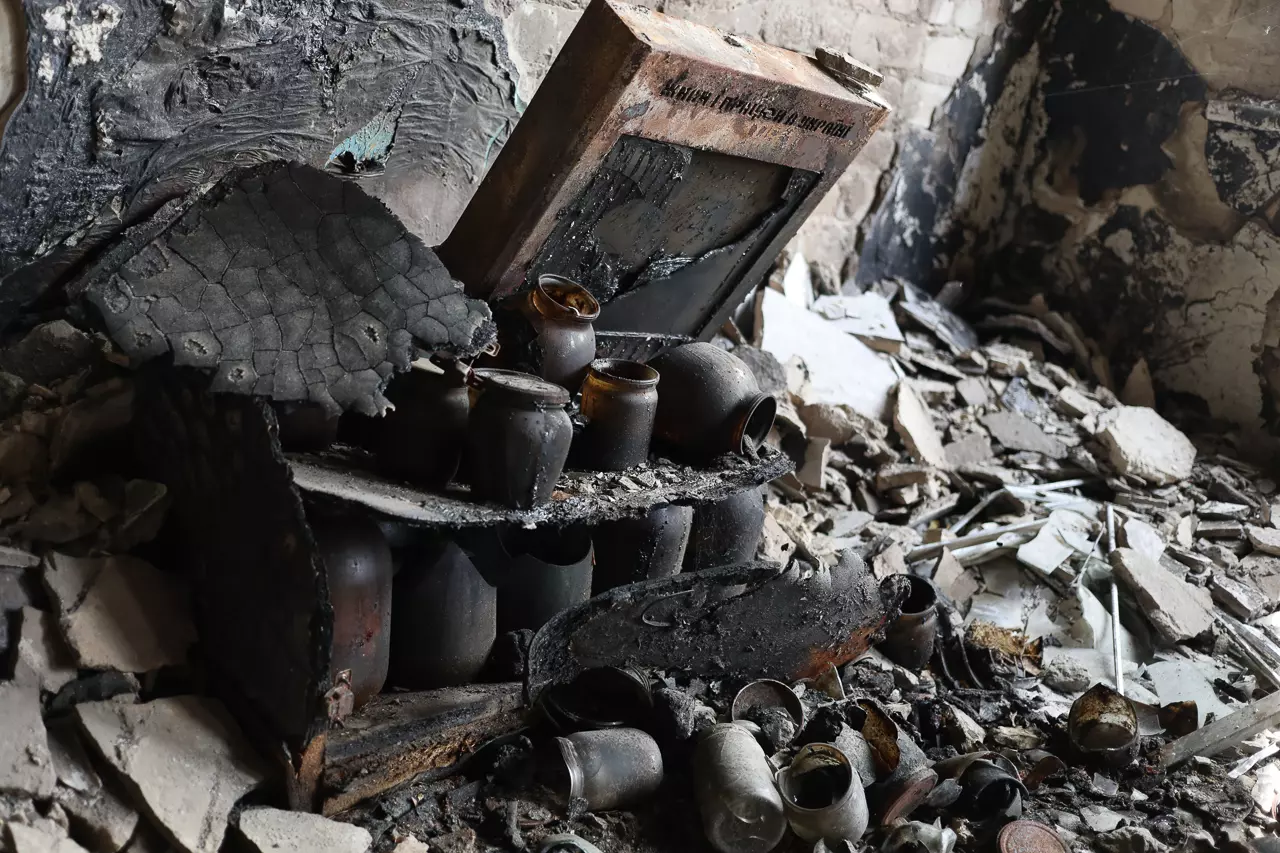
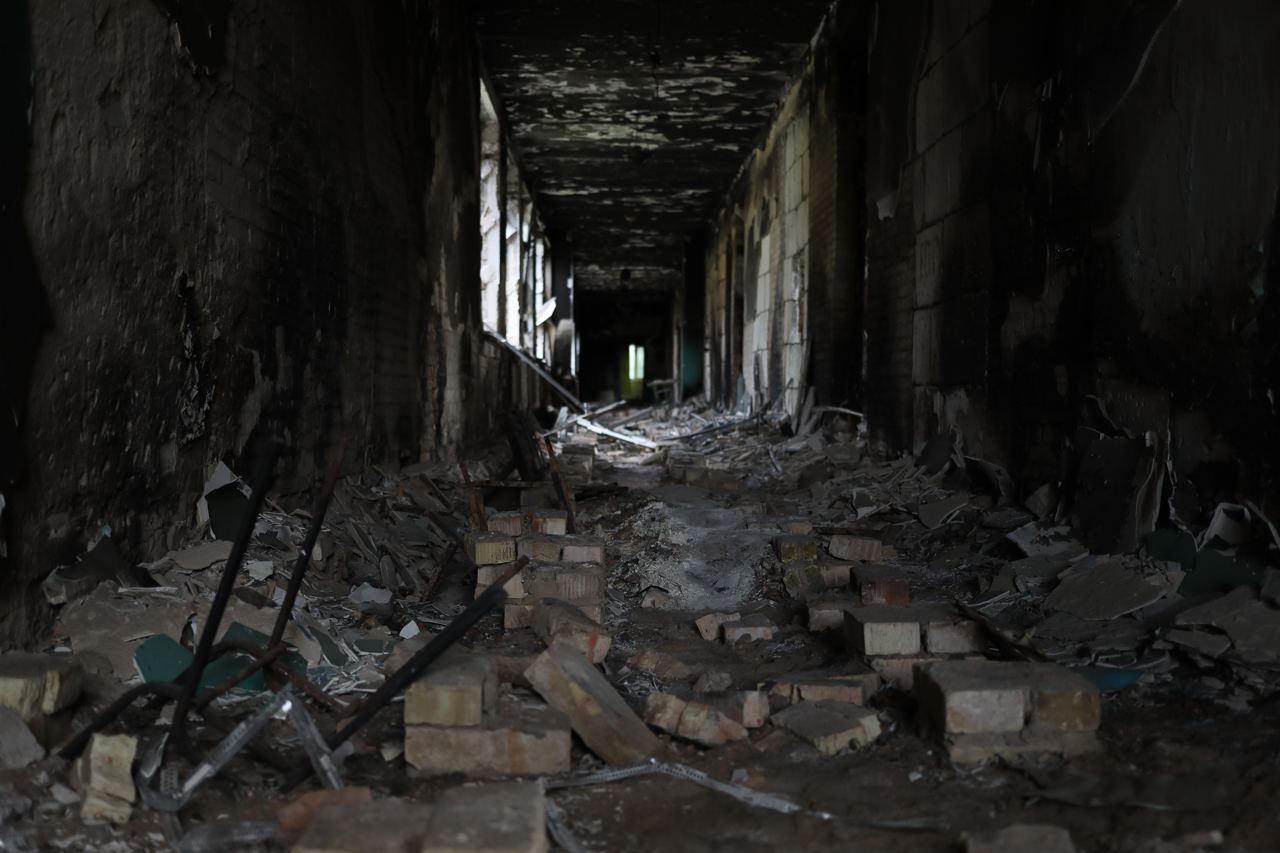
At our request, Serhiy agreed to show us where he had been held. So we head to the ruined school in the neighboring village. It’s now abandoned; the windows have been blown out by explosions, and the interior has been burned out—even the blackboards in the classrooms melted from the fire that raged here.
The school in the village of Bohdanivka in the Brovary District served as headquarters for Russian troops. This is where Serhiy was brought for interrogation, and it appears other prisoners were held here as well. Before fleeing on March 29, the Russians set fire to the school and the ammunition stored on its grounds.
A patriotic display in a school in the Kyiv
region burned down by Russian occupiers The man points to the remains of the classroom where he was held. He says that through the window, sometimes when the Russians weren’t watching, he could make out the trees and a small shop next to the school. He says he recognized this shop because he used to stop by there when he went fishing.
“YOU’RE NAZIS, YOU’RE KHOHLOV, WE ALL HATE YOU, AND WE’RE GOING TO SHOOT YOU ALL, DESTROY YOU”
For the first three days, the Russians tortured Serhiy. According to him, a man from Crimea was particularly brutal.
“He was, as he himself said, a Ukrainian, from Crimea, as he told me. His name was either Ilya or Volodya—I don’t remember. He was dark-haired; I’d recognize him in a photo. He’d sit there the whole time, propping up a school chair, and “spray” me with his automatic rifle—over my head and down my legs, like this.” He was shooting. I’d jump up and cover my head. And he’d hit my leg with the butt of his rifle,” the man recalls.
“He’d knock my hat off, like, ‘Look me in the eye.’ And then this: ‘You’re Nazis, you Ukrainians—we all hate you, and we’re all going to shoot you, destroy you,’”—he quotes the occupiers.
The classroom next to the room where Serhiy was held captive
Other Russians—both Europeans and Buryats—came to see him. According to him, the young conscripts were even more loyal. One of them even helped the prisoner to some extent during the shelling of the school.
“I think the shelling started on the third day. I was lying there in the middle of the classroom. I pushed off with my good leg—the floor was covered with linoleum—and pulled myself up like this. I looked over and saw them standing across from the desks. I squeezed myself in there against the wall because I realized they were coming in to lie down. A Russian soldier came in alone and asked, ‘Who dragged you over here?’ I said, ‘Your guys,’ and he left. Then a young guy ran in; one or two others peeked in. One came in and said, ‘Ah, so you were here after all.’ I confirmed it. So he dragged another desk—the one standing by the door—over like this to block the entrance; it served as a shield to keep the shrapnel from flying in,” Serhiy recounts.
The others, the older Russian military officers, were even more brutal. They accused the man of working for the Armed Forces and beat him.
“There were three or four men; one was attacking me, another with a rubber bullet (he shot me in the arm—ed.), and another was hitting me with the butt of his rifle and slashing at me—I have two wounds right here on my arm. One of them was stepping on me with his foot on the second or third day; I grabbed his leg like this, and it knocked me out. And I put my hands on my chest like this, and he hit me. I felt something blunt—most likely a bayonet knife; I don’t know, it just felt blunt,” Serhiy says, showing the scars on his arms. But he says he still has throat problems because the Russians tried to strangle him several times.
The occupiers held Serhiy for six days on the grounds of a school in Bohdanivka in the Kyiv region, where they had set up their headquarters
They also threatened to kill him.
“Tell the truth, or you’ll end up where the others are—in the sewer or a cesspool—where no one will find you, and you won’t even get a proper burial; you’ll die like a dog. No one will remember where you are or who you are.” That’s how they tried to scare me. They were telling me all this, but I stood my ground, and to me… I told them, I knew exactly where I was going and what I was doing. I’ll never betray my own—never in my life,” the man says. Later, law enforcement officers would find human remains in a local sewer manhole.
“HE HAS A WOUND; IT’LL GET INFECTED. LET HIM SUFFER; HE’LL DIE ON HIS OWN. HE’LL GET GANGRENE, HE’LL DIE ON HIS OWN”
On the fourth day of captivity, according to Serhiy, the Russians were already paying much less attention to him and left him alone more often. He had to lie on an aluminum stretcher that was completely soaked in his blood, unable to even go to the bathroom. His swollen legs, the cold, and the drafts were all tormenting him.
“On the fifth or sixth day, they gave me a pillow and a blanket, because I’d been lying there with absolutely nothing—it was so cold it was unbearable. The door would open, drafts would come in, and I’d be thrown around—the cramps were terrible. For a month in the hospital, I couldn’t… the door would knock, and I’d be thrown up in the air; something was going on, and I couldn’t even sleep. And the cramps—my muscles were constantly tensing up—but then they were able to treat me with injections,” he recalls.
At that time, the Russians fed Serhiy—with their dry rations.
“In the morning, around 7 o’clock, a truck would pull up, reeking of their dry rations. It stank so badly you couldn’t breathe—the whole school reeked of it. And then, around 10 a.m., a Burat came into the room here to see me; you could tell by his slanted eyes that he was a Burat. He had a shashlik, and it actually made me want to eat it—it smelled like meat. But after that, the stench of those dry rations came back. So they gave it to me to eat, and I ate it—but it was impossible to eat. It was so… There was also a chocolate bar there; I took the chocolate bar, and I broke a tooth. It was like rubber—impossible to eat. But I ate it anyway, because I hadn’t eaten in so long—I had to have something,” Serhiy recalls.
The commanders also came to see the Ukrainian prisoner to decide what to do with him.
“Two commanders came on the first and second days and said to shoot him. But another one—maybe their doctor—said, ‘He has a wound; it’ll get infected. Let him suffer; he’ll die on his own. ‘Gangrene will set in, and he’ll die on his own,’” Serhiy recalls.
One day, a wounded Russian soldier was brought into his classroom; he later died.
“He was alive, wrapped in a blanket. The commanders came, asked him which brigade or battalion he was from—I don’t remember—either the Third Regiment or a brigade, something like the 22nd RGD or something like that. He was badly burned. Well, on the 29th, when they were retreating, they took him away,” recalls the former prisoner of war.
When the Ukrainian military began shelling the Russian headquarters, Serhiy had a rough time.
“The shelling was right on my classroom. Everything was on fire, and all that smoke was drifting this way. Me… I think it took me a couple of weeks to scrub the soot off. I couldn’t get it off with wipes. Shrapnel was raining down all over the place, and I couldn’t hear a thing there: whether it was falling right here or landing on the slopes. The glow was blinding. I couldn’t hear a thing. And then it would hit like meat on a grill. Well, I don’t know how I survived here; I looked at the door behind me, and it was full of holes, all above the knees. “It’s a good thing I was lying down,” the man says.
And on March 29, as the Russians were retreating, they set fire to the school and the ammunition inside it. Because when the Ukrainian Armed Forces were shelling the occupiers, the man doesn’t recall any damage like what the school suffered. But he says he heard that as they retreated, his tormentors were discussing that their unit had received an order to redeploy to the Luhansk region.
“IF SOMEONE WOULD GIVE ME THOSE TORMENTORS—I’D CUT THEM TO PIECES”
At that time, Serhiy and another man, also named Serhiy, who had been at the school, were released.
“They shoved Serhiy toward me—he was wearing a hat and handcuffs—and said, ‘You have 5 seconds to get out of here,’ cursing, ‘You won’t get away…’ And we walked out. The roof was on fire. Completely. As soon as we turned the corner of the school, there was an explosion. I thought (Serhiy—Ed.) had been blown up by a tripwire, but he was coming back along the tourniquet,” recalls the former prisoner.
So the second man went back for that rope and the splint they’d used to immobilize his injured leg, which had an open wound and a fracture. Everything was exploding all around them. The man managed to escape only thanks to a bicycle they found on the school grounds—Serhiy used it like a scooter to protect his injured leg. Once he left the school grounds, Serhiy found a woman with a phone and called the police. He was taken from Bohdanivka to the hospital.
Children
will no longer attend the school where Serhiy was held captive Once at the hospital, he was told that he might lose his leg.
“I ended up in the hospital; I had developed an infection, and they wanted to amputate my leg. The senior doctor wanted to operate, but another, younger doctor said, ‘Let’s wait a week or two and see how things go; maybe we can save it,’” Serhiy says.
In the end, they managed to save his leg—he spent two months on a machine and in traction, and he had his first surgery just a month ago. However, his leg still causes him problems. He says he used to think: “It would have been better if they’d just shot me right away rather than leave me crippled and a burden on my family.” But now he’s more optimistic: “If someone handed those torturers over to me, I’d cut them into little pieces. If I start running again, I’ll join the Armed Forces—I can’t just sit around; together with my brothers-in-arms, I want to drive them out of here.”
If you’d prefer to watch the video with subtitles in another language, go to YouTube Settings → Subtitles → Auto-translate and select the language you want.
Authors: Lyubomyra Remazhevska, Vasyl Bidun
Serhiy from Rudnya in the Kyiv region managed to help Ukrainian troops destroy Russian convoys for three weeks before he was taken prisoner
The village of Rudnya in the Kyiv region is located 25 kilometers from Brovary. Throughout March, it was under occupation—Russian troops entered the village on March 9 and did not leave Rudnia until 20 days later, when they retreated from the region. Seven kilometers from Rudnia lies the village of Bohdanivka, where the Russians, specifically the 15th Separate Motorized Rifle Brigade, took up positions in the school and abused the local population: they tortured, killed, and raped people. Prisoners from surrounding villages were also brought to the Bohdanivka school. So it was here that Serhiy was brought from Rudnia.
Journalists from “Slidstvo.Info” traveled to Rudnia and recorded the story of Serhiy Mykolayenko, who spent six days in Russian captivity.
“THEY ENTERED THE VILLAGE, SO WE FLEW; WE DIDN’T EVEN FINISH DIGGING THE GRAVE AT THE CEMETERY”
On the way to Serhiy’s house, we notice the aftermath of Russian shelling. Residents of Rudnia say the Russians entered the village by accident while on their way to Bohdanivka. And they mostly fired at random. However, even this coincidence gave the occupiers an opportunity to “terrorize” the local population—some were even evicted from their homes so the Russians could take them over; they confiscated phones and valuables and looted the houses.
Serhiy Mykolayenko now gets around on crutches. To talk with us, his wife carries pillows out of their old house onto the street and places them on a broken bed. It’s clear that he’s already gotten used to the crutches, but walking is still difficult for him—he’s hampered by a fracture that didn’t heal properly and a large scar from a wound on his leg. He jokes that once he recovers, he’ll start running and join the Armed Forces—to kill Russian soldiers.
Serhiy enlisted in the Rudnya Territorial Defense on the first day of Russia’s full-scale invasion of Ukraine. At that time, a total of 12 people from the village—which has a population of nearly 2,000—had joined its ranks. So as soon as Russian troops approached the neighboring villages, he began assisting the Armed Forces of Ukraine and directing their fire at enemy columns. Together with his friends, he filmed the Russians’ movements and sent their locations to the military.
Before the full-scale invasion, he enjoyed hunting and taking care of his dogs
Serhiy also recounts how the Russians shot local residents in the village.
“Vova was riding his moped to Shevchenkove when he was shot. A neighbor further along the edge of the village was working as a security guard at a summer cottage. He went out to see what all the noise was about—they shot him on the spot,” he recalls.
The man says that the Russians shot at every car they came across on the road, and recalls that his neighbor also ran into a Russian convoy but managed to escape through the village streets.
During the occupation, a couple who had been shot—they were fleeing from Bohdanivka and had accidentally driven into Rudnia—was buried here.
“They ran over the car they’d shot at. It’s a shame—the young man was just a boy, and the girl too. And the husband. The husband is alive now; I don’t know how he’ll get through all this. The woman was shot,” he says.
When the young man and woman killed by the Russians were being buried in the cemetery, the men had to hide because the occupiers entered the village that very day.
“They entered the village, so we fled—we didn’t even finish digging the grave at the cemetery. Our cemetery is right in the center of the village. And then, after they left, we had already buried the girl and the young man. I think those were Sasha and Katya,” says Serhiy.
According to him, a total of five people were shot in Rudnia. He also recalls that his friend—Roman, a hunter from the neighboring village of Shevchenkove—was killed in the village of Mokrets because of the occupiers.
“His dog ran up to me in the forest, let me pet her, and then ran off. At the time, I thought it must be a sign that I’d hear some news about him. And then I found out that he had been killed,” the man says.
Like Roman, who was killed in the neighboring village of Mokrets, Serhiy passed on information about the movements of enemy convoys.
“In the morning, during the day, I didn’t sleep at night—my wife was sleeping, and I was already in the next village. I was giving our side updates on where and what was happening. I almost got caught myself—I was sitting right there by the road, and a vehicle drove three meters past me. I was hiding behind a stump; I don’t know how they didn’t notice that little stump—I just don’t know. Otherwise, I would’ve been caught earlier,” he says.
But not everyone supported what he was doing.
“Everyone asked, ‘Why did you go? Why are you doing this? Who’s asking you to go there? ‘What am I supposed to do, just sit here and wait for them to come?’ I say. ‘They’re coming into people’s homes and shooting them—it’s all happening. Am I supposed to wait until they kill me in my own home or what?’” he exclaims indignantly.
And he says that’s exactly why he didn’t hide, but went to help the Ukrainian military: “Why should I just sit around and wait for them to come to my house and kill me, or come and abuse my wife? In Bobryk, there was a woman’s niece, right? They raped her right there in Bobryk. They did whatever they wanted.”
“THEY TOOK US INTO A ROOM WHERE THE BODIES OF THE KILLED LYED AND SAID, ‘SMELL THE 200s’”
On March 24, Serhiy and his comrades from the Armed Forces were setting up a dugout in the forest near the village. And that’s exactly where the Russians intercepted him—a few days earlier, Ukrainian soldiers had blown up a Russian armored personnel carrier, and the occupiers had begun searching for them, combing through the forest.
“We went to cut some branches and were dragging them toward a pit. I was walking in front, and my comrade was walking behind me. He didn’t cross the road—there’s an old road behind us—but I crossed; there were about 10 meters left… I look up and see one Russian coming from one side and another—a Buryat—from the other. I think, ‘Well, where am I supposed to go?’ The one with the assault rifle is coming toward me, and I’m… well, what can I do? I turned around, immediately signaled to him, threw this Christmas tree on the ground, and headed this way. “He pointed his automatic rifle at me, waving it, like, ‘Go over there,’” he recalls.
Thanks to this, his comrade didn’t fall into Russian captivity, but the Russians shot Serhiy in the right leg and opened fire.
“They ran up, dragged me away—we had a cache there, an RPG, grenades, all sorts of things. I was lying there, thinking, ‘What can I come up with?’” the man says.
He explained his presence in the forest to the Russians by saying he was helping a local old man chop firewood in exchange for a loaf of bread, and that he didn’t know what was in the dugout or who was there. However, the occupiers didn’t really listen to him; they started shouting that he was a Nazi and tried to tie Serhiy up.
“They started tying me up, put a tourniquet on me, beat me, and held a knife to my throat. This Buryat guy sat on me and hit me on the head with the butt of his rifle; I had a bruise right here,” the man says, pointing.
He managed to toss his phone aside by stuffing it into his jacket, so the Russians couldn’t get any evidence of his collaboration with the military.
“Otherwise, they would have shot me on the spot,” the former captive is certain.
Serhiy shows a photo of his injury before surgery
Next, Serhiy was forced to climb onto a Russian vehicle, had a hat pulled over his head so he couldn’t see anything, and was taken out of the village.
“You wonder—where are they taking me? Well, I’ll probably see where they’re taking me. Either Bohdanivka or (Velyka) Dymerka. We drove for a long, long, long time; they took me somewhere—with the hat on, I didn’t understand where or what was going on,” Serhiy shares.
They brought him to some kind of room and stitched up the wound on his leg—which was filled with shrapnel and sand. Later, they carried Serhiy into a room where the bodies of the dead were lying and told him, “Sniff the two-hundreds.” An hour later, they moved him to a classroom, where he lay for several days. It wasn’t until the second day that he was able to carefully push the cap away from his eyes and found a child’s diary on the floor. He says he no longer remembers the name written in it, but he saw that the diary belonged to one of the third-grade students at the school in Bohdanivka. That’s how he finally realized where he was.
At our request, Serhiy agreed to show us where he had been held. So we head to the ruined school in the neighboring village. It’s now abandoned; the windows have been blown out by explosions, and the interior has been burned out—even the blackboards in the classrooms melted from the fire that raged here.
The school in the village of Bohdanivka in the Brovary District served as headquarters for Russian troops. This is where Serhiy was brought for interrogation, and it appears other prisoners were held here as well. Before fleeing on March 29, the Russians set fire to the school and the ammunition stored on its grounds.
A patriotic display in a school in the Kyiv
region burned down by Russian occupiers The man points to the remains of the classroom where he was held. He says that through the window, sometimes when the Russians weren’t watching, he could make out the trees and a small shop next to the school. He says he recognized this shop because he used to stop by there when he went fishing.
“YOU’RE NAZIS, YOU’RE KHOHLOV, WE ALL HATE YOU, AND WE’RE GOING TO SHOOT YOU ALL, DESTROY YOU”
For the first three days, the Russians tortured Serhiy. According to him, a man from Crimea was particularly brutal.
“He was, as he himself said, a Ukrainian, from Crimea, as he told me. His name was either Ilya or Volodya—I don’t remember. He was dark-haired; I’d recognize him in a photo. He’d sit there the whole time, propping up a school chair, and “spray” me with his automatic rifle—over my head and down my legs, like this.” He was shooting. I’d jump up and cover my head. And he’d hit my leg with the butt of his rifle,” the man recalls.
“He’d knock my hat off, like, ‘Look me in the eye.’ And then this: ‘You’re Nazis, you Ukrainians—we all hate you, and we’re all going to shoot you, destroy you,’”—he quotes the occupiers.
The classroom next to the room where Serhiy was held captive
Other Russians—both Europeans and Buryats—came to see him. According to him, the young conscripts were even more loyal. One of them even helped the prisoner to some extent during the shelling of the school.
“I think the shelling started on the third day. I was lying there in the middle of the classroom. I pushed off with my good leg—the floor was covered with linoleum—and pulled myself up like this. I looked over and saw them standing across from the desks. I squeezed myself in there against the wall because I realized they were coming in to lie down. A Russian soldier came in alone and asked, ‘Who dragged you over here?’ I said, ‘Your guys,’ and he left. Then a young guy ran in; one or two others peeked in. One came in and said, ‘Ah, so you were here after all.’ I confirmed it. So he dragged another desk—the one standing by the door—over like this to block the entrance; it served as a shield to keep the shrapnel from flying in,” Serhiy recounts.
The others, the older Russian military officers, were even more brutal. They accused the man of working for the Armed Forces and beat him.
“There were three or four men; one was attacking me, another with a rubber bullet (he shot me in the arm—ed.), and another was hitting me with the butt of his rifle and slashing at me—I have two wounds right here on my arm. One of them was stepping on me with his foot on the second or third day; I grabbed his leg like this, and it knocked me out. And I put my hands on my chest like this, and he hit me. I felt something blunt—most likely a bayonet knife; I don’t know, it just felt blunt,” Serhiy says, showing the scars on his arms. But he says he still has throat problems because the Russians tried to strangle him several times.
The occupiers held Serhiy for six days on the grounds of a school in Bohdanivka in the Kyiv region, where they had set up their headquarters
They also threatened to kill him.
“Tell the truth, or you’ll end up where the others are—in the sewer or a cesspool—where no one will find you, and you won’t even get a proper burial; you’ll die like a dog. No one will remember where you are or who you are.” That’s how they tried to scare me. They were telling me all this, but I stood my ground, and to me… I told them, I knew exactly where I was going and what I was doing. I’ll never betray my own—never in my life,” the man says. Later, law enforcement officers would find human remains in a local sewer manhole.
“HE HAS A WOUND; IT’LL GET INFECTED. LET HIM SUFFER; HE’LL DIE ON HIS OWN. HE’LL GET GANGRENE, HE’LL DIE ON HIS OWN”
On the fourth day of captivity, according to Serhiy, the Russians were already paying much less attention to him and left him alone more often. He had to lie on an aluminum stretcher that was completely soaked in his blood, unable to even go to the bathroom. His swollen legs, the cold, and the drafts were all tormenting him.
“On the fifth or sixth day, they gave me a pillow and a blanket, because I’d been lying there with absolutely nothing—it was so cold it was unbearable. The door would open, drafts would come in, and I’d be thrown around—the cramps were terrible. For a month in the hospital, I couldn’t… the door would knock, and I’d be thrown up in the air; something was going on, and I couldn’t even sleep. And the cramps—my muscles were constantly tensing up—but then they were able to treat me with injections,” he recalls.
At that time, the Russians fed Serhiy—with their dry rations.
“In the morning, around 7 o’clock, a truck would pull up, reeking of their dry rations. It stank so badly you couldn’t breathe—the whole school reeked of it. And then, around 10 a.m., a Burat came into the room here to see me; you could tell by his slanted eyes that he was a Burat. He had a shashlik, and it actually made me want to eat it—it smelled like meat. But after that, the stench of those dry rations came back. So they gave it to me to eat, and I ate it—but it was impossible to eat. It was so… There was also a chocolate bar there; I took the chocolate bar, and I broke a tooth. It was like rubber—impossible to eat. But I ate it anyway, because I hadn’t eaten in so long—I had to have something,” Serhiy recalls.
The commanders also came to see the Ukrainian prisoner to decide what to do with him.
“Two commanders came on the first and second days and said to shoot him. But another one—maybe their doctor—said, ‘He has a wound; it’ll get infected. Let him suffer; he’ll die on his own. ‘Gangrene will set in, and he’ll die on his own,’” Serhiy recalls.
One day, a wounded Russian soldier was brought into his classroom; he later died.
“He was alive, wrapped in a blanket. The commanders came, asked him which brigade or battalion he was from—I don’t remember—either the Third Regiment or a brigade, something like the 22nd RGD or something like that. He was badly burned. Well, on the 29th, when they were retreating, they took him away,” recalls the former prisoner of war.
When the Ukrainian military began shelling the Russian headquarters, Serhiy had a rough time.
“The shelling was right on my classroom. Everything was on fire, and all that smoke was drifting this way. Me… I think it took me a couple of weeks to scrub the soot off. I couldn’t get it off with wipes. Shrapnel was raining down all over the place, and I couldn’t hear a thing there: whether it was falling right here or landing on the slopes. The glow was blinding. I couldn’t hear a thing. And then it would hit like meat on a grill. Well, I don’t know how I survived here; I looked at the door behind me, and it was full of holes, all above the knees. “It’s a good thing I was lying down,” the man says.
And on March 29, as the Russians were retreating, they set fire to the school and the ammunition inside it. Because when the Ukrainian Armed Forces were shelling the occupiers, the man doesn’t recall any damage like what the school suffered. But he says he heard that as they retreated, his tormentors were discussing that their unit had received an order to redeploy to the Luhansk region.
“IF SOMEONE WOULD GIVE ME THOSE TORMENTORS—I’D CUT THEM TO PIECES”
At that time, Serhiy and another man, also named Serhiy, who had been at the school, were released.
“They shoved Serhiy toward me—he was wearing a hat and handcuffs—and said, ‘You have 5 seconds to get out of here,’ cursing, ‘You won’t get away…’ And we walked out. The roof was on fire. Completely. As soon as we turned the corner of the school, there was an explosion. I thought (Serhiy—Ed.) had been blown up by a tripwire, but he was coming back along the tourniquet,” recalls the former prisoner.
So the second man went back for that rope and the splint they’d used to immobilize his injured leg, which had an open wound and a fracture. Everything was exploding all around them. The man managed to escape only thanks to a bicycle they found on the school grounds—Serhiy used it like a scooter to protect his injured leg. Once he left the school grounds, Serhiy found a woman with a phone and called the police. He was taken from Bohdanivka to the hospital.
Children
will no longer attend the school where Serhiy was held captive Once at the hospital, he was told that he might lose his leg.
“I ended up in the hospital; I had developed an infection, and they wanted to amputate my leg. The senior doctor wanted to operate, but another, younger doctor said, ‘Let’s wait a week or two and see how things go; maybe we can save it,’” Serhiy says.
In the end, they managed to save his leg—he spent two months on a machine and in traction, and he had his first surgery just a month ago. However, his leg still causes him problems. He says he used to think: “It would have been better if they’d just shot me right away rather than leave me crippled and a burden on my family.” But now he’s more optimistic: “If someone handed those torturers over to me, I’d cut them into little pieces. If I start running again, I’ll join the Armed Forces—I can’t just sit around; together with my brothers-in-arms, I want to drive them out of here.”
If you’d prefer to watch the video with subtitles in another language, go to YouTube Settings → Subtitles → Auto-translate and select the language you want.
This is an automatic translation generated by DeepL.