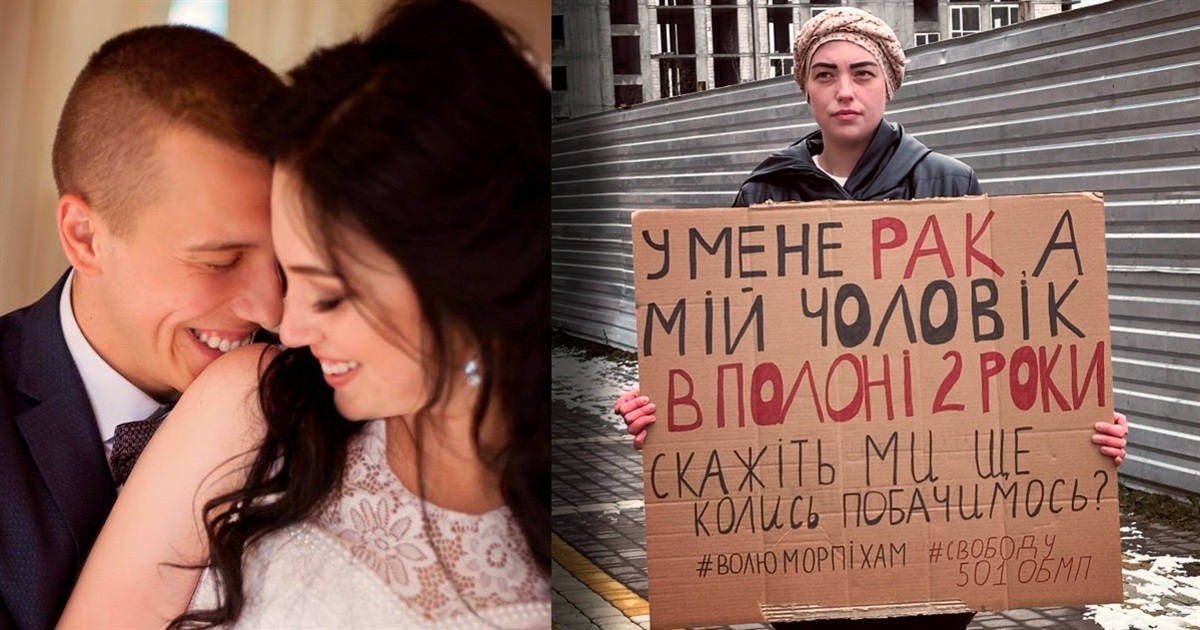
I have stage 4 cancer, and my husband has been held captive for two years. Tell me, will we ever see each other again?
Source: Svoi.City
Author: Hanna KURTSANOVSKA
Olga recently posted a photo on her Instagram page showing her holding a large sign that reads: “I have cancer, and my husband has been held captive for two years. Tell me, will we ever see each other again?” Svoi spoke with Olga about her family’s life before the full-scale war, her battle with cancer, and her husband, who is being held in a prison in the Russian Federation.
My beloved has been at war since 2014. I accepted his choice
Olga is 24 years old; her husband, Ruslan, is 30. Ruslan “celebrated” his last two birthdays in Russian captivity. The couple is from Berdiansk, a city that has been occupied by Russian troops since February 27, 2022.
“We met in 2015. Six months after we met, Ruslan proposed to me, and we got married in May. He was already in the military back then; Ruslan has been at war since the beginning—since 2014. We lived in our hometown of Berdyansk. Well, ‘lived’ is a bit of a stretch, because every year, for six months, my husband was either at training exercises, on missions, or on the front lines. He believed that it was his calling—to protect our people from the enemy.
I love my husband very much, so I understood and accepted his position. I dreamed of a peaceful life, of having children, but, unfortunately, that was impossible because I didn’t want to raise them on my own while my husband was constantly at war.”
During the occupation, I attended pro-Ukrainian rallies. Meanwhile, my husband was in besieged Mariupol
. In April 2021, Olga was diagnosed with cancer. She found out by accident—when, while adjusting her scarf, she felt a lump on her neck. She went to see a doctor, who ordered tests, and the diagnosis was confirmed. Before the full-scale invasion, Olga was undergoing treatment in Mariupol so that her husband could visit her at the hospital for at least one day.
Ruslan was very worried about his beloved and did everything he could to help her recover. But he couldn’t stay with his sick wife for long because of his military service. Eventually, Olga moved back home to Berdiansk.
“On December 6, 2021, Ruslan left for his post in the village of Shyrokyne in Donetsk Oblast, which was then still part of the Joint Forces Operation zone. That’s where he encountered the full-scale invasion. On February 24, he called me that evening and asked me to leave. But I couldn’t do that. Mariupol was only 90 kilometers away from us, and I thought that if I left, I would be abandoning him there. In early March, on orders from their commanders, the marines took up positions at two facilities—Ilyich and Azovmash. Berdiansk had already been occupied. My husband would call once or twice a week; the calls lasted just a few minutes. Ruslan kept insisting that I leave. I resisted this, instead supporting pro-Ukrainian rallies in Berdyansk and even wearing patriotic clothing. After the band “Kalush” won Eurovision, I found a seamstress who made me an identical panama hat; I wore it and also wore T-shirts with slogans in Ukrainian.
We gathered every day, marched through the main square to the sea, and shouted “Glory to Ukraine.” Of course, I didn’t tell my husband about this, so he wouldn’t worry
unnecessarily. For his part, Ruslan protected me and told me almost nothing about Mariupol. I later learned from the wives of my husband’s comrades that they had almost no food or water left because they were completely surrounded. I tried to support Ruslan as much as possible; for several days, I gathered good news about which countries were helping us and told my beloved that everything would be all right. But we both understood that there were only two ways out of Mariupol—death or captivity.”
In early May, the occupiers in Berdiansk broke up the last rally—they fired on people and took pro-Ukrainian residents, former military personnel, and the wives of active-duty soldiers to the “basement.” That’s when Olga really became afraid, and she regretted not having listened to her husband’s advice back then. But she was even more afraid for Ruslan. She recalls how she eagerly awaited his call, and during their conversation, she tried to hold back her tears so that Ruslan wouldn’t be distracted by her emotions. The most important thing then was for him to survive that hell. During one of their last conversations, Olga promised her beloved that once all this horror was over, she would give him three sons.
“On April 4, a video was published on Russian Telegram channels showing that the battalion where my husband serves was being held captive by the Russians. There was only one hope: if they were caught on video, they weren’t going to be killed. Since then, my personal fight for my husband has begun, and it continues to this day.”
Life has become a struggle—both to bring my beloved home and to battle illness
. In the summer of 2022, Olga left the occupied territory. It cost her 3,000 hryvnias. She left Berdyansk at 5 a.m. and arrived in Zaporizhzhia at 7:30 p.m. The distance between the two cities is 230 kilometers. Along the way, she had to pass through 17 Russian checkpoints.
“When I first saw a Ukrainian soldier at our checkpoint, tears of joy just started flowing. I ran to the Ukrainian flag; we looked at each other, and I just couldn’t believe I’d managed to escape the occupation.”
In Zaporizhzhia, Olga got a tattoo on her left arm—an image of a soldier who serves as her guardian angel.
“I wanted to preserve the memory of my husband’s heroism this way. I’m very proud of his choice, despite all the painful and difficult consequences for us. He’s my hero. The tattoo has become a symbol of my love and respect for him, and for his choice to defend people.”
In Zaporizhzhia, Olga learned that she had gone into remission—a period when the symptoms of the disease partially or completely disappear—but she soon came out of remission. After talking with her doctors, she realized this was due to constant stress. Her cancer had progressed from stage two to stage four—the final stage.
“But despite everything, I continued to fight for my husband’s release from captivity—I reached out to everyone involved in the repatriation of prisoners of war. Together with the wives of other prisoners of war, we founded the nonprofit organization ‘Union of Families of Prisoners of War 501’; we communicate with government officials, organize and support peaceful demonstrations in support of the prisoners. We also volunteer.
And in between, I’m constantly in the hospital receiving chemotherapy. I’ve already had nine out of the twelve scheduled sessions. The treatment is actually very difficult; I’ve ended up in the ICU more than once. The only people by my side are my friends, whose husbands are also being held captive. At home, I’m also constantly alone, and the only person who could have been by my side during such difficult moments is my husband—but, unfortunately, he’s still being held captive.”
Every prisoner exchange tears my heart to pieces. Go to rallies and keep the captives
in the public eye. Olga eagerly awaits news of prisoner exchanges. She always carefully examines every photo and every video, searching for her husband in them. But when she realizes he isn’t there again, she simply picks herself back up piece by piece and carries on with her life, waiting for the next prisoner exchange. This has happened 49 times already—that’s exactly how many prisoner exchanges have taken place since the full-scale war began. And for 13 months in a row, not a single soldier from the 501st Marine Infantry Brigade has been included in them.
“I want to appeal to all the women, sisters, and mothers who will read this story—you must be strong; you must hold on and fight for the sake of your loved ones. Because that’s the only thing they live for in captivity; we’re all united by a single hope for a swift exchange.”
In May 2022, Olga received a letter from her husband. It contained only four lines. Nothing more was allowed.
“The Russian National Information Bureau forwards letters to the Ukrainian one, and they then send them directly to the families. They called me and said there was a letter for me and that they would send it by mail. I persuaded them to give it to me that very day, and within half an hour I was at the door of that office. My hands were shaking; I opened the letter on my knees, without moving from the doorway. It was his handwriting. I won’t quote exactly what was written there. But there was one sentence: “I hope you’re doing well, I hope we’ll see each other soon, I love you.” Of course, it was in Russian, because the Russians check all letters before they’re sent. From this, I realized that he hadn’t received a single one of the 50 letters I’d written to him almost every week.”
Olga sorely misses the emotional and physical support of her beloved. She often takes out his photo—especially when things get really tough—and talks to him.
“I know Ruslan would tell me that I have to be strong, no matter what, and that I have to get him out of that captivity. And that gives me the strength and the will to keep living and to continue fighting for him—and to wait for my beloved to return from captivity. I will definitely recover, because I promised my husband I would have children with him.”
Olga also asks people to attend rallies and keep the captives in the public eye. In her words, all Ukrainians around the world must become the voices of the prisoners of war.
Author: Hanna KURTSANOVSKA
Olga recently posted a photo on her Instagram page showing her holding a large sign that reads: “I have cancer, and my husband has been held captive for two years. Tell me, will we ever see each other again?” Svoi spoke with Olga about her family’s life before the full-scale war, her battle with cancer, and her husband, who is being held in a prison in the Russian Federation.
My beloved has been at war since 2014. I accepted his choice
Olga is 24 years old; her husband, Ruslan, is 30. Ruslan “celebrated” his last two birthdays in Russian captivity. The couple is from Berdiansk, a city that has been occupied by Russian troops since February 27, 2022.
“We met in 2015. Six months after we met, Ruslan proposed to me, and we got married in May. He was already in the military back then; Ruslan has been at war since the beginning—since 2014. We lived in our hometown of Berdyansk. Well, ‘lived’ is a bit of a stretch, because every year, for six months, my husband was either at training exercises, on missions, or on the front lines. He believed that it was his calling—to protect our people from the enemy.
I love my husband very much, so I understood and accepted his position. I dreamed of a peaceful life, of having children, but, unfortunately, that was impossible because I didn’t want to raise them on my own while my husband was constantly at war.”
During the occupation, I attended pro-Ukrainian rallies. Meanwhile, my husband was in besieged Mariupol
. In April 2021, Olga was diagnosed with cancer. She found out by accident—when, while adjusting her scarf, she felt a lump on her neck. She went to see a doctor, who ordered tests, and the diagnosis was confirmed. Before the full-scale invasion, Olga was undergoing treatment in Mariupol so that her husband could visit her at the hospital for at least one day.
Ruslan was very worried about his beloved and did everything he could to help her recover. But he couldn’t stay with his sick wife for long because of his military service. Eventually, Olga moved back home to Berdiansk.
“On December 6, 2021, Ruslan left for his post in the village of Shyrokyne in Donetsk Oblast, which was then still part of the Joint Forces Operation zone. That’s where he encountered the full-scale invasion. On February 24, he called me that evening and asked me to leave. But I couldn’t do that. Mariupol was only 90 kilometers away from us, and I thought that if I left, I would be abandoning him there. In early March, on orders from their commanders, the marines took up positions at two facilities—Ilyich and Azovmash. Berdiansk had already been occupied. My husband would call once or twice a week; the calls lasted just a few minutes. Ruslan kept insisting that I leave. I resisted this, instead supporting pro-Ukrainian rallies in Berdyansk and even wearing patriotic clothing. After the band “Kalush” won Eurovision, I found a seamstress who made me an identical panama hat; I wore it and also wore T-shirts with slogans in Ukrainian.
We gathered every day, marched through the main square to the sea, and shouted “Glory to Ukraine.” Of course, I didn’t tell my husband about this, so he wouldn’t worry
unnecessarily. For his part, Ruslan protected me and told me almost nothing about Mariupol. I later learned from the wives of my husband’s comrades that they had almost no food or water left because they were completely surrounded. I tried to support Ruslan as much as possible; for several days, I gathered good news about which countries were helping us and told my beloved that everything would be all right. But we both understood that there were only two ways out of Mariupol—death or captivity.”
In early May, the occupiers in Berdiansk broke up the last rally—they fired on people and took pro-Ukrainian residents, former military personnel, and the wives of active-duty soldiers to the “basement.” That’s when Olga really became afraid, and she regretted not having listened to her husband’s advice back then. But she was even more afraid for Ruslan. She recalls how she eagerly awaited his call, and during their conversation, she tried to hold back her tears so that Ruslan wouldn’t be distracted by her emotions. The most important thing then was for him to survive that hell. During one of their last conversations, Olga promised her beloved that once all this horror was over, she would give him three sons.
“On April 4, a video was published on Russian Telegram channels showing that the battalion where my husband serves was being held captive by the Russians. There was only one hope: if they were caught on video, they weren’t going to be killed. Since then, my personal fight for my husband has begun, and it continues to this day.”
Life has become a struggle—both to bring my beloved home and to battle illness
. In the summer of 2022, Olga left the occupied territory. It cost her 3,000 hryvnias. She left Berdyansk at 5 a.m. and arrived in Zaporizhzhia at 7:30 p.m. The distance between the two cities is 230 kilometers. Along the way, she had to pass through 17 Russian checkpoints.
“When I first saw a Ukrainian soldier at our checkpoint, tears of joy just started flowing. I ran to the Ukrainian flag; we looked at each other, and I just couldn’t believe I’d managed to escape the occupation.”
In Zaporizhzhia, Olga got a tattoo on her left arm—an image of a soldier who serves as her guardian angel.
“I wanted to preserve the memory of my husband’s heroism this way. I’m very proud of his choice, despite all the painful and difficult consequences for us. He’s my hero. The tattoo has become a symbol of my love and respect for him, and for his choice to defend people.”
In Zaporizhzhia, Olga learned that she had gone into remission—a period when the symptoms of the disease partially or completely disappear—but she soon came out of remission. After talking with her doctors, she realized this was due to constant stress. Her cancer had progressed from stage two to stage four—the final stage.
“But despite everything, I continued to fight for my husband’s release from captivity—I reached out to everyone involved in the repatriation of prisoners of war. Together with the wives of other prisoners of war, we founded the nonprofit organization ‘Union of Families of Prisoners of War 501’; we communicate with government officials, organize and support peaceful demonstrations in support of the prisoners. We also volunteer.
And in between, I’m constantly in the hospital receiving chemotherapy. I’ve already had nine out of the twelve scheduled sessions. The treatment is actually very difficult; I’ve ended up in the ICU more than once. The only people by my side are my friends, whose husbands are also being held captive. At home, I’m also constantly alone, and the only person who could have been by my side during such difficult moments is my husband—but, unfortunately, he’s still being held captive.”
Every prisoner exchange tears my heart to pieces. Go to rallies and keep the captives
in the public eye. Olga eagerly awaits news of prisoner exchanges. She always carefully examines every photo and every video, searching for her husband in them. But when she realizes he isn’t there again, she simply picks herself back up piece by piece and carries on with her life, waiting for the next prisoner exchange. This has happened 49 times already—that’s exactly how many prisoner exchanges have taken place since the full-scale war began. And for 13 months in a row, not a single soldier from the 501st Marine Infantry Brigade has been included in them.
“I want to appeal to all the women, sisters, and mothers who will read this story—you must be strong; you must hold on and fight for the sake of your loved ones. Because that’s the only thing they live for in captivity; we’re all united by a single hope for a swift exchange.”
In May 2022, Olga received a letter from her husband. It contained only four lines. Nothing more was allowed.
“The Russian National Information Bureau forwards letters to the Ukrainian one, and they then send them directly to the families. They called me and said there was a letter for me and that they would send it by mail. I persuaded them to give it to me that very day, and within half an hour I was at the door of that office. My hands were shaking; I opened the letter on my knees, without moving from the doorway. It was his handwriting. I won’t quote exactly what was written there. But there was one sentence: “I hope you’re doing well, I hope we’ll see each other soon, I love you.” Of course, it was in Russian, because the Russians check all letters before they’re sent. From this, I realized that he hadn’t received a single one of the 50 letters I’d written to him almost every week.”
Olga sorely misses the emotional and physical support of her beloved. She often takes out his photo—especially when things get really tough—and talks to him.
“I know Ruslan would tell me that I have to be strong, no matter what, and that I have to get him out of that captivity. And that gives me the strength and the will to keep living and to continue fighting for him—and to wait for my beloved to return from captivity. I will definitely recover, because I promised my husband I would have children with him.”
Olga also asks people to attend rallies and keep the captives in the public eye. In her words, all Ukrainians around the world must become the voices of the prisoners of war.
This is an automatic translation generated by DeepL.