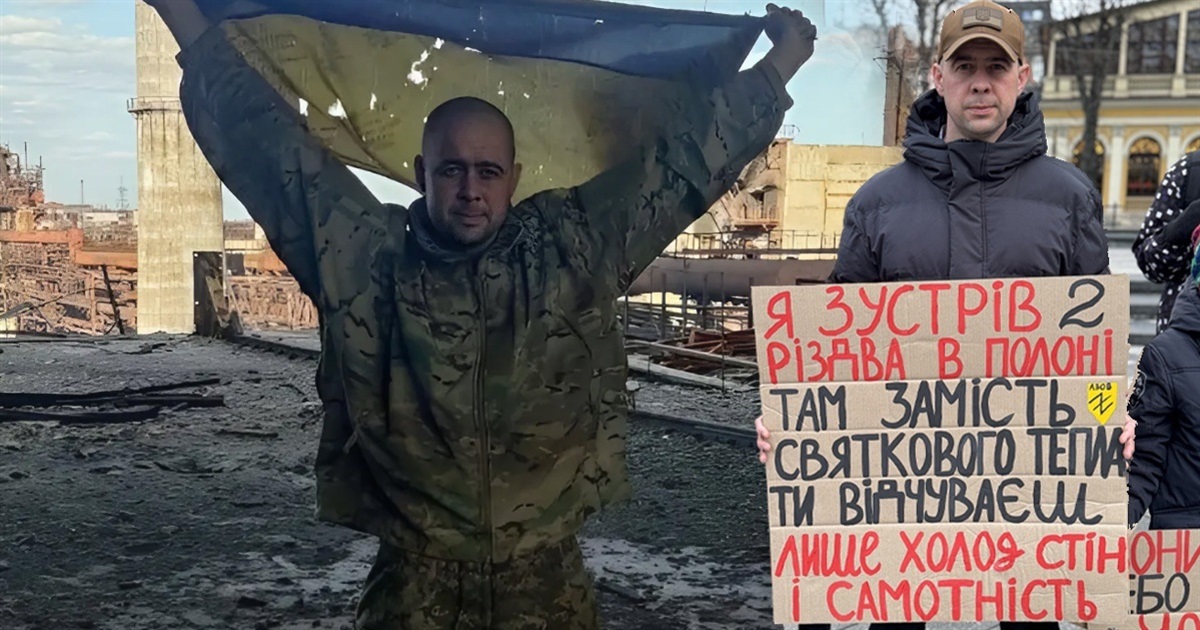
I spent two Christmases in captivity; there, you cling to hope. In captivity, there’s nothing but the coldness of the walls and loneliness
Source: Svoi.City
Author: Hanna KURTSANOVSKA
I never wanted to join the army, but that’s just how life turned out…
I was born in Mariupol 38 years ago. I’m an engineer by training, but I’ve worked all kinds of jobs: I drove a taxi, maintained coffee machines, spent eight years at the Illich Steel Plant in various positions, and so on. My last job in peaceful Mariupol was as a support specialist at an IT company.
When I had to choose after high school—whether to join the army or continue my education—I chose the latter and enrolled at Donetsk National Technical University. The university told me there was a military department and that upon graduation I would become a reserve officer. But I turned down that offer as well, because I didn’t want to be tied to military structures. And look how things turned out in the end.
I never turned off the news; I’ve been monitoring everything since 2014. There were three monitors at work, and the news feed was always open on one of them. For me personally, the “wake-up call” was the hasty closure of international missions in Kyiv and the departure of diplomats from Germany, the United Kingdom, and the United States. The foreign intelligence services of those countries already knew about the war back then. I was also expecting something, but I couldn’t imagine the scale of this war—that we would be attacked simultaneously from the sea, the air, and the ground.
I was hired as a driver
at “Azov” We lived on Kurchatov Street, near the “Skhidny” neighborhood, where the road leads to Sartana. That’s where it all began on February 24. Around half past four, my godfather called—he worked for the Kyiv police—and said the war had started. While having coffee with my wife in the kitchen, I told her I wasn’t going to sit this one out, and she reacted surprisingly calmly; she didn’t try to talk me out of it. I packed my things and drove my car to the military registration office on the Left Bank. It was chaos there—about a hundred men. For “pro-Russian” Mariupol, that’s really a lot.
I waited for my turn. The girls started asking me if I was in the military and what skills I had. I told them I had a lot of driving experience and was very comfortable with computers. But I don’t know how to shoot—except for a few times when I went hunting with my dad and fired a hunting rifle. They gave me two hours to get ready. I arrived at the assembly point and waited there for four hours because they were processing combat veterans first. Later, a guy approached me and suggested I come in the morning of February 25.
We agreed that I’d arrive at five. I spent the night at home. I arrived as we’d agreed. But there had been a flight that night, and there was no
one at the assembly point. A soldier came out and advised me to go to Military Unit 3057. There, they outfitted me and issued me a weapon. And one of the guys said that “Azov” wanted to take me in. They took me to the base near “Veselka” Park. And that’s how I was enlisted in the regiment as a driver. The support in “Azov” was great from the very first minute.
I went to fight, not to sit
around For the first two weeks, I was constantly driving to Azovstal and the Ilyich Steel Plant—transporting food, some slabs, weapons, ammunition, and so on. And when the school where we were based was “cleared out,” we moved to the building of the metallurgical technical school near Azovstal. One of the “Azov” guys came in and said there weren’t enough people at the front lines. If needed, I’d go, of course—it wasn’t even up for discussion. That’s why I joined in the first place—to fight, not to sit on the sidelines. I went on several combat missions.
I remember my youth: whenever I fought, I was always pumped full of adrenaline. But here I was calm—even with the constant explosions, guided bombs striking nearby, tanks firing direct-fire rounds, a sea of blood, and people’s bodies torn apart. Maybe it was just my brain’s way of distancing itself from everything that was happening, which is why I wasn’t afraid.
An aerial bomb hit the building—I nearly died
then I first felt afraid on the night of May 9–10, when KABs fell right where I was. It was a three-story concrete building at Azovstal. We had a bunker there called “Cyclone.” This building was near the coke batteries; we called it the “chem lab” because there were so many different measuring cups and flasks there. We moved here after the Russians burned down our previous building—they pelted it with burning phosphorus.
At night, the guys and I would carry food to “Bastion”—that’s another bunker. When I think back on it, I’m still amazed at how we managed to move around in complete darkness without any of us stepping on a mine. We got back, exhausted, and went straight to sleep. I even took off my clothes, ending up in just my underwear. We slept on the table—it used to be a lab, after all. I don’t know how much time had passed when KAB bombs started raining down from the planes. The first aerial bomb, the second, the third. And the fourth hit right in the center of our building.
We were buried under the rubble. Eight soldiers were killed instantly. And a slab of concrete pinned my right leg down. All around me was total darkness. At that moment, I thought—this is the end
. I couldn’t see anything, but I heard someone shouting, “Crawl toward the light!” My eyes were filled with dust, but I could make out a light in the distance. I managed to free my leg and started crawling. A border guard was crawling behind me. The light was getting closer, and I began to realize that this wasn’t an exit. It was a fire. I couldn’t breathe; I started to lose consciousness. I came to inside the room where we had set up a makeshift kitchen. My comrades pulled me out, including “Pasha,” a member of the Azov Regiment. I was disoriented and suffering from a concussion. I told them I couldn’t open my eyes, but the guys said they were open. I think if I’d stayed under the rubble for a few more minutes, I would have suffocated. That’s why I’m so grateful to the guys.
“Pasha” saved me and another comrade—he was killed in Olenivka
Once I’d fully regained my senses, fighters from the special operations reconnaissance unit arrived. They helped us get out of the building because they knew the enemy would keep shelling it until it was completely destroyed. So we ran. And there I was, in my underwear and barefoot, running about 400 meters to another bunker. It was Armageddon on the surface—a transformer was on fire, as was the neighboring building, and ours had collapsed in half. And we were running, and you know what’s interesting—not a single scratch on my legs.
Closer to noon, we returned to our building, cleared away as much debris as we could, and searched for survivors. With me were “Pasha” and a volunteer named “Stopper,” who had flown into Mariupol by helicopter. We shouted, knocked, and shone our flashlights, hoping someone would respond. And it happened—we found a comrade under the slabs who had been lying there for almost a day. We needed jacks to pull him out. We found four of them. But another problem arose—not everyone could get in there. Luckily, “Pasha” was smaller than the rest of us, so he crawled in. He rescued his comrade from the Ukrainian Armed Forces. Together, we were taken prisoner from Azovstal on May 18. After that, we “Azov” soldiers were taken to the Olenivka penal colony, but I don’t know where that guy ended up. I don’t know what became of him.
I stayed in Olenivka until mid-July, and then I was transferred to the Donetsk pretrial detention center. It was there that I learned about the barracks being blown up. I refused to believe it until the very end. I found out exactly who had been there, and the news that “Pasha” had been killed in that barracks knocked me off my feet.
Life in captivity: no talking allowed, it’s cold, the food is terrible, and there are lice
. I spent 11 months in Donetsk, then was transferred to Horlivka. Another ten months there. Next came prison in Taganrog, and starting September 8, 2024, I was in a Perm detention center.
If I compare the places where I was held captive, Olenivka could be called a camp. We were allowed to read books, socialize, and had free access to walks in the local yard.
But in Donetsk, it was brutal. First of all, the “intake” there was savage—they beat us mercilessly. In a cell measuring six by three meters, there were only ten metal “bunks.” No mattresses, pillows, or blankets—and I won’t even mention bedding. And there was one “hole,” that is, a hole for relieving oneself. One sink. And there were 25 of us. We weren’t allowed to talk.
We could only sit at the table, and it could fit a maximum of eight people. Everyone else had to stand. We took turns—some sat for four hours while others stood
. There were no window panes. We hung T-shirts over the window because it was chilly—and this was in the summer. We were sure they’d get us out of there by winter; there was definitely going to be an exchange, but that didn’t happen. And in the winter, the temperature in the cell was 5–7 degrees. We lay in a “jack” formation and warmed each other’s feet with our hands. And because of the cold, we ran to the bathroom every half hour.
The food was terrible. Some kind of soup and porridge. Everything was tasteless, made from poor-quality ingredients. Before the invasion, I weighed 96 kilograms. Of course, I lost weight during those 86 days in Mariupol. But I lost a lot of weight during the months I spent in the pretrial detention center, down to 56 kilograms.
And then there were the lice, which made life unbearable. There were an unbelievable number of them. For the first four months, they wouldn’t let us shave or get a haircut, so they were usually in our hair and beards. And we had a daily ritual: we’d stand closer to the light bulb—the ceiling in the cells is low, just over two meters—and check each other’s hair for lice. In other cells, there were bedbugs as well. They caught up with me already in Horlivka. Over the course of 11 months, they let us take a shower twice—on New Year’s and Easter. We also had one chest X-ray, and there was one visit with a psychologist.
I was taken from Donetsk on June 20, 2023. For us, any movement meant hope for a prisoner exchange. I remember when they called my last name at the detention center; I started packing my things. And the guard said to me, “Why are you taking them? Don’t you know that taking anything out of the zone is a bad omen?”
If only you knew how much hope I had back then for a prisoner exchange and that I’d soon be home—but instead of being taken for an exchange, they took me to the Horlivka penal colony
In Taganrog, according to the guys who’d been released earlier, life was “no picnic.” But I didn’t end up there until April 2024. If it weren’t for the periodic encounters with special forces—whether from Rostov or Moscow—it would be possible to live there. There are mattresses and pillows, and the food is better. However, it was in Taganrog that I learned what a stun gun is and just how painful it can be. Imagine standing in the “star” position while they shock you with a stun gun on different parts of your body, and there’s nothing you can do. You just have to endure that unbearable pain.
And then there’s the psychological torment. There were video cameras hanging in every cell in Perm, meaning all our movements were monitored—we had to stand all day. We were allowed to sit down twice a day: for half an hour during breakfast and the same amount of time during dinner. And there was a loudspeaker from which the Russian national anthem blared every morning. We were allowed to use the restroom only at designated times. A voice from the loudspeaker would also tell us when. And we weren’t allowed to talk. However, we had to memorize poems and songs about “Great Russia” and then recite them on command. We’d get severely punished if we forgot even a single word. They’d also line us up in the hallway, and a guard would read books to us for 40 minutes. They were about the Great Patriotic War, their leaders, and other “red” Soviet propaganda. But a few times we got lucky—they read *The Godfather* to us.
Shortly before the prisoner exchange—I was already in Perm by then—they took me in for interrogations. They didn’t beat me there anymore, but they put psychological pressure on me. They told me that almost nothing was left of Ukraine, and that in the territory still under Ukrainian control, there was no electricity. They said that no one needed me there, that no one was waiting for me in Ukraine. And that my wife had returned to Mariupol. The last time I’d been in touch with Yulia was in May, when she, my son, and my father were just about to leave. And I didn’t know what to think. What if they hadn’t passed the screening and had been turned back? Twice they offered me the chance to stay and collaborate with them—that is, to join the Russian army. They said, “Choose—either join us and you’ll be free, or you’ll spend a decade in prison.”
My mother died in Mariupol—she will live in my heart forever
I was exchanged on the night of October 19. In total, I spent 2.5 years in captivity—or, more precisely, 885 days. The first person I called was my beloved wife. I knew her phone number by heart.
I knew my mom’s number too, but, unfortunately, I’ll never be able to call her again. And I won’t be able to visit her grave either. She died in Mariupol in 2022—on March 22. At that time, a neighboring house caught fire, and my mom and dad rushed to save others, trying to put out the fire. Then there was a mortar attack: my dad was killed instantly, and my mom suffered fatal shrapnel wounds. I learned of the death of this person so dear to me while at Azovstal. My mom was buried in the yard of our private home; she was 57 years old.
All the moments we shared were filled with her love and care. My mom knew how to turn the ordinary into something special, creating comfort and coziness. She was a sincere supporter of Ukraine’s independence, believing that each of us should contribute to its development. She knew how to find the good in every situation and always supported me.
Her smile could chase away any clouds. She was a true beacon of light for me. In Mariupol, we shared countless wonderful moments together—from simple walks around the city to family dinners, which she always prepared with love. Mom loved life, cherished every moment, and passed those same values on to me. Her kindness and strong spirit will remain in my memory forever. This tragedy has changed our lives. I will always remember her as the person who taught me to love and to be brave. I am grateful for all the moments we spent together and for everything she taught me. Her memory will live on in my heart forever.
Hope lives on as long as people remember you and fight for your return
. I’m currently undergoing rehabilitation in Kyiv, but I periodically visit my family in Lviv—my wife, son, and father settled there after leaving Mariupol. Whenever I have the chance, whether in Kyiv or Lviv, I attend the “Don’t Be Silent! Captivity Kills!” rallies. In prison, we were told that people in different cities across Ukraine were rallying for us, and that gave us hope that we were remembered and not forgotten.
I spent two Christmases in captivity. It’s a time when, instead of the warmth of the holidays, you feel only the cold of the walls and loneliness. But even in such conditions, you hold on to hope because you know that people are waiting for you at home. Hope lives on as long as people remember you and fight for your return. Those who are still in captivity are going through this right now. We have no right to leave them there alone. Help them return home!”
Author: Hanna KURTSANOVSKA
I never wanted to join the army, but that’s just how life turned out…
I was born in Mariupol 38 years ago. I’m an engineer by training, but I’ve worked all kinds of jobs: I drove a taxi, maintained coffee machines, spent eight years at the Illich Steel Plant in various positions, and so on. My last job in peaceful Mariupol was as a support specialist at an IT company.
When I had to choose after high school—whether to join the army or continue my education—I chose the latter and enrolled at Donetsk National Technical University. The university told me there was a military department and that upon graduation I would become a reserve officer. But I turned down that offer as well, because I didn’t want to be tied to military structures. And look how things turned out in the end.
I never turned off the news; I’ve been monitoring everything since 2014. There were three monitors at work, and the news feed was always open on one of them. For me personally, the “wake-up call” was the hasty closure of international missions in Kyiv and the departure of diplomats from Germany, the United Kingdom, and the United States. The foreign intelligence services of those countries already knew about the war back then. I was also expecting something, but I couldn’t imagine the scale of this war—that we would be attacked simultaneously from the sea, the air, and the ground.
I was hired as a driver
at “Azov” We lived on Kurchatov Street, near the “Skhidny” neighborhood, where the road leads to Sartana. That’s where it all began on February 24. Around half past four, my godfather called—he worked for the Kyiv police—and said the war had started. While having coffee with my wife in the kitchen, I told her I wasn’t going to sit this one out, and she reacted surprisingly calmly; she didn’t try to talk me out of it. I packed my things and drove my car to the military registration office on the Left Bank. It was chaos there—about a hundred men. For “pro-Russian” Mariupol, that’s really a lot.
I waited for my turn. The girls started asking me if I was in the military and what skills I had. I told them I had a lot of driving experience and was very comfortable with computers. But I don’t know how to shoot—except for a few times when I went hunting with my dad and fired a hunting rifle. They gave me two hours to get ready. I arrived at the assembly point and waited there for four hours because they were processing combat veterans first. Later, a guy approached me and suggested I come in the morning of February 25.
We agreed that I’d arrive at five. I spent the night at home. I arrived as we’d agreed. But there had been a flight that night, and there was no
one at the assembly point. A soldier came out and advised me to go to Military Unit 3057. There, they outfitted me and issued me a weapon. And one of the guys said that “Azov” wanted to take me in. They took me to the base near “Veselka” Park. And that’s how I was enlisted in the regiment as a driver. The support in “Azov” was great from the very first minute.
I went to fight, not to sit
around For the first two weeks, I was constantly driving to Azovstal and the Ilyich Steel Plant—transporting food, some slabs, weapons, ammunition, and so on. And when the school where we were based was “cleared out,” we moved to the building of the metallurgical technical school near Azovstal. One of the “Azov” guys came in and said there weren’t enough people at the front lines. If needed, I’d go, of course—it wasn’t even up for discussion. That’s why I joined in the first place—to fight, not to sit on the sidelines. I went on several combat missions.
I remember my youth: whenever I fought, I was always pumped full of adrenaline. But here I was calm—even with the constant explosions, guided bombs striking nearby, tanks firing direct-fire rounds, a sea of blood, and people’s bodies torn apart. Maybe it was just my brain’s way of distancing itself from everything that was happening, which is why I wasn’t afraid.
An aerial bomb hit the building—I nearly died
then I first felt afraid on the night of May 9–10, when KABs fell right where I was. It was a three-story concrete building at Azovstal. We had a bunker there called “Cyclone.” This building was near the coke batteries; we called it the “chem lab” because there were so many different measuring cups and flasks there. We moved here after the Russians burned down our previous building—they pelted it with burning phosphorus.
At night, the guys and I would carry food to “Bastion”—that’s another bunker. When I think back on it, I’m still amazed at how we managed to move around in complete darkness without any of us stepping on a mine. We got back, exhausted, and went straight to sleep. I even took off my clothes, ending up in just my underwear. We slept on the table—it used to be a lab, after all. I don’t know how much time had passed when KAB bombs started raining down from the planes. The first aerial bomb, the second, the third. And the fourth hit right in the center of our building.
We were buried under the rubble. Eight soldiers were killed instantly. And a slab of concrete pinned my right leg down. All around me was total darkness. At that moment, I thought—this is the end
. I couldn’t see anything, but I heard someone shouting, “Crawl toward the light!” My eyes were filled with dust, but I could make out a light in the distance. I managed to free my leg and started crawling. A border guard was crawling behind me. The light was getting closer, and I began to realize that this wasn’t an exit. It was a fire. I couldn’t breathe; I started to lose consciousness. I came to inside the room where we had set up a makeshift kitchen. My comrades pulled me out, including “Pasha,” a member of the Azov Regiment. I was disoriented and suffering from a concussion. I told them I couldn’t open my eyes, but the guys said they were open. I think if I’d stayed under the rubble for a few more minutes, I would have suffocated. That’s why I’m so grateful to the guys.
“Pasha” saved me and another comrade—he was killed in Olenivka
Once I’d fully regained my senses, fighters from the special operations reconnaissance unit arrived. They helped us get out of the building because they knew the enemy would keep shelling it until it was completely destroyed. So we ran. And there I was, in my underwear and barefoot, running about 400 meters to another bunker. It was Armageddon on the surface—a transformer was on fire, as was the neighboring building, and ours had collapsed in half. And we were running, and you know what’s interesting—not a single scratch on my legs.
Closer to noon, we returned to our building, cleared away as much debris as we could, and searched for survivors. With me were “Pasha” and a volunteer named “Stopper,” who had flown into Mariupol by helicopter. We shouted, knocked, and shone our flashlights, hoping someone would respond. And it happened—we found a comrade under the slabs who had been lying there for almost a day. We needed jacks to pull him out. We found four of them. But another problem arose—not everyone could get in there. Luckily, “Pasha” was smaller than the rest of us, so he crawled in. He rescued his comrade from the Ukrainian Armed Forces. Together, we were taken prisoner from Azovstal on May 18. After that, we “Azov” soldiers were taken to the Olenivka penal colony, but I don’t know where that guy ended up. I don’t know what became of him.
I stayed in Olenivka until mid-July, and then I was transferred to the Donetsk pretrial detention center. It was there that I learned about the barracks being blown up. I refused to believe it until the very end. I found out exactly who had been there, and the news that “Pasha” had been killed in that barracks knocked me off my feet.
Life in captivity: no talking allowed, it’s cold, the food is terrible, and there are lice
. I spent 11 months in Donetsk, then was transferred to Horlivka. Another ten months there. Next came prison in Taganrog, and starting September 8, 2024, I was in a Perm detention center.
If I compare the places where I was held captive, Olenivka could be called a camp. We were allowed to read books, socialize, and had free access to walks in the local yard.
But in Donetsk, it was brutal. First of all, the “intake” there was savage—they beat us mercilessly. In a cell measuring six by three meters, there were only ten metal “bunks.” No mattresses, pillows, or blankets—and I won’t even mention bedding. And there was one “hole,” that is, a hole for relieving oneself. One sink. And there were 25 of us. We weren’t allowed to talk.
We could only sit at the table, and it could fit a maximum of eight people. Everyone else had to stand. We took turns—some sat for four hours while others stood
. There were no window panes. We hung T-shirts over the window because it was chilly—and this was in the summer. We were sure they’d get us out of there by winter; there was definitely going to be an exchange, but that didn’t happen. And in the winter, the temperature in the cell was 5–7 degrees. We lay in a “jack” formation and warmed each other’s feet with our hands. And because of the cold, we ran to the bathroom every half hour.
The food was terrible. Some kind of soup and porridge. Everything was tasteless, made from poor-quality ingredients. Before the invasion, I weighed 96 kilograms. Of course, I lost weight during those 86 days in Mariupol. But I lost a lot of weight during the months I spent in the pretrial detention center, down to 56 kilograms.
And then there were the lice, which made life unbearable. There were an unbelievable number of them. For the first four months, they wouldn’t let us shave or get a haircut, so they were usually in our hair and beards. And we had a daily ritual: we’d stand closer to the light bulb—the ceiling in the cells is low, just over two meters—and check each other’s hair for lice. In other cells, there were bedbugs as well. They caught up with me already in Horlivka. Over the course of 11 months, they let us take a shower twice—on New Year’s and Easter. We also had one chest X-ray, and there was one visit with a psychologist.
I was taken from Donetsk on June 20, 2023. For us, any movement meant hope for a prisoner exchange. I remember when they called my last name at the detention center; I started packing my things. And the guard said to me, “Why are you taking them? Don’t you know that taking anything out of the zone is a bad omen?”
If only you knew how much hope I had back then for a prisoner exchange and that I’d soon be home—but instead of being taken for an exchange, they took me to the Horlivka penal colony
In Taganrog, according to the guys who’d been released earlier, life was “no picnic.” But I didn’t end up there until April 2024. If it weren’t for the periodic encounters with special forces—whether from Rostov or Moscow—it would be possible to live there. There are mattresses and pillows, and the food is better. However, it was in Taganrog that I learned what a stun gun is and just how painful it can be. Imagine standing in the “star” position while they shock you with a stun gun on different parts of your body, and there’s nothing you can do. You just have to endure that unbearable pain.
And then there’s the psychological torment. There were video cameras hanging in every cell in Perm, meaning all our movements were monitored—we had to stand all day. We were allowed to sit down twice a day: for half an hour during breakfast and the same amount of time during dinner. And there was a loudspeaker from which the Russian national anthem blared every morning. We were allowed to use the restroom only at designated times. A voice from the loudspeaker would also tell us when. And we weren’t allowed to talk. However, we had to memorize poems and songs about “Great Russia” and then recite them on command. We’d get severely punished if we forgot even a single word. They’d also line us up in the hallway, and a guard would read books to us for 40 minutes. They were about the Great Patriotic War, their leaders, and other “red” Soviet propaganda. But a few times we got lucky—they read *The Godfather* to us.
Shortly before the prisoner exchange—I was already in Perm by then—they took me in for interrogations. They didn’t beat me there anymore, but they put psychological pressure on me. They told me that almost nothing was left of Ukraine, and that in the territory still under Ukrainian control, there was no electricity. They said that no one needed me there, that no one was waiting for me in Ukraine. And that my wife had returned to Mariupol. The last time I’d been in touch with Yulia was in May, when she, my son, and my father were just about to leave. And I didn’t know what to think. What if they hadn’t passed the screening and had been turned back? Twice they offered me the chance to stay and collaborate with them—that is, to join the Russian army. They said, “Choose—either join us and you’ll be free, or you’ll spend a decade in prison.”
My mother died in Mariupol—she will live in my heart forever
I was exchanged on the night of October 19. In total, I spent 2.5 years in captivity—or, more precisely, 885 days. The first person I called was my beloved wife. I knew her phone number by heart.
I knew my mom’s number too, but, unfortunately, I’ll never be able to call her again. And I won’t be able to visit her grave either. She died in Mariupol in 2022—on March 22. At that time, a neighboring house caught fire, and my mom and dad rushed to save others, trying to put out the fire. Then there was a mortar attack: my dad was killed instantly, and my mom suffered fatal shrapnel wounds. I learned of the death of this person so dear to me while at Azovstal. My mom was buried in the yard of our private home; she was 57 years old.
All the moments we shared were filled with her love and care. My mom knew how to turn the ordinary into something special, creating comfort and coziness. She was a sincere supporter of Ukraine’s independence, believing that each of us should contribute to its development. She knew how to find the good in every situation and always supported me.
Her smile could chase away any clouds. She was a true beacon of light for me. In Mariupol, we shared countless wonderful moments together—from simple walks around the city to family dinners, which she always prepared with love. Mom loved life, cherished every moment, and passed those same values on to me. Her kindness and strong spirit will remain in my memory forever. This tragedy has changed our lives. I will always remember her as the person who taught me to love and to be brave. I am grateful for all the moments we spent together and for everything she taught me. Her memory will live on in my heart forever.
Hope lives on as long as people remember you and fight for your return
. I’m currently undergoing rehabilitation in Kyiv, but I periodically visit my family in Lviv—my wife, son, and father settled there after leaving Mariupol. Whenever I have the chance, whether in Kyiv or Lviv, I attend the “Don’t Be Silent! Captivity Kills!” rallies. In prison, we were told that people in different cities across Ukraine were rallying for us, and that gave us hope that we were remembered and not forgotten.
I spent two Christmases in captivity. It’s a time when, instead of the warmth of the holidays, you feel only the cold of the walls and loneliness. But even in such conditions, you hold on to hope because you know that people are waiting for you at home. Hope lives on as long as people remember you and fight for your return. Those who are still in captivity are going through this right now. We have no right to leave them there alone. Help them return home!”
This is an automatic translation generated by DeepL.