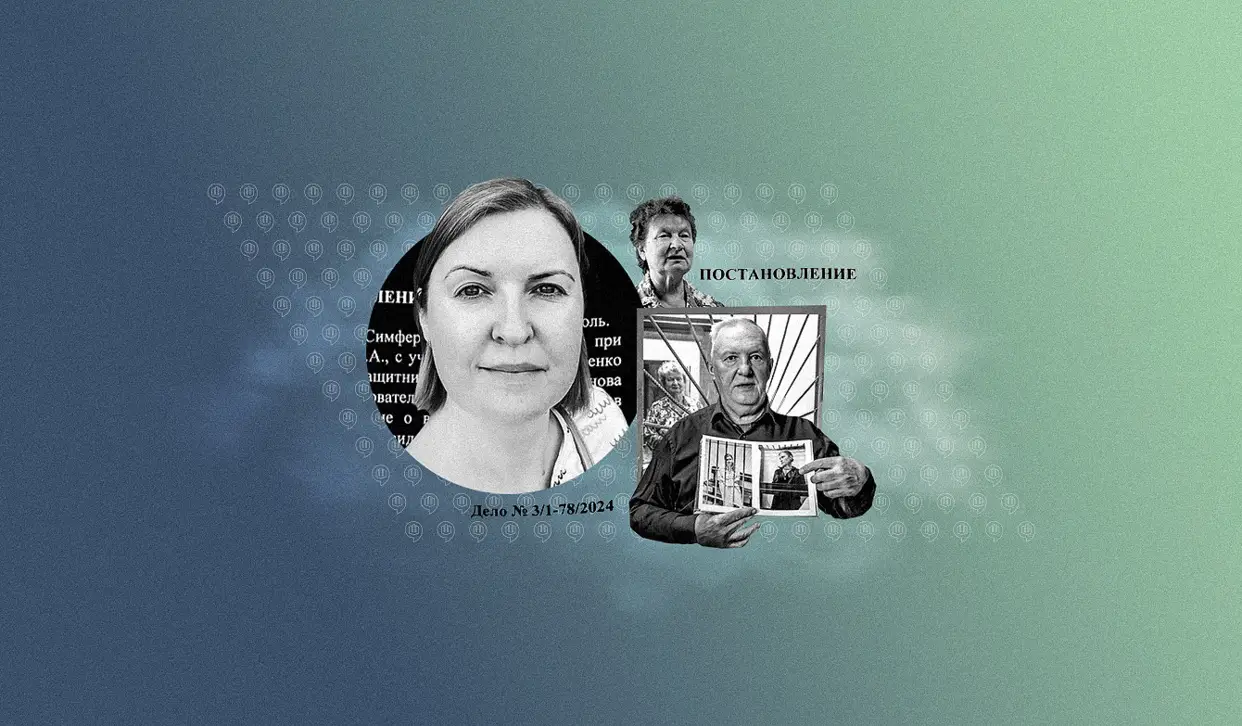
Mom, this is for me. The story of Iryna Gorobtsova, a volunteer from Kherson, who has been held hostage by the occupiers for over two years
Source: Signal to Resist
Author: Viktoria Novikova
“Hi, my dear Mom and Dad!... Your photos brought tears to my eyes, but they were tears of joy. All the girls in my cell said that you look much younger than your age and that you’re doing a great job!...»
The Gorobtsovs, Vladimir and Tatyana, read letters from their daughter Irina in their kitchen in Kherson. All the letters are written in Russian and signed “ZONATELEKOM, FKU SIZO-1 of the Federal Penitentiary Service of Russia,” because Iryna has been held captive in occupied Crimea for three years now.
The Russians brazenly took the 37-year-old woman from her home in the morning on her birthday—May 13, 2022. “They said they would bring her back that evening, but I felt that morning that I would never see my daughter again,” says Tetyana.
Since then, this heroine of the Kherson liberation movement—who saved city residents during the occupation—has become a hostage of the Kremlin and is now awaiting rescue from the basements of the occupiers’ prisons.
To uncover the details of Iryna Horobtsova’s tragic story, we spoke with her relatives and relevant officials in Ukraine.
“Resistance Headquarters”
“It happened here, in this apartment. See the view we have? You can see Chornobaivka and the ring road,” says Tetyana Gorobtsova, pointing to the view from the window, and continues: “They accused my daughter of counting the number of Russian military vehicles moving along the road and passing that information on to our side.”
Since the beginning of the occupation of Kherson, the Gorobtsovs have been attending anti-Russian rallies. But for the most part, Iryna and her mother drove their own car around Kherson and the nearby villages, doing volunteer work. Public transportation stopped running almost immediately, so the women began delivering medications to hospitals, bringing medicine to the homes of the seriously ill, and transporting doctors.
“We drove doctors from their homes to hospitals and back, just like a taxi,” Tetyana recalls.
During the occupation, Iryna was also active on social media, where she demanded the evacuation of “Azov” fighters from Mariupol and referred to her apartment as the “resistance headquarters.”
The Gorobtsovs’ kitchen is warm and cozy, filled with homemade treats. The couple always welcomes guests with open arms. But during the occupation, their home was filled with sadness and pain.
“Mom, this is for me”
The morning of May 13, 2022, was a festive one for the family; Iryna turned 37. A cake was waiting on the table. Suddenly, Iryna’s mother saw a minibus and several cars in the yard. Armed men in balaclavas poured out of the vehicles.
“I was just coming home, and I asked them, ‘What happened?’” says Iryna’s father, Volodymyr. “They replied, ‘We’re checking your documents.’”
At that moment, Iryna also saw the cars from the window and said, “Mom, they’re after me.”
Several Russians broke into the Gorobtsovs’ apartment and conducted a search. They found a Ukrainian flag. The men did not identify themselves, asked no questions, ordered Iryna to gather her documents, phones, and laptop, and took her with them.
Tetyana asked one of the Russian soldiers where she could find her daughter—he replied that she was at the military commandant’s office. The occupiers had established such bodies in the occupied Ukrainian territories to interact with civilians and control public affairs.
So, over the next few weeks, the couple visited every possible occupation authority in Kherson, trying to locate their daughter and find out what would happen to her.
The Gorobtsovs suspect that for the first few days, Iryna was held in the notorious torture chamber—the temporary detention center (ITT) on Teploenergetykiv Street. Only a few weeks after her unlawful detention did the couple accidentally hear that Irina had most likely been taken out of the region to an unknown destination.
“A decision regarding this individual will be made after the conclusion of the special military operation.”
Irina’s relatives continued their search for her every day. During the day, they went to the occupying authorities, and in the evenings and at night, they wrote and sent emails.
“I sent letters to Putin, Patrushev, and every possible Russian official,” recalls Volodymyr Gorobtsov.
In his appeals, Iryna’s father asked for clarification regarding his daughter’s situation and included her full details in every message. Suddenly, he received his first response from the FSB in Crimea.
Instead of Irina’s name, the letter referred to her as “the person in question,” and instead of explaining where she was being held, it stated: “The person in question was obstructing a special military operation. The individual has been detained and is being held in accordance with the requirements of current legislation. A decision regarding the specified individual will be made after the completion of the special military operation.”
That’s how her parents realized that Irina was in Crimea, and at the end of July 2022, they set off for the occupied peninsula on a whim.
“We had no idea where to go or who to turn to; we just went to the FSB office in Simferopol, then to the pretrial detention center, but we didn’t get anywhere,” says Volodymyr.
A little later, with the help of volunteer lawyers in Crimea, her parents confirmed that Iryna was being held in one of Simferopol’s pretrial detention centers. In fact, she was initially held in Pretrial Detention Center No. 1 in solitary confinement, which is also a form of torture.
“During those first few months, Irina read over 80 books,” says Volodymyr.
It was from there that Irina wrote her first letter from prison, in which she stated that she was not being tortured.
Five months later, in October 2022, Iryna was transferred to Pretrial Detention Center No. 2, where she spent 17 months of her life. During this entire time, even under Russian law, she did not have official detainee status.
“In fact, she was kept ‘in the dark,’” say Irina’s parents.
Her relatives received neither official written confirmation of the charges against her nor any information on how to contact her. At the same time, Iryna was unable to hire a private defense attorney. The Russians offered her a free public defender, who performed his duties in a purely formal manner.
Yuriy Belousov, head of the Department for Combating Crimes Committed in the Context of Armed Conflict at the Office of the Prosecutor General of Ukraine, asserts that this Russian practice regarding Ukrainian hostages is standard in the Russian-Ukrainian war:
“The occupiers tell the detainee: ‘No one knows where you are. No one knows what’s happening to you here. I can do whatever I want with you.” And that is exactly why they hide their hostages—so that no one sees them or knows where they are. The Russians believe they will not be held accountable for this.”
At the end of March 2024, Iryna was transferred back to Pretrial Detention Center No. 1. Only then was a so-called criminal case opened against her on suspicion of espionage, effectively legalizing her arrest and detention under Russian law. Court hearings began, and an illegitimate judge issued a ruling imposing pretrial detention as a preventive measure.
Criminal investigators from the Russian Federation also formulated an official charge against Irina: “[...] she is suspected of, during the period from February 24, 2022, to March 15, 2022, in the Kherson region […] while opposing the special military operation […] under the pretext of patriotism, she was recruited—using the pseudonym ‘Alaska’—to engage in confidential cooperation with the Main Intelligence Directorate of the Ministry of Defense of Ukraine…”
A Sea of Flowers
Pretrial Detention Center No. 1 in Simferopol is overcrowded with Ukrainians. Since 2014, this detention facility run by the occupying authorities in Crimea has been widely known in Ukraine, as it held film director Oleg Sentsov, journalists, and human rights activists.
In 2022, Ukrainians in the occupied territories mounted a resistance that the Russians did not expect. As a result, the facility was expanded, adding more than 400 additional detention spaces.
Iryna is currently in a cell with six women ranging in age from 17 to 40. All of the unlawfully detained women are Ukrainian; all are suspected of espionage under Article 276 of the “Criminal Code of the Russian Federation”—the criminal code of the aggressor state.
However, Gorobtsova is one of the few who has received a so-called sentence in her unlawful criminal case. On August 15, 2024, the so-called Kherson Regional Court in occupied Simferopol sentenced her to 10.5 years in prison. Iryna will not be able to obtain prisoner-of-war status and, as a civilian, remains a hostage. Under international humanitarian law, civilian hostages are not subject to exchange, but only to unconditional repatriation.
Yuriy Belousov emphasizes that, in addition to a host of war crimes against civilians, the violation of the right to a fair trial is particularly egregious in such cases:
“The European Court of Human Rights and the European Committee for the Prevention of Torture have consistently stated that three rights must be guaranteed to a detained person: the right to legal representation, the right to medical care, and the right to communicate with the outside world. She has had no contact with the outside world for three years, and her right to legal representation has not been ensured. As for medical care, one can only imagine what kind of medical care that might have been. The mere fact of this already calls into question any verdict regarding this person.”
Iryna currently remains in Simferopol, but very soon the occupiers may deport her to a prison colony deep within the Russian Federation.
Gorobtsova continues to correspond with her parents from captivity; her letters are decorated with flowers. A relative of one of the girls in the cell gave them colored pencils and markers. The women color in ZONATELEKOM forms, showing their families their incredible strength of spirit and hope for release as soon as possible.
“We play chess with her,” says Irina’s father. “We make one move in each letter; we’ve already made three.”
During the “sentencing” in the summer of 2024, Irina was filmed in the courtroom of the so-called Kherson Regional Court in Simferopol. The Russians published the video for their propaganda purposes.
“She looks better now,” notes Tetyana Gorobtsova. “We’re trying, through volunteers, to send her packages with food and medicine as much as possible. For her, for all the girls. In that cell with the flowers.”
***
The Ukrainian Ombudsman’s Office and the Coordination Headquarters for the Treatment of Civilian Prisoners, which deal, in particular, with the return of civilian hostages, are practically powerless against the will of the Russians.
“We know about all the girls, and about thousands of other civilian hostages, and we are preparing everything necessary for their return. We are also prioritizing the return of women in particular. However, the Russians simply won’t release them,” notes a source from the Coordination Headquarters on condition of anonymity.
The procedure for repatriation—the unconditional return of civilian hostages—is not provided for under international law, as it requires the immediate return of a person to the territory of their citizenship. At the same time, the Russians continue to commit war crimes on occupied Ukrainian territory: they abduct civilians, illegally convict them, and hold them on their territory under horrific conditions.
Based on these facts, Ukrainian law enforcement agencies have registered 4,136 criminal cases since February 24, 2022. The highest number—over a thousand—is in the Kherson region. And behind each of these cases lies fear, despair, sorrow, and pain—but also the will to live, the thirst for justice, and the steely resolve of every Ukrainian.
This text was prepared in collaboration with The Reckoning Project (The Reckoning Project)—a global team of journalists and lawyers dedicated to documenting, reporting on, and collecting evidence for the investigation of war crimes—specifically for Signal to Resist.
Author: Viktoria Novikova
“Hi, my dear Mom and Dad!... Your photos brought tears to my eyes, but they were tears of joy. All the girls in my cell said that you look much younger than your age and that you’re doing a great job!...»
The Gorobtsovs, Vladimir and Tatyana, read letters from their daughter Irina in their kitchen in Kherson. All the letters are written in Russian and signed “ZONATELEKOM, FKU SIZO-1 of the Federal Penitentiary Service of Russia,” because Iryna has been held captive in occupied Crimea for three years now.
The Russians brazenly took the 37-year-old woman from her home in the morning on her birthday—May 13, 2022. “They said they would bring her back that evening, but I felt that morning that I would never see my daughter again,” says Tetyana.
Since then, this heroine of the Kherson liberation movement—who saved city residents during the occupation—has become a hostage of the Kremlin and is now awaiting rescue from the basements of the occupiers’ prisons.
To uncover the details of Iryna Horobtsova’s tragic story, we spoke with her relatives and relevant officials in Ukraine.
“Resistance Headquarters”
“It happened here, in this apartment. See the view we have? You can see Chornobaivka and the ring road,” says Tetyana Gorobtsova, pointing to the view from the window, and continues: “They accused my daughter of counting the number of Russian military vehicles moving along the road and passing that information on to our side.”
Since the beginning of the occupation of Kherson, the Gorobtsovs have been attending anti-Russian rallies. But for the most part, Iryna and her mother drove their own car around Kherson and the nearby villages, doing volunteer work. Public transportation stopped running almost immediately, so the women began delivering medications to hospitals, bringing medicine to the homes of the seriously ill, and transporting doctors.
“We drove doctors from their homes to hospitals and back, just like a taxi,” Tetyana recalls.
During the occupation, Iryna was also active on social media, where she demanded the evacuation of “Azov” fighters from Mariupol and referred to her apartment as the “resistance headquarters.”
The Gorobtsovs’ kitchen is warm and cozy, filled with homemade treats. The couple always welcomes guests with open arms. But during the occupation, their home was filled with sadness and pain.
“Mom, this is for me”
The morning of May 13, 2022, was a festive one for the family; Iryna turned 37. A cake was waiting on the table. Suddenly, Iryna’s mother saw a minibus and several cars in the yard. Armed men in balaclavas poured out of the vehicles.
“I was just coming home, and I asked them, ‘What happened?’” says Iryna’s father, Volodymyr. “They replied, ‘We’re checking your documents.’”
At that moment, Iryna also saw the cars from the window and said, “Mom, they’re after me.”
Several Russians broke into the Gorobtsovs’ apartment and conducted a search. They found a Ukrainian flag. The men did not identify themselves, asked no questions, ordered Iryna to gather her documents, phones, and laptop, and took her with them.
Tetyana asked one of the Russian soldiers where she could find her daughter—he replied that she was at the military commandant’s office. The occupiers had established such bodies in the occupied Ukrainian territories to interact with civilians and control public affairs.
So, over the next few weeks, the couple visited every possible occupation authority in Kherson, trying to locate their daughter and find out what would happen to her.
The Gorobtsovs suspect that for the first few days, Iryna was held in the notorious torture chamber—the temporary detention center (ITT) on Teploenergetykiv Street. Only a few weeks after her unlawful detention did the couple accidentally hear that Irina had most likely been taken out of the region to an unknown destination.
“A decision regarding this individual will be made after the conclusion of the special military operation.”
Irina’s relatives continued their search for her every day. During the day, they went to the occupying authorities, and in the evenings and at night, they wrote and sent emails.
“I sent letters to Putin, Patrushev, and every possible Russian official,” recalls Volodymyr Gorobtsov.
In his appeals, Iryna’s father asked for clarification regarding his daughter’s situation and included her full details in every message. Suddenly, he received his first response from the FSB in Crimea.
Instead of Irina’s name, the letter referred to her as “the person in question,” and instead of explaining where she was being held, it stated: “The person in question was obstructing a special military operation. The individual has been detained and is being held in accordance with the requirements of current legislation. A decision regarding the specified individual will be made after the completion of the special military operation.”
That’s how her parents realized that Irina was in Crimea, and at the end of July 2022, they set off for the occupied peninsula on a whim.
“We had no idea where to go or who to turn to; we just went to the FSB office in Simferopol, then to the pretrial detention center, but we didn’t get anywhere,” says Volodymyr.
A little later, with the help of volunteer lawyers in Crimea, her parents confirmed that Iryna was being held in one of Simferopol’s pretrial detention centers. In fact, she was initially held in Pretrial Detention Center No. 1 in solitary confinement, which is also a form of torture.
“During those first few months, Irina read over 80 books,” says Volodymyr.
It was from there that Irina wrote her first letter from prison, in which she stated that she was not being tortured.
Five months later, in October 2022, Iryna was transferred to Pretrial Detention Center No. 2, where she spent 17 months of her life. During this entire time, even under Russian law, she did not have official detainee status.
“In fact, she was kept ‘in the dark,’” say Irina’s parents.
Her relatives received neither official written confirmation of the charges against her nor any information on how to contact her. At the same time, Iryna was unable to hire a private defense attorney. The Russians offered her a free public defender, who performed his duties in a purely formal manner.
Yuriy Belousov, head of the Department for Combating Crimes Committed in the Context of Armed Conflict at the Office of the Prosecutor General of Ukraine, asserts that this Russian practice regarding Ukrainian hostages is standard in the Russian-Ukrainian war:
“The occupiers tell the detainee: ‘No one knows where you are. No one knows what’s happening to you here. I can do whatever I want with you.” And that is exactly why they hide their hostages—so that no one sees them or knows where they are. The Russians believe they will not be held accountable for this.”
At the end of March 2024, Iryna was transferred back to Pretrial Detention Center No. 1. Only then was a so-called criminal case opened against her on suspicion of espionage, effectively legalizing her arrest and detention under Russian law. Court hearings began, and an illegitimate judge issued a ruling imposing pretrial detention as a preventive measure.
Criminal investigators from the Russian Federation also formulated an official charge against Irina: “[...] she is suspected of, during the period from February 24, 2022, to March 15, 2022, in the Kherson region […] while opposing the special military operation […] under the pretext of patriotism, she was recruited—using the pseudonym ‘Alaska’—to engage in confidential cooperation with the Main Intelligence Directorate of the Ministry of Defense of Ukraine…”
A Sea of Flowers
Pretrial Detention Center No. 1 in Simferopol is overcrowded with Ukrainians. Since 2014, this detention facility run by the occupying authorities in Crimea has been widely known in Ukraine, as it held film director Oleg Sentsov, journalists, and human rights activists.
In 2022, Ukrainians in the occupied territories mounted a resistance that the Russians did not expect. As a result, the facility was expanded, adding more than 400 additional detention spaces.
Iryna is currently in a cell with six women ranging in age from 17 to 40. All of the unlawfully detained women are Ukrainian; all are suspected of espionage under Article 276 of the “Criminal Code of the Russian Federation”—the criminal code of the aggressor state.
However, Gorobtsova is one of the few who has received a so-called sentence in her unlawful criminal case. On August 15, 2024, the so-called Kherson Regional Court in occupied Simferopol sentenced her to 10.5 years in prison. Iryna will not be able to obtain prisoner-of-war status and, as a civilian, remains a hostage. Under international humanitarian law, civilian hostages are not subject to exchange, but only to unconditional repatriation.
Yuriy Belousov emphasizes that, in addition to a host of war crimes against civilians, the violation of the right to a fair trial is particularly egregious in such cases:
“The European Court of Human Rights and the European Committee for the Prevention of Torture have consistently stated that three rights must be guaranteed to a detained person: the right to legal representation, the right to medical care, and the right to communicate with the outside world. She has had no contact with the outside world for three years, and her right to legal representation has not been ensured. As for medical care, one can only imagine what kind of medical care that might have been. The mere fact of this already calls into question any verdict regarding this person.”
Iryna currently remains in Simferopol, but very soon the occupiers may deport her to a prison colony deep within the Russian Federation.
Gorobtsova continues to correspond with her parents from captivity; her letters are decorated with flowers. A relative of one of the girls in the cell gave them colored pencils and markers. The women color in ZONATELEKOM forms, showing their families their incredible strength of spirit and hope for release as soon as possible.
“We play chess with her,” says Irina’s father. “We make one move in each letter; we’ve already made three.”
During the “sentencing” in the summer of 2024, Irina was filmed in the courtroom of the so-called Kherson Regional Court in Simferopol. The Russians published the video for their propaganda purposes.
“She looks better now,” notes Tetyana Gorobtsova. “We’re trying, through volunteers, to send her packages with food and medicine as much as possible. For her, for all the girls. In that cell with the flowers.”
***
The Ukrainian Ombudsman’s Office and the Coordination Headquarters for the Treatment of Civilian Prisoners, which deal, in particular, with the return of civilian hostages, are practically powerless against the will of the Russians.
“We know about all the girls, and about thousands of other civilian hostages, and we are preparing everything necessary for their return. We are also prioritizing the return of women in particular. However, the Russians simply won’t release them,” notes a source from the Coordination Headquarters on condition of anonymity.
The procedure for repatriation—the unconditional return of civilian hostages—is not provided for under international law, as it requires the immediate return of a person to the territory of their citizenship. At the same time, the Russians continue to commit war crimes on occupied Ukrainian territory: they abduct civilians, illegally convict them, and hold them on their territory under horrific conditions.
Based on these facts, Ukrainian law enforcement agencies have registered 4,136 criminal cases since February 24, 2022. The highest number—over a thousand—is in the Kherson region. And behind each of these cases lies fear, despair, sorrow, and pain—but also the will to live, the thirst for justice, and the steely resolve of every Ukrainian.
This text was prepared in collaboration with The Reckoning Project (The Reckoning Project)—a global team of journalists and lawyers dedicated to documenting, reporting on, and collecting evidence for the investigation of war crimes—specifically for Signal to Resist.
This is an automatic translation generated by DeepL.