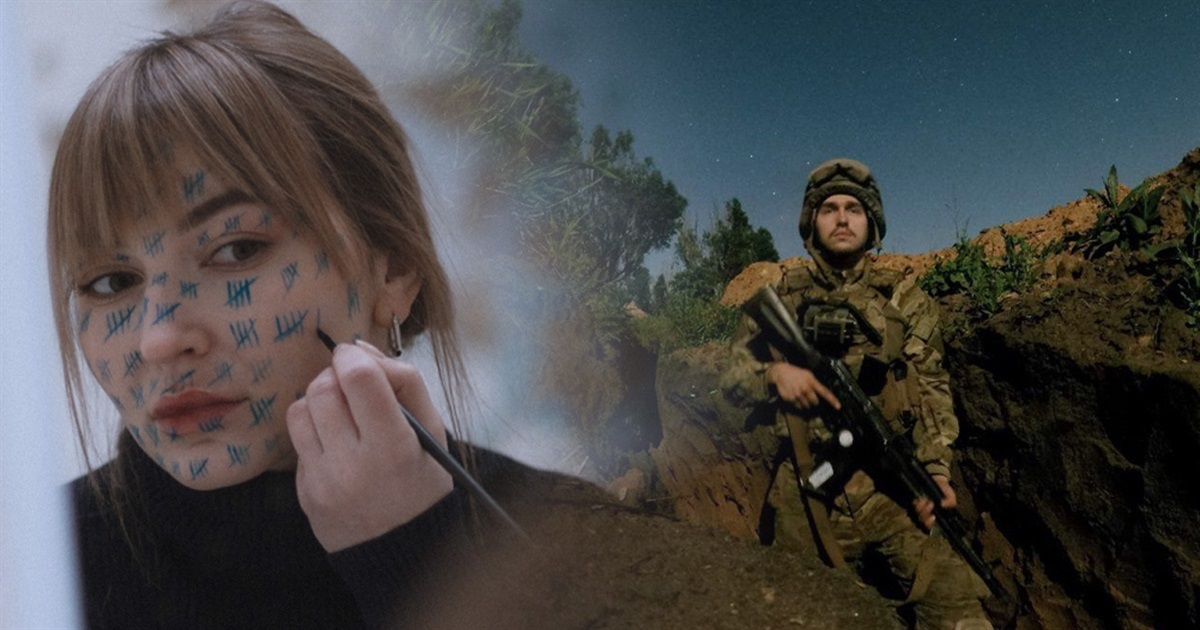
My “Einar” defended his hometown of Mariupol. I count the days, waiting for my beloved to return from captivity—it’s been 650 days already

Source: Svoi.City
Author: Hanna KURTSANOVSKA

Natalia and Dmytro met under sad circumstances—while organizing the funeral of Natalia’s brother, a paramedic with the “Hospitaliers” medical battalion and a volunteer with the 8th “Aratta” battalion. Mykola “Smurfik” Volkov was killed in action in April 2019. Mykola was an ultras fan of the “Mariupol” soccer club. “Smurfik” and “Einar” met in the stands during one of their favorite soccer club’s matches.

“We first spoke on the phone to sort out a few things. Then we met at Mykola’s funeral, and I gave Dmytro a few of his brother’s belongings. That’s how our friendship began. We messaged each other on social media; the only times we didn’t talk were when Dmytro was working or sleeping. He said that after his birthday—Dmytro was born on June 18, 1996; he’s now 28—he’d have a few days off and would come to Mariupol to see me. Dmytro and his comrades were on the Svitlodarsk Arc at the time.”

We met at the hospital
Natalia remembers that day in detail—on the night of June 7, 2019, they were messaging each other as usual, but suddenly he stopped responding. Natalia messaged a mutual friend, and it turned out that shelling had occurred and Dmytro had suffered a concussion. He and seven other soldiers, who sustained injuries of varying severity, were first taken to Chasovyi Yar and then to Dnipro. That night, during an artillery attack on Ukrainian Armed Forces positions near Novoluhanske on the Svitlodarsk arc, two “Azov” fighters were killed—Senior Lieutenant Dmytro “Krugly” Pruglo and Sergeant Maksym “Maksun” Oleksiuk.

“I bought a train ticket and went to Dnipro with some of his female friends. We spent the day together, and then I returned home to Mariupol. Then Dmytro wrote that they were being sent to Kyiv for treatment, so I went there too, and from there we traveled together with other wounded soldiers and their families to a sanatorium in the Poltava region. That’s how our real-life acquaintance turned out.”

Before the war, Dmytro was a soccer fan of his hometown club, “Mariupol.” In 2013–2014, he went through the “golden season,” meaning he attended all of the team’s matches—both home and away. One of the last matches in 2014 took place in early May in Crimea, which had already been occupied, and where harsh repression was already underway.

A tattoo on his leg commemorating the bloody rally in Donetsk
At the start of the Russian invasion of the Donetsk and Luhansk regions, Dmytro was already seriously interested in nationalism. He was 16 at the time. He couldn’t stand idly by while these events unfolded: in Mariupol, he and his friends tore down campaign posters and flags from the tents of the “Party of Regions.” Later, Dmytro and other soccer fans painted over separatist slogans and graffiti on the walls of buildings. This mostly took place at night. Around that same time, the first pro-Ukrainian rallies took place, along with clashes between supporters of opposing camps. They filmed everything on their phones and posted the videos on social media. Soon, SBU agents took an interest in Dmytro.

On March 13, 2014, Smurov traveled from Mariupol to Donetsk for a rally in support of Ukraine’s unity. Natalia says that was when her boyfriend got into his first real fight.

“At first, they were pelted with fireworks and eggs; then they had pepper spray sprayed in their eyes and were beaten. Someone attacked Dmytro with screwdrivers and nearly injured him. Later, he would get a tattoo on his left leg featuring two screwdrivers and the date of that rally.”

That day, the peaceful protest turned into a bloody massacre: non-lethal and firearms were used, and “Svoboda” activist Dmytro Chernyavsky was killed. And Smurov decided he had to go to the front to defend his hometown of Mariupol from the Russian invasion. He called the “Donbas” battalion, but they turned him down, saying he wasn’t old enough—he was 17 at the time. Although Dmytro was about to turn 18 in a month, he didn’t wait—he wrote to “Yadro,” a friend from his soccer crew who was already in “Azov.” On May 28, Dmytro had already arrived at the battalion’s base. Natalia says “Yadro” is considered missing in action in Mariupol.

She left Mariupol a few days before the invasion—Dmytro insisted
she do so. Natalia’s last meeting with Dmytro was on February 20, 2022. She recalls that there had been shelling near Mariupol the day before.

“I woke up to the explosions; Dmytro said it was about 15–20 kilometers from the city, and then he fell back asleep. But I couldn’t close my eyes until the explosions stopped. During the day, Dmytro read the news—both ours and the other side’s. He always followed their Telegram channels and then analyzed everything. He told me to pack an ‘emergency’ backpack; as always, I told him he was overreacting. But I started asking my friends what their husbands in the military were saying. I agreed with one of them that if her husband gave the “go-ahead” to leave the city, she would take me and my friend. But on February 20, our plans changed quickly: we met at a coffee shop, where our guys decided they would drive us out. We went home, quickly packed the essentials, and by that evening we were already in Dnipro.”

On February 23, Natalia and one of her friends were planning to buy train tickets and return to Mariupol, since nothing was happening. But the next day, Russian troops launched a full-scale invasion of Ukraine.

“I woke up to the sound of explosions nearby; my friend instinctively shielded me with her body. I immediately texted Dmytro; he told us to keep going, toward western Ukraine. Then he started sending me links to groups that help people leave the country. But we decided to stay in Dnipro and help however we could there.”

A store with “Smurf” stickers saved “Einar”
Dmytro and Natalia kept in touch until the end of February. But on March 1, contact with “Einar” was lost. The young woman recalls those days of uncertainty with horror, but she still doesn’t know what lies ahead for her.

“My friends—whose boyfriends and husbands were also in ‘Azov’—and I wrote to their comrades to find out at least something—whether they were alive or not. And this went on until April 18. Dmytro messaged from a comrade’s phone number, saying he was now at Azovstal and had been “on leave” due to his injuries, that he missed me and loved me, and that he also wanted to eat and wash up.

We exchanged a few more messages that day; I found out that he’d lost his phone. And Dmytro told me that a piece of shrapnel had flown into the magazine of his assault rifle—the magazine saved him by protecting his chest. You know what’s interesting—there were stickers on the magazine featuring my late brother, “Smurfik.”

Dmytro got in touch for a few more days in a row, but only for 10 minutes at a time. Then I received a text message from a different number asking when my birthday was and describing how they were treating his wound at the factory. For my birthday, the girls bought a bouquet from him with a card, but Dmytro didn’t even know about it. He found out when I wrote to him. His birthday greeting on April 29 was the best gift for me.”

In captivity, he thinks about our future
together On May 5, Dmytro wrote to his girlfriend—or rather, gave her tasks she absolutely had to complete. For example, to clean up her social media accounts. At the end, he added: “And I’ll write a little more later.” And then silence again. It wasn’t until after May 20 that “Einar” called Natalia and told her he was at the prison camp in Olenivka. By then, Natalia already knew that her beloved had been taken prisoner on May 18 along with some of his comrades after leaving “Azovstal.” In June, she received occasional text messages from Dmytro. But since July, silence.

“On September 18, my phone rang; the screen showed an unknown number. To be honest, I don’t answer calls from unknown numbers. But for some reason, I answered that day, and on the other end I heard:

‘Natalia, it’s me. I miss you, I love you so much. Wait for me, but I won’t be back soon.’ I only managed to say that I loved him too before the connection was cut off.”

In May 2023, during one of the prisoner-of-war exchanges, one of “Einar’s” comrades returned to Ukraine. He wrote to the girl that Dmytro had lost weight, but was holding up and keeping the others’ spirits high.

He also shared his thoughts on our future
together. In early February 2024, Natalia learned that Dmytro is currently in the temporarily occupied city of Donetsk.

A story of love and waiting captured in photos
Natalia recently took part in a photo shoot. It was organized by her fellow Mariupol native, photographer Kateryna Prokhoda. Before the full-scale invasion, Kateryna lived in Mariupol. Her house was located near the “Azov” base. In peacetime, Kateryna saw the soldiers every day—the same men who, after Russia’s attack, defended her hometown to the very end.

“I followed the news and worried about the soldiers’ fates, because among them are my friends and acquaintances. Some of them died while defending the city. Some are considered missing in action; others have spent 650 days in captivity. All the emotions that had built up inside me had to find an outlet. I wanted to do more than just photograph the women waiting for their loved ones to return from captivity; I wanted to use these photos to tell their painful stories. Through these photographs, I wanted to reach out to society and remind people of the defenders of Mariupol, who have been held captive for nearly two years.

I wanted anyone who saw these photos to feel the helplessness, loss, and despair—and to put themselves in the shoes of those who have lost family members or loved ones, or who live each day with hope in their hearts, waiting for their loved ones to return from captivity
. I came up with the concept and asked Natalia to bring the idea to life. We’ve known each other for a long time, and I know Dmytro as well. I know their story and how deeply they love each other. And Natalia agreed.”

Some of the photos from the photo shoot conceived by fellow countrywoman and photographer Kateryna Prokhoda | Photo: htovona/instagram
This photo story is about a tender young woman who has been waiting for many months for her “steel-hearted” boyfriend to return from captivity. The photos, which have gone viral on social media, are captioned: “I haven’t felt at home for almost two years, because my home is wherever you are. It’s been 650 days already. How many more days like this will there be? No one knows…”

This is an automatic translation generated by DeepL.