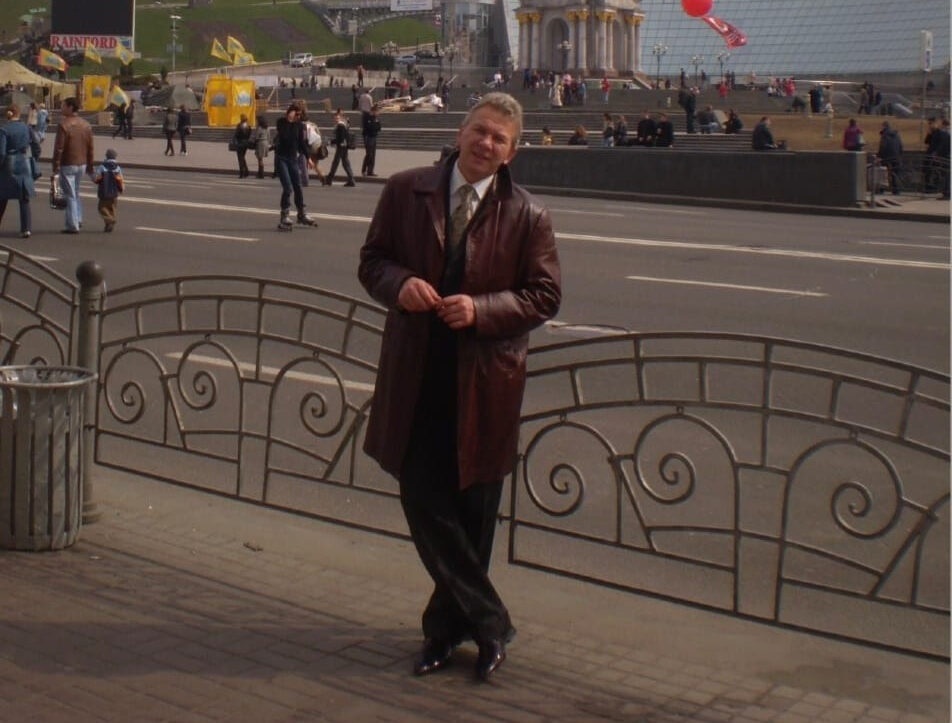
His father is slowly dying. Ihor Kiryanenko has spent six years in captivity with shrapnel lodged in his body—he was abducted in Donetsk
Source: Svoi.City
Author: Hanna KURTSANOVSKA
Rostyslav Kyryanenko shared his father’s story with Svoi. He says he wants to remind the authorities of the civilian prisoners who were taken captive by the Kremlin long before the full-scale invasion. Over the years, Igor Kiryanenko’s family has written hundreds of letters and appeals to officials at all levels, starting when Petro Poroshenko was still in power, and they continue to do so under President Volodymyr Zelenskyy.
A Difficult Childhood and Career
Choice Igor Kiryanenko is now 63 years old. He was born in Donetsk. Igor’s childhood was quite difficult, as his mother raised him and his brother on her own. His older brother has cerebral palsy. So Igor had to grow up very early, as his mother needed his support. At age 14, he started working to help his family: he unloaded train cars on the night shift alongside adult men.
After ninth grade, Igor enrolled in the Donetsk Medical College. Rostislav says this was a conscious choice, because his father liked to be of service and do something meaningful for society, and most importantly—to be able to help his loved ones at any time.
“During his student internship at the Kalinin Hospital, a young woman who had been poisoned was brought to the intensive care unit by ambulance. Her condition worsened every day, and my father was by her side during all his work and free time, trying to save her. But despite all his efforts, unfortunately, the girl died because the poison was extremely toxic. This had a profound impact on my dad, and he decided to enroll in medical school to continually improve his knowledge and skills and to help people.”
Igor Kiryanenko graduated from medical university with a degree in dentistry and worked at the dental clinic in the Proletarsky District of Donetsk. Later, he started his own business related to electronic medical equipment.
He would climb out the window and run to a streetlight to read books
His relatives remember him as a family man.
“Before the occupation of Donetsk, our large family would always get together for Christmas, even though my brother and I had left the city long ago. We could visit for other holidays as well, if we had the opportunity and desire, but spending Christmas with the family was a must. Grandma would come from Horlivka, and our other relatives would visit. My father started this tradition, and it’s now a part of my family as well. I’m very grateful to my father for his constant support and for helping us with both words and deeds.”
Rostyslav recalls that their home was always full of friends, some of whom he’d known since his college days. And they all speak of Igor Volodymyrovych as a kind, caring, and responsible person. He also had a thirst for knowledge from childhood.
“My grandmother told me that he loved to read, but there weren’t many books during his childhood. Later, my father told me that during the Soviet era, it was quite difficult to find books, but they could be exchanged for waste paper. My father would turn in newspapers and magazines, and in this way, he would get rare editions that he would devour. That was during his teenage years. My grandmother also recalled that when my dad was little and she’d put him and his brother to bed, he’d climb out the window. I suppose my grandmother forbade him from reading at night, or perhaps there was no electricity back then—I don’t remember anymore. They lived near the medical school at the time, where my father would later study.
After climbing out the window, my father would walk to the university because the streetlights were on there at night. And he would stand under the streetlights and read books. My father always had this thirst for knowledge, for everything new. That’s why he had a large library. He was particularly interested in the history of Ukraine, especially his native Donetsk region. He also collected stamps and badges.”
He remained under occupation because of his sick mother and brother
When hostilities began in the spring of 2014, Kiryanenko did not leave for territory controlled by Ukraine, but he was forced to abandon his private business because he had to care for his paralyzed mother and his brother, who has a disability. The entire Kiryanenko family has always held a steadfast pro-Ukrainian civic and political stance. According to Rostyslav, although his father lived under occupation, he collaborated with Ukraine’s security services and carried out certain tasks.
Then, in late December 2018, he was abducted in downtown Donetsk by officers of the “Department for Combating Organized Crime of the ‘DPR’ Ministry of Internal Affairs” on suspicion of collaborating with the Security Service of Ukraine and spying for Ukraine. After putting a bag over his head, the militants took the elderly man away to an unknown location.
They tortured him mercilessly but forced him to sign a statement claiming he had fallen down the stairs
. It was only 10 days later that his family learned he was being illegally detained in one of the basements of “Izolyatsia.” Before the start of the Russian aggression, the workshops of the former insulation materials factory had housed a contemporary art center.
“My father was subjected to brutal torture: they electrocuted him, broke his ribs and fingers, damaged his kidneys, pulled out all his teeth with pliers, and kept him in inhumane conditions. His condition was so critical that the administration of the temporary detention center, where the militants had taken him after the torture, refused to admit him in such a horrific state. Only after he was forced to sign a document stating that he had no claims against the detention center’s administration—and attributing his condition to a fall down the stairs—was my father officially transferred there and left for approximately two weeks. He was never provided with medical care during that time.”
As a result of the inhumane torture and abuse, Igor Vladimirovich suffered a myocardial infarction and a stroke. For more than two years, he was held in the basement of the pretrial detention center in Ward 6, where tuberculosis patients were kept. As medical statistics show, two out of four forms of tuberculosis are incurable.
We sent medication to my father, but he did not receive
it there. On December 16, 2020, Igor Kiryanenko was charged with espionage on behalf of Ukraine under Article 321 of the Criminal Code of the self-proclaimed “DPR” and was sentenced to 12 years of imprisonment in a maximum-security penal colony. He is serving his sentence in the ninth unit of the Makiivka Penal Colony No. 32.
“After the prisoner exchange on December 29, 2019 (when 76 Ukrainians, mostly civilians, were released, including writer and journalist Stanislav Aseyev — Svoi), several of those released told me about my father’s condition—that he had begun losing consciousness several times a day, and that he was experiencing cyanosis of the extremities and severe swelling.
His health has been severely compromised by torture and starvation; my father has a history of serious chronic illnesses, including pancreatitis, diabetes, a pancreatic tumor, and others
Unfortunately, adequate medical care is not provided at the prison, and no medical examinations are conducted. Our family has repeatedly tried to send him medication, but not all of it reaches him. And without regular medication following his heart attack, my father’s symptoms of cardiovascular failure have been progressively worsening.”
Sustained shrapnel wounds during the shelling of the Makiivka prison
On August 31, 2022, the prison was shelled with “Grad” rockets—Igor Vladimirovich sustained severe shrapnel wounds to his back, legs, and buttocks. He was taken to Makiyivka Hospital No. 2. There, they did not remove the shrapnel but simply bandaged the wounds. That same day, despite bleeding—because Igor had a through-and-through wound in his thigh—he was sent back to the prison. It wasn’t until September 6, 2022, that the shrapnel was removed from his back at the penal colony. But some remained—in his thighs. Surgery was required to remove them, as the wound was deep and affected the sciatic nerve. After some of the shrapnel was removed, Igor was not kept in the medical unit but was sent back to the barracks. From then on, Kiryanenko had to make his own way—on crutches provided to him—to his dressing appointments despite his severe injuries.
“We’re very concerned about this because, in patients with diabetes, wounds containing shrapnel don’t heal—especially without qualified medical care. This is accompanied by a significant rise in body temperature, which will lead to gangrene in the thighs. My father could simply end up losing his legs.”
International agreements operate unilaterally: Ukraine adheres to them, but Russia does not
. On October 21, 1950, the Geneva Conventions on the Protection of War Victims officially entered into force. These international multilateral agreements, signed by 190 states—that is, nearly every country in the world—were aimed at protecting victims of armed conflicts. People understood that there must also be rules in war, and that the parties must abide by them. This understanding formed the basis of the Geneva Conventions.
“But Russia’s aggression against Ukraine has shown that international agreements and treaties can be easily torn up or violated as often and however one pleases. Russia’s violations of the Geneva Conventions can be documented by tens of thousands of facts and cases, and this was the case even before the full-scale invasion. And now it is even difficult to imagine the endless number of violations.”
According to the Geneva Conventions on the Protection of Civilians in Time of War, military actions against civilians, the sick, and the wounded are prohibited. Civilians must be repatriated unconditionally, especially those in critical condition. However, since 2014, these international multilateral agreements have been operating unilaterally: Ukraine adheres to them, while Russia does not.
In six years of captivity, he has not been visited by a single representative of humanitarian organizations
Representatives of the International Committee of the Red Cross, the UN, the OSCE, and other humanitarian organizations have not once visited the seriously ill civilian prisoner Igor Kiryanenko in six years.
“Since the start of the full-scale invasion, there have been nearly 60 prisoner exchanges, and more than 2,700 people have been released—including civilians—but nothing has changed for my father. He has lost a lot of weight—he’s just a skeleton covered in skin. He has a severe deformation of the lower part of his skull because his jaws have shifted out of alignment; his teeth were pulled out with pliers during torture. After visiting him at the prison colony, our relative was simply unable to recover from what she had seen. My father is slowly dying…”
Igor Kiryanenko’s family has reached out to everyone they could think of: Ukrainian government humanitarian, diplomatic, and other agencies, as well as the International Committee of the Red Cross, the UN, and the OSCE. But to no avail.
“We implore the most influential Ukrainian and international politicians, as well as those involved in prisoner exchanges, to do everything possible—and even the impossible—so that our family, too, may finally experience the long-awaited happiness we have yearned for over the years. Unfortunately, my father will never see his mother again—she passed away on September 4, 2019. She waited for her son to return from captivity until the very end…”
Author: Hanna KURTSANOVSKA
Rostyslav Kyryanenko shared his father’s story with Svoi. He says he wants to remind the authorities of the civilian prisoners who were taken captive by the Kremlin long before the full-scale invasion. Over the years, Igor Kiryanenko’s family has written hundreds of letters and appeals to officials at all levels, starting when Petro Poroshenko was still in power, and they continue to do so under President Volodymyr Zelenskyy.
A Difficult Childhood and Career
Choice Igor Kiryanenko is now 63 years old. He was born in Donetsk. Igor’s childhood was quite difficult, as his mother raised him and his brother on her own. His older brother has cerebral palsy. So Igor had to grow up very early, as his mother needed his support. At age 14, he started working to help his family: he unloaded train cars on the night shift alongside adult men.
After ninth grade, Igor enrolled in the Donetsk Medical College. Rostislav says this was a conscious choice, because his father liked to be of service and do something meaningful for society, and most importantly—to be able to help his loved ones at any time.
“During his student internship at the Kalinin Hospital, a young woman who had been poisoned was brought to the intensive care unit by ambulance. Her condition worsened every day, and my father was by her side during all his work and free time, trying to save her. But despite all his efforts, unfortunately, the girl died because the poison was extremely toxic. This had a profound impact on my dad, and he decided to enroll in medical school to continually improve his knowledge and skills and to help people.”
Igor Kiryanenko graduated from medical university with a degree in dentistry and worked at the dental clinic in the Proletarsky District of Donetsk. Later, he started his own business related to electronic medical equipment.
He would climb out the window and run to a streetlight to read books
His relatives remember him as a family man.
“Before the occupation of Donetsk, our large family would always get together for Christmas, even though my brother and I had left the city long ago. We could visit for other holidays as well, if we had the opportunity and desire, but spending Christmas with the family was a must. Grandma would come from Horlivka, and our other relatives would visit. My father started this tradition, and it’s now a part of my family as well. I’m very grateful to my father for his constant support and for helping us with both words and deeds.”
Rostyslav recalls that their home was always full of friends, some of whom he’d known since his college days. And they all speak of Igor Volodymyrovych as a kind, caring, and responsible person. He also had a thirst for knowledge from childhood.
“My grandmother told me that he loved to read, but there weren’t many books during his childhood. Later, my father told me that during the Soviet era, it was quite difficult to find books, but they could be exchanged for waste paper. My father would turn in newspapers and magazines, and in this way, he would get rare editions that he would devour. That was during his teenage years. My grandmother also recalled that when my dad was little and she’d put him and his brother to bed, he’d climb out the window. I suppose my grandmother forbade him from reading at night, or perhaps there was no electricity back then—I don’t remember anymore. They lived near the medical school at the time, where my father would later study.
After climbing out the window, my father would walk to the university because the streetlights were on there at night. And he would stand under the streetlights and read books. My father always had this thirst for knowledge, for everything new. That’s why he had a large library. He was particularly interested in the history of Ukraine, especially his native Donetsk region. He also collected stamps and badges.”
He remained under occupation because of his sick mother and brother
When hostilities began in the spring of 2014, Kiryanenko did not leave for territory controlled by Ukraine, but he was forced to abandon his private business because he had to care for his paralyzed mother and his brother, who has a disability. The entire Kiryanenko family has always held a steadfast pro-Ukrainian civic and political stance. According to Rostyslav, although his father lived under occupation, he collaborated with Ukraine’s security services and carried out certain tasks.
Then, in late December 2018, he was abducted in downtown Donetsk by officers of the “Department for Combating Organized Crime of the ‘DPR’ Ministry of Internal Affairs” on suspicion of collaborating with the Security Service of Ukraine and spying for Ukraine. After putting a bag over his head, the militants took the elderly man away to an unknown location.
They tortured him mercilessly but forced him to sign a statement claiming he had fallen down the stairs
. It was only 10 days later that his family learned he was being illegally detained in one of the basements of “Izolyatsia.” Before the start of the Russian aggression, the workshops of the former insulation materials factory had housed a contemporary art center.
“My father was subjected to brutal torture: they electrocuted him, broke his ribs and fingers, damaged his kidneys, pulled out all his teeth with pliers, and kept him in inhumane conditions. His condition was so critical that the administration of the temporary detention center, where the militants had taken him after the torture, refused to admit him in such a horrific state. Only after he was forced to sign a document stating that he had no claims against the detention center’s administration—and attributing his condition to a fall down the stairs—was my father officially transferred there and left for approximately two weeks. He was never provided with medical care during that time.”
As a result of the inhumane torture and abuse, Igor Vladimirovich suffered a myocardial infarction and a stroke. For more than two years, he was held in the basement of the pretrial detention center in Ward 6, where tuberculosis patients were kept. As medical statistics show, two out of four forms of tuberculosis are incurable.
We sent medication to my father, but he did not receive
it there. On December 16, 2020, Igor Kiryanenko was charged with espionage on behalf of Ukraine under Article 321 of the Criminal Code of the self-proclaimed “DPR” and was sentenced to 12 years of imprisonment in a maximum-security penal colony. He is serving his sentence in the ninth unit of the Makiivka Penal Colony No. 32.
“After the prisoner exchange on December 29, 2019 (when 76 Ukrainians, mostly civilians, were released, including writer and journalist Stanislav Aseyev — Svoi), several of those released told me about my father’s condition—that he had begun losing consciousness several times a day, and that he was experiencing cyanosis of the extremities and severe swelling.
His health has been severely compromised by torture and starvation; my father has a history of serious chronic illnesses, including pancreatitis, diabetes, a pancreatic tumor, and others
Unfortunately, adequate medical care is not provided at the prison, and no medical examinations are conducted. Our family has repeatedly tried to send him medication, but not all of it reaches him. And without regular medication following his heart attack, my father’s symptoms of cardiovascular failure have been progressively worsening.”
Sustained shrapnel wounds during the shelling of the Makiivka prison
On August 31, 2022, the prison was shelled with “Grad” rockets—Igor Vladimirovich sustained severe shrapnel wounds to his back, legs, and buttocks. He was taken to Makiyivka Hospital No. 2. There, they did not remove the shrapnel but simply bandaged the wounds. That same day, despite bleeding—because Igor had a through-and-through wound in his thigh—he was sent back to the prison. It wasn’t until September 6, 2022, that the shrapnel was removed from his back at the penal colony. But some remained—in his thighs. Surgery was required to remove them, as the wound was deep and affected the sciatic nerve. After some of the shrapnel was removed, Igor was not kept in the medical unit but was sent back to the barracks. From then on, Kiryanenko had to make his own way—on crutches provided to him—to his dressing appointments despite his severe injuries.
“We’re very concerned about this because, in patients with diabetes, wounds containing shrapnel don’t heal—especially without qualified medical care. This is accompanied by a significant rise in body temperature, which will lead to gangrene in the thighs. My father could simply end up losing his legs.”
International agreements operate unilaterally: Ukraine adheres to them, but Russia does not
. On October 21, 1950, the Geneva Conventions on the Protection of War Victims officially entered into force. These international multilateral agreements, signed by 190 states—that is, nearly every country in the world—were aimed at protecting victims of armed conflicts. People understood that there must also be rules in war, and that the parties must abide by them. This understanding formed the basis of the Geneva Conventions.
“But Russia’s aggression against Ukraine has shown that international agreements and treaties can be easily torn up or violated as often and however one pleases. Russia’s violations of the Geneva Conventions can be documented by tens of thousands of facts and cases, and this was the case even before the full-scale invasion. And now it is even difficult to imagine the endless number of violations.”
According to the Geneva Conventions on the Protection of Civilians in Time of War, military actions against civilians, the sick, and the wounded are prohibited. Civilians must be repatriated unconditionally, especially those in critical condition. However, since 2014, these international multilateral agreements have been operating unilaterally: Ukraine adheres to them, while Russia does not.
In six years of captivity, he has not been visited by a single representative of humanitarian organizations
Representatives of the International Committee of the Red Cross, the UN, the OSCE, and other humanitarian organizations have not once visited the seriously ill civilian prisoner Igor Kiryanenko in six years.
“Since the start of the full-scale invasion, there have been nearly 60 prisoner exchanges, and more than 2,700 people have been released—including civilians—but nothing has changed for my father. He has lost a lot of weight—he’s just a skeleton covered in skin. He has a severe deformation of the lower part of his skull because his jaws have shifted out of alignment; his teeth were pulled out with pliers during torture. After visiting him at the prison colony, our relative was simply unable to recover from what she had seen. My father is slowly dying…”
Igor Kiryanenko’s family has reached out to everyone they could think of: Ukrainian government humanitarian, diplomatic, and other agencies, as well as the International Committee of the Red Cross, the UN, and the OSCE. But to no avail.
“We implore the most influential Ukrainian and international politicians, as well as those involved in prisoner exchanges, to do everything possible—and even the impossible—so that our family, too, may finally experience the long-awaited happiness we have yearned for over the years. Unfortunately, my father will never see his mother again—she passed away on September 4, 2019. She waited for her son to return from captivity until the very end…”
This is an automatic translation generated by DeepL.