"A Lesson I Paid For" – Mykhailo Vershinin. A Story of War and Captivity

Source: Frontliner
Author: Andriy Dubchak

“I think this workout is here to stay. We’ll still have time to work out everywhere, and based on that, the simple and most important thing is—if we don’t train, we’ll all die! This applies to everyone!”


“A Lesson I Paid For” – Mykhailo Vershinin. A Story of War and Captivity
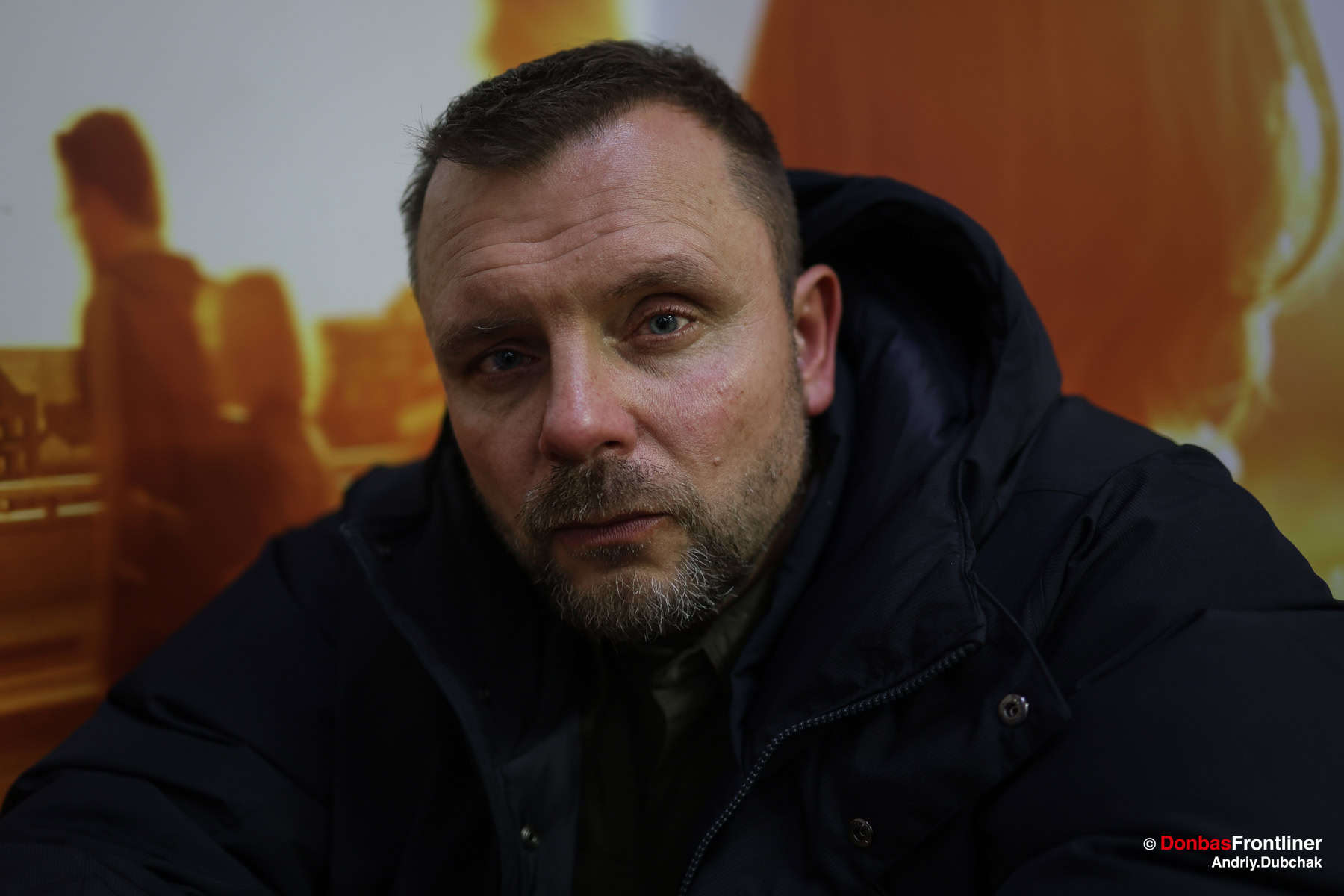
Mykhailo Vershinin during a conversation at a gas station near Dnipro, December 23,
2022 Upon his release from captivity, he was given a weapon and other “tactical goodies.” After all, all his previous possessions had been left behind in Mariupol, which he defended to the very end. Mykhailo Vershinin, better known as “Kit,” is the chief of the Mariupol patrol police; in the past, he was a volunteer with the “Right Sector”; and even further back, he was an entrepreneur from Donetsk. 

He was at Azovstal, then in Olenivka, and later in the Donetsk pretrial detention center. After that “vacation,” he underwent a long course of treatment and rehabilitation in Kyiv.

Andriy Dubchak spoke with Mykhailo Vershinin in Mariupol shortly before Russia’s full-scale invasion. He notes that during their conversation, Mykhailo almost entirely predicted everything that would happen to the city in the coming months. Part of this can be seen in his joint report with the NYTimes: https://youtu.be/0ilKQRXySg8?t=206

Donbas Frontliner spoke with Vershinin about how to talk about prisoners of war without causing harm, what former prisoners of war themselves should avoid doing, and the importance of training for everyone.

“If we don’t train, we’ll die”
I’m doing my absolute best to recover. I’ve already gathered 90% of my gear—equipment I didn’t have at all at first, since I left wearing sneakers, pants, and a T-shirt. I realized I needed everything I had in Mariupol, and I had a ton of stuff. If something were to happen now, I’m not quite ready at this stage, but I can already get moving. I have clothes to wear and weapons to shoot with. And I feel pretty energized. 

I haven’t gotten the go-ahead from the doctors yet, but I’ve come to realize that I can do physical exercises, so I went to my instructor, who trained us back in ’14–’15. And now he leads a group of, let’s say, motivated people who have the means and don’t want to sit on the sidelines. Every Saturday and Sunday, they go to the shooting range, and the sessions there are very dynamic—it’s not just “shooting for the sake of it,” but all kinds of scenarios are played out, and briefings are given. And I’m going through everything I remember all over again. We’re firing rockets and things like that; if you don’t have respect for weapons, if there’s no culture around handling them… it’s like riding a bike. You learned to ride once, and you’ll learn again, but you can do it with finesse, or you can just get around. I want everything to be done with finesse. That’s why I train constantly. Every day I train with the “AR” to work on my mechanics and motor skills. Because a “Kalash” is a “Kalash,” but an “AR” is a different kind of weapon—it requires a different level of skill. I have an HM Defender, an “American.” By the way, it was a gift when I was discharged, and I’m seriously—so damn grateful for that gift!

My commanders also did a lot to get me discharged. And after I was discharged, they helped me out a lot. We have several combat teams in our patrol that are currently operating on the front lines. The teams are well-coordinated, trained, and prepared, and they’re doing a solid job. I hope there’ll be work for me, too.

I think this action is here to stay. We’ll still have time to get out and about everywhere, and based on that, the simple and most important thing is—if we don’t train, we’ll all die! This applies to everyone. This applies to the patrol officers who are out on the streets right now and think they’ll never amount to anything—that they’ll just be cops—and it applies to civilians. Why do I respect these guys we train with? They’re people who have money. They could be out partying. They could have left the country. Instead, they buy themselves weapons—and believe me, really good ones! They train with very good instructors. If some kind of turmoil breaks out—whatever form it may take—there’s already a more or less coordinated unit that can carry out its missions. And this includes those operating “under the wing” of the patrol police.

Mykhailo Vershinin on preparing the civilian population – https://youtu.be/TGKZ62u7FOE

Minimize media coverage of captives

Under no circumstances should either the media or prisoners, upon their release from captivity, be allowed to tell heroic stories. “I beat up the Russians there, and I’ll keep beating them up and cutting them down,” and all that. Any information is monitored. I understand that such things may boost morale, but let that be done by people from combat units who haven’t been in captivity. And when a prisoner is released, they watch what he does as he walks out, and then they really lay into the guys there. They’ll show them videos of former prisoners of war making statements like: “Look, you’ll get out just like that, and you’ll say you’re going to cut us up! You won’t get out like that!” The person conducting the interview and the person being released from captivity—they have to think!

Olenets was like a pioneer camp compared to Donetsk. In other words, they were actually taking me there to be killed. Precisely because I turned out to be a media figure. That doesn’t play out very well. Of course, we have to raise these issues; people need to be remembered. But I’d prefer it if they did it—you know how? In a general way. Like, “our prisoners of war.” But you can’t turn someone into a hero. That raises their profile, and we need to keep the person as safe as possible. 

It’s better for international organizations to put pressure on the “Red Cross” so that the “Red Cross,” using its resources, can reach out to the Russians and confirm that this person is being held captive. As soon as he falls under the jurisdiction of the “Red Cross,” there are at least some guarantees that he won’t be beaten to death.

A guy died in our cell—he burned to death—because he wasn’t given medical care. And one of the reasons they didn’t provide help was this remark: “Just look at what your scum are doing to our city!” “A kid is dying here!” “Let him die! Because your people shelled the city, a little girl was killed,” and all that. And he firmly believes that our people shelled the city, that a little girl died, so I’ll kill you here because you’re my prisoner, and I have power over you.

Our group was released—215 people. Rarely did anyone shout about how we were tortured, destroyed, and all that—that’s wrong. It wasn’t allowed. I’ll say that it wasn’t easy there. But I won’t go into details. Because it’s unnecessary. We have their people here as well. It’s wrong to think that they aren’t interested in anyone who’s been captured by us.

Captivity as a Platform for Information Work
Zolkin is a blogger who’s trying to bring attention to the issue of prisoners of war. He talks with them. But it shouldn’t just be Zolkin—there should be a dozen “Zolkins”… If they won’t make contact—okay, come to the prison camp and please show us the conditions in which they’re living. And I’ll tell you later what conditions I lived in. How long I slept on the concrete, what I slept on while on the concrete, why I got sick, why I nearly died. When I arrived, the doctor told me, “If we hadn’t pulled you out, you would have died in two days.” I had an advanced frontal sinus infection—all this pus between my brain and my forehead. They had to operate on my skull; they drained it, removed it, and then removed it a second time. It was a miracle I pulled through. And this despite the fact that I’d never had a sinus infection or sinusitis in my life—nothing!

We need to keep bringing these issues to light. A great topic—“Russians, surrender! They’re waiting for you!” How was this topic completely shut down? First, by a failure in public information. And second—the killing of that guy, the convict who was beaten to death with a sledgehammer. That was it; the topic was closed. Now nobody even talks about it anymore. But that shouldn’t be the case. There needs to be a concerted effort to show: look, we’re keeping prisoners of war in decent conditions. We accept them. I understand the guys who don’t want to take prisoners. But by killing an enemy instead of taking him prisoner, he’ll end up killing one of his own who’s over there.

Mykhailo Vershinin on prisoners of war, the prisoner exchange fund, and the Ukrainian struggle – https://youtu.be/jGoqRdzPjq0

While we were there, all sorts of rumors were circulating. One rumor was that Zelenskyy had said Azovstal would be featured on the 200-hryvnia bill. That July 26 would be designated “Azovstal Defenders’ Day”. There was a rumor that Zelenskyy had said there would be 10,000 hryvnias for every prisoner of war. We were thrilled. For one simple reason: so the guys could “rake it in.” But no one is doing that. And accordingly, as long as no one is doing that, expecting a “all-for-all” exchange… There would have to be a lot of them here! That’s the first thing.

Second. Someday, this scumbag will return home through a prisoner exchange once the war ends. This is our weapon for the future. Or we’re conditioning them now so that when he gets there, he’ll feel like an idiot who fell for the propaganda, and that nothing here is as it seems, or he’ll arrive there feeling that, yes, of course not everything is so black and white, but they’re absolutely brutal over there! And what do we end up with? We end up with that same hostility for years to come. They need to understand that this is how it is here. We don’t care how it is where you’re from, but things here aren’t the way you’ve been told. We don’t have this, this, or this, and we need to emphasize that as much as possible. He’ll go back there someday. And that will be the best advertisement for Ukraine. Even now—those who weren’t taken prisoner, those who’ve returned from rotation—are already saying, “It’s insane!” They’ve got asphalt, for crying out loud!… They’ve got toilets, for crying out loud!… They’ve got microwaves and everything else!… And by bringing back all sorts of cool stuff from Ukraine—which they’re hoarding—that’s also advertising for Ukraine!

Don’t lose your sense
of self When you’re taken prisoner, it’s foolish to act like a hero who’ll shout “Glory to Ukraine!” during interrogations. That’s my personal opinion; it’s open to debate. You need to behave as calmly as possible. If you have the desire and the opportunity, craft your cover story in such a way that it does you the least harm. And you’ll consistently stick to that story—don’t say one thing today and something else tomorrow. Because that will only make things worse.

Now, if you understand this and believe in your cover story, you can run with it—go ahead and run with it. In other words, stay calm, even if you’re miserable. Don’t say you’re a cook or a driver, because that gives you away. Right now, in my opinion, cooks and drivers get beaten up more than anyone who isn’t a driver. Because in reality, if they’re taken prisoner, it’ll be all the cooks and drivers. And a guy who’s a real cook—he’s never actually held a weapon in his hands! He’d just brush it off! “Who are you?” “I’m a cook.” “Oh, come on! You’re all ‘cooks’ here, and everyone else too.”

And most importantly, try not to lose your inner self, your core. Because… well, they destroy you as a person. They turn you into a creature. I don’t know how to explain it. I felt that my loved ones were pulling me through, and I realized that I had a son—I had to try to make it back to them. I no longer believed I would make it out.

Mykhailo Vershinin on his mental state after returning from captivity – https://youtu.be/Uw5EOi7jrmk

My attitude toward God, faith, and religion has changed dramatically. I would never have changed what I knew before if I hadn’t been through Olenivka, if I hadn’t been through the pretrial detention center. For me, it was a lesson I paid for, and I’ve drawn my conclusions from it. And I’m completely at peace with those conclusions. I’ve resolved a great many issues in my relationship with higher powers that had previously been a bit off track.

And again, sublimation, sublimation… When you’re feeling really down, when there’s a hole in your head that you can’t fill—just push through it! Do squats! Do crunches! Run! Do pull-ups if you can. In Olenivka, when things were really starting to get to me, I started with light exercises—I needed to build up my arm after my injury; I got it back in shape in a month, and then I made the exercises about 10 times harder. In other words, when things got tough—I pushed myself even harder. It gets tough—even more! There were days when I did 3,400 sit-ups in a single day. 400 or 500 push-ups. Plus some number of squats. By exhausting your body, you tame your spirit. You build yourself up. It was a matter of not losing your mind…

Mykhailo Vershinin on captivity after the battles for Mariupol – https://youtu.be/nAHnyJrdkqk

And the next issue, which really bothers everyone—whether you like it or not—is the constant urge to eat. I’ve more or less calmed down about that now. It’s impossible to get food there. Or rather, it’s possible, but for me it was out of the question. You could get a double portion—in Olenivka. When you joined a work crew that was painting, whitewashing, and doing that sort of thing. There, you could also find cigarettes, tea, sugar… Well, all sorts of goodies. You’d go outside the barracks. You could be on duty—as the floor leader or the barracks leader… Oh, and there were the sanitation workers, too. The ones who cleaned the toilets. They took out the buckets. They were the ones who got double rations. I mean, they made their choice.

Or the second option. When you really, really want something sweet. Man, how I wanted it. You won’t get anything sweet. You just imagine a room like that in your head. As vividly as possible, with all the details—closing my eyes, I tried to imagine that I… not even imagine—I was eating it! It was all in my head. I’d pick a candy bar, a pastry, or something else. Preferably something you’ve actually eaten before, so you can draw on your memory of the taste as much as possible. Once you’ve “put” it in your head—yeah, your mouth starts watering like crazy, and that’s it… You even chew! In 20 minutes, your body says, “Oh, thanks, I’ve eaten!” It calms down. This doesn’t mean you’ll refuse it if someone brings it to you. But they won’t bring it to you. You and your brain have tricked the universe. It’s like you’ve already eaten. It works! But to do this, you really need to be in tune with your senses. It got to the point where it was funny—I remembered the taste of the pastries I used to eat when I was 10, back when I’d go out to get milk. It was still the Soviet Union; those pastries cost 22 kopecks each—custard-filled… I remembered the taste—of the pastry itself, of that stuff they drizzled on top, and the taste of the baked dough. And the thing I didn’t like: when the butter filling would freeze in the fridge and lose its flavor. So you had to let it thaw a little. I mean, I “ate” those pastries—I’d even forgotten what they looked like, but then I remembered them!

Yes, perhaps psychiatrists might find this point interesting. But I think it’s a wonderful topic. Kyrylo Nedria (“Cyborg,” Lieutenant in the Armed Forces of Ukraine, Head of the Department of Humanities and Psychology of Police Activities at the Dnipro State University of Internal Affairs. Trainer-instructor for the National Police and a number of international organizations. Candidate of Historical Sciences, Master’s in Political Science and Law—Ed.), and we spoke with him; he discussed this topic. I tried it, and it works. You can also use this to numb the pain. That is, you close your eyes, try to shift your focus, and block out the source of the pain, and sometimes it works. Well, it all depends, I suppose, on your level of training. It didn’t always work for me. Sometimes it was just too painful, and that was that.

Donetsk as an Aggravating Factor
At the beginning of my captivity, I didn’t really need to come up with anything. They knew I was the head of the patrol police… well, if they didn’t know, they would have found out very quickly. If I’d pretended to be a police officer, it would have gotten awkward later on. So when I went out, I kept two things in mind. First: I’m a police officer; I’m carrying out my police duties. What duties? Helping civilians. Ensuring security, convoys, “green corridors,” and everything else. And second… They don’t understand what the patrol police are. They do understand the “Patrol and Post Service”—PPS. In Russia, this is considered one of the lowest-ranking positions. When it comes to the PPS, they think these are people who can’t do any harm. So when they asked, “Patrol officer?” I’d say, “Yes, patrol officer.” “What’s that—‘patrol officer’?” I’d start to realize: Oh, this must be my chance. I’d say, “Well, it’s like what you have here—the Patrol and Post Service!” “PPS, you mean?” “That’s right. PPS.” “Ah… I see…” And they’d lose interest. So I didn’t really have a cover story. When they asked me, “What were you doing in 2014?” I tried not to say I was with the “Right Sector,” and I was right to do so. The Russians didn’t know there were tons of videos where I talk about the “Right Sector.” And when the “deniers” showed up, well, then I had to tweak my cover story a bit. But to the Russians, I’d say, “I was a volunteer.” 

“So you’re from Donetsk?!”—that’s yet another reason to get beaten up. Badly. “Your city’s been destroyed, and you… Ukraine,” whatever… Well, I explained it. Anyway, yes, I’m from Donetsk, and I don’t accept your “DPR.” “Why don’t you accept it?” I say: “Well, look. Let’s take the simplest example. Some drunk vandals came to my place, beat me up, and stole a bunch of stuff. How are you supposed to treat them?” “Why didn’t you go complain?” I say: “All right. I went to complain. Other people came. They said that the ones who came to me were tougher than the ones who came to me the second time. And they can’t do anything about them. What are you going to do?” “Yeah, right.” I said, “That’s why I went to Mariupol.”

That was until the “Dener” guys from the MGB showed up. And then it was all straightforward. I didn’t have to make any statements against myself. They just turned on the computer, pulled up a whole bunch of my interviews… where I talked about myself. I mean, they were actually preparing to give me a life sentence, but I think they were planning to take everyone out there. The vast majority of these 215 people were suicide bombers. That’s why they were the first to be taken out.

When interrogators see an intellectually capable person in front of them, it drives them crazy. I got into a few arguments, which I later regretted deeply. It seemed to me that the person was listening to me, understanding me, and taking me in. There’s no point in talking or arguing about anything. You just switch on the “plant”—and off we go.

There were 25–26 of us in the cell. People would come and go from time to time, and that was a source of information. We could listen to the TV in the convicts’ area or hang out there for a while. Because the convicts lived there… they had a TV, a computer, food… they didn’t eat “balanda.” They went out, got drunk. They treated us with the utmost hostility. In Donetsk, almost all the inmates are those who fought in 2014. They’d served time before, then fought in the war, and were put back in prison. I was taken in for questioning several times; I was held with a man accused of embezzlement. He was desperate to kill me. Because at first, “You’re a Ukrainian,” and then, “Oh, so you’re a cop too!..” And then, “Oh, and you’re from Donetsk, too!...”

Mariupol. Heroes and Not-So-Heroes
A bunch of questions about Mariupol. I hope that when the time comes, there will be answers. A lot of things are unclear to me. The rapid advance and encirclement, the mayor’s behavior—he just left on the 25th. Then he pretended to be in Mariupol from a basement in Zaporizhzhia. The commander of the 23rd Marine Border Guard Detachment. He spent a long time asking where to get fake documents, and then he left anyway, while his men were left behind! He told them, “Write leave requests, change into civilian clothes, and get out of here!” And there are many stories like this.

Mykhailo Vershinin on the fear of death in captivity and “bunker sickness” – https://youtu.be/dpw4-efvrjE

What happened in Mariupol—the exact same things were happening everywhere! In Volnovakha. In Kharkiv. In Popasna. Kherson is a whole other story. In my opinion, the most heroic people there were those “TRO guys” from Lilac Park. But again, these people simply died, and that’s it. It’s good that people found out about them. But how many others are there that no one knows about?

Two fighters—I’d really like to see something written about them. The 73rd Special Operations Center. After receiving orders from the person who took command following the death of their commander—to change into civilian clothes and leave—they laid down their weapons, changed into civilian clothes, and left. These two special forces soldiers were left on their own. Together with us, they took all the special forces’ weapons! An APC, a “Hummer,” a bunch of large-caliber machine guns, a 60-millimeter “NATO-standard” mortar with shells, and everything else. We took all of that, and then distributed it to the “Azov” fighters, who were really piling it on.

These are the people who died heroically at “Azovstal”—no one knows anything about them. Serhiy Ivanyushchenko and Denys Stuzhuk. Serhiy’s relatives say, “This can’t be true! He’s our brother! He was so clumsy!” And their clumsy brother did things like that!… He’d stand there and ride his quad bike while everything was exploding around him; people were afraid to go out to him with a radio to change the batteries. But he was filming and relaying information. “This can’t be true—my brother isn’t like that! He was always falling off his bike, and on his motorcycle he’d crash into a fence…” You know, a “clumsy oaf.” “He has poor eyesight, he wears glasses…” Yes! He wears glasses with lenses like these! But he got things done! And the other one—he’s a radio operator; I’ve never met radio operators like him! The kind who can make do with anything, under any conditions! But in war, it sometimes happens that specialists end up doing the work of ordinary fighters. The guys were killed.

There were only 14 of us police officers on the roster at “Azovstal.” There was a unit of Ministry of Internal Affairs veterans. Garustovich, who people love to pick on because he’s a “separatist.” Back in 2014, the separatists had even proposed Garustovich as the city’s police chief. They literally chanted: “Ga-rus-to-vich!..” So Garustovich gathered a group of police officers—veterans who had already retired. And with this group, he did the things that the cops who had fled the city should have been doing. They drove around helping people and kept watch on the buildings when the tanks rolled in. His guys got wounded…

Mykhailo Vershinin on the National Police insignia – https://youtu.be/8bEUqcB_mMw

Police officer Sasha Skumin—he’s in Pokrovsk now. He was stationed at Azovstal, under shelling. At first, he served as a liaison between the police and the military. But then the police unit was decimated, and since I had direct contact with the military, he was no longer needed in that role. He could have left, but he stayed, getting caught in all the shelling and carrying people out. Right around the time I suffered a concussion, he was wounded—there was a direct hit on headquarters.

That location was most likely identified by the brigade commander of one of the brigades, who led his men in a sort of breakthrough attempt. And they told him: Don’t do this! The convoy commander said they’d leave at 12, but he left at 11 himself—and they blew him to pieces. The convoy saw that the brigade commander had driven off somewhere, so they followed him—they were also wiped out and taken prisoner.

The 501st Battalion was the first to surrender, on the battalion commander’s orders; that’s a whole other story. They were taken unarmed—they simply walked out to the separatists. This was the decision of the battalion commander, who had negotiated the terms. The 36th has a lot of good fighters. But unfortunately, the brigade, with a total of 2,500 men, was taken prisoner. The guys like to say that they surrendered on their own, but that’s not entirely true. Part of the unit surrendered on its own. Some found themselves in a situation where there was simply no point in resisting. “Bova,” one of the battalion commanders of the 36th, surrendered in exchange for sparing the wounded from being shot. He was released in the prisoner exchange with me, by the way. And they cursed him out like crazy over there! But he surrendered to prevent the hospital from being shot up. The hospital wasn’t shot up. Most people were held captive; some were exchanged, and some are still there. Yes, some people died. Because the first group to be released—the 501st and 36th—faced the harshest conditions by May 16–17.

“I want to go to Donetsk so I don’t lose the city mentally”
In Olenivka, they initially created truly greenhouse-like conditions! Not for everyone, though. They started pulling out prominent figures and tormenting them—the “Azov” fighters whose call signs were known. Well, nevertheless, for others, the conditions were more than just “greenhouse-like.” “Captivity,” “sunbathing”—it just doesn’t add up! We were getting sunburned just from the watchtower of the “guards.” So, there’s a watchtower; one of our guys pulls out a sleeping pad, lies down on a towel, and starts warming his belly, then one side, then the other… Yeah, the food was terrible. But we ate three times a day, and as far as I’m concerned, it was basically better than what we ate at Azovstal.

Militarily speaking, we don’t have enough forces to liberate Mariupol. We need to mobilize, train people, and get them weapons. And then we can “make some noise.” Right now, that’s only possible if certain political decisions are made. By and large, taking Melitopol would be difficult. We’d then cut off their little corridor. Things would get tough for them. And we’d push them back bit by bit, in small increments. We could keep pushing them back for years.

No matter what they say—“mobiki,” “chmobiki”… He gets about 300,000 rubles. That’s 150,000 hryvnias in our money. For that kind of money, especially coming from the backwaters, he’ll forget all about everything! He knows that if he gets lucky, in half a year he’ll buy himself a house and a Lada 9. That’s why they’ll keep coming, and they’ll keep fighting. And they’ll keep going to their deaths. Plus, those with their heads full of crap will think, “We’re defending the motherland there.” So first they seized it, then they said it was the “motherland,” and now they’re “valiantly” defending it. Don’t think that the “conscripts”—we’ll take them out with one hand! Go tell that to the guys in Bakhmut, or here in Mariupol, how we’re doing it “with one hand.” It’s the same in Mariupol! So, first the “cannon fodder” goes in, the “cannon fodder” gets wiped out, positions are exposed—they’re overrun, then more “cannon fodder”—and this goes on until they’ve completely wiped us out, until there’s physically no place left to defend ourselves. There’s nothing left—no basements, no trenches—everything’s been leveled! It’s called a “wall of fire.” That’s what happened in Mariupol. That’s what’s happening in Bakhmut.

I hate Russians, but I respect it when the enemy does something clever. There was an interesting incident in Mariupol when they started pretending in front of our troops that they were shooting at each other; our guys stood there dumbfounded, and at that moment a group moved in and seized part of the territory.

People were very scared. There are also patrol officers who defected to the enemy. There are so many cops—I wouldn’t have enough fingers to count them. They used to go on patrol, but now they’ve got assault rifles in their hands and are heading for the trenches! They thought it would be easy—but it won’t be easy. Now it’s time to fight.

I can’t answer the question of where I’d like to go back to. Mariupol—awesome! Donetsk—cool! Donetsk is a whole other story, a whole other kind of pain, and I’d really like to be in Donetsk when our guys move in there, because there’s going to be a lot of injustice toward the people of Donetsk. I need to get them out of there. Some of them are foolish, some aren’t, but there will be trouble. If level-headed people don’t go in there, we’ll lose Donetsk mentally for another hundred years.

Mykhailo Vershinin on the return of the occupied territories of Donbas since 2014 – https://youtu.be/OFRGOxoP74A

There are already a lot of problems there right now. But there are also plenty of people there who want to return to Ukraine. And I really don’t want the operation in Donetsk to take place without me.

Based on conversations with soldiers in the Kherson region, when they enter a village, the entire village runs away and starts snitching on one another. “He’s a separatist!” “No, he’s the collaborator!” “No, that one’s the collaborator!” “And this one gave them water!” “And this one gave them apples!” These are our people! I really don’t want us to lose these people.

This piece was created as part of the “Life in War” project with support from the Public Interest Journalism Lab and the Institute for the Humanities (Institut für die Wissenschaften vom Menschen).

This is an automatic translation generated by DeepL.