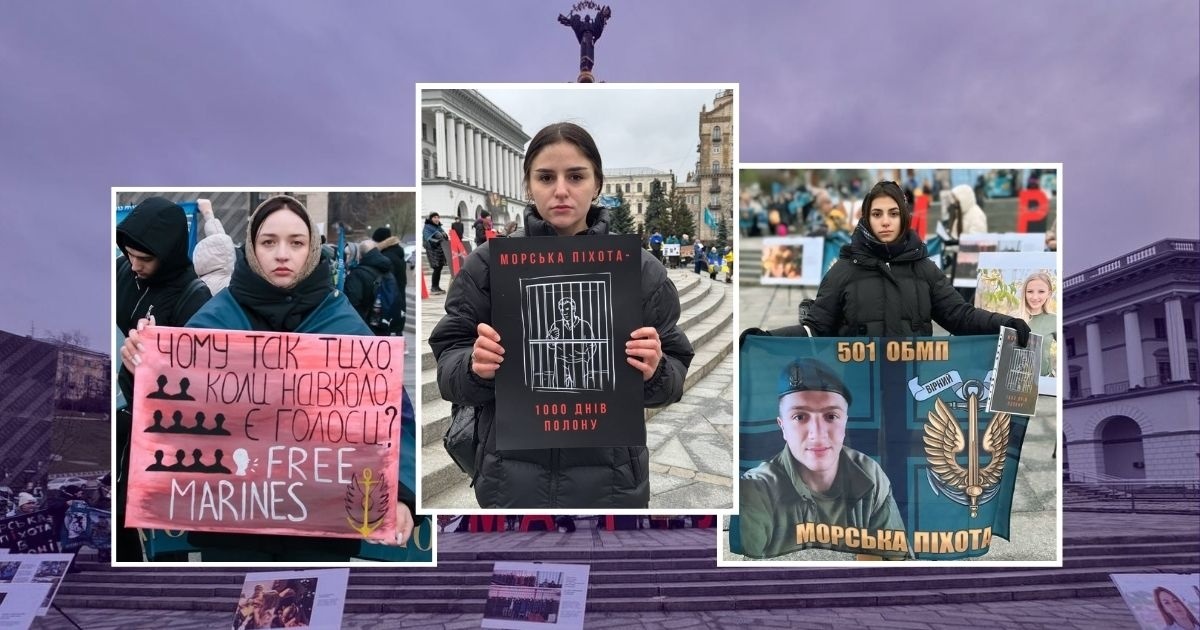
The Marines who defended Mariupol have been behind bars for 1,000 days. Their families continue to fight for them

Source: Svoi.City
Author: Hanna KURTSANOVSKA

It has been 1,000 days since the marines who defended Mariupol were taken prisoner. On January 6, on Independence Square in Kyiv, family members and friends of the captured marines—who have been held captive since April 2022—held a rally in their support. Our reporters spoke with the families of the captured Marine Brigade soldiers: Anastasia is waiting for her father Oleksandr to return; Karina dreams of hugging her older brother Valerii; and Alona longs to kiss her husband Andrii.

This event was organized jointly with the “Union of Ukrainian Marines” Charitable Foundation and the “Power of the Marines” Association. According to the Coordination Headquarters for the Treatment of Prisoners of War, nearly one in three prisoners is a Marine who fought in the battles for Mariupol.


His father’s legs are rotting, and he has contracted tuberculosis
Oleksandr Savov is 45 years old; he volunteered for the war back in 2015. His daughter Anastasia says that when the full-scale war began, her father was on rotation in Sector “M,” on the outskirts of Mariupol. Their family is from Mykolaiv, and that’s where the 36th Separate Marine Brigade was based, which began forming after the annexation of Crimea.

“We weren’t able to talk often. I remember a conversation on March 2—it was my birthday. My father wished me a happy birthday, and then we lost contact with him for a while. Later, I found out that he was at Azovstal with his comrades,” Anastasia said.

After Azovstal, Oleksandr Savov spent some time in Olenivka, then was transferred to Taganrog, and later to Kursk Pretrial Detention Center No. 1. After the Kursk operation began, he was taken to an unknown location.

“I’ve been advocating for prisoners of war since 2022, and I am currently the family coordinator for the nonprofit organization ‘Always Faithful 2022,’ a co-founder of the ‘Power of the Marines’ association, and the operations director at the International Charitable Foundation ‘The Price of Freedom.’ I regularly travel abroad to meet with international, governmental, and nongovernmental organizations, as well as military units. I help organize events to support and raise awareness about issues related to the rights of prisoners of war, missing persons, and civilian hostages, as well as to improve their conditions of detention and ensure compliance with the Geneva Conventions, among other things. “I also document cases of torture,” said Anastasia Savova.

In Mariupol, Oleksandr Savov did not sustain any serious injuries. But after he was taken prisoner, his daughter learned from the freed marines that his legs were rotting and that he had contracted tuberculosis.

“My father also has heart problems, but he had them even before the invasion, and his health deteriorated significantly in captivity without medical care,” says Anastasia.

My brother is like a ray of sunshine, and without him, my life is gray and empty
Karina Gladka is waiting for her older brother—28-year-old Valerii Klishch, a soldier in the 501st Separate Marine Battalion (OBMB). He has been serving in the Armed Forces of Ukraine since 2016, and he didn’t tell any of his family members that he was joining the army and signing a three-year contract. He first underwent training at the “Desna” center, and then fought in the ATO—in one of the “hot spots” in the east of the country.

“I was always so afraid for my brother’s life; I prayed constantly that everything would be all right with him. When Valerii came home on leave, I’d draw him pictures and write on a little note how much I loved him,” Karina shared.

Valerii constantly told his family that he enjoyed serving in the Marine Corps. He devoted a lot of time to sports, particularly weightlifting. According to Karina, her brother was always positive; no one ever had a bad word to say about him, and he was the kind of person who would always come to the rescue in any situation.

“In the summer of 2021, he took me, his wife, and our daughter and son to Berdiansk, where his military unit was stationed. I was so happy back then that I would be spending the whole summer with them. Every day, while waiting for him to return from duty, I would constantly look out from the balcony. Valera replaced everyone for me; his support was incredibly strong. Because my parents worked a lot, he was the one who raised me and was always there for me. He always said, ‘Don’t give up; you have to be strong, just like your brother. You’re a Marine’s sister,’ Karina recalls.

On August 6, 2021, Karina left Berdyansk; that was the last time she saw her brother.

“He saw me off at the train station. We hugged each other tightly, and I started crying. My brother’s eyes were ‘glazed over’ too, but he held it together,” she said.

At the start of the full-scale invasion, Valerii Klishch was with his comrades in the village of Shyrokyne, near Mariupol. And then he was in the city itself, on the shores of the Azov Sea. Karina spoke with her brother on the phone only twice. She didn’t even ask how he was doing, because she knew it was hell out there. But Valerii said it himself: “Karyukh, it’s f***ed up here!”

On March 3, contact with him was lost. Through one of his comrades, she learned that her brother had lost his phone. Valery Klishch was stationed with his unit at the Ilyich Steel Plant.

“I asked them to take a picture of my brother and send it to me, but I never received the photos. Some time later, I came across a video in which I saw my brother and realized that they had been taken prisoner. At that moment, I was in a state of panic: what should I do, where should I go, who should I contact? This uncertainty is killing all of us—me, my brother’s wife, and our mother. The children often ask, ‘When is Dad coming home?’ And we don’t have an answer,” says Karina.

Valery Klishch has been held captive by Russia since April 4, 2022. Currently, his family knows that he is being held in one of the penal colonies in Mordovia.

“His fellow prisoner, who has already returned from captivity and was held in the same cell as my brother, said that he’s holding up well, sharing his food with others, and hasn’t lost hope that he’ll be home soon. We also know that conditions in the Mordovian prison are harsh: they are physically and mentally abused, aggressive dogs are set on them to bite them, they are shocked with electric currents, and they’re forced to stand for 15 hours without even being allowed to sit down for a moment,” she said.

Karina says her brother is like a ray of sunshine, and without him, her life has been gray and empty for a thousand days.

“As soon as news of an exchange comes out, I carefully look through the photos, searching for Valera. I wait—thinking he’ll call any minute now, but no… After every exchange, I feel so devastated, but I pull myself together and keep fighting to bring my brother home. I write to everyone who has influence over prisoner exchanges, I constantly attend rallies in support of the Mariupol defenders held as prisoners of war, and we remind people about our 501st Marine Battalion,” says Karina Gladka.

My husband is in a Mordovian prison camp—the conditions there are
the worst. Alona Skuybida came to Kyiv from the Poltava region, from Myrhorod. She is a co-organizer and host of the rally. Alona is waiting for her husband, Andriy Orla, to be released from captivity. He is 26 years old and a Marine in the 501st Marine Battalion. They are both from Berdiansk; that’s where they met and fell in love.

“We met in a pretty ordinary way—through mutual friends. Shortly before we met, Andriy joined the military. He said he’d wanted to do this as soon as he turned eighteen. He served, and I waited. My beloved was away from home for six, sometimes even nine, months at a time. Of course, the separation was hard on both of us. Phone calls and messages on social media helped us get by. But back then, I knew Andriy would be rotated out and would come home, whereas now there have been a thousand days of captivity and complete silence, which is slowly killing me day by day,” Alona said.

She says her husband loved his service and talked about it a lot. Even at home, when he was on rotation or on leave, his thoughts were still with his comrades.

“Of course, I wanted my husband to spend more time with me, but I always respected his choice to become a soldier and supported him in everything.”

Full-scale invasion: Alona was in Berdiansk, which had been occupied from the very first days, while Andriy was with his unit near Mariupol.

“I remember how Andriy wrote in early March that they were on the outskirts of the city, that they had nothing, and asked for help with supplies. I’ve been a volunteer since 2014, so I immediately found someone from Mariupol and started raising money at the same time. A few days later, I transferred the funds to this man—we hadn’t agreed on a specific amount—and asked him to buy everything the guys needed. He replied, ‘Right now in Mariupol, money is just pieces of paper; it has no value…’ But he promised to do everything in his power. And that’s when I realized that what was happening in Mariupol was far more horrific than what we were seeing on the news.”

Alona says that at the time, Andriy ordered her to leave Berdyansk as quickly as possible.

“But I’m a fighter at heart—I couldn’t abandon the people who were fleeing Mariupol and other towns and coming to us. So I started volunteering—helping out with food, clothing, and so on. And even at my own risk, I took part in protests in Berdyansk against the Russian occupation. But on April 1, I left my hometown because it had become too dangerous to stay there,” Alona said.

Andriy called his wife from Mariupol only once. It was at night, from an unknown number. He said he had a minor bullet wound in his shoulder blade. He also mentioned that there were no medicines at the Illich Plant, so he would wait a bit for the wound to heal a little before returning to duty. The call lasted less than a minute.

“I asked when he’d be able to call again, and Andriy said he didn’t know, because to get a signal, he’d have to go above ground and walk through almost the entire plant. And that’s dangerous, because there are enemy soldiers everywhere. But my beloved was still able to write on March 28, before leaving Berdiansk. He asked me to take care of our cat and to be sure to write as soon as we reached government-controlled territory. And at the end, he said he loved me very much,” she recalls.

On April 1, Alona made it to Zaporizhzhia and immediately wrote to her beloved, but he still hasn’t read that message. On April 4, the marines from the Ilyich Metallurgical Plant were taken prisoner by the Russians.

“Since then, a new chapter in our family’s story has begun—one that has now lasted a thousand days. A life filled with pain and faith. During this time, I’ve grown stronger; I hope Andriy can feel that as I fight here for his release. I only recently received a letter from him that he wrote last summer. And he received my letter, dated early 2023. I keep writing; I hope that my other letters will reach him too,” says Alona.

According to his released comrades, Andriy Orla was transferred from Ryazhsk on February 7, 2023, to a penal colony in Mordovia. That day was Alona’s birthday. This colony is located in the village of Udarnoye in the Zubovo-Polyansky District. According to former prisoners of war, the conditions there are the worst.

“I found out about all his transfers from fellow soldiers who had already been exchanged. There was very little information; the guy just said—‘Polyana No. 10’ penal colony.” “I spent five hours straight searching for the colony on maps and going through a pile of photos. I found it and was the first to report information about this colony to the Coordination Headquarters for the Treatment of Prisoners of War,” Alona noted.

According to Alona Skuybida, medical care is virtually nonexistent at that colony; half the inmates have tuberculosis, and, unfortunately, her husband has contracted it as well. They are not allowed out of their cells; they are confined there around the clock. When the Russian side returned the marines who had been tortured in captivity, some of them were from that very prison in Mordovia. They are extremely thin—you can see all their bones and ribs—and their skin is blue-purple in color. This is because Ukrainian prisoners of war in this colony are mainly fed cabbage boiled in water, which is considered “soup” there. It’s cold in the cells, and the prisoners aren’t given winter clothing.

“I can’t even imagine what it’s like for them in such inhumane conditions. I hope the guys have enough strength of spirit to survive their third winter in captivity. I want this nightmare to end for them as soon as possible so that all the families can finally be together. I dream of hugging my beloved husband. In his letter, Andriy wrote that I should kiss the cat; I want him to come home and give our pet a kiss,” Alona says hopefully.

Alona and Andriy were living together as a common-law couple. They kept putting off their wedding “for later” because they were sure they had plenty of time ahead of them.

“Back when Andriy was still in Mariupol, he wrote: ‘I proposed to you, but we never got married. And so, as soon as I get out of this hell, as soon as we see each other, we’ll have our wedding.’ He said that I was his motivation to hang in there and keep living, that I was his motivation to have children. And those words are like a light at the end of the tunnel for me; I’ve been living with those thoughts for all these thousand days,” said Alona Skuybida.

This is an automatic translation generated by DeepL.