“They were performing surgeries in basements while under fire.” How and why Russia is persecuting, attacking, and capturing Ukrainian medical personnel in violation of international law
Source: Grati
Author: Anastasia Moskvichova
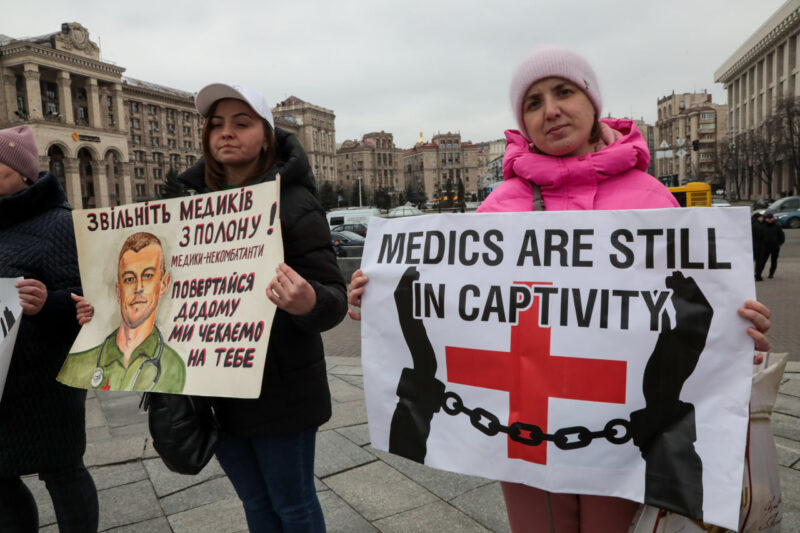
Under international humanitarian law, doctors are considered a protected category of persons. Attacks on medical infrastructure, as well as arbitrary detentions or persecution of medical personnel, constitute war crimes. Russia, however, according to human rights activists, takes civilian medical personnel hostage, tortures them, and kills them, while treating military medical personnel as combatants and taking them prisoner. According to the organization “Military Medics,” which brings together relatives of such captives, about half a thousand medical workers are currently being held captive by Russia.
“Grati” spoke with human rights activists and relatives of the affected doctors and reports on the situation.
“On April 11, he was awarded the title of Hero of Ukraine, and on the 12th, they were taken prisoner.”
For over two years now, Kyiv resident Viktoria Ivchuk has been waiting for her husband, Viktor, to be released from Russian captivity and fighting for his freedom. The nonprofit organization “Military Medics,” which she founded together with other relatives of the captured doctors, began as a group on Viber and is now officially registered, uniting 45 families awaiting the release of their loved ones, and about the same number whose relatives have already been able to return home.
Victoria’s husband—Viktor Ivchuk—is a colonel in the medical service and the commander of a military hospital in Mariupol. In March 2014, when Russia attacked, he was the chief medical officer of the 95th Separate Airborne Brigade. He took part in the liberation of Sloviansk and Kramatorsk in Donetsk Oblast, as well as in the battles for Savur-Mohyla, for which he received state honors: he became one of the first Ukrainian military medics to be awarded the Order of Bohdan Khmelnytsky.
“My husband was seriously wounded at that time, but despite that, he managed to evacuate dozens of other wounded soldiers. After his injury, he could no longer serve in the airborne troops. So, due to his health condition, he was transferred, and he later served as deputy chief at the Dnipro Hospital. He served there as a military officer, while my son and I were in Kyiv, and then we finally managed to arrange for him to be transferred to Kyiv so we could finally be together. That was at the end of 2021. And then, a month before the full-scale war began, in January 2022, he was transferred to Mariupol to serve as commander of the 555th Military Hospital,” says Viktoria Ivchuk.
According to her, from the very beginning of active hostilities around Mariupol—which had come under Russian siege—hospital staff tried to help not only military personnel but also civilians who sought their assistance; there were so many wounded and traumatized people in the city, yet only about 75 people—roughly half the staff—remained working at the hospital. It was very difficult: people worked without sleep, there wasn’t enough food, and then the water ran out.
“My husband would call whenever he had the chance,” Viktoria recalls. “Of course, he didn’t tell me everything so as not to scare me, but we know how things were going there, how they were performing surgeries in basements under that shelling.” And on March 16, just like at the drama theater, an aerial bomb also struck Hospital No. 555 in Mariupol. “They had to evacuate,” she says.
According to her, the doctors in Mariupol then began looking for a place to transport the wounded and found shelter at Azovstal.
“My husband divided them up: he sent half of those 75 workers and medical staff to Azovstal, and the other half to the Illich Plant, where he stayed with them. And that’s how my husband was taken prisoner at the Illich Plant. On April 11, he was awarded the title of Hero of Ukraine, and on the 12th, they were taken prisoner,” she says.
As Viktoria learned, the Russians initially held the prisoners from Mariupol—including the medical personnel—for more than a week at an undisclosed location, in a building resembling a hangar, and then transferred to the Olenivska penal colony in Donetsk Oblast (Volnovakha Penal Colony No. 120). She says that was the only time she was able to speak with her husband—he was allowed to call home.
“The last call from him was in September 2022,” says Viktoria Ivchuk. “And then, according to those who had just been released, it seems he was in Stary Oskol (Belgorod Oblast, Russia). He was there for a long time—more than a year and a half. And from the latest of these prisoner exchanges—where our guys were also released—they said he had been transferred. But I don’t know where. So, for the past five months, I haven’t known where he is or where he was transferred. There’s no information.”
“The only ones who provided medical care to the wounded ‘Azov’ fighters were [Ukrainian] medical personnel held captive.”
The arbitrary detention of medical personnel from the military hospital in Mariupol is one of the largest such incidents in the history of the large-scale Russian invasion, notes Maria Klymik, a journalist with the Media Initiative for Human Rights. Maria is a co-author of a journalistic investigation into the killing of at least 50 Ukrainian prisoners of war in Olenivka in July 2022. According to her, although the hospital staff were career military personnel, they performed the duties of ordinary civilian medical personnel; therefore, under the Geneva Conventions—which recognize doctors as a protected category—they could not be taken prisoner.
“But they were taken prisoner and treated quite harshly while in captivity, because Russia [without evidence or grounds] accused them of allegedly conducting brutal interrogations of Russian prisoners of war and of allegedly castrating Russian prisoners of war, and for this reason they were severely beaten, regardless of whether they were men or women. Nor did they take into account that their military IDs stated they were medical personnel: some were anesthesiologists, some were surgeons, and some were nurses,” notes Maria Klymik.
In addition, according to the human rights activist, Russia used the Ukrainian doctors—who were being illegally detained at the Olenivka colony—to treat other wounded prisoners, while Russian staff refused to do so. As Klymik explains, the occupiers initially confiscated the medical supplies and bandages from the captive medical professionals, but later returned them so that they could treat the wounded Ukrainians.
“Even after the barracks housing the ‘Azov’ fighters were blown up on July 28, 2022, the only ones providing medical care to the wounded ‘Azov’ fighters were the [Ukrainian] captive doctors. In other words, they were simply used as free labor while in captivity,” she says.
“We survived because we chose a different spot, a different spot on the bed.” What has been uncovered a year after the tragedy in Olenivka
“The Russian Federation does not automatically hand over detainees to Ukraine if it has opened a case against them”
Most of the other cases of arbitrary detentions documented by human rights activists involved medical personnel serving in the military who were treating the wounded and evacuating them from the battlefield. As Maria Klymik notes, Russia is very reluctant to acknowledge the detention of doctors and include them on prisoner exchange lists, and those who were eventually exchanged speak of torture and cruel treatment while in Russian captivity. In particular, torture was used to force them to confess to certain crimes.
This is also confirmed by Andriy Kryvtsov, chairman of the board of the organization “Military Medics.” According to him, there have been cases where sentences were handed down in occupation courts based on such fabricated cases. Specifically, in February of this year, Russia’s Investigative Committee announced that a verdict had been handed down in occupied Donetsk against Ukrainian combat medic Vladislav Lyashuk. According to this information, the “DPR” group sentenced him to 28 years in prison. According to the occupation authorities’ investigation, Lyashuk allegedly ordered other Ukrainian servicemen to fire on civilians in Mariupol, resulting in their deaths.
“The Russian Federation does not automatically notify Ukraine when it opens a case against someone. It does so only at our request. That is, if Ukraine sees such a report, the ministry officially contacts the Russian ministry, and then they may or may not confirm it,” he explains.
As Kryvtsov notes, their activists are aware of cases where Russia even handed over Ukrainian citizens for exchange but still did not officially confirm that these people had been held captive by it.
“That’s why we have information from government sources that about 500 medical workers are being held captive by Russia or are missing. Among them are both military and civilian medical personnel, but we do not have an exact figure for how many military medics are in captivity,” says the activist.
According to him, at the start of the full-scale invasion, the situation was catastrophic: Russia did not confirm at all that it was holding medical personnel.
“Currently, about 35–40% of the people on our [list of those the organization is searching for] remain unconfirmed. And there are some, for example, who were captured by the ‘Wagner Group’; no one there knows at all where these people are or what has happened to them. There is information (and I’m talking about military personnel in general, not just military medics) that approximately 2,000 soldiers who were taken prisoner by the ‘Wagner Group’ are currently unaccounted for. “In other words, no one knows—whether they were executed or are still being held; nothing is known,” notes Andriy Kryvtsov.
At the same time, he says the problem is that Ukrainian law enforcement agencies do not treat cases involving medical personnel in captivity as a separate category, and sometimes it turns out that they are unable to track every single case.
Civilian medical personnel are being forced to work for the occupying authorities
Meanwhile, according to human rights activists, civilian medical facilities under Russian occupation are currently facing a significant staff shortage, so the Russians have begun bringing their own medical personnel into the occupied territory and sending Ukrainian medical workers to Russia “for retraining.”
“In the occupied territories, we know that they are forcing civilian medical workers to work for the occupying authorities. In other words, they are taking control of hospitals, and while they do not take those medical workers who did not have time to leave or who were unable to leave captive, they intimidate them by threatening to harm their families. And these medical professionals have no choice but to work for the occupying authorities,” explains Maria Klymik of the Media Initiative for Human Rights (MIHR).
Last year, the “Media Initiative for Human Rights,” together with the Ukrainian Center for Public Health and the international organizations Physicians for Human Rights, eyeWitness to Atrocities, and Insecurity Insight, published two analytical reports: “Hospitals in the Crosshairs” and “Coercion and Control: The Healthcare System Under Russian Occupation,” in which they described practices of targeted, often repeated, attacks on Ukrainian medical infrastructure by Russia, the repurposing of civilian hospitals in Russian-occupied territories to treat wounded Russian soldiers, and the arbitrary detention of Ukrainian medical workers.
In particular, the report “Coercion and Control” documents 68 civilian medical workers who were detained by Russian troops or “forces supporting them,” between February 2022 and August 2023 in the Kherson, Donetsk, Kharkiv, Kyiv, and Zaporizhzhia regions during the occupation. Among other cases, the report describes an incident in Gostomel, Kyiv Oblast, that occurred in the spring of 2022, when the chief physician of the local hospital, Olena Yuzvak, was abducted from her home along with her husband and son and tortured by being suffocated with a plastic bag.
According to the researchers, this was because people living under occupation viewed doctors as a source of support and listened to their advice.
In particular, Olena Yuzvak described the situation in Gostomel—which was occupied at the time—to them as follows: “People—our civilians—were constantly coming to me for medical help. We were already running out of basic medications—for hypertension and diabetes. Obviously, there was nowhere to get them. People began suffering concussions from explosions. People began dying, and there was nowhere to bury them. And they started turning to me, knowing that I’m a doctor. So I had to take on some kind of leadership role.”
The report also describes an incident that occurred in the occupied part of the Kherson region, which was recounted to researchers on condition of anonymity: The Russians tried to force local doctors to give them access to the e-Health electronic patient database, which contains confidential and sensitive information about people’s health, their contacts, and their potential eligibility for special benefits, particularly for veterans.
Another common instance of coercion into violating professional ethics mentioned in the document is the prohibition on doctors providing medical services to people who refuse to accept Russian passports in the occupied territories.
“In addition, doctors who refuse to obtain a Russian passport may also face sanctions or reprisals. According to reports, in September 2023, Russian military personnel abducted and killed 26-year-old Anastasia Saksaganskaya, a doctor from the village of Mali Kopani in the Kherson region, as well as her husband,” the report states.
Human rights activists describe attacks on doctors as a Russian tactic of warfare
Attacks on medical facilities and their staff have been part of Russian warfare tactics in the past as well. In particular, the international organization Physicians for Human Rights (PHR) reported as early as 2001 on violations of international law documented by its experts during the Second Russian-Chechen War, specifically the principle of medical neutrality. This principle stipulates that medical personnel, facilities, and vehicles are not subject to attack by any armed forces as long as they maintain their medical function during hostilities.
“Russian forces harassed medical workers at checkpoints, interfered with the provision of medical care in hospitals, and even attempted to arrest people in hospitals. They seized one hospital to use as military barracks—a flagrant violation of international humanitarian law,” states the PHR report “Endless Brutality: War Crimes in Chechnya.”
More than a decade later, attacks on hospitals and doctors continued—this time in Syria. Physicians for Human Rights (PHR) has documented at least 949 healthcare workers killed in Syria from March 2011 to March 2024. According to the organization, 88% of these were killed by forces loyal to Bashar al-Assad’s government and “his Russian allies.” As noted in materials published by PHR, most of these deaths were linked to airstrikes and artillery shelling; however, 143 medical professionals were “either abducted or detained and subsequently killed.”
It is difficult to trace a direct link to Russia specifically in cases of enforced disappearances or arbitrary detentions of Syrian doctors, notes Ulyana Poltavets, PHR’s emergency response coordinator in Ukraine. However, she says that overall, the same pattern of persecution observed in Ukraine today can be seen in Syria: the affected medical workers were often opinion leaders who played important roles in their communities and had access to information about other people.
“Recently, the International Criminal Court issued arrest warrants for two Russian commanders—Admiral Viktor Sokolov, former commander of the Russian Federation’s Black Sea Fleet, and Sergei Kobylas, commander of the Russian Federation Armed Forces’ Long-Range Aviation: one commanded the Black Sea Fleet, while the other launched missiles at Ukraine’s energy infrastructure. And if you look closely, they were also active in Syria. And if all these people had been held accountable back then in Chechnya, Georgia, and Syria, then perhaps none of this would have happened here,” says Ulyana Poltavets.
According to her, there has already been a precedent in Ukraine where two Russian servicemen were initially convicted for shelling a hospital in Trostyanets, Sumy Oblast, with a tank, and then another one was convicted—albeit in absentia. However, such cases have rarely occurred in international courts before. Poltavets recalls only one example: the torture and execution of approximately 260 men of non-Serbian origin, who were taken from a hospital in Vukovar, Croatia, in November 1991, was heard by the International Tribunal in The Hague.
For this reason, according to the expert, the responsibility for holding perpetrators accountable for crimes against medical personnel will primarily fall on Ukrainian law enforcement agencies and the judicial system.
“Take the International Criminal Court, for example—it’s an office with about 100 people. They can’t handle that many cases at once. And perhaps they’ll end up prosecuting 20 people. The rest of the cases will be handled by us or, perhaps, by a few other countries under the system of universal jurisdiction,” she says.
On February 24, 2024, on the anniversary of the full-scale Russian invasion, Ukrainian Health Minister Viktor Lyashko stated that over the past two years, 194 Ukrainian civilian medical workers had been killed as a result of Russian attacks, and that thousands more combat medics had been killed or wounded on the front lines.
Author: Anastasia Moskvichova
Under international humanitarian law, doctors are considered a protected category of persons. Attacks on medical infrastructure, as well as arbitrary detentions or persecution of medical personnel, constitute war crimes. Russia, however, according to human rights activists, takes civilian medical personnel hostage, tortures them, and kills them, while treating military medical personnel as combatants and taking them prisoner. According to the organization “Military Medics,” which brings together relatives of such captives, about half a thousand medical workers are currently being held captive by Russia.
“Grati” spoke with human rights activists and relatives of the affected doctors and reports on the situation.
“On April 11, he was awarded the title of Hero of Ukraine, and on the 12th, they were taken prisoner.”
For over two years now, Kyiv resident Viktoria Ivchuk has been waiting for her husband, Viktor, to be released from Russian captivity and fighting for his freedom. The nonprofit organization “Military Medics,” which she founded together with other relatives of the captured doctors, began as a group on Viber and is now officially registered, uniting 45 families awaiting the release of their loved ones, and about the same number whose relatives have already been able to return home.
Victoria’s husband—Viktor Ivchuk—is a colonel in the medical service and the commander of a military hospital in Mariupol. In March 2014, when Russia attacked, he was the chief medical officer of the 95th Separate Airborne Brigade. He took part in the liberation of Sloviansk and Kramatorsk in Donetsk Oblast, as well as in the battles for Savur-Mohyla, for which he received state honors: he became one of the first Ukrainian military medics to be awarded the Order of Bohdan Khmelnytsky.
“My husband was seriously wounded at that time, but despite that, he managed to evacuate dozens of other wounded soldiers. After his injury, he could no longer serve in the airborne troops. So, due to his health condition, he was transferred, and he later served as deputy chief at the Dnipro Hospital. He served there as a military officer, while my son and I were in Kyiv, and then we finally managed to arrange for him to be transferred to Kyiv so we could finally be together. That was at the end of 2021. And then, a month before the full-scale war began, in January 2022, he was transferred to Mariupol to serve as commander of the 555th Military Hospital,” says Viktoria Ivchuk.
According to her, from the very beginning of active hostilities around Mariupol—which had come under Russian siege—hospital staff tried to help not only military personnel but also civilians who sought their assistance; there were so many wounded and traumatized people in the city, yet only about 75 people—roughly half the staff—remained working at the hospital. It was very difficult: people worked without sleep, there wasn’t enough food, and then the water ran out.
“My husband would call whenever he had the chance,” Viktoria recalls. “Of course, he didn’t tell me everything so as not to scare me, but we know how things were going there, how they were performing surgeries in basements under that shelling.” And on March 16, just like at the drama theater, an aerial bomb also struck Hospital No. 555 in Mariupol. “They had to evacuate,” she says.
According to her, the doctors in Mariupol then began looking for a place to transport the wounded and found shelter at Azovstal.
“My husband divided them up: he sent half of those 75 workers and medical staff to Azovstal, and the other half to the Illich Plant, where he stayed with them. And that’s how my husband was taken prisoner at the Illich Plant. On April 11, he was awarded the title of Hero of Ukraine, and on the 12th, they were taken prisoner,” she says.
As Viktoria learned, the Russians initially held the prisoners from Mariupol—including the medical personnel—for more than a week at an undisclosed location, in a building resembling a hangar, and then transferred to the Olenivska penal colony in Donetsk Oblast (Volnovakha Penal Colony No. 120). She says that was the only time she was able to speak with her husband—he was allowed to call home.
“The last call from him was in September 2022,” says Viktoria Ivchuk. “And then, according to those who had just been released, it seems he was in Stary Oskol (Belgorod Oblast, Russia). He was there for a long time—more than a year and a half. And from the latest of these prisoner exchanges—where our guys were also released—they said he had been transferred. But I don’t know where. So, for the past five months, I haven’t known where he is or where he was transferred. There’s no information.”
“The only ones who provided medical care to the wounded ‘Azov’ fighters were [Ukrainian] medical personnel held captive.”
The arbitrary detention of medical personnel from the military hospital in Mariupol is one of the largest such incidents in the history of the large-scale Russian invasion, notes Maria Klymik, a journalist with the Media Initiative for Human Rights. Maria is a co-author of a journalistic investigation into the killing of at least 50 Ukrainian prisoners of war in Olenivka in July 2022. According to her, although the hospital staff were career military personnel, they performed the duties of ordinary civilian medical personnel; therefore, under the Geneva Conventions—which recognize doctors as a protected category—they could not be taken prisoner.
“But they were taken prisoner and treated quite harshly while in captivity, because Russia [without evidence or grounds] accused them of allegedly conducting brutal interrogations of Russian prisoners of war and of allegedly castrating Russian prisoners of war, and for this reason they were severely beaten, regardless of whether they were men or women. Nor did they take into account that their military IDs stated they were medical personnel: some were anesthesiologists, some were surgeons, and some were nurses,” notes Maria Klymik.
In addition, according to the human rights activist, Russia used the Ukrainian doctors—who were being illegally detained at the Olenivka colony—to treat other wounded prisoners, while Russian staff refused to do so. As Klymik explains, the occupiers initially confiscated the medical supplies and bandages from the captive medical professionals, but later returned them so that they could treat the wounded Ukrainians.
“Even after the barracks housing the ‘Azov’ fighters were blown up on July 28, 2022, the only ones providing medical care to the wounded ‘Azov’ fighters were the [Ukrainian] captive doctors. In other words, they were simply used as free labor while in captivity,” she says.
“We survived because we chose a different spot, a different spot on the bed.” What has been uncovered a year after the tragedy in Olenivka
“The Russian Federation does not automatically hand over detainees to Ukraine if it has opened a case against them”
Most of the other cases of arbitrary detentions documented by human rights activists involved medical personnel serving in the military who were treating the wounded and evacuating them from the battlefield. As Maria Klymik notes, Russia is very reluctant to acknowledge the detention of doctors and include them on prisoner exchange lists, and those who were eventually exchanged speak of torture and cruel treatment while in Russian captivity. In particular, torture was used to force them to confess to certain crimes.
This is also confirmed by Andriy Kryvtsov, chairman of the board of the organization “Military Medics.” According to him, there have been cases where sentences were handed down in occupation courts based on such fabricated cases. Specifically, in February of this year, Russia’s Investigative Committee announced that a verdict had been handed down in occupied Donetsk against Ukrainian combat medic Vladislav Lyashuk. According to this information, the “DPR” group sentenced him to 28 years in prison. According to the occupation authorities’ investigation, Lyashuk allegedly ordered other Ukrainian servicemen to fire on civilians in Mariupol, resulting in their deaths.
“The Russian Federation does not automatically notify Ukraine when it opens a case against someone. It does so only at our request. That is, if Ukraine sees such a report, the ministry officially contacts the Russian ministry, and then they may or may not confirm it,” he explains.
As Kryvtsov notes, their activists are aware of cases where Russia even handed over Ukrainian citizens for exchange but still did not officially confirm that these people had been held captive by it.
“That’s why we have information from government sources that about 500 medical workers are being held captive by Russia or are missing. Among them are both military and civilian medical personnel, but we do not have an exact figure for how many military medics are in captivity,” says the activist.
According to him, at the start of the full-scale invasion, the situation was catastrophic: Russia did not confirm at all that it was holding medical personnel.
“Currently, about 35–40% of the people on our [list of those the organization is searching for] remain unconfirmed. And there are some, for example, who were captured by the ‘Wagner Group’; no one there knows at all where these people are or what has happened to them. There is information (and I’m talking about military personnel in general, not just military medics) that approximately 2,000 soldiers who were taken prisoner by the ‘Wagner Group’ are currently unaccounted for. “In other words, no one knows—whether they were executed or are still being held; nothing is known,” notes Andriy Kryvtsov.
At the same time, he says the problem is that Ukrainian law enforcement agencies do not treat cases involving medical personnel in captivity as a separate category, and sometimes it turns out that they are unable to track every single case.
Civilian medical personnel are being forced to work for the occupying authorities
Meanwhile, according to human rights activists, civilian medical facilities under Russian occupation are currently facing a significant staff shortage, so the Russians have begun bringing their own medical personnel into the occupied territory and sending Ukrainian medical workers to Russia “for retraining.”
“In the occupied territories, we know that they are forcing civilian medical workers to work for the occupying authorities. In other words, they are taking control of hospitals, and while they do not take those medical workers who did not have time to leave or who were unable to leave captive, they intimidate them by threatening to harm their families. And these medical professionals have no choice but to work for the occupying authorities,” explains Maria Klymik of the Media Initiative for Human Rights (MIHR).
Last year, the “Media Initiative for Human Rights,” together with the Ukrainian Center for Public Health and the international organizations Physicians for Human Rights, eyeWitness to Atrocities, and Insecurity Insight, published two analytical reports: “Hospitals in the Crosshairs” and “Coercion and Control: The Healthcare System Under Russian Occupation,” in which they described practices of targeted, often repeated, attacks on Ukrainian medical infrastructure by Russia, the repurposing of civilian hospitals in Russian-occupied territories to treat wounded Russian soldiers, and the arbitrary detention of Ukrainian medical workers.
In particular, the report “Coercion and Control” documents 68 civilian medical workers who were detained by Russian troops or “forces supporting them,” between February 2022 and August 2023 in the Kherson, Donetsk, Kharkiv, Kyiv, and Zaporizhzhia regions during the occupation. Among other cases, the report describes an incident in Gostomel, Kyiv Oblast, that occurred in the spring of 2022, when the chief physician of the local hospital, Olena Yuzvak, was abducted from her home along with her husband and son and tortured by being suffocated with a plastic bag.
According to the researchers, this was because people living under occupation viewed doctors as a source of support and listened to their advice.
In particular, Olena Yuzvak described the situation in Gostomel—which was occupied at the time—to them as follows: “People—our civilians—were constantly coming to me for medical help. We were already running out of basic medications—for hypertension and diabetes. Obviously, there was nowhere to get them. People began suffering concussions from explosions. People began dying, and there was nowhere to bury them. And they started turning to me, knowing that I’m a doctor. So I had to take on some kind of leadership role.”
The report also describes an incident that occurred in the occupied part of the Kherson region, which was recounted to researchers on condition of anonymity: The Russians tried to force local doctors to give them access to the e-Health electronic patient database, which contains confidential and sensitive information about people’s health, their contacts, and their potential eligibility for special benefits, particularly for veterans.
Another common instance of coercion into violating professional ethics mentioned in the document is the prohibition on doctors providing medical services to people who refuse to accept Russian passports in the occupied territories.
“In addition, doctors who refuse to obtain a Russian passport may also face sanctions or reprisals. According to reports, in September 2023, Russian military personnel abducted and killed 26-year-old Anastasia Saksaganskaya, a doctor from the village of Mali Kopani in the Kherson region, as well as her husband,” the report states.
Human rights activists describe attacks on doctors as a Russian tactic of warfare
Attacks on medical facilities and their staff have been part of Russian warfare tactics in the past as well. In particular, the international organization Physicians for Human Rights (PHR) reported as early as 2001 on violations of international law documented by its experts during the Second Russian-Chechen War, specifically the principle of medical neutrality. This principle stipulates that medical personnel, facilities, and vehicles are not subject to attack by any armed forces as long as they maintain their medical function during hostilities.
“Russian forces harassed medical workers at checkpoints, interfered with the provision of medical care in hospitals, and even attempted to arrest people in hospitals. They seized one hospital to use as military barracks—a flagrant violation of international humanitarian law,” states the PHR report “Endless Brutality: War Crimes in Chechnya.”
More than a decade later, attacks on hospitals and doctors continued—this time in Syria. Physicians for Human Rights (PHR) has documented at least 949 healthcare workers killed in Syria from March 2011 to March 2024. According to the organization, 88% of these were killed by forces loyal to Bashar al-Assad’s government and “his Russian allies.” As noted in materials published by PHR, most of these deaths were linked to airstrikes and artillery shelling; however, 143 medical professionals were “either abducted or detained and subsequently killed.”
It is difficult to trace a direct link to Russia specifically in cases of enforced disappearances or arbitrary detentions of Syrian doctors, notes Ulyana Poltavets, PHR’s emergency response coordinator in Ukraine. However, she says that overall, the same pattern of persecution observed in Ukraine today can be seen in Syria: the affected medical workers were often opinion leaders who played important roles in their communities and had access to information about other people.
“Recently, the International Criminal Court issued arrest warrants for two Russian commanders—Admiral Viktor Sokolov, former commander of the Russian Federation’s Black Sea Fleet, and Sergei Kobylas, commander of the Russian Federation Armed Forces’ Long-Range Aviation: one commanded the Black Sea Fleet, while the other launched missiles at Ukraine’s energy infrastructure. And if you look closely, they were also active in Syria. And if all these people had been held accountable back then in Chechnya, Georgia, and Syria, then perhaps none of this would have happened here,” says Ulyana Poltavets.
According to her, there has already been a precedent in Ukraine where two Russian servicemen were initially convicted for shelling a hospital in Trostyanets, Sumy Oblast, with a tank, and then another one was convicted—albeit in absentia. However, such cases have rarely occurred in international courts before. Poltavets recalls only one example: the torture and execution of approximately 260 men of non-Serbian origin, who were taken from a hospital in Vukovar, Croatia, in November 1991, was heard by the International Tribunal in The Hague.
For this reason, according to the expert, the responsibility for holding perpetrators accountable for crimes against medical personnel will primarily fall on Ukrainian law enforcement agencies and the judicial system.
“Take the International Criminal Court, for example—it’s an office with about 100 people. They can’t handle that many cases at once. And perhaps they’ll end up prosecuting 20 people. The rest of the cases will be handled by us or, perhaps, by a few other countries under the system of universal jurisdiction,” she says.
On February 24, 2024, on the anniversary of the full-scale Russian invasion, Ukrainian Health Minister Viktor Lyashko stated that over the past two years, 194 Ukrainian civilian medical workers had been killed as a result of Russian attacks, and that thousands more combat medics had been killed or wounded on the front lines.
This is an automatic translation generated by DeepL.