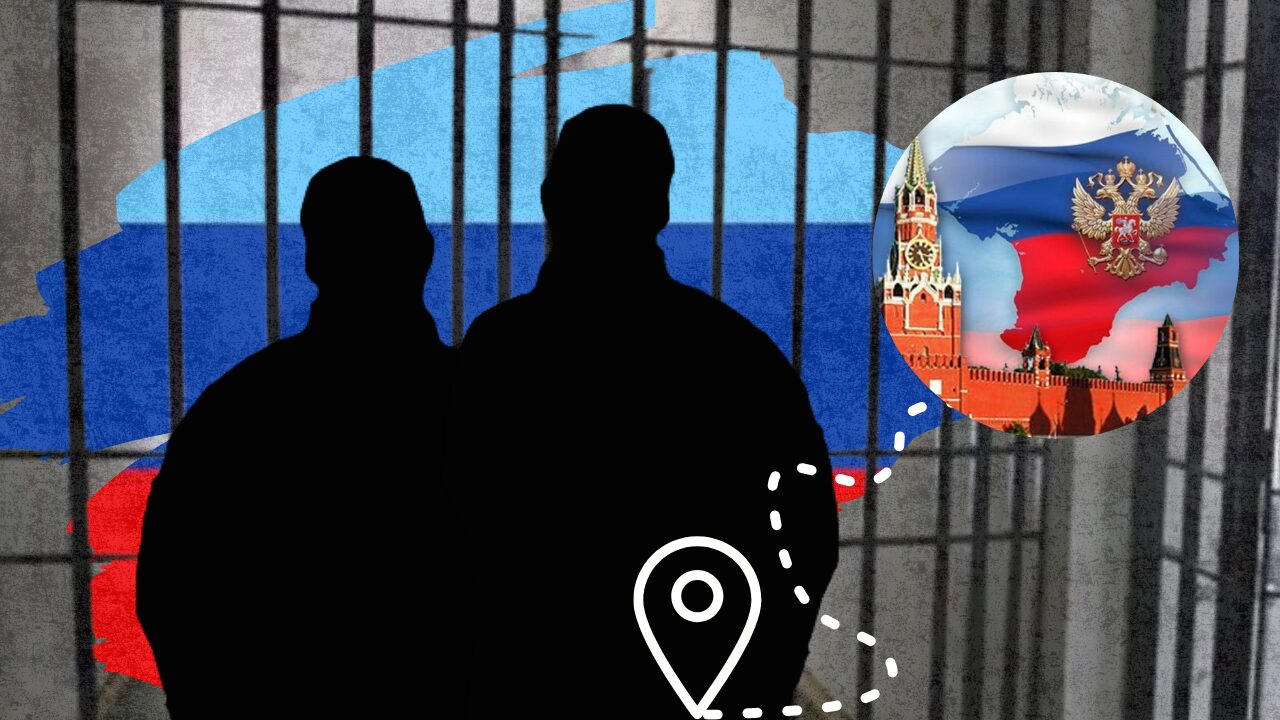
Instead of a prisoner exchange—a new phase. Civilian prisoners from the occupied Luhansk region have begun to be transported to Russia
Source: MIPL
Author: Yulia Abibok, MIPL journalist
“Things are really tough, but I’m holding on and staying strong. I send my love to everyone, and I believe we’ll see each other again. As Schopenhauer said 300 years ago, everything will happen one way or another,” wrote Oleksandr Borisov, a native of Luhansk, to his family in his first letter after being transferred. December 24, 2024. Russia, Yakutsk.
Borisov is one of several dozen civilians who were captured in the occupied part of Luhansk Oblast prior to the full-scale Russian invasion of Ukraine and remain in captivity to this day. Starting in late 2024, they began to be transferred to Russia. Oleksandr was one of the first to be transferred.
“It didn’t work out for us”
Oleksandr Borisov, now 40 years old, lived in Kadiivka (formerly Stakhanov) in the Luhansk region and made a living as a private hauler. In 2014, after the Russians seized the city, he left for Kharkiv, but was later forced to return: in 2015, his father lost a leg in a shelling attack, his mother fell ill with a serious disease from which she never recovered, and his grandparents remained in the family’s care.
Under occupation, Borisov continued to work as a driver: he brought packages from relatives in free territories to the locals and transported people, particularly those facing persecution, says Borisov’s relative Natalia Barchishak.
He was abducted in 2021 on Christmas Eve, while Borisov was waiting for his wife in his car near their home to go visit friends. Around the same time, in another part of Kadiivka, his brother Igor was abducted when he stopped at a red light while returning home from work.
Igor was released three months later, but Oleksandr was kept in captivity, tortured, and threatened with violence against his father, brother, and wife. To put an end to the abuse and protect his family, he attempted suicide, says Natalia Barchyshak.
Borisov was “sentenced” to 14 years in a penal colony for “treason”—the primary charge used against political prisoners in the “Luhansk People’s Republic.” After several years in prison, his wife divorced him. His brother cut off all contact.
Oleksandr Borisov—a natural leader by nature, energetic and proactive—constantly wrote appeals and complaints and prompted inspections at the penal colony. This is how Maksym Butkevych, a human rights activist and veteran who was held captive in the Luhansk region from June 2022 to October 18, 2024, describes him.
After his “trial,” Butkevych was held in the same prison as Borisov and, likely, most of the male “political” prisoners. “He was looking for any way to secure his release within the framework of Russian law. Perhaps he hoped that everyone would get tired of him and release him,” Butkevych recalls.
According to Natalia, Borisov is one of those who still categorically refuses to accept Russian citizenship, which is forced upon prisoners in Russia. Some, however, regardless of their political views and allegiances, take this step in the hope of early release, because after six or seven years of imprisonment, their hopes for an exchange have faded. No one is fighting for the release of many of them.
Anna Slastnikova, the sister of Roman Sagaydak—an entrepreneur detained in 2017—like Natalia later on, had hoped that public attention would help secure her brother’s release. Today, she believes that the Ukrainian side is not concerned about his fate because Roman is a civilian, not a prisoner of war.
Roman was “sentenced” to 11 years in prison, and he is now serving his eighth year. He is being held not where most “political prisoners” are kept, but in Colony No. 38 in Dovzhansk (formerly Sverdlovsk).
“I held out hope for a prisoner exchange for a very long time,” Anna Slastnikova says, barely holding back her tears. “I followed those exchanges so closely. My God, I just couldn’t tear myself away from the TV. And I waited for the call. It was, of course, awful. Every time you stare at his face, you think: what if they just couldn’t reach us? I did everything I could to get him on those lists. Before every exchange, whenever something was being planned or discussed, I wrote to Denysova, to the next ombudsmen, to the SBU, the Red Cross, and civil society organizations. It didn’t work out. We didn’t succeed.”
Since the start of Russia’s full-scale invasion, when civilian exchanges had all but ceased, only one civilian has been released from occupied Luhansk Oblast—Iryna Chyzhevska, who had been imprisoned until 2022.
Legal Absurdity
There are about two dozen “political” prisoners in the occupied Luhansk region who were detained before February 2022, says Maksym Butkevych. Even their relatives do not know the fate of some of them, such as the seriously ill 55-year-old Vadym Dreiev. The man, who, according to a Luhansk “news agency,” “was not aware of his own actions due to a mental disorder,” was imprisoned in April 2019. He was accused of allegedly planting explosives under monuments in Luhansk for sabotage purposes and on orders from the SBU.
A “political” charge does not mean that the person convicted under it actually held pro-Ukrainian views and collaborated with Ukrainian intelligence agencies, as claimed by the occupying “prosecutors” and “judges.” Many “political” prisoners changed their pro-Russian views after several years of participating in the war against Ukraine or after being imprisoned.
One such person is 55-year-old Oleksandr Divakov from the Dnipropetrovsk region, whom Butkevych writes about. Divakov worked in Russia, returned to Ukraine in 2014, and initially traveled to the Luhansk region with humanitarian aid; then joined one of the militant battalions, becoming one of its intelligence commanders, but quickly became disillusioned with the Luhansk “republic” and his own trust in Russian television. When, after yet another series of failures on the front lines, the militants needed to find a scapegoat, Divakov, as a native of a region controlled by Kyiv, was “exposed” for “collaborating with the SBU” and “sentenced” to 14 years in prison.
Nevertheless, Divakov is one of those old-school “political prisoners” who still hopes to be exchanged for Russian prisoners of war. His health has deteriorated significantly in prison, says Butkevych.
Quite a few “political prisoners” ended up behind bars simply because they were in the wrong place at the wrong time. Some of them continue to hold pro-Russian views even while in prison. One of the “political prisoners,” for example, was identified by local “investigators” as a member of a group of 16 saboteurs who, among other things, organized and carried out the killing of “People’s Militia” Colonel Oleg Anaschenko in February 2017. The woman still supports Russia, and her only “crime” was that, as a doctor, she provided medical care to another “saboteur,” says Iryna Chyzhevska, a former captive and a neurologist who remained in the occupied territory to care for her ailing parents. In 2020, during the coronavirus pandemic, the hospital where Chyzhevska worked was repurposed to treat COVID-19 patients.
It was an old hospital, lacking the necessary equipment; poor and elderly patients were sent there, while the “elite”—particularly Russian military personnel—were placed in the regional hospital, which was better equipped to provide proper care. The hospital where Chizhevska worked had a high mortality rate; the doctors were unable to do anything about it under the conditions they were given—they themselves were falling ill, and one doctor died.
One of the doctors then filed a complaint with the authorities about the conditions at the hospital. The response was a crackdown on the hospital’s leadership. Chizhevskaya was arrested in March 2021 as she was leaving her home to go to work.
The prosecution’s version of events changed several times. The doctor was beaten, intimidated, and forced to confess that she had passed lists of COVID-19 patients to the health department of the Luhansk Regional State Administration, where she had worked until 2014, and later—to a relative in the Security Service of Ukraine (SBU).
“They intimidated me with everything they could,” Chizhevska recalled in an interview with MIPL researcher Lydia Tarash.
“They said that if I didn’t agree to sign a statement admitting I’d handed over the lists of COVID-19 patients to the enemy, they wouldn’t keep me in the basement for long.” Instead, they’d send me to a pretrial detention center, to a cell with female convicts whose husbands or brothers are fighting in the war, and those women would beat and rape me every day. They kept telling me, ‘We can do anything.’ It doesn’t matter to us whether you’re guilty or not.”
According to Chyzhevska, she signed everything they demanded after they threatened to take her sick mother away and torture her.
Roman Sagaidak is another person who found himself in the wrong place at the wrong time. He is a jeweler and gemologist who worked with precious metals and gemstones. After the occupation of his hometown of Sorokino (formerly Krasnodon), a business partner offered Sagaydak to sell his share of the business. He refused. The partner used his connections in the “LNR Ministry of State Security” to take over the company, sending his partner to prison.
Sagaidak has been in captivity since July 2017 and has been tortured. To force him to incriminate himself, the occupiers abducted his father twice: once immediately after Roman’s abduction in 2017, and a second time shortly before the “trial” in 2018. The elderly man was held for a month in the basement of the “MGB” without interrogation or beatings, but without contact with his family. Anna Slastnikova of the International Movement for Human Rights (IMHR) recounts this story.
Sagaidak was sentenced to 11 years for “treason” with confiscation of property. In 2024, his case was reviewed under the Russian Criminal Code: the 11-year sentence was upheld, the confiscation was overturned, but part of his property—five cars—is nowhere to be found.
“I was curious to see how they would review the sentences of those convicted of ‘treason.’ How could Ukrainian citizens who lived in Ukraine and had no connection to Russia have betrayed Russia? It turned out that doing so was very simple: just change the article numbers. The fact that this is absurd from a legal standpoint didn’t particularly bother anyone,” Maksym Butkevych comments in an interview with the MIPL.
Step by Step
Konstantin Zhirkov tries to stay in constant contact with his brother Anton Grigorov, who was captured in March 2019 by Russian-backed Luhansk militants and sentenced to 12 years for “espionage.” Prior to that, he had been fired from his job at the university, where he headed the social services department: someone reported him after finding a photo of him on the Maidan with a Ukrainian flag in the background.
For nearly six years now, Kostyantyn has been fighting for his brother’s release, appealing to Ukrainian government agencies, international organizations, and foreign officials. There, he and others like him are told: his name is on the exchange lists, but the Russian side does not confirm his detention or whereabouts.
“Right now, Anton and the others with him are asking people to reach out everywhere, because they want to move their prison colony somewhere up north. They were told this could happen as early as March,” says Konstantin Zhirkov.
Like Oleksandra Borisova and Maksym Butkevych before him, Anton Grigorov is being held at Colony No. 19 near Khrustalnyi (formerly Krasnyi Luch).
“When I was still there, rumors had been circulating for several months that they would be dispersing us all across Russia and closing the colony,” recalls Butkevych. “It was clearly designed to hold a larger number of people at one time, but since many local inmates are now going off to war, the prison population is shrinking. Then there were rumors that they would take away only the ‘political prisoners’ and prisoners of war, or only the ‘political prisoners.’ With the ‘political prisoners,’ that started to come true.”
According to the former prisoner, even earlier, prisoners of war from another colony in the Luhansk region—No. 36, located in Sukhodolsk—had begun to be transported to Russia; these were the ones who hadn’t yet been “tried.”
As for Colony No. 19, it was recently renovated, and the local staff there is being replaced with Russian personnel. All of this, according to Butkevych, indicates that they have no intention of closing the colony.
According to Natalia Barchyshak, Ukrainian prisoners are being transferred to prevent them from communicating with one another and supporting each other. It is known that those who have been transferred or are about to be transferred are being sent to various regions of Russia. Geographically, this ranges from the north to the center—Khanty-Mansiysk, Yakutsk, Omsk, and Perm. In other words, the Ukrainians are not even being kept anywhere near their homeland.
All former captives and relatives of those still in captivity—with whom the IHRC has spoken—testify that it is difficult for captives to survive without care packages, and no one can imagine what or how anything can be sent to Omsk, let alone Yakutsk. is anyone’s guess. Nearly all the prisoners known to the MIPL have health problems, many of them resulting from torture. The medications that kept them alive came in care packages from relatives, not from prison medical units.
“The health of people who come from there is completely shattered,” explains Konstantin Zhirkov. “Last winter, it was catastrophically cold there. Everyone got sick. For those who had no money or no relatives nearby, their cells remained completely unheated. Access to medication is limited, and the food is like pig slop unless you receive regular care packages.”
Many prisoners who had no relatives—or had lost them—in the occupied territories depended on help from the families of other prisoners. The prisoners supported one another, and so did their families. Now, however, Russia is dismantling this network of mutual aid and charity that has formed in and around the Luhansk region over the years of occupation.
This article was published with the support of the European Endowment for Democracy (EED). Its content does not necessarily reflect the official position of the EED. The information or views expressed in this article are the sole responsibility of its authors.
Author: Yulia Abibok, MIPL journalist
“Things are really tough, but I’m holding on and staying strong. I send my love to everyone, and I believe we’ll see each other again. As Schopenhauer said 300 years ago, everything will happen one way or another,” wrote Oleksandr Borisov, a native of Luhansk, to his family in his first letter after being transferred. December 24, 2024. Russia, Yakutsk.
Borisov is one of several dozen civilians who were captured in the occupied part of Luhansk Oblast prior to the full-scale Russian invasion of Ukraine and remain in captivity to this day. Starting in late 2024, they began to be transferred to Russia. Oleksandr was one of the first to be transferred.
“It didn’t work out for us”
Oleksandr Borisov, now 40 years old, lived in Kadiivka (formerly Stakhanov) in the Luhansk region and made a living as a private hauler. In 2014, after the Russians seized the city, he left for Kharkiv, but was later forced to return: in 2015, his father lost a leg in a shelling attack, his mother fell ill with a serious disease from which she never recovered, and his grandparents remained in the family’s care.
Under occupation, Borisov continued to work as a driver: he brought packages from relatives in free territories to the locals and transported people, particularly those facing persecution, says Borisov’s relative Natalia Barchishak.
He was abducted in 2021 on Christmas Eve, while Borisov was waiting for his wife in his car near their home to go visit friends. Around the same time, in another part of Kadiivka, his brother Igor was abducted when he stopped at a red light while returning home from work.
Igor was released three months later, but Oleksandr was kept in captivity, tortured, and threatened with violence against his father, brother, and wife. To put an end to the abuse and protect his family, he attempted suicide, says Natalia Barchyshak.
Borisov was “sentenced” to 14 years in a penal colony for “treason”—the primary charge used against political prisoners in the “Luhansk People’s Republic.” After several years in prison, his wife divorced him. His brother cut off all contact.
Oleksandr Borisov—a natural leader by nature, energetic and proactive—constantly wrote appeals and complaints and prompted inspections at the penal colony. This is how Maksym Butkevych, a human rights activist and veteran who was held captive in the Luhansk region from June 2022 to October 18, 2024, describes him.
After his “trial,” Butkevych was held in the same prison as Borisov and, likely, most of the male “political” prisoners. “He was looking for any way to secure his release within the framework of Russian law. Perhaps he hoped that everyone would get tired of him and release him,” Butkevych recalls.
According to Natalia, Borisov is one of those who still categorically refuses to accept Russian citizenship, which is forced upon prisoners in Russia. Some, however, regardless of their political views and allegiances, take this step in the hope of early release, because after six or seven years of imprisonment, their hopes for an exchange have faded. No one is fighting for the release of many of them.
Anna Slastnikova, the sister of Roman Sagaydak—an entrepreneur detained in 2017—like Natalia later on, had hoped that public attention would help secure her brother’s release. Today, she believes that the Ukrainian side is not concerned about his fate because Roman is a civilian, not a prisoner of war.
Roman was “sentenced” to 11 years in prison, and he is now serving his eighth year. He is being held not where most “political prisoners” are kept, but in Colony No. 38 in Dovzhansk (formerly Sverdlovsk).
“I held out hope for a prisoner exchange for a very long time,” Anna Slastnikova says, barely holding back her tears. “I followed those exchanges so closely. My God, I just couldn’t tear myself away from the TV. And I waited for the call. It was, of course, awful. Every time you stare at his face, you think: what if they just couldn’t reach us? I did everything I could to get him on those lists. Before every exchange, whenever something was being planned or discussed, I wrote to Denysova, to the next ombudsmen, to the SBU, the Red Cross, and civil society organizations. It didn’t work out. We didn’t succeed.”
Since the start of Russia’s full-scale invasion, when civilian exchanges had all but ceased, only one civilian has been released from occupied Luhansk Oblast—Iryna Chyzhevska, who had been imprisoned until 2022.
Legal Absurdity
There are about two dozen “political” prisoners in the occupied Luhansk region who were detained before February 2022, says Maksym Butkevych. Even their relatives do not know the fate of some of them, such as the seriously ill 55-year-old Vadym Dreiev. The man, who, according to a Luhansk “news agency,” “was not aware of his own actions due to a mental disorder,” was imprisoned in April 2019. He was accused of allegedly planting explosives under monuments in Luhansk for sabotage purposes and on orders from the SBU.
A “political” charge does not mean that the person convicted under it actually held pro-Ukrainian views and collaborated with Ukrainian intelligence agencies, as claimed by the occupying “prosecutors” and “judges.” Many “political” prisoners changed their pro-Russian views after several years of participating in the war against Ukraine or after being imprisoned.
One such person is 55-year-old Oleksandr Divakov from the Dnipropetrovsk region, whom Butkevych writes about. Divakov worked in Russia, returned to Ukraine in 2014, and initially traveled to the Luhansk region with humanitarian aid; then joined one of the militant battalions, becoming one of its intelligence commanders, but quickly became disillusioned with the Luhansk “republic” and his own trust in Russian television. When, after yet another series of failures on the front lines, the militants needed to find a scapegoat, Divakov, as a native of a region controlled by Kyiv, was “exposed” for “collaborating with the SBU” and “sentenced” to 14 years in prison.
Nevertheless, Divakov is one of those old-school “political prisoners” who still hopes to be exchanged for Russian prisoners of war. His health has deteriorated significantly in prison, says Butkevych.
Quite a few “political prisoners” ended up behind bars simply because they were in the wrong place at the wrong time. Some of them continue to hold pro-Russian views even while in prison. One of the “political prisoners,” for example, was identified by local “investigators” as a member of a group of 16 saboteurs who, among other things, organized and carried out the killing of “People’s Militia” Colonel Oleg Anaschenko in February 2017. The woman still supports Russia, and her only “crime” was that, as a doctor, she provided medical care to another “saboteur,” says Iryna Chyzhevska, a former captive and a neurologist who remained in the occupied territory to care for her ailing parents. In 2020, during the coronavirus pandemic, the hospital where Chyzhevska worked was repurposed to treat COVID-19 patients.
It was an old hospital, lacking the necessary equipment; poor and elderly patients were sent there, while the “elite”—particularly Russian military personnel—were placed in the regional hospital, which was better equipped to provide proper care. The hospital where Chizhevska worked had a high mortality rate; the doctors were unable to do anything about it under the conditions they were given—they themselves were falling ill, and one doctor died.
One of the doctors then filed a complaint with the authorities about the conditions at the hospital. The response was a crackdown on the hospital’s leadership. Chizhevskaya was arrested in March 2021 as she was leaving her home to go to work.
The prosecution’s version of events changed several times. The doctor was beaten, intimidated, and forced to confess that she had passed lists of COVID-19 patients to the health department of the Luhansk Regional State Administration, where she had worked until 2014, and later—to a relative in the Security Service of Ukraine (SBU).
“They intimidated me with everything they could,” Chizhevska recalled in an interview with MIPL researcher Lydia Tarash.
“They said that if I didn’t agree to sign a statement admitting I’d handed over the lists of COVID-19 patients to the enemy, they wouldn’t keep me in the basement for long.” Instead, they’d send me to a pretrial detention center, to a cell with female convicts whose husbands or brothers are fighting in the war, and those women would beat and rape me every day. They kept telling me, ‘We can do anything.’ It doesn’t matter to us whether you’re guilty or not.”
According to Chyzhevska, she signed everything they demanded after they threatened to take her sick mother away and torture her.
Roman Sagaidak is another person who found himself in the wrong place at the wrong time. He is a jeweler and gemologist who worked with precious metals and gemstones. After the occupation of his hometown of Sorokino (formerly Krasnodon), a business partner offered Sagaydak to sell his share of the business. He refused. The partner used his connections in the “LNR Ministry of State Security” to take over the company, sending his partner to prison.
Sagaidak has been in captivity since July 2017 and has been tortured. To force him to incriminate himself, the occupiers abducted his father twice: once immediately after Roman’s abduction in 2017, and a second time shortly before the “trial” in 2018. The elderly man was held for a month in the basement of the “MGB” without interrogation or beatings, but without contact with his family. Anna Slastnikova of the International Movement for Human Rights (IMHR) recounts this story.
Sagaidak was sentenced to 11 years for “treason” with confiscation of property. In 2024, his case was reviewed under the Russian Criminal Code: the 11-year sentence was upheld, the confiscation was overturned, but part of his property—five cars—is nowhere to be found.
“I was curious to see how they would review the sentences of those convicted of ‘treason.’ How could Ukrainian citizens who lived in Ukraine and had no connection to Russia have betrayed Russia? It turned out that doing so was very simple: just change the article numbers. The fact that this is absurd from a legal standpoint didn’t particularly bother anyone,” Maksym Butkevych comments in an interview with the MIPL.
Step by Step
Konstantin Zhirkov tries to stay in constant contact with his brother Anton Grigorov, who was captured in March 2019 by Russian-backed Luhansk militants and sentenced to 12 years for “espionage.” Prior to that, he had been fired from his job at the university, where he headed the social services department: someone reported him after finding a photo of him on the Maidan with a Ukrainian flag in the background.
For nearly six years now, Kostyantyn has been fighting for his brother’s release, appealing to Ukrainian government agencies, international organizations, and foreign officials. There, he and others like him are told: his name is on the exchange lists, but the Russian side does not confirm his detention or whereabouts.
“Right now, Anton and the others with him are asking people to reach out everywhere, because they want to move their prison colony somewhere up north. They were told this could happen as early as March,” says Konstantin Zhirkov.
Like Oleksandra Borisova and Maksym Butkevych before him, Anton Grigorov is being held at Colony No. 19 near Khrustalnyi (formerly Krasnyi Luch).
“When I was still there, rumors had been circulating for several months that they would be dispersing us all across Russia and closing the colony,” recalls Butkevych. “It was clearly designed to hold a larger number of people at one time, but since many local inmates are now going off to war, the prison population is shrinking. Then there were rumors that they would take away only the ‘political prisoners’ and prisoners of war, or only the ‘political prisoners.’ With the ‘political prisoners,’ that started to come true.”
According to the former prisoner, even earlier, prisoners of war from another colony in the Luhansk region—No. 36, located in Sukhodolsk—had begun to be transported to Russia; these were the ones who hadn’t yet been “tried.”
As for Colony No. 19, it was recently renovated, and the local staff there is being replaced with Russian personnel. All of this, according to Butkevych, indicates that they have no intention of closing the colony.
According to Natalia Barchyshak, Ukrainian prisoners are being transferred to prevent them from communicating with one another and supporting each other. It is known that those who have been transferred or are about to be transferred are being sent to various regions of Russia. Geographically, this ranges from the north to the center—Khanty-Mansiysk, Yakutsk, Omsk, and Perm. In other words, the Ukrainians are not even being kept anywhere near their homeland.
All former captives and relatives of those still in captivity—with whom the IHRC has spoken—testify that it is difficult for captives to survive without care packages, and no one can imagine what or how anything can be sent to Omsk, let alone Yakutsk. is anyone’s guess. Nearly all the prisoners known to the MIPL have health problems, many of them resulting from torture. The medications that kept them alive came in care packages from relatives, not from prison medical units.
“The health of people who come from there is completely shattered,” explains Konstantin Zhirkov. “Last winter, it was catastrophically cold there. Everyone got sick. For those who had no money or no relatives nearby, their cells remained completely unheated. Access to medication is limited, and the food is like pig slop unless you receive regular care packages.”
Many prisoners who had no relatives—or had lost them—in the occupied territories depended on help from the families of other prisoners. The prisoners supported one another, and so did their families. Now, however, Russia is dismantling this network of mutual aid and charity that has formed in and around the Luhansk region over the years of occupation.
This article was published with the support of the European Endowment for Democracy (EED). Its content does not necessarily reflect the official position of the EED. The information or views expressed in this article are the sole responsibility of its authors.
This is an automatic translation generated by DeepL.