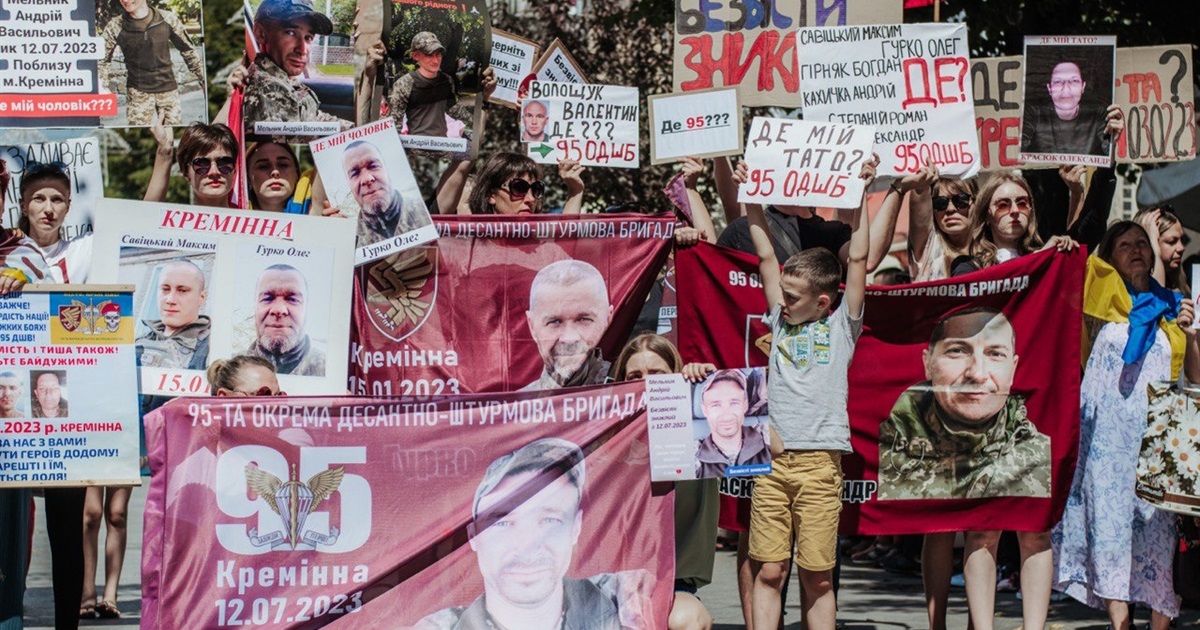
Two years ago, our loved ones went missing in the Luhansk region. Stories of the assault troops from the 95th Brigade
Source: Svoi.City
Author: Hanna KURTSANOVSKA
On January 15, 2023, soldiers of the 95th Separate Airborne Assault Brigade launched an assault in the Serebryansky Forest near Kreminna in the Luhansk region. Since then, the servicemen have been considered missing in action. Their families refuse to give up and are doing everything in their power to secure the return of their husbands, fathers, sons, and brothers: they constantly initiate meetings with representatives of the Coordination Headquarters for the Treatment of Prisoners of War, with the Verkhovna Rada Commissioner for Human Rights, Dmytro Lubinets, and organizing protests in Zhytomyr—where this brigade is stationed—as well as in Kyiv. They are publishing three stories of assault troops from the 95th Airborne Brigade—Oleg Gurko, Oleksandr Krasyuk, and Maksym Savitskyi—whose fates have been unknown for two years now.
Tetyana Hoydyk is waiting for her older brother, Oleg Gurko:
“My dad has had two heart attacks—my parents’ hearts are broken with grief.”
My brother was born on November 26, 1977, in the Ruzhyn District of Zhytomyr Oblast. He is now 47 years old. Long before my brother was born, my mom knew she would name him Oleg. She loved that name so much. And even the fact that her older sister had named her younger son Oleg didn’t stop my mom. My mom always had a special love for him; when he was a child, she never let him out of her sight.
Our parents are veterinarians. Oleg also studied to become a veterinarian, although he had dreamed of a military career his whole life. He knows history very well: we could talk with him until four in the morning about historical events and figures. We’d have friendly debates, and we never argued!
We weren’t at all surprised when Oleg made that fateful decision—to defend his homeland. He was very proud to join the ranks of the 95th Airborne Brigade and become an assault soldier. He trained in the UK, where he was recognized as one of the best snipers. And on the day the brigade’s fighters returned from training, they were immediately “thrown” into the battle near Bakhmut. Oleg always tried to stay in touch with me. Whenever he went on a long mission, he’d ask me to tell Mom that it was just a communication problem. We were very protective of Mom.
There was one incident that really broke him. His comrade Misha was dying in his arms after being wounded. Unfortunately, the medics couldn’t provide proper care because the injury was too severe. It was the first time I’d ever heard my brother scream and cry—that evening, it felt as if someone had ripped my soul out.
On the eve of the final assault, Olezhka suffered a severe concussion—he couldn’t hear in either ear, and he was feeling very nauseous, but despite this, he volunteered to take part in the assault. He doesn’t know how to complain or whine. If it has to be done, it has to be done. The only thing he did was call and ask us to pray.
The news that my little brother had gone missing on January 15, 2023, during the assault in the notorious Serebryansky Forest, wasn’t delivered to my mom until three days later. This wasn’t negligence on the part of the Territorial Military Commissariat. Our district is small; people generally know each other. My mother’s boss and the military commissar believed until the very end that Olezhka would get in touch, that he’d turn up somewhere in a hospital. But no miracle happened.
I’ll never forget that phone call, my mom’s screams on the line. How I ran into the kitchen and screamed silently so as not to wake the baby. All the blood vessels in my eyes burst from the horror.
I remember the following month as if in a fog. My friends were my lifeline. My friend Nastya and my niece Vika lived with me; my friend Borya came over every morning and stayed until late at night. No one remained indifferent; everyone supported me as best they could.
The most painful part of all this is that I didn’t get to see my brother. At Olezhka’s request, I bought winter uniforms for the guys in his battalion. On January 19, I was supposed to deliver them to my brother with my volunteer friends from Zhytomyr. The paradox is that I’ve been a volunteer since 2014, I’ve helped thousands of people, but I didn’t make it in time for my own brother. It gnaws at me, and I’ll never forgive myself for this.
We, along with the families of the soldiers who went missing along with my brother, managed to find out that the battle was extremely fierce and lasted over three hours. As a result of the battle, 10 defenders went missing, including my brother. One of the soldiers was returned from captivity a month after the assault; he was seriously wounded. But since he had only been assigned to my brother’s battalion on January 14, he couldn’t provide any information about the missing soldiers—he didn’t know them. His comrades didn’t get in touch. Oleg had left his phone and documents at home. My mother, my brother’s wife Alla, and I called nonstop, but no one ever picked up the phone.
We, the relatives of those missing in action, had to piece together every bit of information about the events of that day bit by bit. During the search for my brother, I used every possible method to find out where he might be and whether he was still alive. Sources I’d rather not name gave me hope that, as of March 2023, my brother had been seriously wounded and was being treated at one of the specialized hospitals for Ukrainian Armed Forces soldiers in the temporarily occupied territory.
A few months later, when the families of friends from “Azov” and other brigades began organizing protests, I started joining them in January 2024. I remember crying at the first protest because, out of our brigade of many thousands, only Olena Bulba—who is now a close friend of mine, and whose husband, Kostyantyn, is also missing in action—and I were there. In fact, only two or three relatives attended the first protests; the rest were our friends and fellow townspeople. I’ll say a few words about my friends—they’re the people I rely on. Take Nastya Stupak, for example. She’s not just someone close to me, but also a co-organizer of the protests—a driving force. Nastya even taught herself photography to document the protests. My friends Anya Gordina and Oksana Novokshchonova are also my constant support and pillar of strength.
I remember when we first went to a rally in Zhytomyr a year ago. There were up to 20 people there. Exactly the same number of my friends showed up. After incredible efforts by our relatives from various teams, we managed to turn the protests in Zhytomyr into mass demonstrations. And whereas before, when we marched down central Mykhailivska Street chanting slogans like “Captivity kills” and “Missing doesn’t mean forgotten,” people used to look away and walk around us, but now they put their hands over their hearts.
My friends say I’m doing a lot, but in reality, I’ll always blame myself for not doing enough and for the fact that my brother still isn’t home. In this struggle, I am incredibly grateful to all my photographer friends who document our pain and even travel from Kyiv to protests in other cities. To my journalist friends who tell our stories, and to my incredible friends who are always by my side. These are the only people keeping me going!
On the eve of the second anniversary of my brother’s disappearance, our dad suffered two heart attacks. It’s no exaggeration to say that my parents’ hearts are broken with grief. I have only one dream: that they’ll be able to wait for Olezhik, that they’ll be able to wait for their son. And I’ll keep doing everything possible—and impossible—to hear: “Tanyushka, I’m home…”.
Alevtina Veremenko is waiting for her father, Oleksandr Krasyuk:
“The day before the assault was my father’s birthday—I sent him a package, which he never received.”
My dad is from the village of Vilenka in the Zhytomyr region. He’s 48 years old now. I remember how Dad loved to tell me that he was born on a stove. He spent his childhood and teenage years in the Zhytomyr region, where he also went to school. After that came the army. He then served in what was then the police force, but didn’t continue working in that profession. My dad also regularly attended church and fasted, because he’s a deeply religious person. That’s why he tried to follow the commandments and said that one must live according to God’s laws.
He lived in a village in the Kyiv region. My father had always been interested in military matters. As early as 2014, he said he felt out of place and that he should be helping the guys in the east.
At the start of the full-scale invasion, my dad was the first to call and say, “The war has begun; Russia has attacked us.” From the very first days, he was part of the territorial defense forces and regularly applied to join the 95th Brigade—at that time, it was fully staffed, so they weren’t recruiting new people. I remember when my father came home and told us that he’d been accepted into that brigade and would be heading to the training ground in a week.
Dad always said that he was going to fight so that we would have a future, so that it wouldn’t be young boys who died, but men who had seen something in life and left their mark.
The last time I spoke with him was on his birthday, January 14, two years ago. I wished him a happy birthday and sent a package with treats for him and the guys, which he never received…
Tetyana Kushniruk and Iryna Zakharchuk are waiting for their brother Maksym Savitsky:
“He had planned to spend his vacation with the daughter of his comrade-in-arms, who went in search of the assault troops and died a heroic death.”
Our brother was born in the village of Pluzhne in the Khmelnytskyi region. He is now 32 years old. We’ve appealed to every authority; we’ve done everything possible—filled out and submitted all the necessary paperwork for the search. Now, having joined forces with the families of the missing, we’re participating in rallies to draw attention to the missing soldiers of the 95th Airborne Brigade. No one has ever explained to us why there’s such silence surrounding them. Why can we count on the fingers of two hands the number of men from our brigade whose fate has been determined—and where are the rest? Whether they’re alive or not, we must bring them home.
We had to wait a very long time for the official investigation. Even before receiving the document, we knew its contents because we had conducted our own investigation. The document states that sniper Maksym Savitsky heroically engaged an enemy tank and then disappeared from the command’s line of sight. We know that the boys completed their mission, captured the enemy trenches, and fired until their last round, but the odds were against them, and they ran out of ammunition. The Russians brought in heavy equipment and “mowed down” the ominous Serebryansky Forest. Unfortunately, neither the evacuation team nor the second line of defense arrived to assist. The boys were left face to face with the enemy.
My brother wanted so badly to have a family. And while he was in the East, he met his comrade’s daughter online and was planning to visit her during his leave. We still remember how jealous we were, because we were the ones waiting for him at home. This story is heartbreaking. When contact with Maksym was lost, the wife of the comrade-in-arms—whose daughter our brother had met—posted on social media. She said that her husband was attending a training course when that horrific assault took place. When he found out that Maxim hadn’t returned from it, he called home and said he was going to go look for him. And he never returned—he died a hero. She calls from time to time, asking if there’s any news about our Maksym. I think that little girl is also waiting for him to come home.
“Missing in action”—two words that have become a terrifying reality for us. We’ve been left alone with our grief. But we understand that this isn’t just our war, and that the people living nearby must share this pain and know their heroes by face, know the stories of their disappearances, and know their families. After all, this is our story. And we must speak about this not years from now, but right now, so that this terrible tragedy does not repeat itself. We decided to hold themed events in our village under the slogan: “Let us unite, brothers, in this hour of need; let the enemy know—we stand for Ukraine. We’ll give our souls to God as one, and bring our loved ones back to our homeland!” At these events, we tell the stories of our heroes and help foster a sense of patriotism among the people of our village. Thanks to our initiative, the village will soon feature an installation called “The Iron Heart of Hope,” dedicated to those missing in action, prisoners of war, and their families.
This installation is important to us because we truly have nowhere else to turn. Our loved ones have no graves, no memorials—only hope and pain. We’ll be able to gather at the installation on the anniversaries of their disappearances to share in each family’s pain.
We also believe this is important for the community, because everyone needs to know that there are people who have gone missing—and there are so many of them—and that their families, children, mothers, sisters, and brothers are waiting for each of them to come home.
I appeal to everyone—do not remain indifferent; join peaceful demonstrations in support of the families and soldiers who are considered prisoners of war or missing in action. Let them know that they have not been forgotten, that people are fighting for them. We will never give up the fight for their freedom. And I believe that the next article will be about the return of Maksym and his comrades from captivity.
Author: Hanna KURTSANOVSKA
On January 15, 2023, soldiers of the 95th Separate Airborne Assault Brigade launched an assault in the Serebryansky Forest near Kreminna in the Luhansk region. Since then, the servicemen have been considered missing in action. Their families refuse to give up and are doing everything in their power to secure the return of their husbands, fathers, sons, and brothers: they constantly initiate meetings with representatives of the Coordination Headquarters for the Treatment of Prisoners of War, with the Verkhovna Rada Commissioner for Human Rights, Dmytro Lubinets, and organizing protests in Zhytomyr—where this brigade is stationed—as well as in Kyiv. They are publishing three stories of assault troops from the 95th Airborne Brigade—Oleg Gurko, Oleksandr Krasyuk, and Maksym Savitskyi—whose fates have been unknown for two years now.
Tetyana Hoydyk is waiting for her older brother, Oleg Gurko:
“My dad has had two heart attacks—my parents’ hearts are broken with grief.”
My brother was born on November 26, 1977, in the Ruzhyn District of Zhytomyr Oblast. He is now 47 years old. Long before my brother was born, my mom knew she would name him Oleg. She loved that name so much. And even the fact that her older sister had named her younger son Oleg didn’t stop my mom. My mom always had a special love for him; when he was a child, she never let him out of her sight.
Our parents are veterinarians. Oleg also studied to become a veterinarian, although he had dreamed of a military career his whole life. He knows history very well: we could talk with him until four in the morning about historical events and figures. We’d have friendly debates, and we never argued!
We weren’t at all surprised when Oleg made that fateful decision—to defend his homeland. He was very proud to join the ranks of the 95th Airborne Brigade and become an assault soldier. He trained in the UK, where he was recognized as one of the best snipers. And on the day the brigade’s fighters returned from training, they were immediately “thrown” into the battle near Bakhmut. Oleg always tried to stay in touch with me. Whenever he went on a long mission, he’d ask me to tell Mom that it was just a communication problem. We were very protective of Mom.
There was one incident that really broke him. His comrade Misha was dying in his arms after being wounded. Unfortunately, the medics couldn’t provide proper care because the injury was too severe. It was the first time I’d ever heard my brother scream and cry—that evening, it felt as if someone had ripped my soul out.
On the eve of the final assault, Olezhka suffered a severe concussion—he couldn’t hear in either ear, and he was feeling very nauseous, but despite this, he volunteered to take part in the assault. He doesn’t know how to complain or whine. If it has to be done, it has to be done. The only thing he did was call and ask us to pray.
The news that my little brother had gone missing on January 15, 2023, during the assault in the notorious Serebryansky Forest, wasn’t delivered to my mom until three days later. This wasn’t negligence on the part of the Territorial Military Commissariat. Our district is small; people generally know each other. My mother’s boss and the military commissar believed until the very end that Olezhka would get in touch, that he’d turn up somewhere in a hospital. But no miracle happened.
I’ll never forget that phone call, my mom’s screams on the line. How I ran into the kitchen and screamed silently so as not to wake the baby. All the blood vessels in my eyes burst from the horror.
I remember the following month as if in a fog. My friends were my lifeline. My friend Nastya and my niece Vika lived with me; my friend Borya came over every morning and stayed until late at night. No one remained indifferent; everyone supported me as best they could.
The most painful part of all this is that I didn’t get to see my brother. At Olezhka’s request, I bought winter uniforms for the guys in his battalion. On January 19, I was supposed to deliver them to my brother with my volunteer friends from Zhytomyr. The paradox is that I’ve been a volunteer since 2014, I’ve helped thousands of people, but I didn’t make it in time for my own brother. It gnaws at me, and I’ll never forgive myself for this.
We, along with the families of the soldiers who went missing along with my brother, managed to find out that the battle was extremely fierce and lasted over three hours. As a result of the battle, 10 defenders went missing, including my brother. One of the soldiers was returned from captivity a month after the assault; he was seriously wounded. But since he had only been assigned to my brother’s battalion on January 14, he couldn’t provide any information about the missing soldiers—he didn’t know them. His comrades didn’t get in touch. Oleg had left his phone and documents at home. My mother, my brother’s wife Alla, and I called nonstop, but no one ever picked up the phone.
We, the relatives of those missing in action, had to piece together every bit of information about the events of that day bit by bit. During the search for my brother, I used every possible method to find out where he might be and whether he was still alive. Sources I’d rather not name gave me hope that, as of March 2023, my brother had been seriously wounded and was being treated at one of the specialized hospitals for Ukrainian Armed Forces soldiers in the temporarily occupied territory.
A few months later, when the families of friends from “Azov” and other brigades began organizing protests, I started joining them in January 2024. I remember crying at the first protest because, out of our brigade of many thousands, only Olena Bulba—who is now a close friend of mine, and whose husband, Kostyantyn, is also missing in action—and I were there. In fact, only two or three relatives attended the first protests; the rest were our friends and fellow townspeople. I’ll say a few words about my friends—they’re the people I rely on. Take Nastya Stupak, for example. She’s not just someone close to me, but also a co-organizer of the protests—a driving force. Nastya even taught herself photography to document the protests. My friends Anya Gordina and Oksana Novokshchonova are also my constant support and pillar of strength.
I remember when we first went to a rally in Zhytomyr a year ago. There were up to 20 people there. Exactly the same number of my friends showed up. After incredible efforts by our relatives from various teams, we managed to turn the protests in Zhytomyr into mass demonstrations. And whereas before, when we marched down central Mykhailivska Street chanting slogans like “Captivity kills” and “Missing doesn’t mean forgotten,” people used to look away and walk around us, but now they put their hands over their hearts.
My friends say I’m doing a lot, but in reality, I’ll always blame myself for not doing enough and for the fact that my brother still isn’t home. In this struggle, I am incredibly grateful to all my photographer friends who document our pain and even travel from Kyiv to protests in other cities. To my journalist friends who tell our stories, and to my incredible friends who are always by my side. These are the only people keeping me going!
On the eve of the second anniversary of my brother’s disappearance, our dad suffered two heart attacks. It’s no exaggeration to say that my parents’ hearts are broken with grief. I have only one dream: that they’ll be able to wait for Olezhik, that they’ll be able to wait for their son. And I’ll keep doing everything possible—and impossible—to hear: “Tanyushka, I’m home…”.
Alevtina Veremenko is waiting for her father, Oleksandr Krasyuk:
“The day before the assault was my father’s birthday—I sent him a package, which he never received.”
My dad is from the village of Vilenka in the Zhytomyr region. He’s 48 years old now. I remember how Dad loved to tell me that he was born on a stove. He spent his childhood and teenage years in the Zhytomyr region, where he also went to school. After that came the army. He then served in what was then the police force, but didn’t continue working in that profession. My dad also regularly attended church and fasted, because he’s a deeply religious person. That’s why he tried to follow the commandments and said that one must live according to God’s laws.
He lived in a village in the Kyiv region. My father had always been interested in military matters. As early as 2014, he said he felt out of place and that he should be helping the guys in the east.
At the start of the full-scale invasion, my dad was the first to call and say, “The war has begun; Russia has attacked us.” From the very first days, he was part of the territorial defense forces and regularly applied to join the 95th Brigade—at that time, it was fully staffed, so they weren’t recruiting new people. I remember when my father came home and told us that he’d been accepted into that brigade and would be heading to the training ground in a week.
Dad always said that he was going to fight so that we would have a future, so that it wouldn’t be young boys who died, but men who had seen something in life and left their mark.
The last time I spoke with him was on his birthday, January 14, two years ago. I wished him a happy birthday and sent a package with treats for him and the guys, which he never received…
Tetyana Kushniruk and Iryna Zakharchuk are waiting for their brother Maksym Savitsky:
“He had planned to spend his vacation with the daughter of his comrade-in-arms, who went in search of the assault troops and died a heroic death.”
Our brother was born in the village of Pluzhne in the Khmelnytskyi region. He is now 32 years old. We’ve appealed to every authority; we’ve done everything possible—filled out and submitted all the necessary paperwork for the search. Now, having joined forces with the families of the missing, we’re participating in rallies to draw attention to the missing soldiers of the 95th Airborne Brigade. No one has ever explained to us why there’s such silence surrounding them. Why can we count on the fingers of two hands the number of men from our brigade whose fate has been determined—and where are the rest? Whether they’re alive or not, we must bring them home.
We had to wait a very long time for the official investigation. Even before receiving the document, we knew its contents because we had conducted our own investigation. The document states that sniper Maksym Savitsky heroically engaged an enemy tank and then disappeared from the command’s line of sight. We know that the boys completed their mission, captured the enemy trenches, and fired until their last round, but the odds were against them, and they ran out of ammunition. The Russians brought in heavy equipment and “mowed down” the ominous Serebryansky Forest. Unfortunately, neither the evacuation team nor the second line of defense arrived to assist. The boys were left face to face with the enemy.
My brother wanted so badly to have a family. And while he was in the East, he met his comrade’s daughter online and was planning to visit her during his leave. We still remember how jealous we were, because we were the ones waiting for him at home. This story is heartbreaking. When contact with Maksym was lost, the wife of the comrade-in-arms—whose daughter our brother had met—posted on social media. She said that her husband was attending a training course when that horrific assault took place. When he found out that Maxim hadn’t returned from it, he called home and said he was going to go look for him. And he never returned—he died a hero. She calls from time to time, asking if there’s any news about our Maksym. I think that little girl is also waiting for him to come home.
“Missing in action”—two words that have become a terrifying reality for us. We’ve been left alone with our grief. But we understand that this isn’t just our war, and that the people living nearby must share this pain and know their heroes by face, know the stories of their disappearances, and know their families. After all, this is our story. And we must speak about this not years from now, but right now, so that this terrible tragedy does not repeat itself. We decided to hold themed events in our village under the slogan: “Let us unite, brothers, in this hour of need; let the enemy know—we stand for Ukraine. We’ll give our souls to God as one, and bring our loved ones back to our homeland!” At these events, we tell the stories of our heroes and help foster a sense of patriotism among the people of our village. Thanks to our initiative, the village will soon feature an installation called “The Iron Heart of Hope,” dedicated to those missing in action, prisoners of war, and their families.
This installation is important to us because we truly have nowhere else to turn. Our loved ones have no graves, no memorials—only hope and pain. We’ll be able to gather at the installation on the anniversaries of their disappearances to share in each family’s pain.
We also believe this is important for the community, because everyone needs to know that there are people who have gone missing—and there are so many of them—and that their families, children, mothers, sisters, and brothers are waiting for each of them to come home.
I appeal to everyone—do not remain indifferent; join peaceful demonstrations in support of the families and soldiers who are considered prisoners of war or missing in action. Let them know that they have not been forgotten, that people are fighting for them. We will never give up the fight for their freedom. And I believe that the next article will be about the return of Maksym and his comrades from captivity.
This is an automatic translation generated by DeepL.