“You believe in your Jesus, but did he save you?” How Russians mocked Ukrainian priest Serhiy Chudynovych in occupied Kherson
Source: Signal to Resist
Author: Olena Pavlenko
Russian military personnel in the occupied territories are treating priests of the Orthodox Church of Ukraine with particular cruelty.
While Russian dictator Vladimir Putin complains about the alleged oppression of the Moscow Patriarchate, the Russians are kidnapping, torturing, and killing priests of the OCU, and destroying the churches themselves. According to Ukrainian President Volodymyr Zelenskyy, since the start of the full-scale war, the occupiers have killed 50 clergy members and destroyed about 700 churches.
Serhiy Chudinovich, rector of the Church of the Intercession of the Most Holy Mother of God in Kherson, also fell victim to the Russians. From the very first days of the city’s occupation, his church served as a center of aid for local residents.
Father Serhiy organized the distribution of medicine and food in the church building, and even set up a makeshift barbershop. He continued to conduct services in Ukrainian and kept up the morale of his parishioners. For this, the Russians arrested him, accusing him of working for Ukrainian sabotage groups. The priest was beaten, mocked for his faith, subjected to attempted rape, and threatened with the murder of his family.
Two and a half years after these horrific events, Serhiy Chudinovich recounted how the Ukrainian Church helped Kherson survive the occupation, what Russians believe in, and how he managed to escape captivity.
“I began celebrating the Divine Liturgy for the soldiers”
Father Serhiy meets us in Irpin, at the church dedicated to St. Nicholas and the Transfiguration of the Lord. The walls of the small church are pockmarked here and there with shrapnel, and the roof is riddled with holes.
When the Russians advanced on Kyiv in February and March 2022, they mercilessly shelled the suburbs, including Irpin. At that time, this church still belonged to the Moscow Patriarchate, but the occupiers paid no heed even to that. The local priest was killed during the shelling.
Serhiy Chudinovich became the rector of the church in June 2024. At that time, all of the city’s religious communities voted to leave the jurisdiction of the Moscow Patriarchate and join the Orthodox Church of Ukraine.
“In Irpin, people are angry at the Russians. There isn’t a single Russian church here. Those who’ve had enough of them have no sympathy for Russians,” says Father Serhiy.
He himself lost any illusions about Russia’s intentions to start a war 10 years ago, when the Russians annexed Crimea. On March 1, 2014, Russian troops seized the Crimean parliament, which, under their pressure, voted to allow Russian troops onto the peninsula. Just two days later, Serhiy Chudinovich, along with his colleague, Father Igor, delivered humanitarian aid to a military unit located in the Kherson region.
The priest recalls that his first impression of the state of the Ukrainian army was that he “wanted to hug them and cry.” In 2014, the soldiers had very poor-quality “Dubok” uniforms and boots that were impossible to wear. Parishioners of the Ukrainian Orthodox Church collected donations, which the clergy used to buy combat boots from thrift stores and deliver them to the units. But they didn’t just help the troops with their daily bread. In those uncertain times of fear and uncertainty, priests of the Kyiv Patriarchate devised a special liturgy, which they celebrated in military units.
“The concept of a chaplaincy didn’t exist in 2014,” says Father Serhiy. “I began celebrating the Divine Liturgy for the soldiers. It was an abbreviated service agreed upon with the church leadership at the time; they developed a short service, and we have been celebrating it for nearly eight years.”
Chaplains still use this abbreviated service—which lasts 30–40 minutes—when conducting services near the front lines. During those days, the priest got to know many servicemen with whom he maintained friendly relationships for many years. One of them is Brigadier General Serhiy Sobko, former deputy commander of the Territorial Defense Forces of Ukraine. At the time, he was a major in the 95th Brigade of the Armed Forces of Ukraine.
“A good, decent soldier; he maintained German-style discipline in his unit,” recalls Chudinovich.
In the spring of 2014, clergy from nearly all Christian denominations joined forces in Kherson to support the Ukrainian military. Or rather, all except the Orthodox Church of the Moscow Patriarchate. On March 16 of that year, priests from the Ukrainian Orthodox, Greek Catholic, and several Protestant churches held an open prayer service for Ukraine near the Kherson Regional Council.
“If I love a Ukrainian soldier, I’ll go there and say a prayer for him,” Serhiy Chudinovich said that day in the square. “If my parishioner loves a Ukrainian soldier, there’s no need to organize him. He himself set up a mission to support the Ukrainian military through the church. I know that in every church in Kherson—Catholic, Orthodox, and Protestant, all except the Moscow-affiliated ones—people are donating their last penny to support the Ukrainian military, and this is how their love is expressed.”
Back then, in the first months of the Russian-Ukrainian war, Father Serhiy “lost” his brother, who lived in Feodosia. In the winter of 2014, the priest called him to arrange a meeting, but after the illegal referendum on Crimea’s annexation to the Russian Federation and the start of the Russian invasion of the peninsula, everything changed:
“I called a week after the ‘referendum’—but my brother had already been watching Russian television and was parroting their propaganda. I hung up, and we haven’t spoken since.”
This personal loss did not change the priest’s attitude toward the Ukrainian military or toward Ukraine. Back then, in 2014, he saw how enemy intelligence services could sow discord even within a single family. Father Serhiy expected the occupiers to continue their advance. And eight years later, his fears became a reality.
“I called my wife and said goodbye.”
Serhiy Chudinovich returned from Mykolaiv to Kherson on the second day of the full-scale war—and went to the Territorial Defense Recruitment Center to enlist. However, by that time, automatic weapons had already been distributed to all who wanted them.
Since there were no weapons left, the priest returned to his parishioners and continued to conduct services in Ukrainian at the church on Ostrov. When the internet was available, with the help of his assistants, he streamed services live on the church’s Facebook page for those who could not join the prayers in person.
Residents of the surrounding neighborhoods then began to gather at the Church of the Intercession of the Most Holy Mother of God. The church became a hub for distributing humanitarian aid and even a sort of “club” for people living in uncertainty and fear.
Pharmacies in Kherson had closed, and the city lacked many essential medications that people with chronic illnesses needed to take regularly, so the priests traveled to Mykolaiv, where these medications were still available, and brought them back to Kherson.
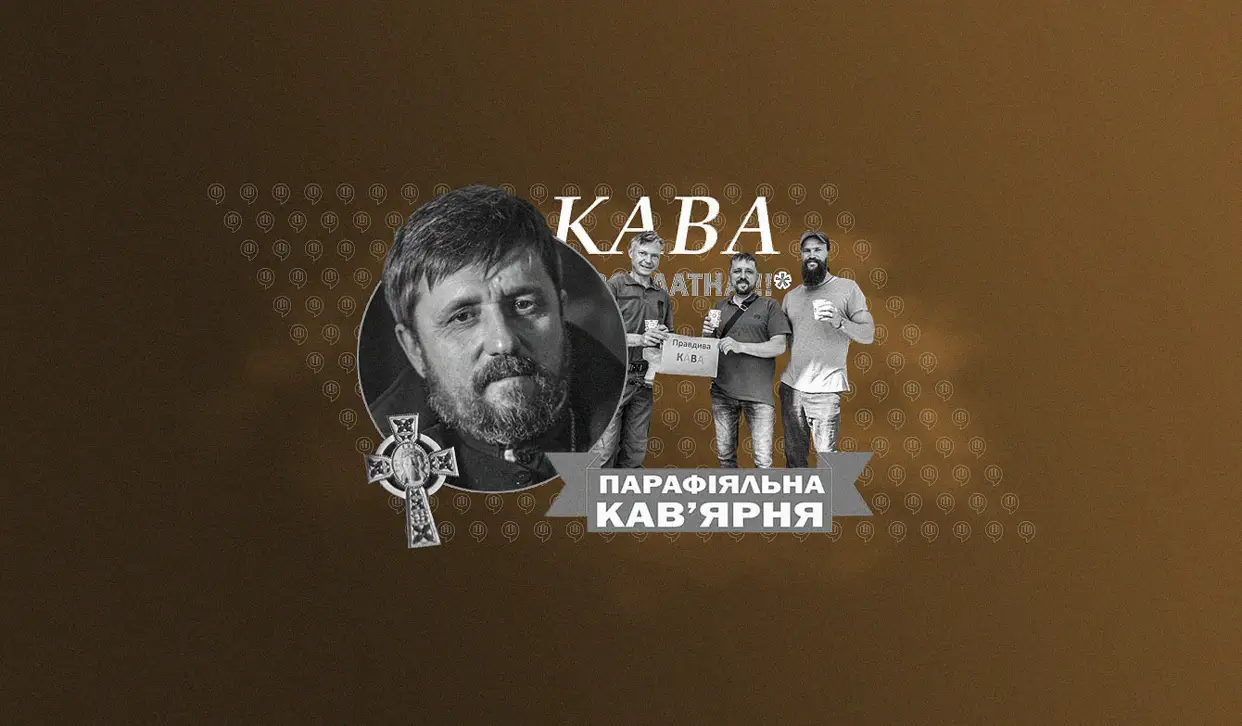
They set up a coffee machine in the church and handed out free coffee to anyone who wanted it. Serhiy came up with a humorous announcement to encourage patriotic parishioners: “‘One coffee’—1,000 UAH, ‘One coffee’—500 hryvnias, ‘One coffee, please’—on the church’s tab.” But in reality, all parishioners were free to enjoy a hot drink.
A medical clinic opened nearby, where doctors checked blood pressure and dispensed medication; in March 2022, a hair salon also began operating at the church. There was no set price for the services, but donations were welcome. All the funds raised were spent on gas to drive to Mykolaiv for medicine—until the siege around Kherson closed in.
“I don’t like the word ‘volunteer,’ because for a Christian, it’s impossible not to show goodwill,” says the priest. “We did what we could; we helped with simple things. I didn’t have much time back then, so I held a service I called ‘people’s worship.’ I told the parishioners, ‘Here’s a book in the middle of the church; this is what you need to read.’ The faithful would come up and take turns reading from the Holy Scriptures. That’s how it was: here was the service, here they were brewing coffee, here they were cutting hair, and right next to it, they were handing out pills.”
In early March 2022, the Russians had already begun entering the city. On March 1, local Territorial Defense forces tried to engage them in Buzkovy Park, but the forces were unequal; the occupiers simply mowed them down with large-caliber machine guns and armored personnel carriers. Most of the city’s defenders were killed.
On March 3, the former mayor of Kherson, Volodymyr Mykolayenko, called Serhiy Chudynovych at home and asked him to come and conduct a funeral service for the fallen members of the territorial defense unit at the cemetery near the village of Zymivnyk in the steppe outside the city. The bodies of the defenders of Lilac Park and those members of the self-defense units who had been picked up in other neighborhoods were brought there.
Father Serhiy called his wife to say goodbye and gave his parishioners instructions on where he should be buried—he feared he would not return alive from this service.
“The first bus arrived, driven by the director of the municipal funeral service,” recalls Father Serhiy. “First, he brought eight bodies, then ten. They had no coffins; some were wrapped in some kind of cloth. They were simply laid out in rows and photographed so we could remember where they were later. Meanwhile, I conducted the memorial service, filmed it, and sent the footage to my friend.”
To this day, it remains unclear exactly how many people died on March 1 in Kherson. Some bodies were found near the Antonivsky Bridge; others were collected from the streets. Of many people, only remains were left, which were gathered into bags and brought to the cemetery that way. At that time, the Russians did not interfere with the burial of the city’s fallen defenders. They did not interfere on March 15 either, when Serhiy Chudinovich conducted a funeral service at the church on Ostrov for Ukrainian Armed Forces soldier Ihor Ivanovych from Ivano-Frankivsk, whose body had not yet been removed from Kherson. The service was streamed on Facebook, allowing the soldier’s family to participate in the liturgy.
Meanwhile, Russian intelligence agencies were closely monitoring the activities of the church community and its tireless pastor. And soon they made their presence known.
“Now we’re going to tear you apart”
In the early days of the occupation, when pro-Ukrainian rallies were taking place in Kherson, the invaders left the Church of the Intercession of the Most Holy Mother of God untouched. However, by the end of March, once they had established a foothold in the city, they turned their attention to it.
At first, the same announcement about free coffee began circulating in pro-Russian Telegram groups. When Serhiy Chudinovich found out about this, he began spending the night away from his registered address. But later, representatives of the Russian special services paid a visit to the church. This happened on March 30. Every morning, Father Serhiy held a meeting with his assistants at the church. The Russians arrived just as the meeting was about to begin; apparently, an informant had tipped them off about the church’s daily routine.
Author: Olena Pavlenko
Russian military personnel in the occupied territories are treating priests of the Orthodox Church of Ukraine with particular cruelty.
While Russian dictator Vladimir Putin complains about the alleged oppression of the Moscow Patriarchate, the Russians are kidnapping, torturing, and killing priests of the OCU, and destroying the churches themselves. According to Ukrainian President Volodymyr Zelenskyy, since the start of the full-scale war, the occupiers have killed 50 clergy members and destroyed about 700 churches.
Serhiy Chudinovich, rector of the Church of the Intercession of the Most Holy Mother of God in Kherson, also fell victim to the Russians. From the very first days of the city’s occupation, his church served as a center of aid for local residents.
Father Serhiy organized the distribution of medicine and food in the church building, and even set up a makeshift barbershop. He continued to conduct services in Ukrainian and kept up the morale of his parishioners. For this, the Russians arrested him, accusing him of working for Ukrainian sabotage groups. The priest was beaten, mocked for his faith, subjected to attempted rape, and threatened with the murder of his family.
Two and a half years after these horrific events, Serhiy Chudinovich recounted how the Ukrainian Church helped Kherson survive the occupation, what Russians believe in, and how he managed to escape captivity.
“I began celebrating the Divine Liturgy for the soldiers”
Father Serhiy meets us in Irpin, at the church dedicated to St. Nicholas and the Transfiguration of the Lord. The walls of the small church are pockmarked here and there with shrapnel, and the roof is riddled with holes.
When the Russians advanced on Kyiv in February and March 2022, they mercilessly shelled the suburbs, including Irpin. At that time, this church still belonged to the Moscow Patriarchate, but the occupiers paid no heed even to that. The local priest was killed during the shelling.
Serhiy Chudinovich became the rector of the church in June 2024. At that time, all of the city’s religious communities voted to leave the jurisdiction of the Moscow Patriarchate and join the Orthodox Church of Ukraine.
“In Irpin, people are angry at the Russians. There isn’t a single Russian church here. Those who’ve had enough of them have no sympathy for Russians,” says Father Serhiy.
He himself lost any illusions about Russia’s intentions to start a war 10 years ago, when the Russians annexed Crimea. On March 1, 2014, Russian troops seized the Crimean parliament, which, under their pressure, voted to allow Russian troops onto the peninsula. Just two days later, Serhiy Chudinovich, along with his colleague, Father Igor, delivered humanitarian aid to a military unit located in the Kherson region.
The priest recalls that his first impression of the state of the Ukrainian army was that he “wanted to hug them and cry.” In 2014, the soldiers had very poor-quality “Dubok” uniforms and boots that were impossible to wear. Parishioners of the Ukrainian Orthodox Church collected donations, which the clergy used to buy combat boots from thrift stores and deliver them to the units. But they didn’t just help the troops with their daily bread. In those uncertain times of fear and uncertainty, priests of the Kyiv Patriarchate devised a special liturgy, which they celebrated in military units.
“The concept of a chaplaincy didn’t exist in 2014,” says Father Serhiy. “I began celebrating the Divine Liturgy for the soldiers. It was an abbreviated service agreed upon with the church leadership at the time; they developed a short service, and we have been celebrating it for nearly eight years.”
Chaplains still use this abbreviated service—which lasts 30–40 minutes—when conducting services near the front lines. During those days, the priest got to know many servicemen with whom he maintained friendly relationships for many years. One of them is Brigadier General Serhiy Sobko, former deputy commander of the Territorial Defense Forces of Ukraine. At the time, he was a major in the 95th Brigade of the Armed Forces of Ukraine.
“A good, decent soldier; he maintained German-style discipline in his unit,” recalls Chudinovich.
In the spring of 2014, clergy from nearly all Christian denominations joined forces in Kherson to support the Ukrainian military. Or rather, all except the Orthodox Church of the Moscow Patriarchate. On March 16 of that year, priests from the Ukrainian Orthodox, Greek Catholic, and several Protestant churches held an open prayer service for Ukraine near the Kherson Regional Council.
“If I love a Ukrainian soldier, I’ll go there and say a prayer for him,” Serhiy Chudinovich said that day in the square. “If my parishioner loves a Ukrainian soldier, there’s no need to organize him. He himself set up a mission to support the Ukrainian military through the church. I know that in every church in Kherson—Catholic, Orthodox, and Protestant, all except the Moscow-affiliated ones—people are donating their last penny to support the Ukrainian military, and this is how their love is expressed.”
Back then, in the first months of the Russian-Ukrainian war, Father Serhiy “lost” his brother, who lived in Feodosia. In the winter of 2014, the priest called him to arrange a meeting, but after the illegal referendum on Crimea’s annexation to the Russian Federation and the start of the Russian invasion of the peninsula, everything changed:
“I called a week after the ‘referendum’—but my brother had already been watching Russian television and was parroting their propaganda. I hung up, and we haven’t spoken since.”
This personal loss did not change the priest’s attitude toward the Ukrainian military or toward Ukraine. Back then, in 2014, he saw how enemy intelligence services could sow discord even within a single family. Father Serhiy expected the occupiers to continue their advance. And eight years later, his fears became a reality.
“I called my wife and said goodbye.”
Serhiy Chudinovich returned from Mykolaiv to Kherson on the second day of the full-scale war—and went to the Territorial Defense Recruitment Center to enlist. However, by that time, automatic weapons had already been distributed to all who wanted them.
Since there were no weapons left, the priest returned to his parishioners and continued to conduct services in Ukrainian at the church on Ostrov. When the internet was available, with the help of his assistants, he streamed services live on the church’s Facebook page for those who could not join the prayers in person.
Residents of the surrounding neighborhoods then began to gather at the Church of the Intercession of the Most Holy Mother of God. The church became a hub for distributing humanitarian aid and even a sort of “club” for people living in uncertainty and fear.
Pharmacies in Kherson had closed, and the city lacked many essential medications that people with chronic illnesses needed to take regularly, so the priests traveled to Mykolaiv, where these medications were still available, and brought them back to Kherson.
They set up a coffee machine in the church and handed out free coffee to anyone who wanted it. Serhiy came up with a humorous announcement to encourage patriotic parishioners: “‘One coffee’—1,000 UAH, ‘One coffee’—500 hryvnias, ‘One coffee, please’—on the church’s tab.” But in reality, all parishioners were free to enjoy a hot drink.
A medical clinic opened nearby, where doctors checked blood pressure and dispensed medication; in March 2022, a hair salon also began operating at the church. There was no set price for the services, but donations were welcome. All the funds raised were spent on gas to drive to Mykolaiv for medicine—until the siege around Kherson closed in.
“I don’t like the word ‘volunteer,’ because for a Christian, it’s impossible not to show goodwill,” says the priest. “We did what we could; we helped with simple things. I didn’t have much time back then, so I held a service I called ‘people’s worship.’ I told the parishioners, ‘Here’s a book in the middle of the church; this is what you need to read.’ The faithful would come up and take turns reading from the Holy Scriptures. That’s how it was: here was the service, here they were brewing coffee, here they were cutting hair, and right next to it, they were handing out pills.”
In early March 2022, the Russians had already begun entering the city. On March 1, local Territorial Defense forces tried to engage them in Buzkovy Park, but the forces were unequal; the occupiers simply mowed them down with large-caliber machine guns and armored personnel carriers. Most of the city’s defenders were killed.
On March 3, the former mayor of Kherson, Volodymyr Mykolayenko, called Serhiy Chudynovych at home and asked him to come and conduct a funeral service for the fallen members of the territorial defense unit at the cemetery near the village of Zymivnyk in the steppe outside the city. The bodies of the defenders of Lilac Park and those members of the self-defense units who had been picked up in other neighborhoods were brought there.
Father Serhiy called his wife to say goodbye and gave his parishioners instructions on where he should be buried—he feared he would not return alive from this service.
“The first bus arrived, driven by the director of the municipal funeral service,” recalls Father Serhiy. “First, he brought eight bodies, then ten. They had no coffins; some were wrapped in some kind of cloth. They were simply laid out in rows and photographed so we could remember where they were later. Meanwhile, I conducted the memorial service, filmed it, and sent the footage to my friend.”
To this day, it remains unclear exactly how many people died on March 1 in Kherson. Some bodies were found near the Antonivsky Bridge; others were collected from the streets. Of many people, only remains were left, which were gathered into bags and brought to the cemetery that way. At that time, the Russians did not interfere with the burial of the city’s fallen defenders. They did not interfere on March 15 either, when Serhiy Chudinovich conducted a funeral service at the church on Ostrov for Ukrainian Armed Forces soldier Ihor Ivanovych from Ivano-Frankivsk, whose body had not yet been removed from Kherson. The service was streamed on Facebook, allowing the soldier’s family to participate in the liturgy.
Meanwhile, Russian intelligence agencies were closely monitoring the activities of the church community and its tireless pastor. And soon they made their presence known.
“Now we’re going to tear you apart”
In the early days of the occupation, when pro-Ukrainian rallies were taking place in Kherson, the invaders left the Church of the Intercession of the Most Holy Mother of God untouched. However, by the end of March, once they had established a foothold in the city, they turned their attention to it.
At first, the same announcement about free coffee began circulating in pro-Russian Telegram groups. When Serhiy Chudinovich found out about this, he began spending the night away from his registered address. But later, representatives of the Russian special services paid a visit to the church. This happened on March 30. Every morning, Father Serhiy held a meeting with his assistants at the church. The Russians arrived just as the meeting was about to begin; apparently, an informant had tipped them off about the church’s daily routine.
The priest was led out to a car; the parishioners were told he was being taken away for a 40-minute conversation; his eyes were blindfolded with a scarf, and he was driven away. Based on the car’s route, Serhiy Chudinovich, an experienced driver, determined that he had been taken to the building of the regional headquarters of the National Police.
At first, the priest recalls, they did not beat him. They checked his phone and asked about his activities and his ties to the Ukrainian military and sabotage groups. Serhiy said he had no such ties, and then they took him to the basement, took his fingerprints, photographed him, and locked him up. They didn’t give him any water or let him use the restroom. The captive spent several hours in that basement.
Later, the Russians returned and said, “The lying Ukrainian media have declared you dead, so nothing is holding us back. Now we’re going to tear you to pieces.”
Then they began beating the priest with a rubber baton, choking him with their hands, and undressing him: for every answer that didn’t satisfy his tormentors, they removed one item of clothing from him until he was left completely naked in the cell. The physical torture was accompanied by mockery of his faith.
“There was one man nicknamed ‘The Raven’; he said, ‘You believe in your Jesus, but did he save you? I, for one, believe in Odin,” Serhiy Chudinovich recounts about the most terrifying day of his life. “I was thirsty and couldn’t speak; I asked for water, and they gave me diluted alcohol. They beat me in the chest and choked me with their hands. They forced me to my knees and started shoving a baton into my anus.”
Eventually, Serhiy signed a cooperation agreement—and the torture stopped. Chudinovich was given a task: to lead the occupiers to a group of Kherson residents whom they suspected of sabotage. He agreed. After that, the prisoner was once again put into a car blindfolded, driven away from the National Police building, and dropped off on the street.
Father Chudinovich went home and didn’t even get out of bed for the first few days after the torture. But in addition to physical pain, he was tormented by emotional anguish—after all, he had agreed to hand over his acquaintances to the Russians. Then the priest made a difficult decision—to flee the city rather than collaborate with the enemy.
On April 6, the eve of the Annunciation, Serhiy got into a car and drove across the fields, past Russian checkpoints, toward the Mykolaiv region. It was dangerous because the fields were mined, but he managed to break through unharmed. The first thing the Kherson priest did upon reaching territory free from occupation was to go to the police and file a statement detailing everything that had happened to him in the Russian torture chamber.
“I went through screening and a polygraph test,” says Serhiy. “The state has no questions for me.”
“The Moscow Patriarchate is a branch of the FSB”
After Kherson’s liberation, Serhiy Chudinovich returned to the city, resumed church services, and resumed helping those in need.
However, the occupiers began shelling the city. Guided bombs fell right into the churchyard, so the distribution of humanitarian aid at the church had to be suspended. When the Russians blew up the Kakhovka Hydroelectric Power Plant, the island was flooded, and with it—the church.
Since the summer of 2024, Father Serhiy has been living in Irpin. The torture did not leave him unscathed; the priest began to experience health problems and was hospitalized three times in the stroke unit. Nevertheless, he continues his ministry and gathers the Kherson community around the church.
Long after the de-occupation, propaganda brochures praising the “Russian Orthodox Army” and icons of Russian saints were still being found in the Irpin church.
“The Russians don’t even use the word ‘Christianity’; for them, it’s ‘Orthodoxy.’ The Moscow Patriarchate is a branch of the FSB,” says Chudinovich. “It’s the best kind of agent—it does everything an agent does, but doesn’t consider itself one.”
According to Serhiy, among the other factors contributing to Kherson’s resilience under occupation, language and faith were perhaps the most important. As of 2014, when the occupation of Crimea and the war in Donbas began, there were 22 Ukrainian Orthodox congregations in the city. There were more Russian ones—35—but they did not hold a dominant position.
Every Sunday during the eight years that passed from the start of Russia’s war against Ukraine until the full-scale invasion, liturgy was held in Ukrainian churches, and the community gathered around them—and this prevented the total Russification of the city.
“Take away culture, take away faith—and then neither the people nor the army can help. The Russians are working very hard on this; they’re still infiltrating us through music and computer programs—they do this constantly and will continue to do so,” says a priest from Kherson, who has experienced firsthand what the “Russian World” is like.
At first, the priest recalls, they did not beat him. They checked his phone and asked about his activities and his ties to the Ukrainian military and sabotage groups. Serhiy said he had no such ties, and then they took him to the basement, took his fingerprints, photographed him, and locked him up. They didn’t give him any water or let him use the restroom. The captive spent several hours in that basement.
Later, the Russians returned and said, “The lying Ukrainian media have declared you dead, so nothing is holding us back. Now we’re going to tear you to pieces.”
Then they began beating the priest with a rubber baton, choking him with their hands, and undressing him: for every answer that didn’t satisfy his tormentors, they removed one item of clothing from him until he was left completely naked in the cell. The physical torture was accompanied by mockery of his faith.
“There was one man nicknamed ‘The Raven’; he said, ‘You believe in your Jesus, but did he save you? I, for one, believe in Odin,” Serhiy Chudinovich recounts about the most terrifying day of his life. “I was thirsty and couldn’t speak; I asked for water, and they gave me diluted alcohol. They beat me in the chest and choked me with their hands. They forced me to my knees and started shoving a baton into my anus.”
Eventually, Serhiy signed a cooperation agreement—and the torture stopped. Chudinovich was given a task: to lead the occupiers to a group of Kherson residents whom they suspected of sabotage. He agreed. After that, the prisoner was once again put into a car blindfolded, driven away from the National Police building, and dropped off on the street.
Father Chudinovich went home and didn’t even get out of bed for the first few days after the torture. But in addition to physical pain, he was tormented by emotional anguish—after all, he had agreed to hand over his acquaintances to the Russians. Then the priest made a difficult decision—to flee the city rather than collaborate with the enemy.
On April 6, the eve of the Annunciation, Serhiy got into a car and drove across the fields, past Russian checkpoints, toward the Mykolaiv region. It was dangerous because the fields were mined, but he managed to break through unharmed. The first thing the Kherson priest did upon reaching territory free from occupation was to go to the police and file a statement detailing everything that had happened to him in the Russian torture chamber.
“I went through screening and a polygraph test,” says Serhiy. “The state has no questions for me.”
“The Moscow Patriarchate is a branch of the FSB”
After Kherson’s liberation, Serhiy Chudinovich returned to the city, resumed church services, and resumed helping those in need.
However, the occupiers began shelling the city. Guided bombs fell right into the churchyard, so the distribution of humanitarian aid at the church had to be suspended. When the Russians blew up the Kakhovka Hydroelectric Power Plant, the island was flooded, and with it—the church.
Since the summer of 2024, Father Serhiy has been living in Irpin. The torture did not leave him unscathed; the priest began to experience health problems and was hospitalized three times in the stroke unit. Nevertheless, he continues his ministry and gathers the Kherson community around the church.
Long after the de-occupation, propaganda brochures praising the “Russian Orthodox Army” and icons of Russian saints were still being found in the Irpin church.
“The Russians don’t even use the word ‘Christianity’; for them, it’s ‘Orthodoxy.’ The Moscow Patriarchate is a branch of the FSB,” says Chudinovich. “It’s the best kind of agent—it does everything an agent does, but doesn’t consider itself one.”
According to Serhiy, among the other factors contributing to Kherson’s resilience under occupation, language and faith were perhaps the most important. As of 2014, when the occupation of Crimea and the war in Donbas began, there were 22 Ukrainian Orthodox congregations in the city. There were more Russian ones—35—but they did not hold a dominant position.
Every Sunday during the eight years that passed from the start of Russia’s war against Ukraine until the full-scale invasion, liturgy was held in Ukrainian churches, and the community gathered around them—and this prevented the total Russification of the city.
“Take away culture, take away faith—and then neither the people nor the army can help. The Russians are working very hard on this; they’re still infiltrating us through music and computer programs—they do this constantly and will continue to do so,” says a priest from Kherson, who has experienced firsthand what the “Russian World” is like.
This is an automatic translation generated by DeepL.