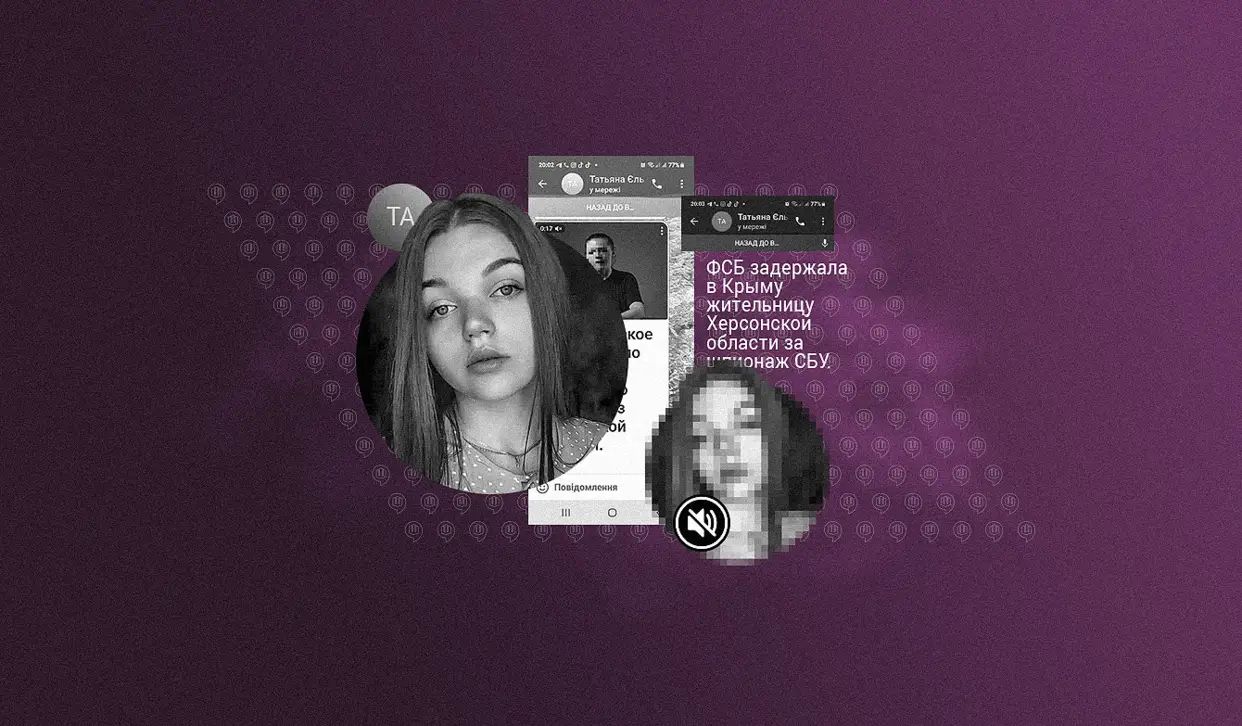
A bag over her head. And—into the car. How the Russians kidnapped Kherson student Anya Yeltsova and forced her to testify against herself
Source: Signal to Resist
Author: Viktoria Novikova
After the liberation of Kherson, the Russians launched a brutal campaign of terror against civilians on the left bank of the Kherson region, which remains under occupation.
Anya Yeltsova, a 21-year-old student at Kherson State University, was abducted in November 2022 in the village of Agaimany. FSB agents broke into her grandmother’s house, conducted a search, and carried out interrogations. And in the end, they brazenly took Anya away right in front of her family. For over two years now, the young woman has been held captive in Crimea, accused of espionage because of her pro-Ukrainian views and love for her homeland.
We spoke with Anya Yeltsova’s relatives and relevant officials to find out who might have tipped off the authorities about her and handed her over to the occupiers, how she stays in touch with her family, why the Russians are lying that they captured Anya only a few months ago, and how she was forced to confess.
“Everyone knew she was for Ukraine”
“Her grandmother was there when they took her away,” recalls Anya Yeltsova’s aunt, Svitlana Kushnir. “Anya had gone to visit her grandmother, who is a school principal. The [Russians] would often come to her and force her to cooperate.”
Her grandmother refused to cooperate with the occupiers. However, that time they didn’t come for her. Everyone in the house was separated into different rooms and interrogated at length, especially Anya. Her grandmother heard the armed men in balaclavas saying aloud that they had been monitoring her granddaughter on social media for a long time. They also mentioned that they didn’t like something they found on her phone. The occupiers interpreted what they found as support for the Ukrainian army.
“A bag over her head. And then—into the car. That’s how they took Anya away,” says Svitlana.
The Russians persecute residents of the occupied territories for any displays of patriotism, Ukrainian symbols, and the like. And those who, like Anya Yeltsova, openly declare their stance—well, that’s another story altogether. For many residents of the Kherson region, patriotism has cost them their lives.
“We knew that Anya had a pro-Ukrainian stance, that she didn’t want to cooperate [with the occupiers],” says Svitlana. “She asked for help [for the Ukrainian Armed Forces] on social media.” When Kherson was liberated, she posted a video: ‘Kherson, my dearest, you’re home.’ And she wrote that winter was coming—saying, ‘Let’s help our boys stay warm.’ So, of course, everyone understood that she was for Ukraine.”
Even now, you can see patriotic posts on Anya’s social media, and even her own poems written from the perspective of a Ukrainian soldier. When she posted them, the student could hardly have imagined what her pro-Ukrainian stance would cost her—or what the Russians were capable of.
Student Resistance
Anya Yeltsova is from the village of Balashove in the Ivanivka District, located on the left bank of the Kherson region, 80 kilometers from Henichesk. The Russians occupied it immediately after the start of the full-scale invasion.
The girl’s parents are ordinary villagers. She kept in touch with them, but lived in Kherson herself, where she was a senior at Kherson State University and was set to graduate with a degree in education. She wanted to become a psychologist and loved to draw.
On March 1, 2022, Russian troops entered Kherson. City residents began organizing rallies against the occupation, demonstrating their Ukrainian identity in every way possible and blocking the movement of Russian military vehicles. Kherson’s resistance inspired the entire country.
Amid this resistance, the Russians began persecuting pro-Ukrainian activists, journalists, politicians, ATO veterans, volunteers, and, in general, anyone who might be connected to the resistance movement. One by one, people were taken from their homes to torture chambers, persecuted, and intimidated.
Starting in early April, when the Ukrainian Armed Forces began liberating villages in the Kherson region, the occupiers launched even harsher repressions against patriotic residents in anticipation of a Ukrainian counteroffensive. It was then that Russian soldiers came to the dormitory where Anya lived.
“The Russians told the students to either cooperate with them or leave the dormitory. How could they cooperate? I can’t imagine,” says Anya’s aunt, Svitlana, in disbelief.
For the students, however, demonstrating a patriotic stance meant becoming heroes of their time. Anya, too, could not have acted otherwise. Because of the occupiers’ demands in Kherson to make contact with them, the girl left the dormitory and went home to Balashove. Later, her grandmother invited her to stay with her in the village of Ahaimany, also in the Kherson region. Anya agreed and moved in with her.
How and by whom Anya was betrayed
When the Russians took Anya captive, her grandmother began to suffer from serious health problems. She felt guilty that her granddaughter had gotten into trouble.
“At first, just the mention of Anya would make her faint—she felt so guilty that her granddaughter had been taken away from her,” says Svitlana. “And then [a few months later—ed.] I saw a journalistic investigation revealing that my niece had been framed by a fellow villager, a collaborator.” This woman was always dissatisfied with something, and during the occupation, she volunteered to collaborate with the Russians. And out of revenge against her grandmother [who refused to head the school under the occupation—ed.], she could have framed Anya.”
The journalistic investigation suggests that Galina Kostenko, the “Gauleiter” of the village of Ahaimany, may have been involved in the abduction of Anya Yeltsova. At the beginning of the occupation, she herself put herself forward for this “position” and, having gained power unprecedented in her life, tried to demonstrate her importance.
Kostenko actively collaborated with the occupiers: she housed Russian soldiers in vacant homes, demanded that locals apply for Russian passports, and threatened the parents of young children with deportation to Russia if they did not comply with her demands.
The author of the investigation, citing local residents, claimed that Kostenko was trying to take revenge on the student’s family for their defiance and thereby intimidate others, forcing them to collaborate with the enemy.
In November 2024, the Office of the Prosecutor General notified Kostenko that she was suspected of collaboration. She faces five to ten years in prison with confiscation of property.
A Year-Long Search
After Anya was detained, her parents immediately began searching for her and traveled to Henichesk.
“We went to the military commandant’s office, but they just sent us back and forth. Some said it was ‘not allowed’ for us to know, others said no one would tell us where Anya was. They said there was no point in filing a report either,” says the girl’s mother, Oksana*.
A few days after her abduction, Anya called her parents and briefly reported that she was fine—saying she was being fed and wasn’t being mistreated. However, she did not say where she was.
The captive’s relatives in Ukraine-controlled territory contacted the police and every possible official agency. But our country’s government agencies are physically unable to search for people in the occupied territory.
Suddenly, in December 2022, a video featuring Anya appeared on the Russian propaganda outlet “RIA Novosti”; her relatives and friends saw it and recognized her. In the video, she is looking down at something and monotonously reciting sentences taken out of context.
Both Anya’s aunt and her friends believe that she was subjected to violence to force her to incriminate herself publicly.
“She has bruises under her eyes. And if you zoom in on the video, you can see that she’s crying—there are tears in her eyes. She doesn’t usually look like that,” Svitlana emphasizes.
Anya’s friends and acquaintances sounded the alarm from the very beginning and shared her photo along with a post about her disappearance. Her entire university was worried about her fate.
“The young woman was a student at Kherson State University. Her parents haven’t heard from her for a month,” wrote the university’s rector, Oleksandr Spivakovsky.
Meanwhile, through their propaganda efforts, the Russians spread rumors that supposedly no one except the rector was looking for the student, and that her disappearance had been fabricated.
On some propaganda channels on social media, the occupiers shared posts in which Anya was threatened with up to 20 years in prison, called a spy, and accused of allegedly passing information to Ukraine’s intelligence services.
Her relatives did everything they could to urge people to join the public search for Ani and continued to reach out everywhere they could. As of early 2023, her parents still did not know where their daughter was. They believed that her kidnappers were holding her somewhere in Henichesk.
“I have no idea how Anya’s mom managed to endure it all,” Svitlana laments. “She said that her evenings were a time for prayer; she’d say, ‘I’m talking to Anya.’ I’d ask, ‘What do you mean, you’re talking to her?!’ And she’d say, ‘I tell her that everything will be okay, I know you’ll come home.’”
The First Letter Home
A year had passed since Anya’s abduction before her parents received a letter with a Crimean postmark. That’s how the girl’s mom and dad first learned what had happened at her grandmother’s house and where Anya had been all that time.
“My daughter wrote that when we first came to Henichesk, she was there,” says Oksana. “And a couple of days later, on December 20, her birthday, she was taken to Melitopol. And from there, within a month, she was sent to Crimea.”
She also wrote that they shouldn’t try to visit her, since she wouldn’t be allowed to see her family. From the handwriting and writing style, her parents realized it was definitely Anya. In the letter, she asked her parents to contact her through “Zona Telecom.”
So her parents sent letters to Anya, but for some reason, she never received them. This went on for almost two years. It wasn’t until August 2024 that a man—who identified himself as a state-appointed attorney assigned by the Russians to Anya’s case—contacted her parents.
From him, her relatives learned that the student was suspected of espionage and so-called “treason against the motherland”—meaning Russia. For such a charge, she would have to be, at the very least, a citizen of the aggressor country. But it cannot be ruled out that she was forced to obtain a Russian passport. Later, after the lawyer appeared, Anya herself got in touch.
“She called for the first time. And she couldn’t tell us almost anything. She said she’d lost 10 kilos. And that it was very cold, that there were bars on the cell but no glass in the window,” her relatives recounted her words.
Through another person, whom they paid for this service, her parents were able to send their daughter personal hygiene items and clothing. But the staff at the so-called detention center returned her bedding to them because it wasn’t white—allegedly, only white bedding was allowed in the detention center.
Whenever her parents asked questions about Anya’s case, they were told that everything was classified. At least her relatives realized that the student was being held in one of the Crimean pretrial detention centers.
Then, suddenly, on October 18, 2024, the Russian propaganda outlet TASS published a news story with a video in which, despite her face being blurred, Anya could be identified. The report claimed that the Russian FSB had allegedly detained a resident of the Kherson region in Crimea for spying for the SBU, and that she had allegedly collected and transmitted information about the location of Russian military personnel.
At the end of the video, a courtroom is visible, and one can hear that the girl is being ordered to remain in custody for two months pending the court proceedings.
“I don’t understand why they’re spreading these lies if she’s been with them for two years? And the Russians say it’s two months,” the girl’s aunt exclaims indignantly. “Perhaps the occupiers are using this to intimidate people in Crimea. Lately, they’ve been publishing a lot of information about how someone was caught in Feodosia or in Sevastopol. And what’s the point of this information that she supposedly passed on to the SBU… We understand ourselves that she does whatever they tell her to do. I don’t think she’s saying this of her own free will. She was forced to.”
In the same cell as Anya are other Ukrainian women whom the Russians are charging under the same article—espionage. In particular, volunteer Iryna Horobtsova, whom the occupiers abducted in May 2022. Some of the prisoners, including Iryna, have been sentenced to decades of restricted freedom. Their families are waiting for them all at home.
“We’re really looking forward to seeing her; we miss our dear daughter so much,” says Anya’s mother.
“Forced to incriminate herself”
The case of Ani Yeltsova contains numerous elements of a war crime, according to the Prosecutor General’s Office of Ukraine.
In particular, law enforcement officials see signs of an enforced disappearance that took place in the presence of witnesses. After all, back in November 2022, FSB officers took the young woman from her home in the presence of her relatives to an unknown destination and concealed her whereabouts for a long time, completely cutting off her contact with the outside world, and violated her right to legal defense and medical care.
A lawyer was only able to meet with Ani after her formal arrest—nearly two years after the student had been illegally detained “in secret.” Subsequently, the Russians released a video in which the young woman makes a confession. This practice has become standard for them.
“Anya was simply forced to incriminate herself,” explains Yuriy Belousov, head of the Department for Combating Crimes Committed in Conditions of Armed Conflict at the Office of the Prosecutor General of Ukraine.
More than 90% of cases where hostages confess to allegedly committing crimes are evidence that the person was subjected to torture or cruel treatment. Hostages may incriminate themselves or say things that did not actually happen. This is nearly 100 percent confirmation that the person was subjected to serious psychological or physical pressure.”
There could be many reasons for the release of a new video featuring Anya nearly two years after her disappearance—including to intimidate Ukrainian civilians in the occupied territories—but in this case, that motive is secondary, according to Yuriy Belousov.
When the Russians falsify the actual date of a person’s detention, it is an attempt to conceal the crime of enforced disappearance and unlawful detention. If, at the same time, no one knows anything about the person—according to their calculations—it will be difficult to prove that the person was in their custody. In 99% of cases of enforced disappearance, there is also illegal criminal prosecution and a denial of the right to a fair trial.
According to the standards of the European Court of Human Rights and the European Committee for the Prevention of Torture, every detained person has the right to legal representation, medical care, and contact with the outside world. Proving that these rights were not upheld already casts doubt on any verdict in such a case, according to the Prosecutor General’s Office. But the most important thing is to gain access to information regarding the unlawfully detained person. And this is where the defense plays a crucial role.
“Civilians who are detained are usually ‘charged’ with all sorts of offenses: ‘espionage,’ ‘resistance to the “special military operation,”’ and other ‘terrorist acts,’” says Yuriy Belousov. “And here it is important to provide people in the occupied territories with protection, as much as possible. There are a number of determined organizations that are involved in the legal proceedings, and it is from them that one can obtain information about what is actually happening in the case.”
Under international humanitarian law, Anya Yeltsova is a civilian hostage. In our country, the case against her is being investigated under Article 438 of the Criminal Code of Ukraine—violation of the laws and customs of war. Specifically, the case involves enforced disappearance and unlawful criminal prosecution; law enforcement officials are also investigating allegations of torture and inhuman treatment.
Under the rules and customs of war described in international humanitarian law, the civilian population is under special protection, and any detention, confinement against one’s will, or trials of civilians are illegal. Russia ignores the norms of international humanitarian law and is illegally persecuting the civilian population on a massive scale in the occupied territories of Ukraine.
Hostages are often held incommunicado for years before their detention is formally documented. This is followed by protracted illegal trials, resulting in harsh sentences of decades of imprisonment.
*** In late October 2024, Anya’s parents managed to visit their daughter.
“It was very hard for Mom during those two visits,” says Aunt Svitlana. “She said she took tranquilizers so she wouldn’t cry, but they didn’t help.” According to the rules, visits are allowed only twice a month, but it’s very expensive for Mom to travel, so she used those two days for two visits in a row. Anya said that this detention center is better than the previous one. But Mom still sends her a lot of medicine—painkillers and sedatives. Anya can’t tell us anything, of course. You can tell she’s emotionally broken.”
According to her relatives, the first so-called court hearing in Anya’s case will take place very soon, and she will be taken to Chongar for it. While her case is being heard in the so-called court, Anya is prohibited from seeing her parents or communicating with them. And on February 13, 2025, Russian media reported that Anya had been sentenced to 10 years in prison for “espionage.”
*Name changed
This text was prepared in collaboration with The Reckoning Project — a global team of journalists and lawyers dedicated to documenting, reporting on, and gathering evidence to investigate war crimes — specifically for Signal to Resist.
Author: Viktoria Novikova
After the liberation of Kherson, the Russians launched a brutal campaign of terror against civilians on the left bank of the Kherson region, which remains under occupation.
Anya Yeltsova, a 21-year-old student at Kherson State University, was abducted in November 2022 in the village of Agaimany. FSB agents broke into her grandmother’s house, conducted a search, and carried out interrogations. And in the end, they brazenly took Anya away right in front of her family. For over two years now, the young woman has been held captive in Crimea, accused of espionage because of her pro-Ukrainian views and love for her homeland.
We spoke with Anya Yeltsova’s relatives and relevant officials to find out who might have tipped off the authorities about her and handed her over to the occupiers, how she stays in touch with her family, why the Russians are lying that they captured Anya only a few months ago, and how she was forced to confess.
“Everyone knew she was for Ukraine”
“Her grandmother was there when they took her away,” recalls Anya Yeltsova’s aunt, Svitlana Kushnir. “Anya had gone to visit her grandmother, who is a school principal. The [Russians] would often come to her and force her to cooperate.”
Her grandmother refused to cooperate with the occupiers. However, that time they didn’t come for her. Everyone in the house was separated into different rooms and interrogated at length, especially Anya. Her grandmother heard the armed men in balaclavas saying aloud that they had been monitoring her granddaughter on social media for a long time. They also mentioned that they didn’t like something they found on her phone. The occupiers interpreted what they found as support for the Ukrainian army.
“A bag over her head. And then—into the car. That’s how they took Anya away,” says Svitlana.
The Russians persecute residents of the occupied territories for any displays of patriotism, Ukrainian symbols, and the like. And those who, like Anya Yeltsova, openly declare their stance—well, that’s another story altogether. For many residents of the Kherson region, patriotism has cost them their lives.
“We knew that Anya had a pro-Ukrainian stance, that she didn’t want to cooperate [with the occupiers],” says Svitlana. “She asked for help [for the Ukrainian Armed Forces] on social media.” When Kherson was liberated, she posted a video: ‘Kherson, my dearest, you’re home.’ And she wrote that winter was coming—saying, ‘Let’s help our boys stay warm.’ So, of course, everyone understood that she was for Ukraine.”
Even now, you can see patriotic posts on Anya’s social media, and even her own poems written from the perspective of a Ukrainian soldier. When she posted them, the student could hardly have imagined what her pro-Ukrainian stance would cost her—or what the Russians were capable of.
Student Resistance
Anya Yeltsova is from the village of Balashove in the Ivanivka District, located on the left bank of the Kherson region, 80 kilometers from Henichesk. The Russians occupied it immediately after the start of the full-scale invasion.
The girl’s parents are ordinary villagers. She kept in touch with them, but lived in Kherson herself, where she was a senior at Kherson State University and was set to graduate with a degree in education. She wanted to become a psychologist and loved to draw.
On March 1, 2022, Russian troops entered Kherson. City residents began organizing rallies against the occupation, demonstrating their Ukrainian identity in every way possible and blocking the movement of Russian military vehicles. Kherson’s resistance inspired the entire country.
Amid this resistance, the Russians began persecuting pro-Ukrainian activists, journalists, politicians, ATO veterans, volunteers, and, in general, anyone who might be connected to the resistance movement. One by one, people were taken from their homes to torture chambers, persecuted, and intimidated.
Starting in early April, when the Ukrainian Armed Forces began liberating villages in the Kherson region, the occupiers launched even harsher repressions against patriotic residents in anticipation of a Ukrainian counteroffensive. It was then that Russian soldiers came to the dormitory where Anya lived.
“The Russians told the students to either cooperate with them or leave the dormitory. How could they cooperate? I can’t imagine,” says Anya’s aunt, Svitlana, in disbelief.
For the students, however, demonstrating a patriotic stance meant becoming heroes of their time. Anya, too, could not have acted otherwise. Because of the occupiers’ demands in Kherson to make contact with them, the girl left the dormitory and went home to Balashove. Later, her grandmother invited her to stay with her in the village of Ahaimany, also in the Kherson region. Anya agreed and moved in with her.
How and by whom Anya was betrayed
When the Russians took Anya captive, her grandmother began to suffer from serious health problems. She felt guilty that her granddaughter had gotten into trouble.
“At first, just the mention of Anya would make her faint—she felt so guilty that her granddaughter had been taken away from her,” says Svitlana. “And then [a few months later—ed.] I saw a journalistic investigation revealing that my niece had been framed by a fellow villager, a collaborator.” This woman was always dissatisfied with something, and during the occupation, she volunteered to collaborate with the Russians. And out of revenge against her grandmother [who refused to head the school under the occupation—ed.], she could have framed Anya.”
The journalistic investigation suggests that Galina Kostenko, the “Gauleiter” of the village of Ahaimany, may have been involved in the abduction of Anya Yeltsova. At the beginning of the occupation, she herself put herself forward for this “position” and, having gained power unprecedented in her life, tried to demonstrate her importance.
Kostenko actively collaborated with the occupiers: she housed Russian soldiers in vacant homes, demanded that locals apply for Russian passports, and threatened the parents of young children with deportation to Russia if they did not comply with her demands.
The author of the investigation, citing local residents, claimed that Kostenko was trying to take revenge on the student’s family for their defiance and thereby intimidate others, forcing them to collaborate with the enemy.
In November 2024, the Office of the Prosecutor General notified Kostenko that she was suspected of collaboration. She faces five to ten years in prison with confiscation of property.
A Year-Long Search
After Anya was detained, her parents immediately began searching for her and traveled to Henichesk.
“We went to the military commandant’s office, but they just sent us back and forth. Some said it was ‘not allowed’ for us to know, others said no one would tell us where Anya was. They said there was no point in filing a report either,” says the girl’s mother, Oksana*.
A few days after her abduction, Anya called her parents and briefly reported that she was fine—saying she was being fed and wasn’t being mistreated. However, she did not say where she was.
The captive’s relatives in Ukraine-controlled territory contacted the police and every possible official agency. But our country’s government agencies are physically unable to search for people in the occupied territory.
Suddenly, in December 2022, a video featuring Anya appeared on the Russian propaganda outlet “RIA Novosti”; her relatives and friends saw it and recognized her. In the video, she is looking down at something and monotonously reciting sentences taken out of context.
Both Anya’s aunt and her friends believe that she was subjected to violence to force her to incriminate herself publicly.
“She has bruises under her eyes. And if you zoom in on the video, you can see that she’s crying—there are tears in her eyes. She doesn’t usually look like that,” Svitlana emphasizes.
Anya’s friends and acquaintances sounded the alarm from the very beginning and shared her photo along with a post about her disappearance. Her entire university was worried about her fate.
“The young woman was a student at Kherson State University. Her parents haven’t heard from her for a month,” wrote the university’s rector, Oleksandr Spivakovsky.
Meanwhile, through their propaganda efforts, the Russians spread rumors that supposedly no one except the rector was looking for the student, and that her disappearance had been fabricated.
On some propaganda channels on social media, the occupiers shared posts in which Anya was threatened with up to 20 years in prison, called a spy, and accused of allegedly passing information to Ukraine’s intelligence services.
Her relatives did everything they could to urge people to join the public search for Ani and continued to reach out everywhere they could. As of early 2023, her parents still did not know where their daughter was. They believed that her kidnappers were holding her somewhere in Henichesk.
“I have no idea how Anya’s mom managed to endure it all,” Svitlana laments. “She said that her evenings were a time for prayer; she’d say, ‘I’m talking to Anya.’ I’d ask, ‘What do you mean, you’re talking to her?!’ And she’d say, ‘I tell her that everything will be okay, I know you’ll come home.’”
The First Letter Home
A year had passed since Anya’s abduction before her parents received a letter with a Crimean postmark. That’s how the girl’s mom and dad first learned what had happened at her grandmother’s house and where Anya had been all that time.
“My daughter wrote that when we first came to Henichesk, she was there,” says Oksana. “And a couple of days later, on December 20, her birthday, she was taken to Melitopol. And from there, within a month, she was sent to Crimea.”
She also wrote that they shouldn’t try to visit her, since she wouldn’t be allowed to see her family. From the handwriting and writing style, her parents realized it was definitely Anya. In the letter, she asked her parents to contact her through “Zona Telecom.”
So her parents sent letters to Anya, but for some reason, she never received them. This went on for almost two years. It wasn’t until August 2024 that a man—who identified himself as a state-appointed attorney assigned by the Russians to Anya’s case—contacted her parents.
From him, her relatives learned that the student was suspected of espionage and so-called “treason against the motherland”—meaning Russia. For such a charge, she would have to be, at the very least, a citizen of the aggressor country. But it cannot be ruled out that she was forced to obtain a Russian passport. Later, after the lawyer appeared, Anya herself got in touch.
“She called for the first time. And she couldn’t tell us almost anything. She said she’d lost 10 kilos. And that it was very cold, that there were bars on the cell but no glass in the window,” her relatives recounted her words.
Through another person, whom they paid for this service, her parents were able to send their daughter personal hygiene items and clothing. But the staff at the so-called detention center returned her bedding to them because it wasn’t white—allegedly, only white bedding was allowed in the detention center.
Whenever her parents asked questions about Anya’s case, they were told that everything was classified. At least her relatives realized that the student was being held in one of the Crimean pretrial detention centers.
Then, suddenly, on October 18, 2024, the Russian propaganda outlet TASS published a news story with a video in which, despite her face being blurred, Anya could be identified. The report claimed that the Russian FSB had allegedly detained a resident of the Kherson region in Crimea for spying for the SBU, and that she had allegedly collected and transmitted information about the location of Russian military personnel.
At the end of the video, a courtroom is visible, and one can hear that the girl is being ordered to remain in custody for two months pending the court proceedings.
“I don’t understand why they’re spreading these lies if she’s been with them for two years? And the Russians say it’s two months,” the girl’s aunt exclaims indignantly. “Perhaps the occupiers are using this to intimidate people in Crimea. Lately, they’ve been publishing a lot of information about how someone was caught in Feodosia or in Sevastopol. And what’s the point of this information that she supposedly passed on to the SBU… We understand ourselves that she does whatever they tell her to do. I don’t think she’s saying this of her own free will. She was forced to.”
In the same cell as Anya are other Ukrainian women whom the Russians are charging under the same article—espionage. In particular, volunteer Iryna Horobtsova, whom the occupiers abducted in May 2022. Some of the prisoners, including Iryna, have been sentenced to decades of restricted freedom. Their families are waiting for them all at home.
“We’re really looking forward to seeing her; we miss our dear daughter so much,” says Anya’s mother.
“Forced to incriminate herself”
The case of Ani Yeltsova contains numerous elements of a war crime, according to the Prosecutor General’s Office of Ukraine.
In particular, law enforcement officials see signs of an enforced disappearance that took place in the presence of witnesses. After all, back in November 2022, FSB officers took the young woman from her home in the presence of her relatives to an unknown destination and concealed her whereabouts for a long time, completely cutting off her contact with the outside world, and violated her right to legal defense and medical care.
A lawyer was only able to meet with Ani after her formal arrest—nearly two years after the student had been illegally detained “in secret.” Subsequently, the Russians released a video in which the young woman makes a confession. This practice has become standard for them.
“Anya was simply forced to incriminate herself,” explains Yuriy Belousov, head of the Department for Combating Crimes Committed in Conditions of Armed Conflict at the Office of the Prosecutor General of Ukraine.
More than 90% of cases where hostages confess to allegedly committing crimes are evidence that the person was subjected to torture or cruel treatment. Hostages may incriminate themselves or say things that did not actually happen. This is nearly 100 percent confirmation that the person was subjected to serious psychological or physical pressure.”
There could be many reasons for the release of a new video featuring Anya nearly two years after her disappearance—including to intimidate Ukrainian civilians in the occupied territories—but in this case, that motive is secondary, according to Yuriy Belousov.
When the Russians falsify the actual date of a person’s detention, it is an attempt to conceal the crime of enforced disappearance and unlawful detention. If, at the same time, no one knows anything about the person—according to their calculations—it will be difficult to prove that the person was in their custody. In 99% of cases of enforced disappearance, there is also illegal criminal prosecution and a denial of the right to a fair trial.
According to the standards of the European Court of Human Rights and the European Committee for the Prevention of Torture, every detained person has the right to legal representation, medical care, and contact with the outside world. Proving that these rights were not upheld already casts doubt on any verdict in such a case, according to the Prosecutor General’s Office. But the most important thing is to gain access to information regarding the unlawfully detained person. And this is where the defense plays a crucial role.
“Civilians who are detained are usually ‘charged’ with all sorts of offenses: ‘espionage,’ ‘resistance to the “special military operation,”’ and other ‘terrorist acts,’” says Yuriy Belousov. “And here it is important to provide people in the occupied territories with protection, as much as possible. There are a number of determined organizations that are involved in the legal proceedings, and it is from them that one can obtain information about what is actually happening in the case.”
Under international humanitarian law, Anya Yeltsova is a civilian hostage. In our country, the case against her is being investigated under Article 438 of the Criminal Code of Ukraine—violation of the laws and customs of war. Specifically, the case involves enforced disappearance and unlawful criminal prosecution; law enforcement officials are also investigating allegations of torture and inhuman treatment.
Under the rules and customs of war described in international humanitarian law, the civilian population is under special protection, and any detention, confinement against one’s will, or trials of civilians are illegal. Russia ignores the norms of international humanitarian law and is illegally persecuting the civilian population on a massive scale in the occupied territories of Ukraine.
Hostages are often held incommunicado for years before their detention is formally documented. This is followed by protracted illegal trials, resulting in harsh sentences of decades of imprisonment.
*** In late October 2024, Anya’s parents managed to visit their daughter.
“It was very hard for Mom during those two visits,” says Aunt Svitlana. “She said she took tranquilizers so she wouldn’t cry, but they didn’t help.” According to the rules, visits are allowed only twice a month, but it’s very expensive for Mom to travel, so she used those two days for two visits in a row. Anya said that this detention center is better than the previous one. But Mom still sends her a lot of medicine—painkillers and sedatives. Anya can’t tell us anything, of course. You can tell she’s emotionally broken.”
According to her relatives, the first so-called court hearing in Anya’s case will take place very soon, and she will be taken to Chongar for it. While her case is being heard in the so-called court, Anya is prohibited from seeing her parents or communicating with them. And on February 13, 2025, Russian media reported that Anya had been sentenced to 10 years in prison for “espionage.”
*Name changed
This text was prepared in collaboration with The Reckoning Project — a global team of journalists and lawyers dedicated to documenting, reporting on, and gathering evidence to investigate war crimes — specifically for Signal to Resist.
This is an automatic translation generated by DeepL.