She was abducted from the passport office. The FSB held a Melitopol resident in detention for more than eight months
Source: MIPL
Author: Yana Gubska
Melitopol, a city in the steppe region located in the south of Zaporizhzhia Oblast, is of strategic importance. Its occupation created a convenient corridor for Russia between Crimea and the southern regions of the Donbas. And the city was occupied almost instantly. Russian forces outnumbered Ukrainian forces several times over, so by February 26, 2022, Melitopol was already fully under the control of the Russian Armed Forces. The first purges began. And the first abductions of civilians.
The longer the city remains under Russian occupation, the further the invaders’ tentacles spread. After some time, Russian passports began to be issued in Melitopol. It is possible to refuse one, but doing so is very likely to create additional problems for the person and their family. Pressure is applied to those who express their dissatisfaction. This is exactly what happened to Lyudmila Chub.
Lyudmila Chub worked at a cosmetics store. A year and a half after the Russian occupation began, the store owners forced her to take Russian citizenship, threatening to fire her. Lyudmila went to the occupation passport office.
“No passport, no job,” Lyudmila recalls. “So I had to do it.” I have a video of myself standing at the passport office, outraged at how many people had been forced to get these “fake” passports. Well, a security guard saw that. From then on, everything snowballed.
Lyudmila Chub. Photo: Heroine’s
Facebook page The security guard at the passport office turned out to be Russian. He took the woman to the occupation police. There, she was interrogated by the FSB. Among other things, they checked Chub’s phone, where they found a video she had made in 2022. The video shows Russian military equipment, with Lyudmila’s commentary on the occupiers’ actions playing in the background. Among the media files were also recordings of the enemy’s equipment locations in the park, which the woman later sent to a journalist.
“When they saw everything, they said they’d put me in prison for 20 years. And I just looked around, wondering what kind of circus I’d gotten myself into, and couldn’t make head or tail of it,” says Chub. “They questioned me about why I was filming the video.” I replied that I was just filming from memory.
Eventually, they confiscated her passport and phone and detained her for three days, locking her up in the Melitopol temporary detention center (ITT). No one asked if she was hungry; they said she “wasn’t allowed” to eat.
The detention center is located next to the Primary Health Care Center and the Melitopol District State Administration
Toward the end of the third day of detention, Lyudmila Chub was taken home so they could conduct a search. During the search, the Russians found a Ukrainian flag and patriotic ribbons.
I sometimes hung up signs that read “Melitopol—Ukraine.” I wasn’t a member of any organizations; I just did it on my own.
They took the woman’s computer, phones, flash drives, and money. After that, they took her to the FSB.
The FSB office in a house
of prayer The FSB agents had set up their office in a house of prayer. Even though she had a bag over her head, she spotted a large painting of Jesus Christ on the wall and realized where they had taken her. Two Russians began interrogating her about her ties to the Ukrainian Armed Forces.
They asked, “Where did you get the money?” And I just looked at them like they were idiots. What was I supposed to tell them? “Were you at the rally?” — “Yes, I was. So what?” Then they started saying that I had organized these rallies. And I just stared at them in disbelief: “Who organized them?! I was there twice.”
Lyudmila recalls that the Russians who interrogated her were over 40 years old; one of them went by the call sign “Frenchman.” After the interrogation, she was taken back to the temporary detention center, where the head was a Caucasian man nicknamed “Beard.” He promised that if they didn’t find anything on Lyudmila’s confiscated computer that they wouldn’t like, she would be released.
Representatives of the Russian Federal Security Service (FSB), among others, are responsible for the illegal detentions of Ukrainians in the occupied territories. Illustrative photo
Chub spent 15 days in the temporary detention center—“The Frenchman” arranged for the occupation court to impose an administrative penalty on her, allegedly for violating the curfew. After her term expired, the occupation court—composed largely of collaborators—repeatedly imposed administrative penalties on her for eight consecutive months. Throughout this time, the woman was held in captivity. The court hearings, she says, lasted five minutes each.
Later, “Beard” took the woman to the FSB office. On the way, he talked about the brutal Ukrainians and claimed that Russians had found Nazi literature and symbols in libraries. When Lyudmila Chub was brought to the FSB for the second time, she protested, asking, “How much longer are they going to keep shuttling me around like this?!” The occupiers began yelling at her, twisted her arms behind her back, and bound them with duct tape.
I struggled and screamed. They taped my hands, but I tore the tape off. They looked at me and said, “Okay, now handcuffs.” I don’t know how, but I managed to free one of my hands from them.
Lyudmila Chub. Photo: The heroine’s
Facebook page Imprisonment in Pryazovsk, Yakymivka, and Vesele
After new detainees began arriving at the Melitopol temporary detention center, they decided to transfer Lyudmila Chub to the Priazovsk temporary detention center:
— In Priazovsk, I didn’t even see a pat of butter. In the morning, they gave us soup or borscht. In the summer—some kind of salad, and at the end of the day—kefir or ryazhenka with a roll. The food was terrible.
Later, Chub was transferred to Yakymivka, where the worst ordeal for her was the constant checks, fingerprinting, saliva samples, and polygraph tests—a total of 24 times:
I told them that with all those fingerprints, they could already pave the road to Moscow and back.
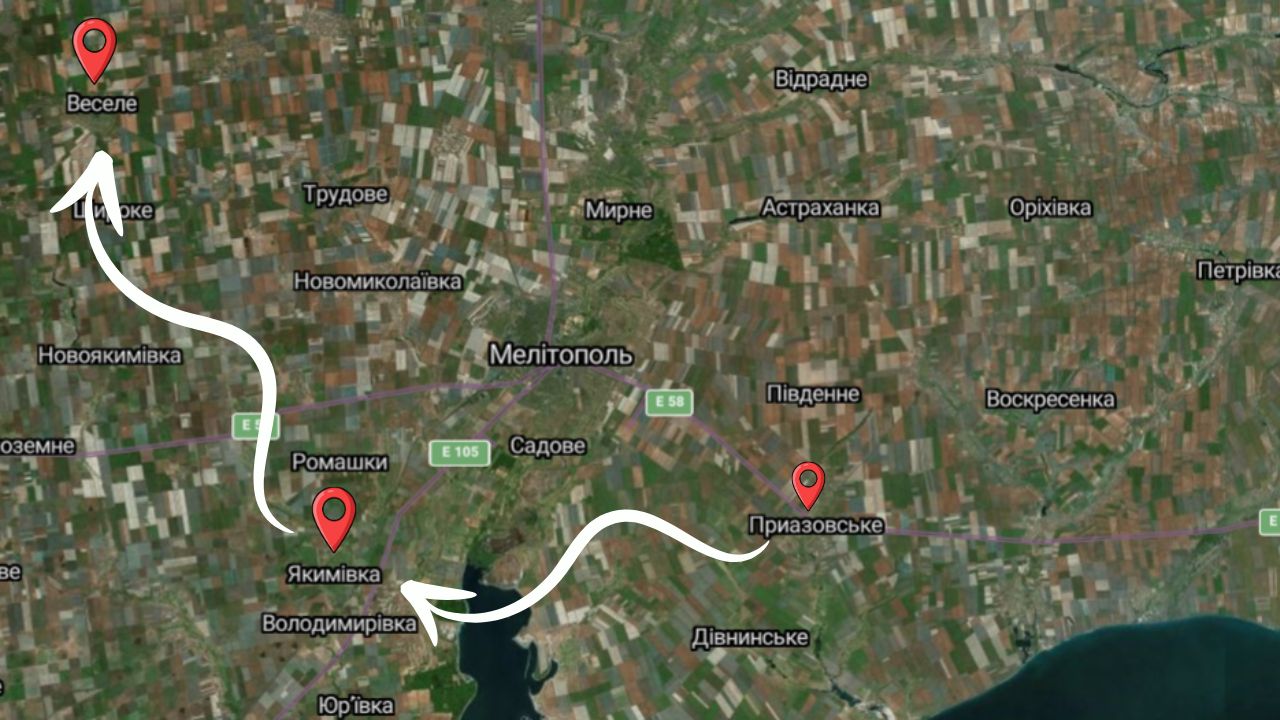
After her detention in Yakymivka, Lyudmila Chub was transferred to the detention center in the village of Vesele. There, she was able to communicate with other detainees, as they were taken out for walks together. In Vesele, Lyudmila recalls, the detainees were treated slightly better than in other places: they were allowed to walk for two hours. However, packages from family members were not always allowed—it all depended on the guard. Once, on New Year’s Eve, family members sent fruit to one of the detainees, but she never received it.
Lyudmila Chub’s
probable route of movement In Veselyi, the detainees were also put to work doing manual labor. The men, in particular, were forced to fill sandbags and build fortifications. In this detention center, the occupiers also liked to play the Russian national anthem. Lyudmila recalls a guard who introduced himself as a teacher from Saratov, where he had previously taught at a vocational school and earned 16,000 rubles a month. The man came to work as a guard at the occupation detention center for a higher salary.
Deportation
In February 2024, Lyudmila Chub was taken to court once again. The occupiers checked on the equipment the woman had filmed in 2022. It turned out that everything was fine with it, so they released her.
They constantly reproached me for this. One of them—I didn’t see who, because my eyes were blindfolded—would get into the car all the time and start: “Why don’t you like Russia so much?” And I’d say, “Why should I like it at all?”
Later, Lyudmila was ordered to go to the occupation immigration service, where she signed a document stating that she would be deported. They didn’t give her a hard copy of the document; instead, the FSB handed her a computer and a phone. Lyudmila was also forced to record a video stating that she does not accept the regime of the Russian Federation and does not agree with it. After that, they put her on a bus and drove her away. “The Frenchman” asked where Chub was going. She replied that she was going to Kyiv or Zaporizhzhia.
And he said, “Oh, well, we’ll be in Zaporizhzhia in a month.” I said nothing.
On March 21, 2024, Lyudmila Chub crossed the border into Russia. Five other captives were traveling with her. They were taken by bus through Rostov to the Caucasus. At 6 a.m., they were taken to the Georgian border, but they didn’t manage to cross until evening.
Lyudmila’s story is one of the few in which a person detained under occupation ultimately manages to regain their freedom. Those she met in detention centers, as well as other civilians from Melitopol, remain behind bars.
Author: Yana Gubska
Melitopol, a city in the steppe region located in the south of Zaporizhzhia Oblast, is of strategic importance. Its occupation created a convenient corridor for Russia between Crimea and the southern regions of the Donbas. And the city was occupied almost instantly. Russian forces outnumbered Ukrainian forces several times over, so by February 26, 2022, Melitopol was already fully under the control of the Russian Armed Forces. The first purges began. And the first abductions of civilians.
The longer the city remains under Russian occupation, the further the invaders’ tentacles spread. After some time, Russian passports began to be issued in Melitopol. It is possible to refuse one, but doing so is very likely to create additional problems for the person and their family. Pressure is applied to those who express their dissatisfaction. This is exactly what happened to Lyudmila Chub.
Lyudmila Chub worked at a cosmetics store. A year and a half after the Russian occupation began, the store owners forced her to take Russian citizenship, threatening to fire her. Lyudmila went to the occupation passport office.
“No passport, no job,” Lyudmila recalls. “So I had to do it.” I have a video of myself standing at the passport office, outraged at how many people had been forced to get these “fake” passports. Well, a security guard saw that. From then on, everything snowballed.
Lyudmila Chub. Photo: Heroine’s
Facebook page The security guard at the passport office turned out to be Russian. He took the woman to the occupation police. There, she was interrogated by the FSB. Among other things, they checked Chub’s phone, where they found a video she had made in 2022. The video shows Russian military equipment, with Lyudmila’s commentary on the occupiers’ actions playing in the background. Among the media files were also recordings of the enemy’s equipment locations in the park, which the woman later sent to a journalist.
“When they saw everything, they said they’d put me in prison for 20 years. And I just looked around, wondering what kind of circus I’d gotten myself into, and couldn’t make head or tail of it,” says Chub. “They questioned me about why I was filming the video.” I replied that I was just filming from memory.
Eventually, they confiscated her passport and phone and detained her for three days, locking her up in the Melitopol temporary detention center (ITT). No one asked if she was hungry; they said she “wasn’t allowed” to eat.
The detention center is located next to the Primary Health Care Center and the Melitopol District State Administration
Toward the end of the third day of detention, Lyudmila Chub was taken home so they could conduct a search. During the search, the Russians found a Ukrainian flag and patriotic ribbons.
I sometimes hung up signs that read “Melitopol—Ukraine.” I wasn’t a member of any organizations; I just did it on my own.
They took the woman’s computer, phones, flash drives, and money. After that, they took her to the FSB.
The FSB office in a house
of prayer The FSB agents had set up their office in a house of prayer. Even though she had a bag over her head, she spotted a large painting of Jesus Christ on the wall and realized where they had taken her. Two Russians began interrogating her about her ties to the Ukrainian Armed Forces.
They asked, “Where did you get the money?” And I just looked at them like they were idiots. What was I supposed to tell them? “Were you at the rally?” — “Yes, I was. So what?” Then they started saying that I had organized these rallies. And I just stared at them in disbelief: “Who organized them?! I was there twice.”
Lyudmila recalls that the Russians who interrogated her were over 40 years old; one of them went by the call sign “Frenchman.” After the interrogation, she was taken back to the temporary detention center, where the head was a Caucasian man nicknamed “Beard.” He promised that if they didn’t find anything on Lyudmila’s confiscated computer that they wouldn’t like, she would be released.
Representatives of the Russian Federal Security Service (FSB), among others, are responsible for the illegal detentions of Ukrainians in the occupied territories. Illustrative photo
Chub spent 15 days in the temporary detention center—“The Frenchman” arranged for the occupation court to impose an administrative penalty on her, allegedly for violating the curfew. After her term expired, the occupation court—composed largely of collaborators—repeatedly imposed administrative penalties on her for eight consecutive months. Throughout this time, the woman was held in captivity. The court hearings, she says, lasted five minutes each.
Later, “Beard” took the woman to the FSB office. On the way, he talked about the brutal Ukrainians and claimed that Russians had found Nazi literature and symbols in libraries. When Lyudmila Chub was brought to the FSB for the second time, she protested, asking, “How much longer are they going to keep shuttling me around like this?!” The occupiers began yelling at her, twisted her arms behind her back, and bound them with duct tape.
I struggled and screamed. They taped my hands, but I tore the tape off. They looked at me and said, “Okay, now handcuffs.” I don’t know how, but I managed to free one of my hands from them.
Lyudmila Chub. Photo: The heroine’s
Facebook page Imprisonment in Pryazovsk, Yakymivka, and Vesele
After new detainees began arriving at the Melitopol temporary detention center, they decided to transfer Lyudmila Chub to the Priazovsk temporary detention center:
— In Priazovsk, I didn’t even see a pat of butter. In the morning, they gave us soup or borscht. In the summer—some kind of salad, and at the end of the day—kefir or ryazhenka with a roll. The food was terrible.
Later, Chub was transferred to Yakymivka, where the worst ordeal for her was the constant checks, fingerprinting, saliva samples, and polygraph tests—a total of 24 times:
I told them that with all those fingerprints, they could already pave the road to Moscow and back.
After her detention in Yakymivka, Lyudmila Chub was transferred to the detention center in the village of Vesele. There, she was able to communicate with other detainees, as they were taken out for walks together. In Vesele, Lyudmila recalls, the detainees were treated slightly better than in other places: they were allowed to walk for two hours. However, packages from family members were not always allowed—it all depended on the guard. Once, on New Year’s Eve, family members sent fruit to one of the detainees, but she never received it.
Lyudmila Chub’s
probable route of movement In Veselyi, the detainees were also put to work doing manual labor. The men, in particular, were forced to fill sandbags and build fortifications. In this detention center, the occupiers also liked to play the Russian national anthem. Lyudmila recalls a guard who introduced himself as a teacher from Saratov, where he had previously taught at a vocational school and earned 16,000 rubles a month. The man came to work as a guard at the occupation detention center for a higher salary.
Deportation
In February 2024, Lyudmila Chub was taken to court once again. The occupiers checked on the equipment the woman had filmed in 2022. It turned out that everything was fine with it, so they released her.
They constantly reproached me for this. One of them—I didn’t see who, because my eyes were blindfolded—would get into the car all the time and start: “Why don’t you like Russia so much?” And I’d say, “Why should I like it at all?”
Later, Lyudmila was ordered to go to the occupation immigration service, where she signed a document stating that she would be deported. They didn’t give her a hard copy of the document; instead, the FSB handed her a computer and a phone. Lyudmila was also forced to record a video stating that she does not accept the regime of the Russian Federation and does not agree with it. After that, they put her on a bus and drove her away. “The Frenchman” asked where Chub was going. She replied that she was going to Kyiv or Zaporizhzhia.
And he said, “Oh, well, we’ll be in Zaporizhzhia in a month.” I said nothing.
On March 21, 2024, Lyudmila Chub crossed the border into Russia. Five other captives were traveling with her. They were taken by bus through Rostov to the Caucasus. At 6 a.m., they were taken to the Georgian border, but they didn’t manage to cross until evening.
Lyudmila’s story is one of the few in which a person detained under occupation ultimately manages to regain their freedom. Those she met in detention centers, as well as other civilians from Melitopol, remain behind bars.
This is an automatic translation generated by DeepL.