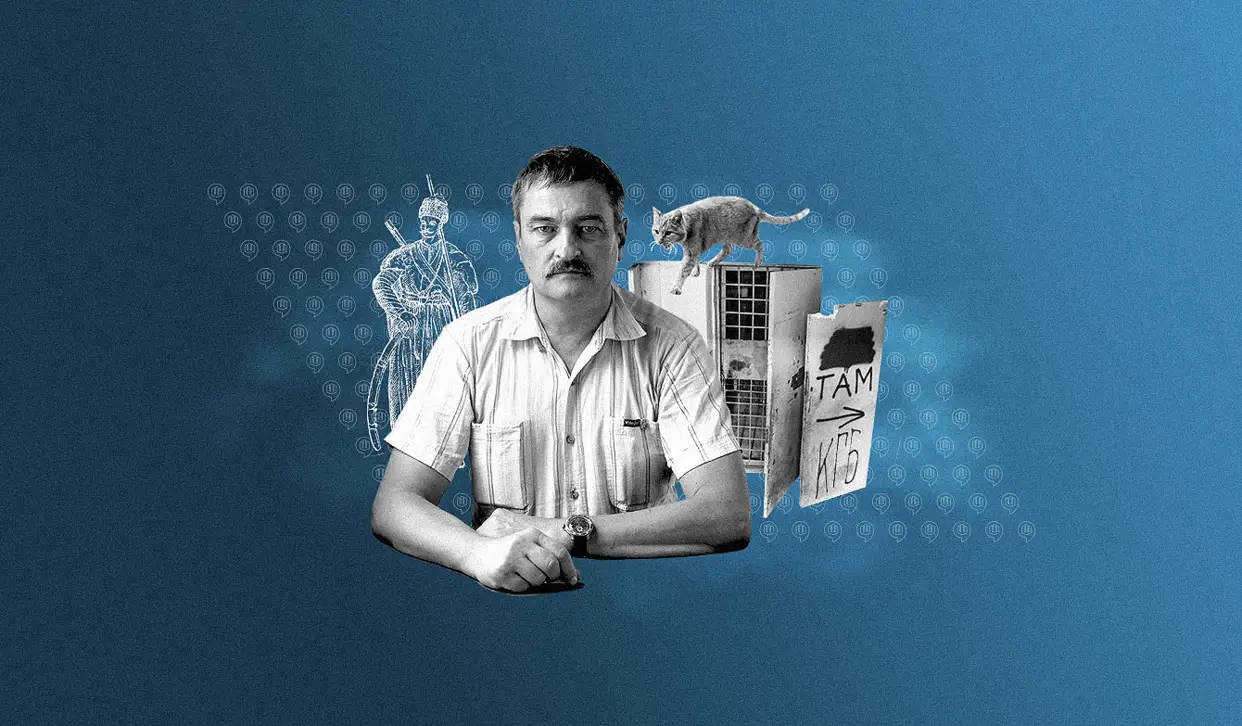
"Historian, you bitch, if you refuse, I'll wipe you out." How Oleksiy Patalah, a native of Kherson, survived the torture chamber and outwitted the FSB
Source: Signal to Resist
Author: Olena Pavlenko
The occupation of Kherson lasted eight months. During that time, the Russians managed to set up 11 torture chambers in the city and the region. There, they created hell on earth not only for local patriots, military personnel, and members of the resistance movement, but also for completely random people who happened to cross paths with the enraged occupiers.
Oleksiy Patalah, a local historian and writer, was held in one of these camps. He was threatened with torture and forced to participate in Russian propaganda. Eventually, the prisoner managed to escape.
Two years later, Oleksiy described the methods the FSB uses to recruit supporters in their dungeons and how his knowledge of the history of the Russian Empire helped him save his life and health.
“The Reckoning Came Before the Elections”
Now, as Oleksiy Patalakh lives in Kherson under constant shelling—but free—he often recalls the peaceful and, it would seem, carefree years that preceded the occupation. He still harbors considerable resentment toward both the local leadership, which neglected the city, and Kyiv’s indifference—it is in these, the historian believes, that the seeds of the tragedy that befell the Ukrainian South lie.
Oleksiy Patalah was born in Kherson, where he grew up and received his education in the 1980s, when the city had already been completely Russified. His paternal grandfather instilled in him a love for the Ukrainian language and history—it was from him that young Oleksa learned that he had Cossacks among his ancestors. It was then that he decided for himself that he would become a Cossack at any cost.
As he grew older, he enrolled in the history department at Mykolaiv Pedagogical University, though he had already begun studying Cossack registers while still in high school. It was then that he became fascinated by the works of historian Dmytro Yavornytskyi and wanted to create something similar, even though in the late 1990s and early 2000s, the mood in the south was not exactly pro-Ukrainian.
“The history of the Kherson region was always taught like this: the Scythians, the Sarmatians, then a gap—boom—Catherine II appears,” Patalah explains. “Frankly, I got tired of it, so I tried to fill that gap. Meanwhile, back here in the ’90s, some retirees started shouting: ‘Kherson is a Russian city; Ukrainians—get out of Kherson!’”
In 2005, Oleksiy Patalah published his first book—a travel guide titled *A Journey Through the Kherson Region*. It was written in Russian but with Ukrainian content: about Cossack churches, monasteries, burial mounds, ancient settlements, estates, and Zaporizhian crosses, as well as natural landmarks.
Later, the local historian published several more works—on the Zaporizhian Cossacks’ participation in the Russo-Turkish War and Cossack settlements in the Kherson region. By that time, he was already a member of a local Cossack organization. It was there that he met Kherson politician Volodymyr Saldo, who would later play a tragic role in the city’s history—in the spring of 2022, he would betray Ukraine and head the occupation administration. Back then, in 2002, the politician ran for mayor for the first time.
“Saldo came to our community before the election to win our support. Before that, the old neighborhoods were falling apart, and everything was being plundered. But under Saldo, this policy continued,” recalls Oleksiy Patalah. “I wouldn’t say he was ideologically pro-Russian; he was an ideologically driven fighter for money. His worldview was this: to take as many kickbacks as possible. Under Saldo, the active demolition of old neighborhoods began, and when he was finally ousted, I breathed a sigh of relief.”
In 2012, Saldo was elected to parliament as a member of the “Party of Regions.” Local money-lovers were replaced by outsiders. According to the historian, Kherson did not accept the people from Donetsk because they were squeezing out local businessmen and trying to take everything over. That is why the city welcomed the Revolution of Dignity with open arms.
After the Maidan, interest in the past grew. Oleksiy Patalah completed a tour guide training course and threw himself headlong into studying the city’s history, not suspecting that he would soon be discussing it in an interrogation room with FSB officers.
“I asked, ‘Will they shoot me?’ And they said, ‘We’ll roast you and eat you.’”
With the outbreak of full-scale war, Oleksiy Patalah tried to join the ranks of the territorial defense forces: he approached an acquaintance, the deputy commander of a local territorial defense battalion, but the man refused—a few months earlier, the historian had suffered from severe COVID-19 pneumonia, so he could neither run nor lift heavy objects.
Patalah returned home and fell ill again with a fever, so he didn’t leave the house during the first weeks of the occupation and learned about events from his wife’s accounts. He says that as long as the regular army was in the city, it was relatively quiet, but at the end of March 2022, the Rosgvardia arrived, and brutal crackdowns on protests and a reign of terror began.
“The Rosgvardia knows how to disperse protests very aggressively, although, as front-line soldiers say, on the battlefield they ran away like rabbits. Of all the state agencies, they’re the biggest thugs. They beat women, and they beat up an old man,” the historian recalls. “But a group of doctors secretly treated our wounded, giving them documents and civilian clothes so they could hide. My wife works at the Luchansky Hospital; that’s how I know about this.”
Like all patriotic Kherson residents, Patalah tried to avoid encounters with Russians. Soon he went to his dacha to keep a lower profile. However, in September 2022, he returned to the city to buy groceries for himself and his cat, who had the exotic name Philip Bedrosovich.
It was because of the cat that Oleksiy decided against leaving the occupied territory. By that time, the cat was already 20 years old and had led a difficult life. His former owners had abandoned him near a summer cottage community; the cat meowed so loudly that local summer residents nicknamed him Kirkorov—after his booming voice. At first, a neighbor took care of him; after the neighbor’s death, Alexei’s mother took over; and when she passed away, Alexei took care of him himself.
So on September 6, the local historian left his apartment to go to the market and restock on food for Philip Bedrosovich, but on the stairs he was surrounded by a group of armed, masked men. They ordered him to identify himself, took his passport, and when they read his last name, they said, “You’re the one we’re looking for.” They put handcuffs on him and shoved him back into the apartment, where they began turning everything upside down. It was then, Patalah recalls, that he realized just how uneducated the Russian special forces were.
“I concluded that the Russians are some kind of Neanderthals,” he explains. “Just before that, I’d poured out some grape juice and set it aside to steep. They asked, ‘What, are you making drugs?’ They saw a souvenir pistol and started looking for how to load it. They saw a whip and a bridle—“What, are you into sadomasochism?” And right next to them were my photos on horseback from a historical reenactment; they didn’t even make the connection.”
The Russian special forces tried with all their might to find evidence of Alexei’s ties to Ukrainian nationalists, while demonstrating incredible ignorance.
One of the group—the historian later learned it was the FSB’s “Antiterror” special unit—claimed he was a Kuban Cossack. But upon seeing a portrait on the wall of Zakhar Chepiga, the koshovo ataman who led the Cossacks from the Black Sea region to the Kuban, he asked, “Is that Bandera?”
The uninvited guests claimed that an ordinary winter cap was a cap of the SS “Galicia” Division. And these weren’t just uneducated Buryats or residents of the Russian backwoods where there’s no opportunity to get an education—even Russia’s elite security forces turned out to be completely illiterate.
Eventually, the security officers grew tired of the conversation about Cossacks and horses; they blindfolded Oleksii with his late mother’s scarf and ordered him to leave.
“I asked, ‘Are they going to shoot me?’” recalls the local historian. “And they said, ‘No, we’ll roast you and eat you.’”
Patalakh braced himself for death, but it soon turned out that the Russian propagandists desperately needed him alive.
“So, historian, where did the Ukrainians come from?”
An hour later, Oleksiy Patalakh was taken to a building, blindfolded, thrown into a cell, and told not to remove the blindfold until their footsteps in the hallway had faded away. The man sat motionless for a few minutes, made sure no one was near him, removed the scarf, and began to look around.
It was a solitary confinement cell with no sunlight, as the window was covered by a sheet of iron. Instead of a bed, there was a wooden platform. The prisoner realized he was in an SBU building in the city center. Later, a guard brought two buckets: one for water, the other for personal hygiene. Water could be drawn from the heating pipes. Of course, it wasn’t drinkable, but he had no choice but to use it.
That same day, Oleksiy met the head of the “Anti-Terrorist Unit,” nicknamed “The Raven.” He came to the cell himself and began questioning his prisoner about history. At first, he played the “good cop”—he said he had read the researcher’s books and praised them. But four days later, Oleksiy was taken to “Raven” for interrogation in his office—and there, the conversation took a completely different turn:
“He began questioning me: ‘So, historian, where did the Ukrainians come from? Russians lived here until the 1990s, then the Americans drove them out, brought in Ukrainians who were cloned, but you won’t be here much longer.” Most likely, this is how Russian technology works: they hammer all these ideas into people’s heads, and even intellectuals can come to believe such things. He claimed he had nothing against Ukraine as a cultural phenomenon. He said: “What, didn’t we let you wear vyshyvankas and dance the hopak?” That’s the extent of their understanding of Ukraine—the hopak and vyshyvankas.”
Oleksiy had to talk to “Voron” a few more times. It seemed to him that this officer was quite favorably disposed toward him—Patalakh might have appealed to the Russian with his monarchist views.
The historian wasn’t pretending here, because he truly believes that a monarchy is the best form of government, and “Voron,” as it turned out, fully shared this view. But during one of these interrogations, the occupier grew tired of playing “good cop,” and he strapped wire-covered cuffs to the prisoner’s hands. He tried to shock him with electricity—but nothing happened.
“He rushed to the car, shouting a barrage of profanities, with only a few non-profane words mixed in: ‘You can’t trust anyone—they’ve broken the car!’” recalls Oleksiy Patalah. “After that, no one was tortured for about five days.”
However, not everyone was lucky enough to avoid torture. During his month in captivity, the historian met many people.
Once, his cellmate was a 16-year-old teenager—he and his uncle had been stopped by patrol officers at a checkpoint while on their way to get medicine for his mother. In the end, they were forced to take off their shoes, driven into a pit, and shot at their feet, and then thrown behind bars.
There was also an ordinary salesman from the village of Bilozerka in the cell—one Russian National Guard officer didn’t like the way he served him, so he beat him so badly that the poor man couldn’t even see.
“Catching a real partisan is no easy task, so these FSB guys were grabbing anyone and everyone to meet their quota. There were a lot of guys from the market,” recalls Patalakh.
Even agreeing to side with the occupiers didn’t save anyone from torture. A former police officer from Oleshky was imprisoned alongside Oleksiy Patalah. After the occupation, his boss agreed to work for the Russians; Oleksandr figured he had to feed his family—so he also accepted his boss’s offer—but soon his boss was caught taking a bribe, so the Russians staged a show trial against all his subordinates—they needed to demonstrate their fight against corruption. The prisoner, Oleksiy says, was beaten so badly that an old fracture reopened.
From time to time, the historian heard screams and gunshots in the hallways.
Another form of torture was starvation. Now Oleksiy jokes that they were fed three times a day—on Monday, Wednesday, and Friday. They were given a spoonful of pasta or barley porridge and a hard cracker instead of bread—one so hard you could hammer nails with it. In a month, he lost so much weight that he had to punch two extra holes in his belt.
“I reminded myself of the monks from the early years of the Kyiv-Pechersk Lavra, who lived in caves and subsisted only on roots,” Oleksiy recalls.
But soon an opportunity arose to return home—the Russians offered a deal.
“‘The first toast—to Russia.’ And in a whisper: ‘Without clinking glasses.’”
Oleksiy now recalls that from the very beginning of his captivity, he decided to lull the enemy into a false sense of security in order to survive, and to do so, he pretended to agree with everything. As a role model, the historian chose a character from his favorite writer, Henryk Sienkiewicz—Pan Zagłoba, a cunning patriot who, thanks to his resourcefulness, managed to emerge unscathed from all his adventures.
However, at times this charade was incredibly difficult. Once, during an interrogation, “The Raven” asked about his relationship with a local activist and public figure, Nina Usachova. Oleksiy did not know that she, too, had already been arrested and imprisoned. He was forced to pretend that he would help them catch her, even though he hadn’t actually spoken to the activist since 2019.
“I left that interrogation with a heavy heart,” Patalah recalls.
However, after this conversation, his captors began to treat him much more leniently—they likely thought he had broken down psychologically and would do whatever they ordered. They brought him a Russian brochure titled “200 Years of Kherson” and ordered him to come up with a series of historical articles; in return, they gave him a better cell and allowed him longer walks. And soon, an investigator whom everyone called Palych said:
“Historian, get ready to go out—you’re going to give an interview.”
And indeed—Oleksiy Patalakh was once again blindfolded with a scarf, led out of prison, and driven home. There, he was ordered to shave and tidy up his room.
It turned out that the local historian had been released for an interview with the Russian news agency RIA Novosti. The propagandists chose as their topic the magazine *Ukrainian Cossacks*, which was published by émigrés in Chicago in the 1960s and 1970s. Patalakh recalls that a local journalist came to see him and began filming everything on his phone.
Oleksiy spoke, in particular, about Pavlo Shandruk, commander of the Ukrainian National Army, who agreed to collaborate with the German occupiers during World War II. The Germans ordered him to form the “Galicia-2” Division, but he tricked them and led the division not onto the battlefield, but straight into American captivity. Russian news outlets portrayed this as if Ukraine were glorifying Nazi collaborators.
After filming, the occupiers softened their stance and even allowed Oleksiy to bring homemade wine and jam into his cell. That day, he and his cellmate Vadym threw a celebration.
“We knew perfectly well that we were being bugged,” Patalah says. “So I poured the wine, raised our glasses, and proclaimed loudly, ‘The first toast—to Russia.’ And then, in a whisper: ‘Without clinking glasses.’ The second: ‘Shall we forget to drink to President Putin?’ Whispering: ‘May the earth be light upon him.’ So that’s the kind of banquet we threw. Prisons are kept afloat by a sense of humor.”
After the interview, investigator Palych finally decided that the Kherson historian was on their side and even offered him a position in the occupation administration. Realizing that things had gone too far, Oleksiy refused, citing poor health and a lack of education.
“And then he yells: ‘Historian, you son of a bitch, if you refuse—I’ll wipe you out!’ Vadik and I started thinking it over and decided we had to agree. If things go bad for them, I’ll run somewhere, hide, and wait until our people arrive. And if things go badly for our side, I’ll have access to information at the administration, and our underground network will be able to contact me from time to time,” Patalah decided at the time.
But there was no need to put this plan into action—October arrived, the Ukrainian Armed Forces were approaching Kherson, and explosions rang out every day as the Ukrainian army destroyed the Antonivsky Bridge. The occupiers had no time for propaganda, so they simply let Oleksiy go home. This happened on October 4—they blindfolded him again and drove him all the way to his building’s entrance.
“I walked into the apartment and couldn’t figure out for a long time why it smelled just like the cell,” Oleksiy says in surprise. “And then it turned out that snipers had set up an ambush for themselves in the apartment. They ate my food, drank my wine, and stole my clothespins. For some reason, they didn’t use the toilet; they relieved themselves in plastic bottles, which they hid behind the gas stove.”
But that didn’t really matter anymore—on November 11, 2022, Ukrainian troops liberated Kherson. A former prisoner of a Russian torture chamber hung a yellow-and-blue flag on his balcony—one he’d managed to hide from the occupiers inside an electric razor. When Ukrainian police returned to the city, he went to them on his own and told them about his days in the torture chamber.
Oleksiy believes that a sense of humor and solidarity helped him and the other FSB prisoners survive and endure—they shared everything they had with one another.
“Prisons are sustained by a sense of humor,” the historian believes.
***
Now, two years after Kherson’s liberation, Oleksiy’s life has changed.
His wife left the city in early November 2022, when the Russians began shelling the regional capital. She was granted asylum in Finland and still lives there.
His cat, Philip Bedrosovich, survived the occupation and died of old age in 2023.
The only thing that has remained unchanged is Oleksiy Patalakh’s interest in the history of the Kherson region. He continues to study history and occasionally gives lectures.
Author: Olena Pavlenko
The occupation of Kherson lasted eight months. During that time, the Russians managed to set up 11 torture chambers in the city and the region. There, they created hell on earth not only for local patriots, military personnel, and members of the resistance movement, but also for completely random people who happened to cross paths with the enraged occupiers.
Oleksiy Patalah, a local historian and writer, was held in one of these camps. He was threatened with torture and forced to participate in Russian propaganda. Eventually, the prisoner managed to escape.
Two years later, Oleksiy described the methods the FSB uses to recruit supporters in their dungeons and how his knowledge of the history of the Russian Empire helped him save his life and health.
“The Reckoning Came Before the Elections”
Now, as Oleksiy Patalakh lives in Kherson under constant shelling—but free—he often recalls the peaceful and, it would seem, carefree years that preceded the occupation. He still harbors considerable resentment toward both the local leadership, which neglected the city, and Kyiv’s indifference—it is in these, the historian believes, that the seeds of the tragedy that befell the Ukrainian South lie.
Oleksiy Patalah was born in Kherson, where he grew up and received his education in the 1980s, when the city had already been completely Russified. His paternal grandfather instilled in him a love for the Ukrainian language and history—it was from him that young Oleksa learned that he had Cossacks among his ancestors. It was then that he decided for himself that he would become a Cossack at any cost.
As he grew older, he enrolled in the history department at Mykolaiv Pedagogical University, though he had already begun studying Cossack registers while still in high school. It was then that he became fascinated by the works of historian Dmytro Yavornytskyi and wanted to create something similar, even though in the late 1990s and early 2000s, the mood in the south was not exactly pro-Ukrainian.
“The history of the Kherson region was always taught like this: the Scythians, the Sarmatians, then a gap—boom—Catherine II appears,” Patalah explains. “Frankly, I got tired of it, so I tried to fill that gap. Meanwhile, back here in the ’90s, some retirees started shouting: ‘Kherson is a Russian city; Ukrainians—get out of Kherson!’”
In 2005, Oleksiy Patalah published his first book—a travel guide titled *A Journey Through the Kherson Region*. It was written in Russian but with Ukrainian content: about Cossack churches, monasteries, burial mounds, ancient settlements, estates, and Zaporizhian crosses, as well as natural landmarks.
Later, the local historian published several more works—on the Zaporizhian Cossacks’ participation in the Russo-Turkish War and Cossack settlements in the Kherson region. By that time, he was already a member of a local Cossack organization. It was there that he met Kherson politician Volodymyr Saldo, who would later play a tragic role in the city’s history—in the spring of 2022, he would betray Ukraine and head the occupation administration. Back then, in 2002, the politician ran for mayor for the first time.
“Saldo came to our community before the election to win our support. Before that, the old neighborhoods were falling apart, and everything was being plundered. But under Saldo, this policy continued,” recalls Oleksiy Patalah. “I wouldn’t say he was ideologically pro-Russian; he was an ideologically driven fighter for money. His worldview was this: to take as many kickbacks as possible. Under Saldo, the active demolition of old neighborhoods began, and when he was finally ousted, I breathed a sigh of relief.”
In 2012, Saldo was elected to parliament as a member of the “Party of Regions.” Local money-lovers were replaced by outsiders. According to the historian, Kherson did not accept the people from Donetsk because they were squeezing out local businessmen and trying to take everything over. That is why the city welcomed the Revolution of Dignity with open arms.
After the Maidan, interest in the past grew. Oleksiy Patalah completed a tour guide training course and threw himself headlong into studying the city’s history, not suspecting that he would soon be discussing it in an interrogation room with FSB officers.
“I asked, ‘Will they shoot me?’ And they said, ‘We’ll roast you and eat you.’”
With the outbreak of full-scale war, Oleksiy Patalah tried to join the ranks of the territorial defense forces: he approached an acquaintance, the deputy commander of a local territorial defense battalion, but the man refused—a few months earlier, the historian had suffered from severe COVID-19 pneumonia, so he could neither run nor lift heavy objects.
Patalah returned home and fell ill again with a fever, so he didn’t leave the house during the first weeks of the occupation and learned about events from his wife’s accounts. He says that as long as the regular army was in the city, it was relatively quiet, but at the end of March 2022, the Rosgvardia arrived, and brutal crackdowns on protests and a reign of terror began.
“The Rosgvardia knows how to disperse protests very aggressively, although, as front-line soldiers say, on the battlefield they ran away like rabbits. Of all the state agencies, they’re the biggest thugs. They beat women, and they beat up an old man,” the historian recalls. “But a group of doctors secretly treated our wounded, giving them documents and civilian clothes so they could hide. My wife works at the Luchansky Hospital; that’s how I know about this.”
Like all patriotic Kherson residents, Patalah tried to avoid encounters with Russians. Soon he went to his dacha to keep a lower profile. However, in September 2022, he returned to the city to buy groceries for himself and his cat, who had the exotic name Philip Bedrosovich.
It was because of the cat that Oleksiy decided against leaving the occupied territory. By that time, the cat was already 20 years old and had led a difficult life. His former owners had abandoned him near a summer cottage community; the cat meowed so loudly that local summer residents nicknamed him Kirkorov—after his booming voice. At first, a neighbor took care of him; after the neighbor’s death, Alexei’s mother took over; and when she passed away, Alexei took care of him himself.
So on September 6, the local historian left his apartment to go to the market and restock on food for Philip Bedrosovich, but on the stairs he was surrounded by a group of armed, masked men. They ordered him to identify himself, took his passport, and when they read his last name, they said, “You’re the one we’re looking for.” They put handcuffs on him and shoved him back into the apartment, where they began turning everything upside down. It was then, Patalah recalls, that he realized just how uneducated the Russian special forces were.
“I concluded that the Russians are some kind of Neanderthals,” he explains. “Just before that, I’d poured out some grape juice and set it aside to steep. They asked, ‘What, are you making drugs?’ They saw a souvenir pistol and started looking for how to load it. They saw a whip and a bridle—“What, are you into sadomasochism?” And right next to them were my photos on horseback from a historical reenactment; they didn’t even make the connection.”
The Russian special forces tried with all their might to find evidence of Alexei’s ties to Ukrainian nationalists, while demonstrating incredible ignorance.
One of the group—the historian later learned it was the FSB’s “Antiterror” special unit—claimed he was a Kuban Cossack. But upon seeing a portrait on the wall of Zakhar Chepiga, the koshovo ataman who led the Cossacks from the Black Sea region to the Kuban, he asked, “Is that Bandera?”
The uninvited guests claimed that an ordinary winter cap was a cap of the SS “Galicia” Division. And these weren’t just uneducated Buryats or residents of the Russian backwoods where there’s no opportunity to get an education—even Russia’s elite security forces turned out to be completely illiterate.
Eventually, the security officers grew tired of the conversation about Cossacks and horses; they blindfolded Oleksii with his late mother’s scarf and ordered him to leave.
“I asked, ‘Are they going to shoot me?’” recalls the local historian. “And they said, ‘No, we’ll roast you and eat you.’”
Patalakh braced himself for death, but it soon turned out that the Russian propagandists desperately needed him alive.
“So, historian, where did the Ukrainians come from?”
An hour later, Oleksiy Patalakh was taken to a building, blindfolded, thrown into a cell, and told not to remove the blindfold until their footsteps in the hallway had faded away. The man sat motionless for a few minutes, made sure no one was near him, removed the scarf, and began to look around.
It was a solitary confinement cell with no sunlight, as the window was covered by a sheet of iron. Instead of a bed, there was a wooden platform. The prisoner realized he was in an SBU building in the city center. Later, a guard brought two buckets: one for water, the other for personal hygiene. Water could be drawn from the heating pipes. Of course, it wasn’t drinkable, but he had no choice but to use it.
That same day, Oleksiy met the head of the “Anti-Terrorist Unit,” nicknamed “The Raven.” He came to the cell himself and began questioning his prisoner about history. At first, he played the “good cop”—he said he had read the researcher’s books and praised them. But four days later, Oleksiy was taken to “Raven” for interrogation in his office—and there, the conversation took a completely different turn:
“He began questioning me: ‘So, historian, where did the Ukrainians come from? Russians lived here until the 1990s, then the Americans drove them out, brought in Ukrainians who were cloned, but you won’t be here much longer.” Most likely, this is how Russian technology works: they hammer all these ideas into people’s heads, and even intellectuals can come to believe such things. He claimed he had nothing against Ukraine as a cultural phenomenon. He said: “What, didn’t we let you wear vyshyvankas and dance the hopak?” That’s the extent of their understanding of Ukraine—the hopak and vyshyvankas.”
Oleksiy had to talk to “Voron” a few more times. It seemed to him that this officer was quite favorably disposed toward him—Patalakh might have appealed to the Russian with his monarchist views.
The historian wasn’t pretending here, because he truly believes that a monarchy is the best form of government, and “Voron,” as it turned out, fully shared this view. But during one of these interrogations, the occupier grew tired of playing “good cop,” and he strapped wire-covered cuffs to the prisoner’s hands. He tried to shock him with electricity—but nothing happened.
“He rushed to the car, shouting a barrage of profanities, with only a few non-profane words mixed in: ‘You can’t trust anyone—they’ve broken the car!’” recalls Oleksiy Patalah. “After that, no one was tortured for about five days.”
However, not everyone was lucky enough to avoid torture. During his month in captivity, the historian met many people.
Once, his cellmate was a 16-year-old teenager—he and his uncle had been stopped by patrol officers at a checkpoint while on their way to get medicine for his mother. In the end, they were forced to take off their shoes, driven into a pit, and shot at their feet, and then thrown behind bars.
There was also an ordinary salesman from the village of Bilozerka in the cell—one Russian National Guard officer didn’t like the way he served him, so he beat him so badly that the poor man couldn’t even see.
“Catching a real partisan is no easy task, so these FSB guys were grabbing anyone and everyone to meet their quota. There were a lot of guys from the market,” recalls Patalakh.
Even agreeing to side with the occupiers didn’t save anyone from torture. A former police officer from Oleshky was imprisoned alongside Oleksiy Patalah. After the occupation, his boss agreed to work for the Russians; Oleksandr figured he had to feed his family—so he also accepted his boss’s offer—but soon his boss was caught taking a bribe, so the Russians staged a show trial against all his subordinates—they needed to demonstrate their fight against corruption. The prisoner, Oleksiy says, was beaten so badly that an old fracture reopened.
From time to time, the historian heard screams and gunshots in the hallways.
Another form of torture was starvation. Now Oleksiy jokes that they were fed three times a day—on Monday, Wednesday, and Friday. They were given a spoonful of pasta or barley porridge and a hard cracker instead of bread—one so hard you could hammer nails with it. In a month, he lost so much weight that he had to punch two extra holes in his belt.
“I reminded myself of the monks from the early years of the Kyiv-Pechersk Lavra, who lived in caves and subsisted only on roots,” Oleksiy recalls.
But soon an opportunity arose to return home—the Russians offered a deal.
“‘The first toast—to Russia.’ And in a whisper: ‘Without clinking glasses.’”
Oleksiy now recalls that from the very beginning of his captivity, he decided to lull the enemy into a false sense of security in order to survive, and to do so, he pretended to agree with everything. As a role model, the historian chose a character from his favorite writer, Henryk Sienkiewicz—Pan Zagłoba, a cunning patriot who, thanks to his resourcefulness, managed to emerge unscathed from all his adventures.
However, at times this charade was incredibly difficult. Once, during an interrogation, “The Raven” asked about his relationship with a local activist and public figure, Nina Usachova. Oleksiy did not know that she, too, had already been arrested and imprisoned. He was forced to pretend that he would help them catch her, even though he hadn’t actually spoken to the activist since 2019.
“I left that interrogation with a heavy heart,” Patalah recalls.
However, after this conversation, his captors began to treat him much more leniently—they likely thought he had broken down psychologically and would do whatever they ordered. They brought him a Russian brochure titled “200 Years of Kherson” and ordered him to come up with a series of historical articles; in return, they gave him a better cell and allowed him longer walks. And soon, an investigator whom everyone called Palych said:
“Historian, get ready to go out—you’re going to give an interview.”
And indeed—Oleksiy Patalakh was once again blindfolded with a scarf, led out of prison, and driven home. There, he was ordered to shave and tidy up his room.
It turned out that the local historian had been released for an interview with the Russian news agency RIA Novosti. The propagandists chose as their topic the magazine *Ukrainian Cossacks*, which was published by émigrés in Chicago in the 1960s and 1970s. Patalakh recalls that a local journalist came to see him and began filming everything on his phone.
Oleksiy spoke, in particular, about Pavlo Shandruk, commander of the Ukrainian National Army, who agreed to collaborate with the German occupiers during World War II. The Germans ordered him to form the “Galicia-2” Division, but he tricked them and led the division not onto the battlefield, but straight into American captivity. Russian news outlets portrayed this as if Ukraine were glorifying Nazi collaborators.
After filming, the occupiers softened their stance and even allowed Oleksiy to bring homemade wine and jam into his cell. That day, he and his cellmate Vadym threw a celebration.
“We knew perfectly well that we were being bugged,” Patalah says. “So I poured the wine, raised our glasses, and proclaimed loudly, ‘The first toast—to Russia.’ And then, in a whisper: ‘Without clinking glasses.’ The second: ‘Shall we forget to drink to President Putin?’ Whispering: ‘May the earth be light upon him.’ So that’s the kind of banquet we threw. Prisons are kept afloat by a sense of humor.”
After the interview, investigator Palych finally decided that the Kherson historian was on their side and even offered him a position in the occupation administration. Realizing that things had gone too far, Oleksiy refused, citing poor health and a lack of education.
“And then he yells: ‘Historian, you son of a bitch, if you refuse—I’ll wipe you out!’ Vadik and I started thinking it over and decided we had to agree. If things go bad for them, I’ll run somewhere, hide, and wait until our people arrive. And if things go badly for our side, I’ll have access to information at the administration, and our underground network will be able to contact me from time to time,” Patalah decided at the time.
But there was no need to put this plan into action—October arrived, the Ukrainian Armed Forces were approaching Kherson, and explosions rang out every day as the Ukrainian army destroyed the Antonivsky Bridge. The occupiers had no time for propaganda, so they simply let Oleksiy go home. This happened on October 4—they blindfolded him again and drove him all the way to his building’s entrance.
“I walked into the apartment and couldn’t figure out for a long time why it smelled just like the cell,” Oleksiy says in surprise. “And then it turned out that snipers had set up an ambush for themselves in the apartment. They ate my food, drank my wine, and stole my clothespins. For some reason, they didn’t use the toilet; they relieved themselves in plastic bottles, which they hid behind the gas stove.”
But that didn’t really matter anymore—on November 11, 2022, Ukrainian troops liberated Kherson. A former prisoner of a Russian torture chamber hung a yellow-and-blue flag on his balcony—one he’d managed to hide from the occupiers inside an electric razor. When Ukrainian police returned to the city, he went to them on his own and told them about his days in the torture chamber.
Oleksiy believes that a sense of humor and solidarity helped him and the other FSB prisoners survive and endure—they shared everything they had with one another.
“Prisons are sustained by a sense of humor,” the historian believes.
***
Now, two years after Kherson’s liberation, Oleksiy’s life has changed.
His wife left the city in early November 2022, when the Russians began shelling the regional capital. She was granted asylum in Finland and still lives there.
His cat, Philip Bedrosovich, survived the occupation and died of old age in 2023.
The only thing that has remained unchanged is Oleksiy Patalakh’s interest in the history of the Kherson region. He continues to study history and occasionally gives lectures.
This is an automatic translation generated by DeepL.