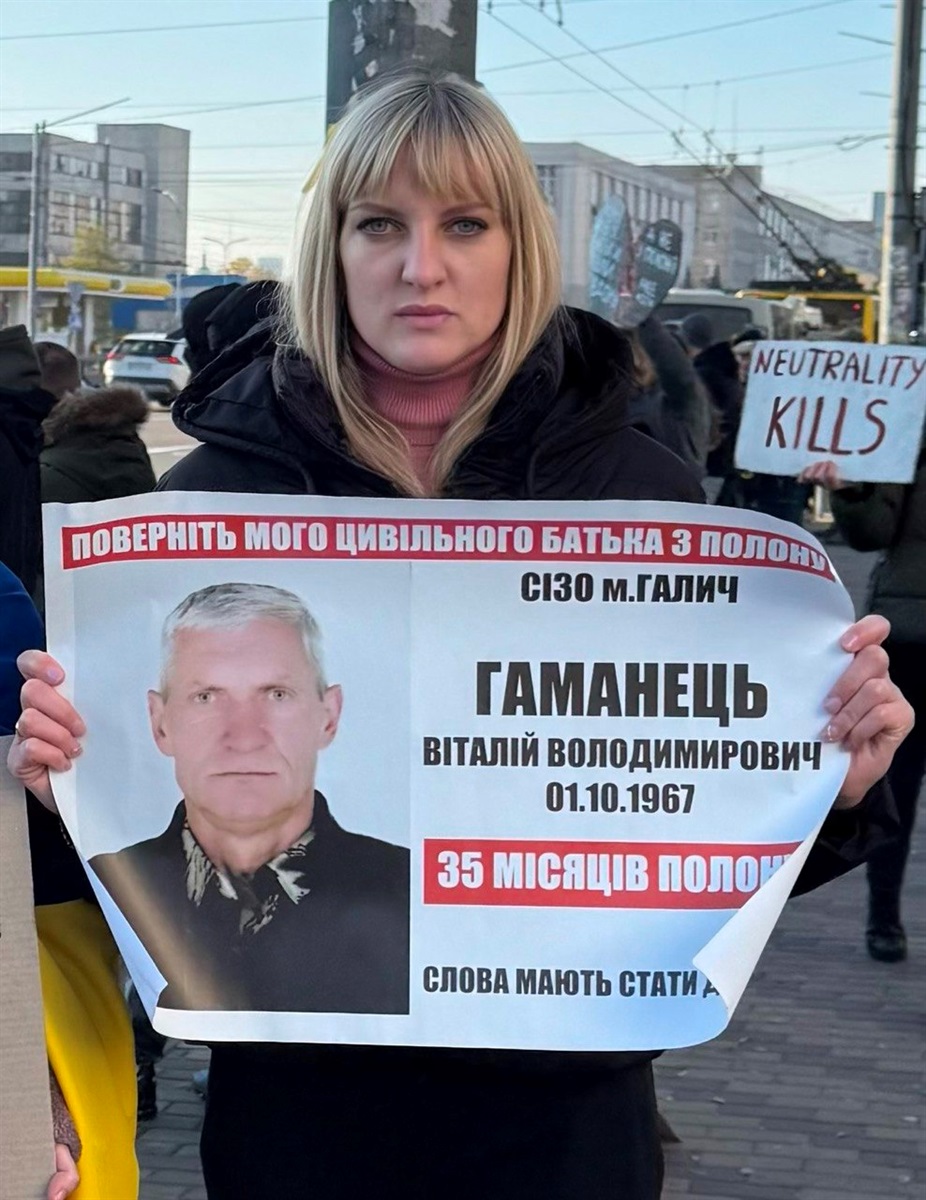
Keep searching, keep following the trail. The occupiers have been holding Vitaliy Hamants in captivity for three years—here is his story

Source: Svoi.City
Author: Anastasia KHARINA

The Occupiers’
Arbitrary Actions
Vitaliy’s daughter, Kateryna, was evacuated to Germany when the full-scale war began. Her father called her on April 9, 2022, at 5:00 p.m. He told her he was heading to another village to find shelter with an acquaintance because his house in Yegorivka had come under fire. The road to Blahodatne would not be easy, as he had to pass through numerous checkpoints manned by the occupiers.

Kateryna says that was the last time she heard her father’s voice. At one of the so-called “DNR” checkpoints, Vitalii was detained; they took his car, all his documents, and his personal belongings. Since then, neither Kateryna nor any other relatives have heard anything about Vitalii. Until the occupiers came themselves.

“Since the car my father used to leave the village belonged to my husband—who was also under occupation at the time—Russian soldiers came to his home and informed him that they had my father. They said just one thing: ‘Don’t look for him and forget about him. If you keep looking, you’ll end up following him,’ Kateryna recalls.

But despite the threats, the family immediately began filing reports about Vitaliy’s disappearance. They left information everywhere, hoping to get at least some result as quickly as possible—they used online platforms and reached out to international organizations. They tried on their own to find even the slightest bit of information about Vitaliy Hamants.

However, numerous appeals to the police, the Security Service of Ukraine (SBU), the International Committee of the Red Cross, the Coordination Headquarters, the Office of the President, and other agencies—including Russian ones—yielded no results; there was no news about Vitalii. His family could not find out where exactly he was or whether he was alive.

I often write letters to my dad, but I don’t know if he receives
them. After some time, Kateryna’s husband managed to leave the occupied territory and return to the area controlled by the Ukrainian government. He immediately filed a written report with the police regarding his relative’s disappearance. This report was also registered with the Security Service of Ukraine (SBU).

It wasn’t until a year after the search for Vitaliy Hamants began that his family managed to receive a letter from him through the Red Cross. He wrote that he was somewhere in Russia and was very hopeful for a prisoner exchange.

“I often write letters to Dad, telling him how much our family loves him, how we’re fighting for his release, and asking him not to lose hope. I send them through the Red Cross. But I don’t know if these letters are reaching him…,” Kateryna says sadly.

Bring my civilian father home from captivity!
Almost two years after his abduction, in January 2024, the family found for the first time a released prisoner who had been held in the same prison where Vitaliy Hamants was being detained. The man confirmed that he had seen him. For Kateryna, this was proof that her father was alive.

“To this day, there is still no mechanism in place that would allow for the return of civilian prisoners from the aggressor’s hands. In all this time—almost three years—not a single organization involved in the repatriation of prisoners has been able to answer the question: why is my father still in captivity? Technical and bureaucratic obstacles, the lack of a mechanism for returning civilians from Russian captivity, and the lack of a clear answer from government agencies—all of this leaves us in a dead end,” says the captive’s daughter.

In the fall of 2024, the family received another glimmer of hope—after yet another prisoner exchange, a soldier who had been held in the same cell as Vitalii confirmed his place of detention. The family again appealed to the authorities and met with representatives of the Coordination Headquarters and the Ombudsman’s Office, but so far to no avail.

To gather more information, Kateryna continued to seek out other relatives of people who had been or still were in captivity. In one of these groups, she found a young woman from Novomayorske in the Volnovakha district whose father had been taken prisoner on the same day as Vitaliy.

“This young woman is currently in Moscow, but she, too, has been unable to reach the authorities there or obtain any information about her father,” says Kateryna.

Vitaliy Hamants’s family hopes that everyone currently working to bring Ukrainians home from Russian captivity will develop a clear mechanism specifically for the return of civilians.

Kateryna’s appeal: “Bring my civilian father home from captivity”—this is the plea of Vitaliy Hamants’s family and the heartfelt cry of many Ukrainian families fighting to bring their loved ones home.

This is an automatic translation generated by DeepL.