One had his leg broken and was released; the other was also maimed and taken to Russia. What happened to the brothers from the Kyiv region?
Source: MIPL
Author: Natalia Bohuta
Melting snow on the roads, deserted streets where people occasionally ride by on bicycles or a few pedestrians walk—this is the village of Dymer in the Kyiv region in late November 2022. The weather here was about the same in March, when the region was under occupation by Russian troops. Back then, instead of civilian vehicles, the roads were filled with the occupiers’ military vehicles, and checkpoints were set up in several places where they thoroughly checked the documents of local residents and the photos on their phones.
Oleg Chernenko, 45, is a driver on the “Dymer–Kyiv” minibus route. He spent the entire occupation at home in Dymer with his wife and their young child, who turned seven months old in March. He says he wasn’t particularly worried because, despite the Russian positions near his home, he didn’t see any danger to himself or his family. Oleg’s brother, Andriy Pashchenko—a 38-year-old handyman—lived near Oleg’s home, on the fifth floor of a high-rise building. “Andriy decided to stay in Dymer; he didn’t want to leave, even though he had the chance to escape the occupation. But he said that this was his home, that he grew up here, so he would stay,” recalls his sister, Olga Volokhina, quoting Andriy’s words.
“They were looking for informants. They took him out into a field, beat him, and forced him to swallow a cross.”
The relatively peaceful life of Oleg Chernenko’s family under occupation came to an end on March 29.
“Everything had been normal up until that day. My brother Andriy would come by every day, then go home; we talked all the time. The Russians came to see me twice. Their main goal was to check what was on my phone. Once I went outside to smoke, and they told me, ‘Stop!’ They came into the house, checked my phone, looked through my car, searched for weapons, and examined the photos on my phone, but there was nothing suspicious,” Oleg Chernenko tells the MIPL. He points out that Russian military vehicles were stationed a few meters from the house, and in the village itself, the newly appointed occupation authorities were led by Oleksandr Kharchenko (a man detained by the SBU on suspicion of collaboration).
Oleg Chernenko—a resident of Dymer and the brother of the abducted Andriy Pashchenko /photo—MIPL
With no TV or internet, Oleg had to find out the latest news on his own—he drove around the surrounding villages. “I’d get in the car and drive around to see what was happening where—I was just curious. Of course, they’d stop me at the checkpoints and check my vehicle registration, but I’d just keep driving; nothing bad ever happened,” says Oleg. Until March 29, he was convinced that nothing bad would happen, even though on March 5 the occupiers had already captured Oleg’s sister’s husband—Vasyl Volokhin—and later took him to a pretrial detention center in Russia.
Oleg remembers March 29 down to the smallest detail, because that was the day the occupiers abducted him and his brother, Andriy Pashchenko, and took them away from Dymer.
“On the morning of March 29, two Russian cars pulled up to my house. They asked where my brother was. I replied that he was at his apartment. But a man from the 4th floor—Andriy’s neighbor, nicknamed Sokolyk—betrayed us; he told the Russians that we were spotters. They stood right here in my yard with their assault rifles. Half an hour later, they brought my brother back, blindfolded: ‘Come with us.’ They came up to us, blindfolded us and tied our hands, then took us away. “I don’t know where they took us—somewhere in a field outside the village; the wind was blowing so hard,” recalls Oleg Chernenko. He says that once they were taken out to the field, they and his brother were severely beaten—with fists and the butts of their guns. They shouted at the captives, accusing them of being coordinators and claiming that because of their activities, the Ukrainian Armed Forces had shelled their positions on the grounds of the “Viknaland” enterprise in Dymer.
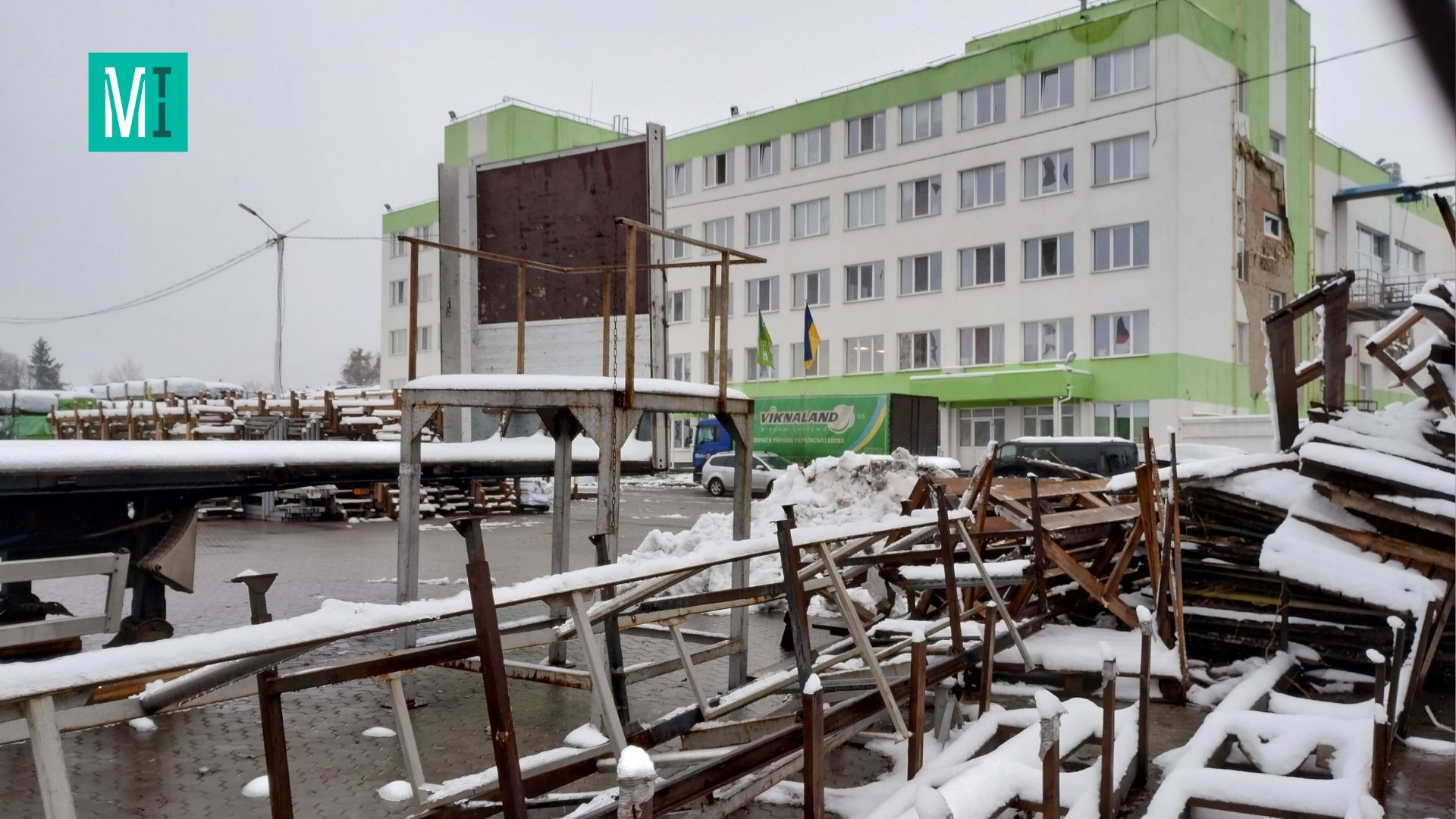
The “Viknaland” enterprise—hostages were held here in March / photo – MIPL
“They beat us severely. They forced me to swallow my gold cross—I couldn’t see, my eyes were blindfolded, but I just knew it. They broke my leg—the bone in my lower leg above the foot. Then they took us somewhere into the forest and threw us into a pit. At first, there were seven of us in that pit, and then they brought more—there were 13 captives in total, and we spent the night there on the bare ground,” says Oleg, showing his leg, which the occupiers later bound with sticks.
“They said the house was mined. But they were lying—we escaped from captivity.”
According to Oleg Chernenko’s testimony, on March 30, the occupiers informed the prisoners that some would be released, while others would be taken to Gostomel. It should be noted that Gostomel, as a hub for the occupiers’ transfer of captives, is frequently mentioned in conversations between MIHR correspondents and other witnesses of the occupation in the Kyiv region. In other words, it appears that the occupiers conducted the first screening of prisoners at the place of detention, the second in Gostomel, from where the captives were transported to Belarus, and then to various pretrial detention centers in Russia.
“They took me and seven other people to a house near Katyuzhanka. They said, ‘You’ll spend the night here, but the house is booby-trapped, so don’t go outside.’ The house was empty, so we stayed there for the night. We could hear their convoys passing down the street, but we didn’t realize they were already leaving the Kyiv region. My leg hurt, and we had no food or water. We knew nothing about my brother’s fate. “Was it cold? No, after a night in a pit, it wasn’t that cold in the unheated house,” says Oleg.
Andriy Pashchenko lived in this house in Dymer / photo – MIPL
All night long, the captives heard the rumble of Russian military vehicles—the Russians were leaving the Kyiv region. And in the morning, at their own risk, they opened the door. It turned out there were no landmines. On March 31, the prisoners were freed—they were set free in the literal sense, since there were no longer any Russians in Dymer or the surrounding villages.
“Then some guys came from Katyuzhanka and took me to the hospital in Dymer—my leg was broken, after all. Why did they let me go? I don’t know. I told them about my seven-month-old child; maybe they took pity on me. But they took my brother,” says Oleg Chernenko. He suspects that his brother also had a seriously injured leg as of March 30, when he last saw him. As for the shootings, Oleg did not witness such crimes. He says he heard shots fired into the ground to intimidate the prisoners. But he does not rule out the possibility that Russian soldiers killed someone. “There was an ATO veteran with us in the pit in the forest. I don’t know what happened to him; they might have killed him,” Oleg speculates.
“My brother Andriy is in prison in Russia. I received a letter from him, but nothing else is clear.”
Oleg’s wife, Oksana, reported her husband and his brother Andriy Pashchenko’s abduction to the police on the same day the occupiers took them both—March 29. Later, when Ukrainian military personnel, as well as investigators from the SBU, the prosecutor’s office, and police representatives, arrived in the village, Oleg repeatedly gave testimony about his own abduction and that of Andriy Pashchenko. He says that some people from the SBU and the police still periodically call to clarify details. But he knows nothing about the opening of a criminal case regarding Andriy’s captivity. “My mom went to submit a DNA sample. The authorities call endlessly. But what’s the point? I can’t even find out the name of the investigator handling this case, and I still can’t get a certificate confirming his captivity,” says Oleg Chernenko.
Center of the town of Dymer, Kyiv Oblast / Photo – MIPL
The man says that in the fall, a letter from the captive Andriy Pashchenko arrived via the International Committee of the Red Cross. “A letter came, and it said: ‘Hey, bro, say hi to Mom, Oleg, and the kids. Maybe we’ll meet.” Before that, there had been no reports confirming Andriy’s whereabouts. It was only from the letter that we realized he was in Russia, in captivity,” says Oleg Chernenko. In his opinion, Andriy may be held in the same Pretrial Detention Center No. 2 in the Bryansk region where his sister’s husband, Vasyl Volokhin, is being held.
Andriy Pashchenko, abducted by the Russians from Dymer / photo – MIPL
“The only confirmation that he is in Russia is a letter from Andriy that bears the ‘Russian Post’ stamp.” “I received this letter from Andriy in August; at the same time, I also received a letter from Vasyl’s husband,” says Andriy Pashchenko’s sister, Olga Volokhina.
She suspects that Andriy is being held in Pretrial Detention Center No. 2 in the Bryansk region. “Our local community has a list—it includes 56 captives. Many relatives of these people communicate on Telegram, and some have already been released from that pretrial detention center through prisoner exchanges, so we think Andriy might also be there,” says Olga. She adds that no official has informed the family of Andriy Pashchenko’s place of detention. Nor have the authorities made any promises to return civilians from Russian captivity. “When I was recently at a meeting at the Coordination Headquarters for the Treatment of Prisoners of War, they said that they submit general lists to Russia for prisoner exchanges—those lists include both civilians and military personnel. They submit the lists, and then the other side approves them—that’s how the exchanges take place,” Olga states.
She told the MIPL that UN representatives recently visited Dymer and advised the relatives of citizens taken to Russia to write a joint letter of appeal to Russia. “They say we need to write a letter to the Russian Ministry of Defense, and the UN representatives will oversee the mailing and delivery of this letter. Perhaps there will be some response from the Russian Ministry of Defense regarding the detainees from the Kyiv region. For now, we’re being told to wait—maybe there will be prisoner exchanges,” says Olga. Since March, two of her loved ones—her brother Andriy Pashchenko and her husband Vasyl Volokhin—have been held captive in Russia.
Author: Natalia Bohuta
Melting snow on the roads, deserted streets where people occasionally ride by on bicycles or a few pedestrians walk—this is the village of Dymer in the Kyiv region in late November 2022. The weather here was about the same in March, when the region was under occupation by Russian troops. Back then, instead of civilian vehicles, the roads were filled with the occupiers’ military vehicles, and checkpoints were set up in several places where they thoroughly checked the documents of local residents and the photos on their phones.
Oleg Chernenko, 45, is a driver on the “Dymer–Kyiv” minibus route. He spent the entire occupation at home in Dymer with his wife and their young child, who turned seven months old in March. He says he wasn’t particularly worried because, despite the Russian positions near his home, he didn’t see any danger to himself or his family. Oleg’s brother, Andriy Pashchenko—a 38-year-old handyman—lived near Oleg’s home, on the fifth floor of a high-rise building. “Andriy decided to stay in Dymer; he didn’t want to leave, even though he had the chance to escape the occupation. But he said that this was his home, that he grew up here, so he would stay,” recalls his sister, Olga Volokhina, quoting Andriy’s words.
“They were looking for informants. They took him out into a field, beat him, and forced him to swallow a cross.”
The relatively peaceful life of Oleg Chernenko’s family under occupation came to an end on March 29.
“Everything had been normal up until that day. My brother Andriy would come by every day, then go home; we talked all the time. The Russians came to see me twice. Their main goal was to check what was on my phone. Once I went outside to smoke, and they told me, ‘Stop!’ They came into the house, checked my phone, looked through my car, searched for weapons, and examined the photos on my phone, but there was nothing suspicious,” Oleg Chernenko tells the MIPL. He points out that Russian military vehicles were stationed a few meters from the house, and in the village itself, the newly appointed occupation authorities were led by Oleksandr Kharchenko (a man detained by the SBU on suspicion of collaboration).
Oleg Chernenko—a resident of Dymer and the brother of the abducted Andriy Pashchenko /photo—MIPL
With no TV or internet, Oleg had to find out the latest news on his own—he drove around the surrounding villages. “I’d get in the car and drive around to see what was happening where—I was just curious. Of course, they’d stop me at the checkpoints and check my vehicle registration, but I’d just keep driving; nothing bad ever happened,” says Oleg. Until March 29, he was convinced that nothing bad would happen, even though on March 5 the occupiers had already captured Oleg’s sister’s husband—Vasyl Volokhin—and later took him to a pretrial detention center in Russia.
Oleg remembers March 29 down to the smallest detail, because that was the day the occupiers abducted him and his brother, Andriy Pashchenko, and took them away from Dymer.
“On the morning of March 29, two Russian cars pulled up to my house. They asked where my brother was. I replied that he was at his apartment. But a man from the 4th floor—Andriy’s neighbor, nicknamed Sokolyk—betrayed us; he told the Russians that we were spotters. They stood right here in my yard with their assault rifles. Half an hour later, they brought my brother back, blindfolded: ‘Come with us.’ They came up to us, blindfolded us and tied our hands, then took us away. “I don’t know where they took us—somewhere in a field outside the village; the wind was blowing so hard,” recalls Oleg Chernenko. He says that once they were taken out to the field, they and his brother were severely beaten—with fists and the butts of their guns. They shouted at the captives, accusing them of being coordinators and claiming that because of their activities, the Ukrainian Armed Forces had shelled their positions on the grounds of the “Viknaland” enterprise in Dymer.
The “Viknaland” enterprise—hostages were held here in March / photo – MIPL
“They beat us severely. They forced me to swallow my gold cross—I couldn’t see, my eyes were blindfolded, but I just knew it. They broke my leg—the bone in my lower leg above the foot. Then they took us somewhere into the forest and threw us into a pit. At first, there were seven of us in that pit, and then they brought more—there were 13 captives in total, and we spent the night there on the bare ground,” says Oleg, showing his leg, which the occupiers later bound with sticks.
“They said the house was mined. But they were lying—we escaped from captivity.”
According to Oleg Chernenko’s testimony, on March 30, the occupiers informed the prisoners that some would be released, while others would be taken to Gostomel. It should be noted that Gostomel, as a hub for the occupiers’ transfer of captives, is frequently mentioned in conversations between MIHR correspondents and other witnesses of the occupation in the Kyiv region. In other words, it appears that the occupiers conducted the first screening of prisoners at the place of detention, the second in Gostomel, from where the captives were transported to Belarus, and then to various pretrial detention centers in Russia.
“They took me and seven other people to a house near Katyuzhanka. They said, ‘You’ll spend the night here, but the house is booby-trapped, so don’t go outside.’ The house was empty, so we stayed there for the night. We could hear their convoys passing down the street, but we didn’t realize they were already leaving the Kyiv region. My leg hurt, and we had no food or water. We knew nothing about my brother’s fate. “Was it cold? No, after a night in a pit, it wasn’t that cold in the unheated house,” says Oleg.
Andriy Pashchenko lived in this house in Dymer / photo – MIPL
All night long, the captives heard the rumble of Russian military vehicles—the Russians were leaving the Kyiv region. And in the morning, at their own risk, they opened the door. It turned out there were no landmines. On March 31, the prisoners were freed—they were set free in the literal sense, since there were no longer any Russians in Dymer or the surrounding villages.
“Then some guys came from Katyuzhanka and took me to the hospital in Dymer—my leg was broken, after all. Why did they let me go? I don’t know. I told them about my seven-month-old child; maybe they took pity on me. But they took my brother,” says Oleg Chernenko. He suspects that his brother also had a seriously injured leg as of March 30, when he last saw him. As for the shootings, Oleg did not witness such crimes. He says he heard shots fired into the ground to intimidate the prisoners. But he does not rule out the possibility that Russian soldiers killed someone. “There was an ATO veteran with us in the pit in the forest. I don’t know what happened to him; they might have killed him,” Oleg speculates.
“My brother Andriy is in prison in Russia. I received a letter from him, but nothing else is clear.”
Oleg’s wife, Oksana, reported her husband and his brother Andriy Pashchenko’s abduction to the police on the same day the occupiers took them both—March 29. Later, when Ukrainian military personnel, as well as investigators from the SBU, the prosecutor’s office, and police representatives, arrived in the village, Oleg repeatedly gave testimony about his own abduction and that of Andriy Pashchenko. He says that some people from the SBU and the police still periodically call to clarify details. But he knows nothing about the opening of a criminal case regarding Andriy’s captivity. “My mom went to submit a DNA sample. The authorities call endlessly. But what’s the point? I can’t even find out the name of the investigator handling this case, and I still can’t get a certificate confirming his captivity,” says Oleg Chernenko.
Center of the town of Dymer, Kyiv Oblast / Photo – MIPL
The man says that in the fall, a letter from the captive Andriy Pashchenko arrived via the International Committee of the Red Cross. “A letter came, and it said: ‘Hey, bro, say hi to Mom, Oleg, and the kids. Maybe we’ll meet.” Before that, there had been no reports confirming Andriy’s whereabouts. It was only from the letter that we realized he was in Russia, in captivity,” says Oleg Chernenko. In his opinion, Andriy may be held in the same Pretrial Detention Center No. 2 in the Bryansk region where his sister’s husband, Vasyl Volokhin, is being held.
Andriy Pashchenko, abducted by the Russians from Dymer / photo – MIPL
“The only confirmation that he is in Russia is a letter from Andriy that bears the ‘Russian Post’ stamp.” “I received this letter from Andriy in August; at the same time, I also received a letter from Vasyl’s husband,” says Andriy Pashchenko’s sister, Olga Volokhina.
She suspects that Andriy is being held in Pretrial Detention Center No. 2 in the Bryansk region. “Our local community has a list—it includes 56 captives. Many relatives of these people communicate on Telegram, and some have already been released from that pretrial detention center through prisoner exchanges, so we think Andriy might also be there,” says Olga. She adds that no official has informed the family of Andriy Pashchenko’s place of detention. Nor have the authorities made any promises to return civilians from Russian captivity. “When I was recently at a meeting at the Coordination Headquarters for the Treatment of Prisoners of War, they said that they submit general lists to Russia for prisoner exchanges—those lists include both civilians and military personnel. They submit the lists, and then the other side approves them—that’s how the exchanges take place,” Olga states.
She told the MIPL that UN representatives recently visited Dymer and advised the relatives of citizens taken to Russia to write a joint letter of appeal to Russia. “They say we need to write a letter to the Russian Ministry of Defense, and the UN representatives will oversee the mailing and delivery of this letter. Perhaps there will be some response from the Russian Ministry of Defense regarding the detainees from the Kyiv region. For now, we’re being told to wait—maybe there will be prisoner exchanges,” says Olga. Since March, two of her loved ones—her brother Andriy Pashchenko and her husband Vasyl Volokhin—have been held captive in Russia.
This is an automatic translation generated by DeepL.