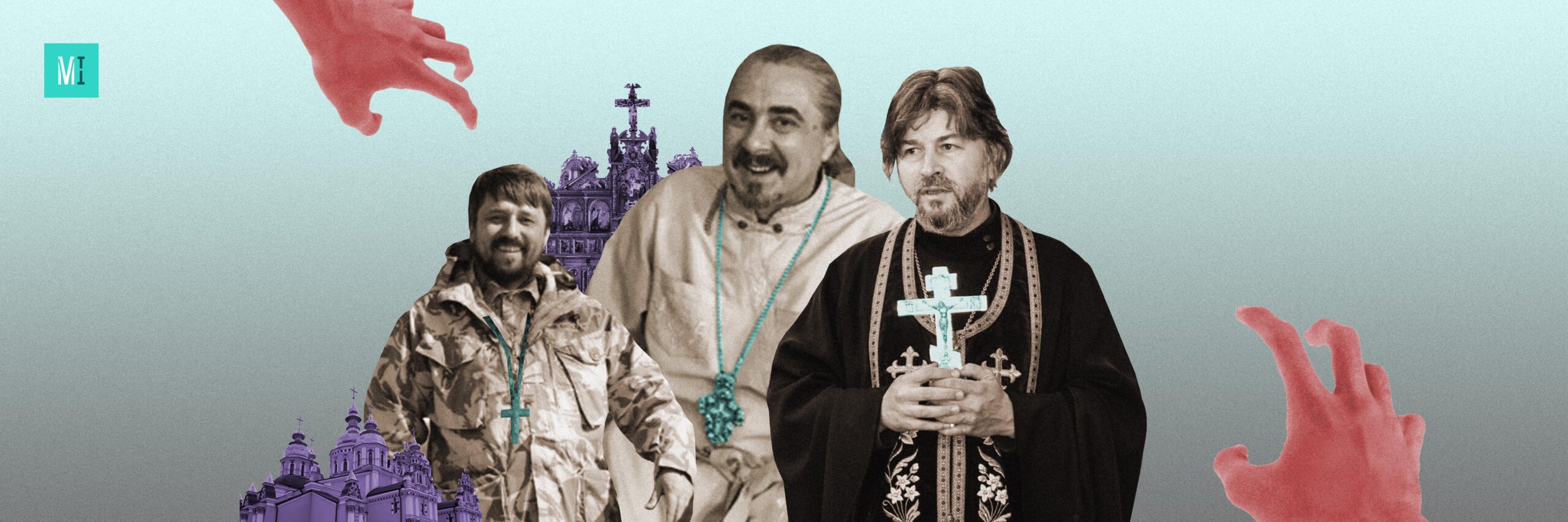
Priests Held Hostage: A Tactic of Influence and Intimidation
Source: MIPL
Author: Maria Klymik
Since the start of the war, Russian military personnel have been storming Ukrainian churches, conducting illegal searches, and detaining clergy, primarily from the Orthodox Church of Ukraine.
A Secret Mission to Zmiinyi
Island
On February 25, 2022, the Ukrainian Maritime Search and Rescue Service vessel “Sapphire” was dispatched to Zmiinyi Island to assist Ukrainian soldiers—who were believed to have been killed following shelling by Russian troops. Protopriest Vasyl Vyrozub, a clergyman of the Odesa Diocese of the OCU, was on board the vessel with the crew. The following day, it became known that on February 26, the rescue vessel had not been allowed to approach the island and was being held by Russian military forces. Virozub was among those detained.
“I received a phone call from Archpriest Vasyl Vyrozub stating that the vessel, the crew, and mission representatives are being escorted in an unknown direction. He also emphasized that there were no fallen soldiers on the island, and that the crew of the *Sapphire* had effectively become hostages,” Bishop Afanasy, head of the Odesa Diocese of the Orthodox Church of Ukraine, wrote in an official statement.
As the Main Intelligence Directorate of the Ukrainian Ministry of Defense later reported, the vessel was forcibly transported to the port of occupied Sevastopol. There is still no contact with the chaplain.
“This was a highly classified mission. I didn’t know he was on the ship. I found out only when he called and said he had been taken prisoner and needed to be rescued,” says Lyudmila, the wife of Archpriest Vasyl Vyrozub.
On March 24, a prisoner exchange took place; 19 Ukrainian civilian sailors from the rescue vessel “Sapphire” returned home, but Vasyl Vyrozub was not among them. “I’m in contact with representatives of the Red Cross and government officials regarding the exchange. But so far, there have been no results. Negotiations are still ongoing,” Bishop Afanasy told the International Center for Human Rights and Political Freedom (MIPL).
The Practice of Detentions
Subsequently, the practice of detaining clergy in the newly temporarily occupied territories continued.
For example, on March 14, Oleg Nikolaev, a priest of the OCU, was abducted from his home in occupied Berdyansk. Earlier, on his Facebook page, Father Oleg had posted a screenshot of threats he had received from the enemy on his phone. According to local parishioners, armed men surrounded the priest’s home, searched the premises, and arrested him, taking him to an unknown location. He was released the same day.
On March 16, the Information and Education Department of the Ukrainian Orthodox Church (UOC) reported the abduction of priest Gennadiy Batenko. Unidentified armed men broke into his home in the village of Tomashivka, Fastiv District, Kyiv Region, forcibly removed him from the house, and took him to an unknown location. And on March 17, Bishop Mykolai of Vasylkiv posted on his Facebook page that Father Gennadiy had already returned home.
On March 19, reports also emerged that Dmytro Bodiu, pastor of the “Word of Life” church in Melitopol, had been detained. According to eyewitness accounts, Russian soldiers stormed the pastor’s home on March 19, confiscated the cell phones of all his family members, searched the house, and then took Dmytro out onto the street and headed toward the church. According to the publication “All-Ukrainian Council,” Russian soldiers took the church’s charter documents and all office equipment from the church, and transported the pastor himself to an unknown location. The next day, soldiers returned to the church, took Dmytro’s sleeping bag and Bible, and banned the church from holding worship services, conducting charitable activities, and providing humanitarian aid. It is also known that Dmytro Bodiu is a U.S. citizen. Eleven days after his abduction, reports began to appear online that he had been released.
On March 30, unknown individuals broke into the Church of the Holy Mother of God in Kherson, identifying themselves as “police,” conducted a search, and took the rector, Serhiy Chudynovych, to an unknown location. That same day, the priest posted on his Facebook page that he had returned. In a video Sergei posted, he said: “I’m fine; they didn’t beat me. They talked a lot. They asked about everything—about peace issues, about the church, and about our social services. Then they asked the same questions over and over again. And then, sometime before curfew, they drove me there, dropped me off, and I walked back to the church.”
Possible Motives for the Abduction
Mykola Kikkas, a lawyer and legal expert at the Regional Center for Human Rights, says that the motives for the detention are difficult to determine.
“Usually, a motive is an element of behavior that is very difficult to establish, since it involves a person’s mental attitude toward their own actions. In other words, it is an element of behavior that we cannot see with our own eyes. Therefore, in each individual case, the exact motives for the abduction must be determined on a case-by-case basis, taking into account the nature of the occupiers’ actions, the victim’s own testimony, and so on. However, recalling the history of persecution of religious figures in the occupied territories of Crimea and Donbas since 2014, it is possible to identify the main probable motives for the abductions in the context of a full-scale invasion,” he explains.
Among them, Kikos lists:
– Forcing a priest to cooperate with the occupiers
Clergy are authoritative figures in their religious communities. And if, in addition to their pastoral ministry, they are actively involved in civic or volunteer work, they can also be influential in broader, non-church circles of society. By persuading a priest to cooperate, the occupiers aim to use him to convey their desired messages to the population.
– Intimidation to force silence
If the occupiers realize that they will not be able to persuade a priest to actively cooperate with them, the goal of applying pressure (including through abduction) may be to force him to remain silent and prevent him from inciting his congregation to resist the occupation.
– Pressure on religious denominations whose activities are “undesirable” to the occupying authorities
The Russian Federation is known for its practice of exerting pressure on religious organizations that, for one reason or another, do not fit into the ideological framework of the “Russian World.” This practice is observed both within Russia itself and in the territories it occupies. This involves the systematic persecution of Jehovah’s Witnesses, certain Protestant denominations, the Orthodox Church of Ukraine, and some other Orthodox churches that are not part of the Moscow Patriarchate. Through this persecution, the Russian authorities are attempting to “cleanse” the religious sphere of disloyal elements, either by forcing them out or coercing them into cooperation.
– Blackmail aimed at obtaining a ransom or replenishing the “exchange fund”
We should not rule out trivial, self-serving motives, where abductions occur with the aim of subsequently extorting a ransom from relatives or a religious community. In addition, abductions may also occur for the purpose of a subsequent exchange for Russian prisoners of war.
“Taking civilians in occupied territory hostage is categorically prohibited by Article 3 of the 1949 Geneva Convention relative to the Protection of Civilian Persons in Time of War. Hostage-taking, abduction, and arbitrary deprivation of liberty are also prohibited by customary rules of international humanitarian law (Rules 96, 98, 99). Violations of these laws and customs of war entail liability under Article 438 of the Criminal Code of Ukraine. “Furthermore, under the Rome Statute, such acts constitute war crimes, and therefore the perpetrators may be prosecuted by the International Criminal Court,” adds Mykola Kikkas, a legal expert at the Regional Center for Human Rights.
In the event that military chaplains are captured by the enemy (as in the case of Vasyl Vyrozub), the following should be kept in mind. Chaplains may be detained solely for the purpose of providing spiritual support to prisoners of war from the armed forces of their own state. If there is no such purpose, the chaplain must be released immediately.
“While under the authority of the enemy state, a chaplain—although not having the status of a prisoner of war—enjoys all the rights and privileges provided for by the 1949 Geneva Convention relative to the Protection of Prisoners of War,” explains the lawyer.
Author: Maria Klymik
Since the start of the war, Russian military personnel have been storming Ukrainian churches, conducting illegal searches, and detaining clergy, primarily from the Orthodox Church of Ukraine.
A Secret Mission to Zmiinyi
Island
On February 25, 2022, the Ukrainian Maritime Search and Rescue Service vessel “Sapphire” was dispatched to Zmiinyi Island to assist Ukrainian soldiers—who were believed to have been killed following shelling by Russian troops. Protopriest Vasyl Vyrozub, a clergyman of the Odesa Diocese of the OCU, was on board the vessel with the crew. The following day, it became known that on February 26, the rescue vessel had not been allowed to approach the island and was being held by Russian military forces. Virozub was among those detained.
“I received a phone call from Archpriest Vasyl Vyrozub stating that the vessel, the crew, and mission representatives are being escorted in an unknown direction. He also emphasized that there were no fallen soldiers on the island, and that the crew of the *Sapphire* had effectively become hostages,” Bishop Afanasy, head of the Odesa Diocese of the Orthodox Church of Ukraine, wrote in an official statement.
As the Main Intelligence Directorate of the Ukrainian Ministry of Defense later reported, the vessel was forcibly transported to the port of occupied Sevastopol. There is still no contact with the chaplain.
“This was a highly classified mission. I didn’t know he was on the ship. I found out only when he called and said he had been taken prisoner and needed to be rescued,” says Lyudmila, the wife of Archpriest Vasyl Vyrozub.
On March 24, a prisoner exchange took place; 19 Ukrainian civilian sailors from the rescue vessel “Sapphire” returned home, but Vasyl Vyrozub was not among them. “I’m in contact with representatives of the Red Cross and government officials regarding the exchange. But so far, there have been no results. Negotiations are still ongoing,” Bishop Afanasy told the International Center for Human Rights and Political Freedom (MIPL).
The Practice of Detentions
Subsequently, the practice of detaining clergy in the newly temporarily occupied territories continued.
For example, on March 14, Oleg Nikolaev, a priest of the OCU, was abducted from his home in occupied Berdyansk. Earlier, on his Facebook page, Father Oleg had posted a screenshot of threats he had received from the enemy on his phone. According to local parishioners, armed men surrounded the priest’s home, searched the premises, and arrested him, taking him to an unknown location. He was released the same day.
On March 16, the Information and Education Department of the Ukrainian Orthodox Church (UOC) reported the abduction of priest Gennadiy Batenko. Unidentified armed men broke into his home in the village of Tomashivka, Fastiv District, Kyiv Region, forcibly removed him from the house, and took him to an unknown location. And on March 17, Bishop Mykolai of Vasylkiv posted on his Facebook page that Father Gennadiy had already returned home.
On March 19, reports also emerged that Dmytro Bodiu, pastor of the “Word of Life” church in Melitopol, had been detained. According to eyewitness accounts, Russian soldiers stormed the pastor’s home on March 19, confiscated the cell phones of all his family members, searched the house, and then took Dmytro out onto the street and headed toward the church. According to the publication “All-Ukrainian Council,” Russian soldiers took the church’s charter documents and all office equipment from the church, and transported the pastor himself to an unknown location. The next day, soldiers returned to the church, took Dmytro’s sleeping bag and Bible, and banned the church from holding worship services, conducting charitable activities, and providing humanitarian aid. It is also known that Dmytro Bodiu is a U.S. citizen. Eleven days after his abduction, reports began to appear online that he had been released.
On March 30, unknown individuals broke into the Church of the Holy Mother of God in Kherson, identifying themselves as “police,” conducted a search, and took the rector, Serhiy Chudynovych, to an unknown location. That same day, the priest posted on his Facebook page that he had returned. In a video Sergei posted, he said: “I’m fine; they didn’t beat me. They talked a lot. They asked about everything—about peace issues, about the church, and about our social services. Then they asked the same questions over and over again. And then, sometime before curfew, they drove me there, dropped me off, and I walked back to the church.”
Possible Motives for the Abduction
Mykola Kikkas, a lawyer and legal expert at the Regional Center for Human Rights, says that the motives for the detention are difficult to determine.
“Usually, a motive is an element of behavior that is very difficult to establish, since it involves a person’s mental attitude toward their own actions. In other words, it is an element of behavior that we cannot see with our own eyes. Therefore, in each individual case, the exact motives for the abduction must be determined on a case-by-case basis, taking into account the nature of the occupiers’ actions, the victim’s own testimony, and so on. However, recalling the history of persecution of religious figures in the occupied territories of Crimea and Donbas since 2014, it is possible to identify the main probable motives for the abductions in the context of a full-scale invasion,” he explains.
Among them, Kikos lists:
– Forcing a priest to cooperate with the occupiers
Clergy are authoritative figures in their religious communities. And if, in addition to their pastoral ministry, they are actively involved in civic or volunteer work, they can also be influential in broader, non-church circles of society. By persuading a priest to cooperate, the occupiers aim to use him to convey their desired messages to the population.
– Intimidation to force silence
If the occupiers realize that they will not be able to persuade a priest to actively cooperate with them, the goal of applying pressure (including through abduction) may be to force him to remain silent and prevent him from inciting his congregation to resist the occupation.
– Pressure on religious denominations whose activities are “undesirable” to the occupying authorities
The Russian Federation is known for its practice of exerting pressure on religious organizations that, for one reason or another, do not fit into the ideological framework of the “Russian World.” This practice is observed both within Russia itself and in the territories it occupies. This involves the systematic persecution of Jehovah’s Witnesses, certain Protestant denominations, the Orthodox Church of Ukraine, and some other Orthodox churches that are not part of the Moscow Patriarchate. Through this persecution, the Russian authorities are attempting to “cleanse” the religious sphere of disloyal elements, either by forcing them out or coercing them into cooperation.
– Blackmail aimed at obtaining a ransom or replenishing the “exchange fund”
We should not rule out trivial, self-serving motives, where abductions occur with the aim of subsequently extorting a ransom from relatives or a religious community. In addition, abductions may also occur for the purpose of a subsequent exchange for Russian prisoners of war.
“Taking civilians in occupied territory hostage is categorically prohibited by Article 3 of the 1949 Geneva Convention relative to the Protection of Civilian Persons in Time of War. Hostage-taking, abduction, and arbitrary deprivation of liberty are also prohibited by customary rules of international humanitarian law (Rules 96, 98, 99). Violations of these laws and customs of war entail liability under Article 438 of the Criminal Code of Ukraine. “Furthermore, under the Rome Statute, such acts constitute war crimes, and therefore the perpetrators may be prosecuted by the International Criminal Court,” adds Mykola Kikkas, a legal expert at the Regional Center for Human Rights.
In the event that military chaplains are captured by the enemy (as in the case of Vasyl Vyrozub), the following should be kept in mind. Chaplains may be detained solely for the purpose of providing spiritual support to prisoners of war from the armed forces of their own state. If there is no such purpose, the chaplain must be released immediately.
“While under the authority of the enemy state, a chaplain—although not having the status of a prisoner of war—enjoys all the rights and privileges provided for by the 1949 Geneva Convention relative to the Protection of Prisoners of War,” explains the lawyer.
This is an automatic translation generated by DeepL.