The Ukrainian national anthem, sung softly, and daily prayers—Kateryna Skopina, a medical worker at a military hospital in Mariupol, explained what helped her endure nearly nine months in cap
Source: Vgolos
On December 6, 2022, the government announced that another 60 Ukrainian defenders had been freed from Russian captivity. The official statement noted that 58 men and two women had returned home.
One of these two women is Kateryna Skopina, an officer with the command of the military hospital in Mariupol.
She spent nearly nine months in captivity in a prison on Russian territory.
She is currently undergoing medical examinations. And she volunteered to tell her story. She explained it this way:
“My husband and many other women are still in captivity. Now that I’m home, I’ve learned how many people contributed to my release: they spoke out, wrote letters, took action, and prayed. I am grateful to everyone for this. And I ask for help in freeing all those who are still in captivity.”
Recalling the events of February this year, Kateryna says she had been living at work for quite some time. Although Russia’s full-scale invasion of Ukraine began on February 24, some fighting in the Donetsk region had already taken place earlier. So their hospital was providing care to the wounded. In addition, civilian hospitals in Mariupol were short on medical staff, so doctors from the hospital were also on duty there.
First and foremost, they evacuated the wounded
The woman says they first felt the airstrikes hitting the hospital back in February. And on March 16, a bomb fell on the intensive care unit.
When these bombings occurred, Kateryna was at the triage area where the wounded were being brought. So, the decision was made to move to the basements of the Illich Plant.
“There weren’t any bunkers there, like at Azovstal. We set up camp in the basements. But even there, we had to keep changing our location all the time because they were bombing us constantly. At first, everything was fine. But then traitors betrayed our positions. So the commander decided to change locations. We’d quickly pack up and leave. We evacuated the wounded first,” says Kateryna Skopina.
She adds that a monument should be erected to the doctors who treated the wounded in Mariupol during those days, because they gave their all to save the injured.
“We couldn’t stay in one place for long because drones were constantly circling overhead. And we were being fired upon with every weapon imaginable. We learned to recognize from the sounds what was being used to shoot at us, and whether the fighting was close by or far away. The walls were shaking constantly, and the exits were collapsing. But the doctors kept working,” she says.
Bronik is a dog who brings joy
As she recounts how the hospital operated under bombardment, Kateryna also mentions her beloved pet—a miniature silver poodle named Bronik.
When she was called to work, she took her dog with her. At home, she also had snails, a turtle, a parrot, and a hamster. Unfortunately, she wasn’t able to save them all. But Bronik stayed with the hospital staff until the moment they were taken prisoner.
“When a bomb hit the intensive care unit, he got lost somewhere. I ran around looking for him, crying. And then—another ‘strike.’ But I found him and took him to the basement,” says Kateryna Skopina.
During moments of respite, Bronik entertained the medical staff and the wounded as best he could. For example, he danced, jumped, and sang. To be honest, he sang along with the hostess.
“I sing well. He sings along. Sometimes he’d sing so loudly that you couldn’t even hear me. And when he sings, he throws his head back and falls over,” the woman says, laughing.
Her memories of Bronik are among the warmest from her time in the basements of the factory in Mariupol during the bombings.
Now, while talking to her daughter on the phone, Kateryna tells her that the snails, the parakeet, the hamster, and the turtle got dressed up and went to another home. And the dog found himself a bride and ran off to her.
Then came captivity
Kateryna recalls that day—April 12, 2022. The medics no longer had any medicine to treat the wounded. The enemy was constantly bombing them. And they had nothing with which to fight back. So the decision was made to attempt a breakthrough. The Ukrainian defenders hoped to break through to their own lines. Unfortunately, the attempt was unsuccessful.
“We didn’t know where we were going: whether to Azovstal or somewhere else. When our convoy set off to leave the plant, the Russians started firing ‘Grad’ rockets at us. The vehicle I was in was parked near the Christmas trees on the factory grounds, at the exit from Mariupol. If you turn left, there’s a detention center or a penal colony in Kam’yanka, where we were later held,” she says.
So they returned to the basements. That’s how the night passed.
In the morning, the medics took a white blanket and wrote the number 300 on it, which means “wounded.”
But the enemy was already on the factory grounds. Kateryna Skopina now believes they were soldiers from the so-called “DNR.” And they began taking them prisoner.
The woman admits that she managed to get her hands on a pistol. She isn’t supposed to have a weapon at work. But at that moment, she thought that if they tried to abuse her while she was in captivity, she would use that pistol to try to defend herself and take a few enemies with her to the afterlife.
She also wanted to keep her gold trident-shaped earrings, which her parents had given her. She thought she could hide them in her mouth. However, at the last moment, she threw away both the pistol and the earrings.
The first thing her enemies did was start searching them and taking their belongings: if anyone had a computer or phone, nice clothes, or anything else, they took it all.
Kateryna was also carrying Bronika in her arms. Someone rushed up to her and struck her hands, and the puppy fell out. The woman hopes that he ran away somewhere, that someone picked him up, and is taking care of him. After all, he’s so kind and friendly.
Love Above All
Else For nearly a month, right up until they were taken prisoner, Kateryna’s husband, Marine Igor Dmitrikovsky, was by her side. He arrived at the hospital when the Russians bombed the intensive care unit and was ordered to stay there and help.
“We didn’t have any stretchers, so he carried the wounded in his arms. He carried them down to the basement,” she says.
Kateryna and Igor last saw each other on April 13. At that time, using her knowledge as a psychologist, she persuaded her captors to let her see her husband.
Igor Dmitrikovsky
They were even allowed to board the same bus that was transporting Ukrainian defenders to the site of their initial detention.
“We traveled from Mariupol to Olenivka for almost 12 hours. We were told that the Russians had already captured the entire Donetsk region. But along the way, I saw that they had lied. I said to my husband, ‘Igor, they really fooled us.’ And he said to me, ‘Quiet, the guards are listening to what we’re saying,’ ” Kateryna recalls.
On the bus, Igor took off his wedding ring and gave it to his wife. She really wanted to keep it. So she ripped open a seam in her underwear and hid it there.
But, unfortunately, in one of the prisons, the women who were being held captive were stripped naked and searched down to every seam in their clothing.
“The wedding ring was still there in Valuyki. But when they transferred us to Kursk, it was already gone,” she says.
Upon returning to Ukraine, Kateryna immediately began inquiring about her husband’s fate. First of all, she asked the men who had been freed on the same day she was. Unfortunately, however, no one could tell her anything.
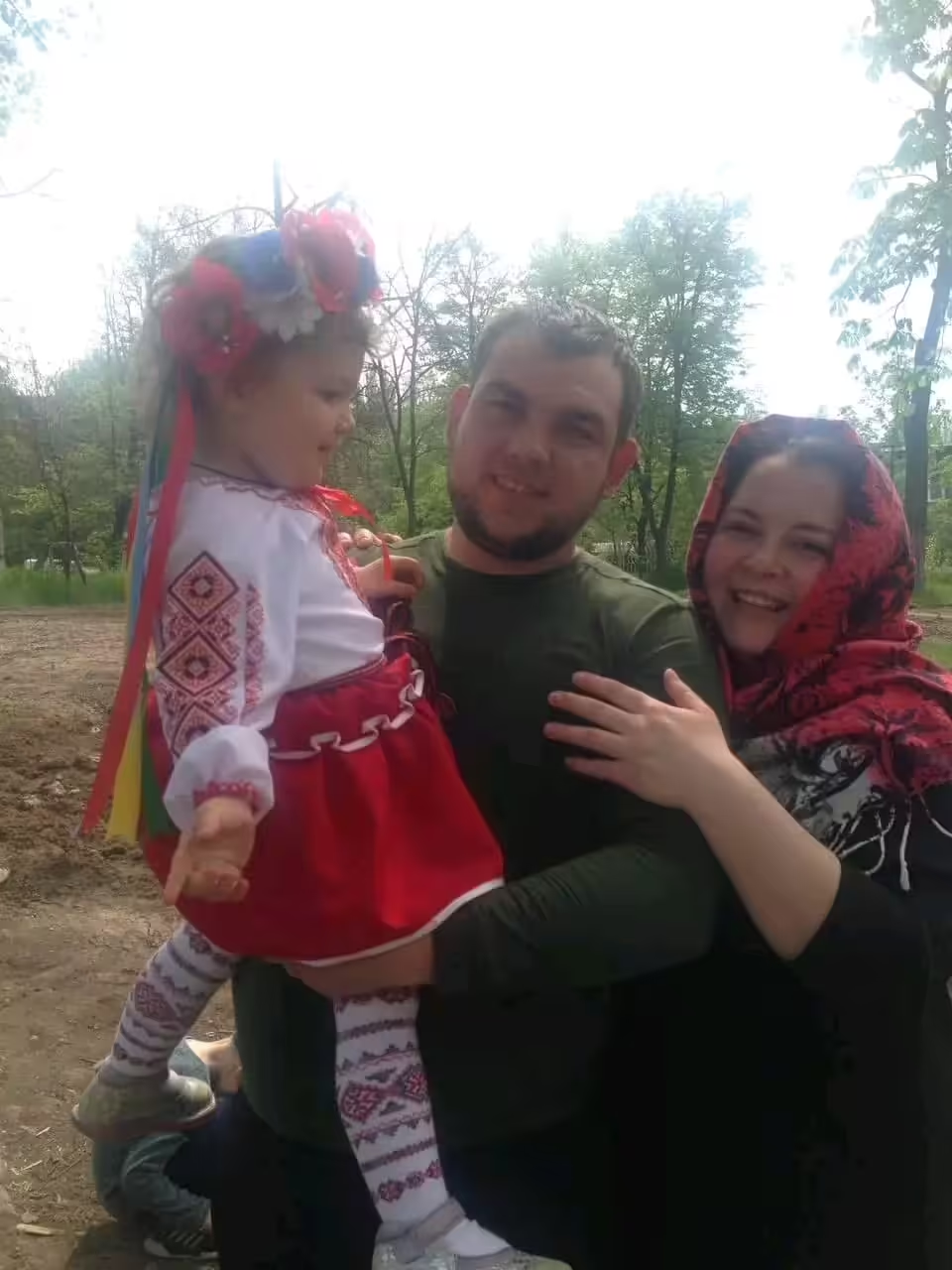
Kateryna with her husband and daughter. A photo from her previous happy life
Kateryna with her husband and daughter. A photo from their previous happy life
She then turned to the command of the unit where Igor Dmitrikovsky served. But she didn’t learn anything there either.
“The command told me that his last name is constantly included in the lists for exchange. That he is on the territory of the Russian Federation. And that we have to wait. Today they told me, ‘If we had the chance, we would have already gone and brought him back,’ says Kateryna.
But for her, every day of waiting is torture.
Why does she have her hair in a braid? It’s not allowed!
Returning to what she had to endure in captivity, Kateryna recalls that the worst treatment was in Taganrog.
“They gave us food three times a day. But it was impossible to eat it. Even a starving dog wouldn’t eat that. ‘Soup made from husks,’ she says.”
By comparison, the food was better in other places.
She recalls that during the first days of captivity in Olenivka, all the female medical personnel were kept together. But in Taganrog, they were separated: officers were placed in one building, sergeants and soldiers in another.
Kateryna Skopina says that their day began at six in the morning.
“The national anthem plays. Then comes roll call, breakfast, lunch, and dinner. And the day ended at 10 p.m. with the same anthem. In between, they’d be called in for interrogations,” she says, briefly describing a typical day in captivity.
Some of the prisoners agreed to work and went to the sewing workshops. But Kateryna herself refused such “kindness,” knowing full well that, according to the Geneva Conventions, no one could force her to do so.
While in captivity, the Russians suspected that Kateryna Skopina was a sniper. They were led to this conclusion by the calluses on her fingers. In the end, they still couldn’t understand why Ukrainian women defend their homeland and fellow citizens so passionately.
As for hygiene, she was finally able to wash her hair for the first time on May 24.
“I had my hair braided. By the way, they don’t like braids in Russia. They probably associate braids with our national symbol—ears of wheat. They demanded that we unbraid our hair. And when I refused, the guard in Taganrog threatened to bring scissors and cut them off. I replied, ‘If that brings you pleasure and joy, then I feel sorry for you,’ the woman says.
Prayers and the Ukrainian
National Anthem Even while in captivity, Kateryna thought more about her fellow prisoners than about herself. She supported them as best she could.
The women talked about food, about who liked to cook what, and shared recipes.
She also dreamed of returning home and thought about what renovations she would make at her parents’ house. After all, she knew that her apartment in Mariupol had been destroyed.
“I thought about where I’d put the bed, where the table would go. What kind of wardrobe I’d buy, what kind of shelves there would be. Where my daughter’s bed would go. I even decided it would be a bunk bed: she’d sleep on top, and her desk would be on the bottom,” she says.
And they also sang songs.
Kateryna admits that on Ukraine’s Independence Day, they sang the Ukrainian national anthem. All together.
“I sang louder. The girls sang more quietly. And when they forced us to sing the Russian anthem, everyone expected me to start singing, ‘Ukraine Has Not Yet Perished.’ Because they didn’t say which anthem we were supposed to sing. And every time, I wanted to clarify which one,” the woman laughs.
The women who were held captive also prayed every day, in the morning and in the evening. They would sit in a circle and, at a signal, begin their prayer.
“On August 24, we agreed that as soon as I sneezed, we’d start. I sneeze loudly. And that day, I sneezed even louder. We prayed for Ukraine,” says Kateryna.
Punishment—Solitary Confinement
The woman says that the prison guards never once managed to catch them singing the Ukrainian national anthem. Although on all Ukrainian national holidays, the Ukrainian women felt they were treated worse.
But the indomitable Kateryna demanded that she and her fellow prisoners be treated in accordance with the Geneva Conventions. She even urged everyone to go on a hunger strike.
“I reminded them that we are not prisoners, but prisoners of war. Therefore, they must provide us with information in accordance with our status and treat us accordingly. I demanded that they inform us of our rights as prisoners of war. Perhaps we have the right to call home, write letters, or do something else. After all, we didn’t know any of this,” she says.
The girls agreed to write letters to the military commandant and informed the administration of the facility where they were being held. They wanted to find out about the exchange procedure. However, the administration found another way to respond: those who asked too many questions were placed in solitary confinement.
Kateryna spent an entire week there. She says her mental state was terrible.
Now, back in Ukraine, she is learning just how much was done to secure her release. And she hopes that no less effort will be made to secure the release of her husband, Igor Dmitrikovsky, and her friends.
“I’m currently undergoing medical examinations and treatment. I’ve also been offered rehabilitation in the Carpathians. I could have refused, but I agreed. I’m going to restore my health so that I’ll have the strength to help my husband recover when he returns home,” says Kateryna.
On December 6, 2022, the government announced that another 60 Ukrainian defenders had been freed from Russian captivity. The official statement noted that 58 men and two women had returned home.
One of these two women is Kateryna Skopina, an officer with the command of the military hospital in Mariupol.
She spent nearly nine months in captivity in a prison on Russian territory.
She is currently undergoing medical examinations. And she volunteered to tell her story. She explained it this way:
“My husband and many other women are still in captivity. Now that I’m home, I’ve learned how many people contributed to my release: they spoke out, wrote letters, took action, and prayed. I am grateful to everyone for this. And I ask for help in freeing all those who are still in captivity.”
Recalling the events of February this year, Kateryna says she had been living at work for quite some time. Although Russia’s full-scale invasion of Ukraine began on February 24, some fighting in the Donetsk region had already taken place earlier. So their hospital was providing care to the wounded. In addition, civilian hospitals in Mariupol were short on medical staff, so doctors from the hospital were also on duty there.
First and foremost, they evacuated the wounded
The woman says they first felt the airstrikes hitting the hospital back in February. And on March 16, a bomb fell on the intensive care unit.
When these bombings occurred, Kateryna was at the triage area where the wounded were being brought. So, the decision was made to move to the basements of the Illich Plant.
“There weren’t any bunkers there, like at Azovstal. We set up camp in the basements. But even there, we had to keep changing our location all the time because they were bombing us constantly. At first, everything was fine. But then traitors betrayed our positions. So the commander decided to change locations. We’d quickly pack up and leave. We evacuated the wounded first,” says Kateryna Skopina.
She adds that a monument should be erected to the doctors who treated the wounded in Mariupol during those days, because they gave their all to save the injured.
“We couldn’t stay in one place for long because drones were constantly circling overhead. And we were being fired upon with every weapon imaginable. We learned to recognize from the sounds what was being used to shoot at us, and whether the fighting was close by or far away. The walls were shaking constantly, and the exits were collapsing. But the doctors kept working,” she says.
Bronik is a dog who brings joy
As she recounts how the hospital operated under bombardment, Kateryna also mentions her beloved pet—a miniature silver poodle named Bronik.
When she was called to work, she took her dog with her. At home, she also had snails, a turtle, a parrot, and a hamster. Unfortunately, she wasn’t able to save them all. But Bronik stayed with the hospital staff until the moment they were taken prisoner.
“When a bomb hit the intensive care unit, he got lost somewhere. I ran around looking for him, crying. And then—another ‘strike.’ But I found him and took him to the basement,” says Kateryna Skopina.
During moments of respite, Bronik entertained the medical staff and the wounded as best he could. For example, he danced, jumped, and sang. To be honest, he sang along with the hostess.
“I sing well. He sings along. Sometimes he’d sing so loudly that you couldn’t even hear me. And when he sings, he throws his head back and falls over,” the woman says, laughing.
Her memories of Bronik are among the warmest from her time in the basements of the factory in Mariupol during the bombings.
Now, while talking to her daughter on the phone, Kateryna tells her that the snails, the parakeet, the hamster, and the turtle got dressed up and went to another home. And the dog found himself a bride and ran off to her.
Then came captivity
Kateryna recalls that day—April 12, 2022. The medics no longer had any medicine to treat the wounded. The enemy was constantly bombing them. And they had nothing with which to fight back. So the decision was made to attempt a breakthrough. The Ukrainian defenders hoped to break through to their own lines. Unfortunately, the attempt was unsuccessful.
“We didn’t know where we were going: whether to Azovstal or somewhere else. When our convoy set off to leave the plant, the Russians started firing ‘Grad’ rockets at us. The vehicle I was in was parked near the Christmas trees on the factory grounds, at the exit from Mariupol. If you turn left, there’s a detention center or a penal colony in Kam’yanka, where we were later held,” she says.
So they returned to the basements. That’s how the night passed.
In the morning, the medics took a white blanket and wrote the number 300 on it, which means “wounded.”
But the enemy was already on the factory grounds. Kateryna Skopina now believes they were soldiers from the so-called “DNR.” And they began taking them prisoner.
The woman admits that she managed to get her hands on a pistol. She isn’t supposed to have a weapon at work. But at that moment, she thought that if they tried to abuse her while she was in captivity, she would use that pistol to try to defend herself and take a few enemies with her to the afterlife.
She also wanted to keep her gold trident-shaped earrings, which her parents had given her. She thought she could hide them in her mouth. However, at the last moment, she threw away both the pistol and the earrings.
The first thing her enemies did was start searching them and taking their belongings: if anyone had a computer or phone, nice clothes, or anything else, they took it all.
Kateryna was also carrying Bronika in her arms. Someone rushed up to her and struck her hands, and the puppy fell out. The woman hopes that he ran away somewhere, that someone picked him up, and is taking care of him. After all, he’s so kind and friendly.
Love Above All
Else For nearly a month, right up until they were taken prisoner, Kateryna’s husband, Marine Igor Dmitrikovsky, was by her side. He arrived at the hospital when the Russians bombed the intensive care unit and was ordered to stay there and help.
“We didn’t have any stretchers, so he carried the wounded in his arms. He carried them down to the basement,” she says.
Kateryna and Igor last saw each other on April 13. At that time, using her knowledge as a psychologist, she persuaded her captors to let her see her husband.
Igor Dmitrikovsky
They were even allowed to board the same bus that was transporting Ukrainian defenders to the site of their initial detention.
“We traveled from Mariupol to Olenivka for almost 12 hours. We were told that the Russians had already captured the entire Donetsk region. But along the way, I saw that they had lied. I said to my husband, ‘Igor, they really fooled us.’ And he said to me, ‘Quiet, the guards are listening to what we’re saying,’ ” Kateryna recalls.
On the bus, Igor took off his wedding ring and gave it to his wife. She really wanted to keep it. So she ripped open a seam in her underwear and hid it there.
But, unfortunately, in one of the prisons, the women who were being held captive were stripped naked and searched down to every seam in their clothing.
“The wedding ring was still there in Valuyki. But when they transferred us to Kursk, it was already gone,” she says.
Upon returning to Ukraine, Kateryna immediately began inquiring about her husband’s fate. First of all, she asked the men who had been freed on the same day she was. Unfortunately, however, no one could tell her anything.
Kateryna with her husband and daughter. A photo from her previous happy life
Kateryna with her husband and daughter. A photo from their previous happy life
She then turned to the command of the unit where Igor Dmitrikovsky served. But she didn’t learn anything there either.
“The command told me that his last name is constantly included in the lists for exchange. That he is on the territory of the Russian Federation. And that we have to wait. Today they told me, ‘If we had the chance, we would have already gone and brought him back,’ says Kateryna.
But for her, every day of waiting is torture.
Why does she have her hair in a braid? It’s not allowed!
Returning to what she had to endure in captivity, Kateryna recalls that the worst treatment was in Taganrog.
“They gave us food three times a day. But it was impossible to eat it. Even a starving dog wouldn’t eat that. ‘Soup made from husks,’ she says.”
By comparison, the food was better in other places.
She recalls that during the first days of captivity in Olenivka, all the female medical personnel were kept together. But in Taganrog, they were separated: officers were placed in one building, sergeants and soldiers in another.
Kateryna Skopina says that their day began at six in the morning.
“The national anthem plays. Then comes roll call, breakfast, lunch, and dinner. And the day ended at 10 p.m. with the same anthem. In between, they’d be called in for interrogations,” she says, briefly describing a typical day in captivity.
Some of the prisoners agreed to work and went to the sewing workshops. But Kateryna herself refused such “kindness,” knowing full well that, according to the Geneva Conventions, no one could force her to do so.
While in captivity, the Russians suspected that Kateryna Skopina was a sniper. They were led to this conclusion by the calluses on her fingers. In the end, they still couldn’t understand why Ukrainian women defend their homeland and fellow citizens so passionately.
As for hygiene, she was finally able to wash her hair for the first time on May 24.
“I had my hair braided. By the way, they don’t like braids in Russia. They probably associate braids with our national symbol—ears of wheat. They demanded that we unbraid our hair. And when I refused, the guard in Taganrog threatened to bring scissors and cut them off. I replied, ‘If that brings you pleasure and joy, then I feel sorry for you,’ the woman says.
Prayers and the Ukrainian
National Anthem Even while in captivity, Kateryna thought more about her fellow prisoners than about herself. She supported them as best she could.
The women talked about food, about who liked to cook what, and shared recipes.
She also dreamed of returning home and thought about what renovations she would make at her parents’ house. After all, she knew that her apartment in Mariupol had been destroyed.
“I thought about where I’d put the bed, where the table would go. What kind of wardrobe I’d buy, what kind of shelves there would be. Where my daughter’s bed would go. I even decided it would be a bunk bed: she’d sleep on top, and her desk would be on the bottom,” she says.
And they also sang songs.
Kateryna admits that on Ukraine’s Independence Day, they sang the Ukrainian national anthem. All together.
“I sang louder. The girls sang more quietly. And when they forced us to sing the Russian anthem, everyone expected me to start singing, ‘Ukraine Has Not Yet Perished.’ Because they didn’t say which anthem we were supposed to sing. And every time, I wanted to clarify which one,” the woman laughs.
The women who were held captive also prayed every day, in the morning and in the evening. They would sit in a circle and, at a signal, begin their prayer.
“On August 24, we agreed that as soon as I sneezed, we’d start. I sneeze loudly. And that day, I sneezed even louder. We prayed for Ukraine,” says Kateryna.
Punishment—Solitary Confinement
The woman says that the prison guards never once managed to catch them singing the Ukrainian national anthem. Although on all Ukrainian national holidays, the Ukrainian women felt they were treated worse.
But the indomitable Kateryna demanded that she and her fellow prisoners be treated in accordance with the Geneva Conventions. She even urged everyone to go on a hunger strike.
“I reminded them that we are not prisoners, but prisoners of war. Therefore, they must provide us with information in accordance with our status and treat us accordingly. I demanded that they inform us of our rights as prisoners of war. Perhaps we have the right to call home, write letters, or do something else. After all, we didn’t know any of this,” she says.
The girls agreed to write letters to the military commandant and informed the administration of the facility where they were being held. They wanted to find out about the exchange procedure. However, the administration found another way to respond: those who asked too many questions were placed in solitary confinement.
Kateryna spent an entire week there. She says her mental state was terrible.
Now, back in Ukraine, she is learning just how much was done to secure her release. And she hopes that no less effort will be made to secure the release of her husband, Igor Dmitrikovsky, and her friends.
“I’m currently undergoing medical examinations and treatment. I’ve also been offered rehabilitation in the Carpathians. I could have refused, but I agreed. I’m going to restore my health so that I’ll have the strength to help my husband recover when he returns home,” says Kateryna.
This is an automatic translation generated by DeepL.