“Someone like you doesn’t need a lawyer.” A monologue by Marina Mishchenko, a former prisoner of war from the “Aidar” battalion—about Olenivka, the Donetsk pretrial detention center, and the
Source: Grati
Authors: Tetiana Kozak, Anastasia Moskvichova
On September 13, 2024, another prisoner exchange took place between Ukraine and Russia. Among the women returned by Russia at that time was Marina Mishchenko, a medic with the 24th Separate Assault Battalion “Aidar.” She was 25 years old when she was taken prisoner. This happened on March 11, 2022, during the Russian offensive in the Volnovakha sector. She was initially held in Olenivka and then in Donetsk, where she was tortured and accused of terrorism for her service in “Aidar.” The prisoner of war was then transferred to Pretrial Detention Center No. 1 in Rostov-on-Don and, along with 17 other Aidar members, was put on trial.
In 2016, the “DPR” designated the “Aidar” battalion as a terrorist organization, and in 2023, Russia added it to its list of terrorist organizations. In effect, the Aidar members were tried for serving in the battalion. This violates international humanitarian law, which prohibits the prosecution of military personnel for participating in combat operations, and constitutes a crime.
Mishchenko was one of two women in this group of prisoners; the other was 56-year-old medic Lilia Prutyan. Both were exchanged before the verdict was announced.
At a hearing on September 12, the court decided to separate their case into a separate proceeding “regarding the use of prohibited means and methods of warfare by representatives of Ukraine’s security forces.” The current status of this case is unknown.
The verdict for the men who remained in captivity was announced in October of this year. They were sentenced to prison terms ranging from 15 to 21 years.
After returning home, Marina Mishchenko underwent rehabilitation and returned to civilian life. In her monologue, she recalls her captivity, the trial, and her release.
“They were specifically targeting the Aidar fighters”
Our medical station was located in the village of Petrivske in the Donetsk region. The Russians began an intense offensive.
We had two evacuation vehicles, and we heard one of them explode. Since the Russians couldn’t open it, they simply shot it up, and the vehicle exploded. We realized then that we couldn’t go anywhere. To put it bluntly, the vehicles were parked across the road, not near our house—on purpose, so as not to give away our location. But the Russians were going door to door and entered our house. There were countless of them—they were all members of the “Akhmat” battalion, formed in Chechnya.
There were six of us at the medical station: the head of medical services, two drivers, a doctor, a medical instructor, and me. And they took all six of us together.
I found out [later] that many others had been taken as well. They took us all to one place—a school in the village of Petrivske. A very heavy mortar barrage began—so heavy that the building was literally crumbling. It was our own forces shelling them—they didn’t know we’d been taken prisoner: our communications had been jammed. I suffered a concussion and was unconscious. They tied me up. The Russians just threw us onto tanks: the girls separately, the boys separately.
And then they drove us around. For a very long time. They captured us on March 11, and I ended up at the Donetsk UBOZ—the Organized Crime Division—on the 19th. They drove us around to their various positions. Torture, interrogations, all that sort of thing.
They were specifically looking for Aidar fighters. They told us this themselves during the interrogations. I heard them talking about how they’d get a reward for the head of so-and-so or so-and-so.
The other girls and I said we were medics—they didn’t believe us. They asked for intelligence: positions, equipment, weapons, where things were located, where people were. I said, “How would I know? I’m just a medic at the medical station. I don’t have an officer’s rank; I don’t have any access.” They didn’t believe us. They said, “No, you’re a sniper,” as if they had evidence—testimony from others—that I’d undergone training.
I said, “Are you kidding me? I’m a medic.” They said, “No.” They insisted right up until the exchange itself—all of them, wherever I was—that Lilia Prutyan and I were snipers.
“I stayed in Olenivka for a month”
It didn’t matter to them whether we were a woman or a man. Our hands were tied, our eyes were blindfolded. There was an elderly man with us—a civilian in his 70s—and they beat him with sticks and whatever else they could get their hands on. They beat all of us.
At 9:00 p.m. on March 19, they brought us [to the Donetsk Organized Crime Control Department], and at dawn—to Olenivka, Colony No. 120, located in the occupied part of the Donetsk region, in the village of Molodizhne. After leaving “Azovstal” in late May 2022, Ukrainian defenders of Mariupol, including “Azov” fighters, were transported there. There, they were subjected to torture, and as a result of an explosion at the prison, at least 50 prisoners of war were killed and more than 70 were seriously injured. The full circumstances of the crime and those responsible have not been established, as Russia has never granted an independent investigation access to the prison.
I stayed in Olenivka for a month. There, I met Lilia [Prutyan]—I was surprised. She had been captured by other Russians in the same village [Petrivske]. She said that even while she was at the UBOZ, she knew she would meet me one way or another, because they were actively asking questions about me.
Lilia Prutyan and Marina Mishchenko at the Southern District Military Court in Rostov-on-Don. Photo: Mediazona
In Olenivka, the girls were held separately from the boys. The conditions there were terrible: no water, it was cold, and unsanitary. The shifts [of the guards] there were terrible. They tried not to bother the women too much at all—we were lucky in that regard. But as for the guys there… When they’d take in new arrivals—we’d just sit there and sob. They stood right under [our] cameras, and the prison guards were literally beating them to death right there. And we could hear it.
There were Kirill and Yura [prison staff members Kirill Shakurov and Yuriy Dmytrenko], who were tormenting the guys there. Everyone there knew about it. Olenivka, Kirill, and Yura—everyone was like, “Hmm, I see.”
At first, we were in the disciplinary isolation unit (DIZO). Well, everyone was there, because there weren’t many [prisoners]. But before they started bringing in the Azov fighters from “Azovstal”—after they’d surrendered—they began distributing everyone en masse to various prisons.
“You own nothing, you’re not allowed anything—you’ve forgotten who you are.”
On April 18, 2022, they took me away. A guard came for me and said, “They’ve come for you.” I asked, “Who?” He said, “Come with me.” I was like, “Well, okay.” I went out, and they put handcuffs on me: “A case has been opened against you for such-and-such; you’re suspected of such-and-such.”
In Olenivka, some investigators came to see me. They didn’t mention that an investigation was underway. Then they just presented me with a fait accompli—as I was leaving Olenivka, they informed me about the criminal case. And they took me to the prosecutor’s office. From that prosecutor’s office, they took me to the Donetsk pretrial detention center.
Well, the Donetsk pretrial detention center is a wonderful place, in quotation marks.
They put us in such horrible cells! A tiny little window through which you couldn’t even see the sky—you could only see the ground or the concrete floor and the [neighboring] building—that’s all. And even to see that, you had to climb onto the radiator and hold onto the bars on the window. The cell was meant for two people—but they crammed the four of us in there. Then they moved us to another cell, an even worse one.
We stayed there for a week. It was terribly cold; we were freezing. Then they transferred us to the basement. When more people arrived, they moved us to another cell—also cold—where there was absolutely nothing. And then, when they started bringing in a lot of girls [prisoners] from Olenivka, they moved us to yet another cell—a different one, this time for good—and that’s where we stayed until our departure for Rostov. It was a ten-person cell. There were 22 of us in there.
Every time we had to leave the cell [at the Donetsk pretrial detention center] was torture: no one wanted to go out, because they could beat us up, throw us to the ground dozens of times, and we could bang our heads against the iron door frames. This happened all the time. Plus—we were constantly forced to wear bags over our heads, soiled by cats and who knows who else.
Complete unsanitary conditions! The walls were crumbling, the ceilings were crumbling. The dampness is insane, the filth! They gave us some kind of mattresses—people had died and rotted on them a hundred times over. We weren’t allowed to have any personal belongings, and there were no hygiene products either. “You own nothing, you’re not allowed anything—have you forgotten who you are?!”
There was even a period—back when Donetsk was under shelling and their water supply was cut off—when they deliberately refused to give us water for over a week. Forget about washing—that wasn’t even an option. I don’t know if they were conducting some kind of experiment on us there, but we just started rotting away. We were rotting alive—you’d wake up covered in these pus-filled blisters, then wake up even more swollen, your body swelling up. I went to sleep feeling fine, and when I woke up, my leg was swollen, covered in pus-filled blisters this big. You call the medic, and he says, “Just use laundry soap.” We said, “Are you serious? The condition is already beyond gangrene—are you serious?” He said, “Laundry soap.”
We found out that this happened to everyone. Where the prisoners were held in the basement, practically everyone had this. Some kind of infection—maybe they slipped something into it; we don’t know.
Then Rostov started examining them. Because we were supposed to be tried in Rostov. The administration was terrified of what awaited them there—that they’d be in for it, so to speak. And a female doctor came in and started shining a flashlight on us, on everyone. When she saw us, she practically fell on her butt. “Oh my God, oh, horror, horror, horror.” They gave us medicine and more or less got us back on our feet.
“It’s so nice to sit among the dead”
In the detention center, a DNR investigator came up to me: “Sign the papers.” I said, “I’m not signing anything; I have every right to a lawyer.” He said, “Someone like you doesn’t need a lawyer.” As if to say, a lawyer won’t save you. I said, “I won’t sign.” He said, “We’ll beat the crap out of you, and you’ll sign anyway.” So I signed (obviously, I didn’t want to get beaten up), admitting that I was guilty of all these crimes they were charging me with—all that nonsense. Things like “seizure of power” and “aiding terrorism.”
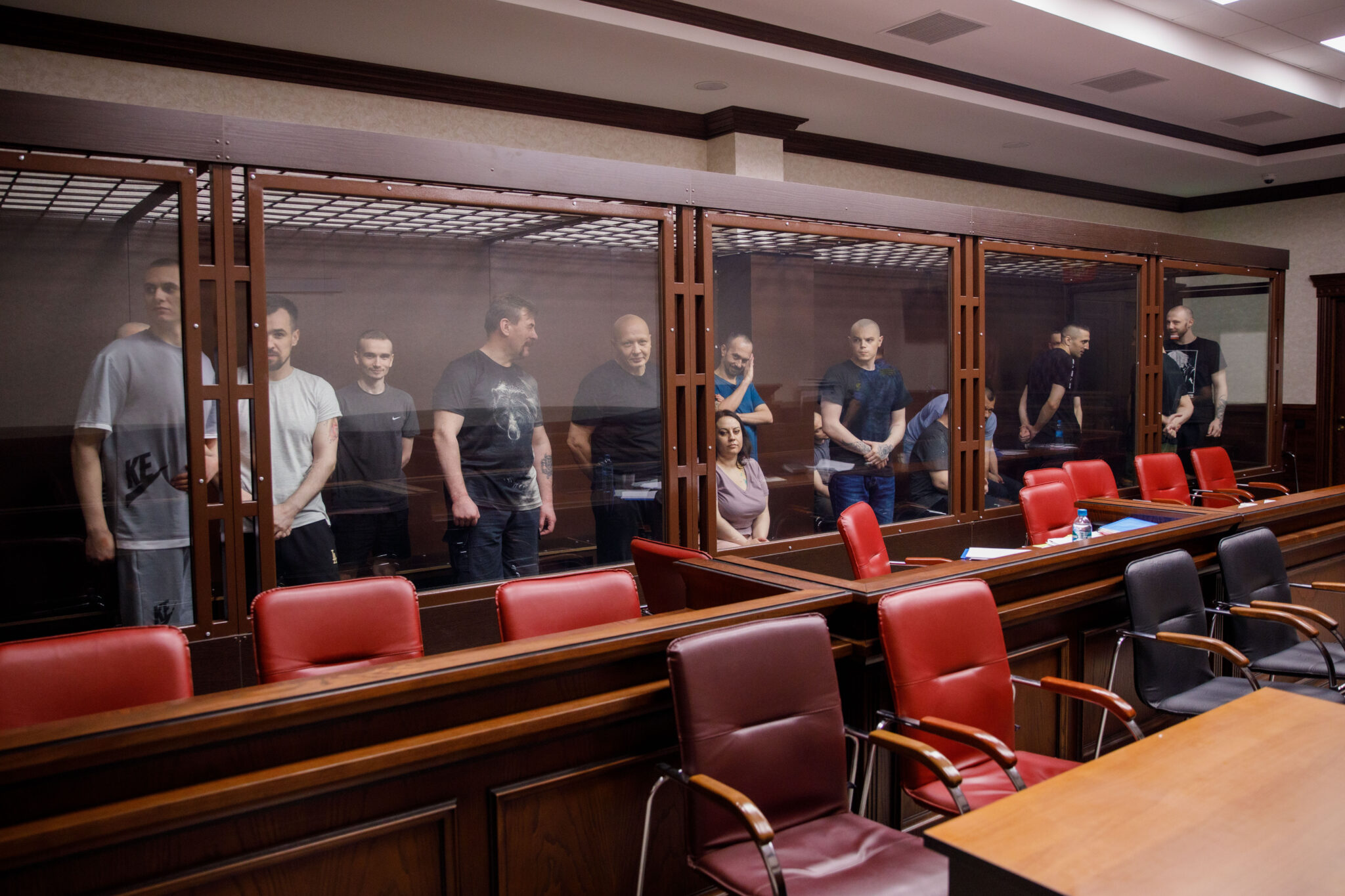
We had three or four court hearings to extend our detention. And then they started trying us [in the Southern District Military Court in Rostov-on-Don].
They grouped us together [with 18 other accused Aidar fighters]—we were shocked. But at least that way we found out that our guys were alive. We thought some of them had been killed, and we were so happy when we learned that wasn’t the case. We saw each other when they were taking us to a psychiatrist [for an evaluation during the investigation in Donetsk].
I told them, “It’s really nice to be sitting among the dead.” And they replied, “Same here—we thought you were dead.”
Fighters from the Aidar Battalion (Marina Mishchenko in the center) at the Southern District Military Court in Rostov-on-Don. Photo: Mediazona
They took us to Rostov in July 2023. We thought it would be much worse in Rostov. At Rostov Pretrial Detention Center No. 1.
They yelled at us—that’s how they “greeted” us at first. But when I asked them about it later, they said it was just a “pat on the head” compared to what happened in Donetsk. After that, no one touched anyone
In court, they started spouting their nonsense—all those charges. When we answered in court, we said we were defending our country. So why are we on trial? We’re prisoners of war. But talking to [the court and investigators] is like talking to a wall. I didn’t want to admit guilt in court. Why should I admit it? They told me I was looking at 15 years—that’s all, they said. That’s all?!
The way they transported us to court! It was horrific. Screams, handcuffs, hands held behind our backs. The guys had shackles just like in the movie *The Green Mile*. Like how they lead death row inmates in America. Yes, chains on our legs, chains on our hands—these ones connected—in a “swallow” position. You’re looking at the ground with your nose. They hauled us around like cattle: sometimes they’d throw us [on the floor], sometimes they’d do something else, and they’d yell. In short, they tried to do everything just to spite us.
We reported this mistreatment in court, but the judge said it wasn’t within his jurisdiction—that we should discuss it with our lawyers.
Our case had already reached the stage of questioning [the defendants], and then there were supposed to be closing arguments. But the questioning never took place; we left [for the exchange] with Lilia.
“They took us away twice and brought us back to the Rostov pretrial detention center”
On Monday, September 9 [2024], they came to see us [at the Rostov pretrial detention center] and named the surnames of nine women from “Azov” and Lilia and me—that makes 11 people. We asked, “Where are we going? To see a doctor?” Because we’d complained about it before. The head doctor there isn’t very nice. You go to her, and she says, ‘Why did you come? You’re healthy—get out of here.’
Then they [the prison guards] came in: ‘Take off your clothes.’ They photographed all the bruises, tattoos, scars, and wounds. If there was a wound, you had to describe it. We thought they were taking us somewhere else again, to some other detention center. Or maybe the lawyers had managed to get them to check, to see if we were being beaten here or not.
And then at night they came to us and said the transfer was at 3 a.m. We asked where. They didn’t answer us.
We got ready. How many times had they already shuttled us around and hidden us away? Whenever an exchange took place, they’d hide us somewhere. Well, we figured we’d be going on “vacation” again. There were times when word got out that we were supposed to be exchanged. And then they’d take us away suddenly, out of the blue. And later we’d find out that an exchange had taken place a day or two after we left. Twice they took us away and brought us back to the Rostov pretrial detention center.
The third time, we weren’t expecting [an exchange] anymore.
Exchange on September 13, 2024. Photo: Volodymyr Zelenskyy’s
Telegram channel We could hear, already inside the police van: “Hurry up, we’re going to miss the train; they need to be taken to the train.” We found out it was the “Rostov–Moscow” train. We traveled in a compartment with bars, several people to a compartment. But we didn’t make it to Moscow—we arrived in Voronezh. From there, we were taken in the police van somewhere else. They brought us to a pretrial detention center, where we spent the night. Then it was back into the police van, onto the train, and from the train—back into the police van again. And that’s how we ended up at the pretrial detention center in the Bryansk region.
At our final holding location, from where we were taken for the exchange, they connected us [via video link] to the court hearing. The hearing was on the 12th [of September], a Thursday. I wasn’t expecting it.
We even talked a little with the guys. We saw them, said goodbye, told them we love them, and that we’re waiting for them to come home as soon as possible. Well, we already had a hunch [about the exchange], but the guys figured it out [earlier], when they took us away.
They dropped us from the case, handed it over to the prosecutor for further investigation, and tacked on a bunch of additional charges.
Early in the morning, I’m lying in bed on the second floor, looking out the window. I said, “Girls, am I hallucinating, or is this real?” I could see two white buses. They all jumped up and said, “No, it’s real.” And we waited. Then we looked out the window—and the buses were already gone. We started to panic!
It turned out they weren’t our [buses]; they were just people who had arrived. Then the gate opened: time to leave. And we were like, “Where to now?” They led us out. We heard the FSB agents say, “Okay, we’re loading them onto the bus now.”
And we were like, “Enough already!” The gates opened. “Get on the bus!” And we saw those buses. And we realized that, apparently, we were definitely on our way to the exchange!
We were driving, we were crying, we were driving. And it was very…
Then they told us: “Head for the exit.” We looked at the clock on the bus—1:13 p.m., Friday the 13th. It was amazing! We couldn’t believe it—how much time had passed, how it had all happened. There were tears and snot. It was incredible joy. It felt like, well, if you just closed your eyes and opened them again—it would all just be a dream.
“I wasn’t afraid of blood before, but now I am”
Marina Mishchenko after her release from captivity, photo from Mishchenko’s
personal archive I couldn’t believe it. The first week [after the exchange], you’d fall asleep, only to wake up from nightmares—you’d wake yourself up, trembling in your sleep. You’d open your eyes, look around, not understand where you were, then you start to come to your senses, realize that you’re home now, everything’s fine, you’re in rehab. And that went on for a long time. I was in rehab until early December. Now I sleep like a baby.
I left [the service]. I got a civilian job. I want a family; I want everything to be normal—I want children. I met my current husband in rehab.
I’m working, but not in medicine. I might not go back to medicine. I just can’t bear to see certain things now after everything I’ve been through. I wasn’t afraid of blood before, but now I am. When I see it, those memories immediately come flooding back.
This material was prepared with the support of the International Renaissance Foundation. The material represents the authors’ views and does not necessarily reflect the position of the International Renaissance Foundation.
Authors: Tetiana Kozak, Anastasia Moskvichova
On September 13, 2024, another prisoner exchange took place between Ukraine and Russia. Among the women returned by Russia at that time was Marina Mishchenko, a medic with the 24th Separate Assault Battalion “Aidar.” She was 25 years old when she was taken prisoner. This happened on March 11, 2022, during the Russian offensive in the Volnovakha sector. She was initially held in Olenivka and then in Donetsk, where she was tortured and accused of terrorism for her service in “Aidar.” The prisoner of war was then transferred to Pretrial Detention Center No. 1 in Rostov-on-Don and, along with 17 other Aidar members, was put on trial.
In 2016, the “DPR” designated the “Aidar” battalion as a terrorist organization, and in 2023, Russia added it to its list of terrorist organizations. In effect, the Aidar members were tried for serving in the battalion. This violates international humanitarian law, which prohibits the prosecution of military personnel for participating in combat operations, and constitutes a crime.
Mishchenko was one of two women in this group of prisoners; the other was 56-year-old medic Lilia Prutyan. Both were exchanged before the verdict was announced.
At a hearing on September 12, the court decided to separate their case into a separate proceeding “regarding the use of prohibited means and methods of warfare by representatives of Ukraine’s security forces.” The current status of this case is unknown.
The verdict for the men who remained in captivity was announced in October of this year. They were sentenced to prison terms ranging from 15 to 21 years.
After returning home, Marina Mishchenko underwent rehabilitation and returned to civilian life. In her monologue, she recalls her captivity, the trial, and her release.
“They were specifically targeting the Aidar fighters”
Our medical station was located in the village of Petrivske in the Donetsk region. The Russians began an intense offensive.
We had two evacuation vehicles, and we heard one of them explode. Since the Russians couldn’t open it, they simply shot it up, and the vehicle exploded. We realized then that we couldn’t go anywhere. To put it bluntly, the vehicles were parked across the road, not near our house—on purpose, so as not to give away our location. But the Russians were going door to door and entered our house. There were countless of them—they were all members of the “Akhmat” battalion, formed in Chechnya.
There were six of us at the medical station: the head of medical services, two drivers, a doctor, a medical instructor, and me. And they took all six of us together.
I found out [later] that many others had been taken as well. They took us all to one place—a school in the village of Petrivske. A very heavy mortar barrage began—so heavy that the building was literally crumbling. It was our own forces shelling them—they didn’t know we’d been taken prisoner: our communications had been jammed. I suffered a concussion and was unconscious. They tied me up. The Russians just threw us onto tanks: the girls separately, the boys separately.
And then they drove us around. For a very long time. They captured us on March 11, and I ended up at the Donetsk UBOZ—the Organized Crime Division—on the 19th. They drove us around to their various positions. Torture, interrogations, all that sort of thing.
They were specifically looking for Aidar fighters. They told us this themselves during the interrogations. I heard them talking about how they’d get a reward for the head of so-and-so or so-and-so.
The other girls and I said we were medics—they didn’t believe us. They asked for intelligence: positions, equipment, weapons, where things were located, where people were. I said, “How would I know? I’m just a medic at the medical station. I don’t have an officer’s rank; I don’t have any access.” They didn’t believe us. They said, “No, you’re a sniper,” as if they had evidence—testimony from others—that I’d undergone training.
I said, “Are you kidding me? I’m a medic.” They said, “No.” They insisted right up until the exchange itself—all of them, wherever I was—that Lilia Prutyan and I were snipers.
“I stayed in Olenivka for a month”
It didn’t matter to them whether we were a woman or a man. Our hands were tied, our eyes were blindfolded. There was an elderly man with us—a civilian in his 70s—and they beat him with sticks and whatever else they could get their hands on. They beat all of us.
At 9:00 p.m. on March 19, they brought us [to the Donetsk Organized Crime Control Department], and at dawn—to Olenivka, Colony No. 120, located in the occupied part of the Donetsk region, in the village of Molodizhne. After leaving “Azovstal” in late May 2022, Ukrainian defenders of Mariupol, including “Azov” fighters, were transported there. There, they were subjected to torture, and as a result of an explosion at the prison, at least 50 prisoners of war were killed and more than 70 were seriously injured. The full circumstances of the crime and those responsible have not been established, as Russia has never granted an independent investigation access to the prison.
I stayed in Olenivka for a month. There, I met Lilia [Prutyan]—I was surprised. She had been captured by other Russians in the same village [Petrivske]. She said that even while she was at the UBOZ, she knew she would meet me one way or another, because they were actively asking questions about me.
Lilia Prutyan and Marina Mishchenko at the Southern District Military Court in Rostov-on-Don. Photo: Mediazona
In Olenivka, the girls were held separately from the boys. The conditions there were terrible: no water, it was cold, and unsanitary. The shifts [of the guards] there were terrible. They tried not to bother the women too much at all—we were lucky in that regard. But as for the guys there… When they’d take in new arrivals—we’d just sit there and sob. They stood right under [our] cameras, and the prison guards were literally beating them to death right there. And we could hear it.
There were Kirill and Yura [prison staff members Kirill Shakurov and Yuriy Dmytrenko], who were tormenting the guys there. Everyone there knew about it. Olenivka, Kirill, and Yura—everyone was like, “Hmm, I see.”
At first, we were in the disciplinary isolation unit (DIZO). Well, everyone was there, because there weren’t many [prisoners]. But before they started bringing in the Azov fighters from “Azovstal”—after they’d surrendered—they began distributing everyone en masse to various prisons.
“You own nothing, you’re not allowed anything—you’ve forgotten who you are.”
On April 18, 2022, they took me away. A guard came for me and said, “They’ve come for you.” I asked, “Who?” He said, “Come with me.” I was like, “Well, okay.” I went out, and they put handcuffs on me: “A case has been opened against you for such-and-such; you’re suspected of such-and-such.”
In Olenivka, some investigators came to see me. They didn’t mention that an investigation was underway. Then they just presented me with a fait accompli—as I was leaving Olenivka, they informed me about the criminal case. And they took me to the prosecutor’s office. From that prosecutor’s office, they took me to the Donetsk pretrial detention center.
Well, the Donetsk pretrial detention center is a wonderful place, in quotation marks.
They put us in such horrible cells! A tiny little window through which you couldn’t even see the sky—you could only see the ground or the concrete floor and the [neighboring] building—that’s all. And even to see that, you had to climb onto the radiator and hold onto the bars on the window. The cell was meant for two people—but they crammed the four of us in there. Then they moved us to another cell, an even worse one.
We stayed there for a week. It was terribly cold; we were freezing. Then they transferred us to the basement. When more people arrived, they moved us to another cell—also cold—where there was absolutely nothing. And then, when they started bringing in a lot of girls [prisoners] from Olenivka, they moved us to yet another cell—a different one, this time for good—and that’s where we stayed until our departure for Rostov. It was a ten-person cell. There were 22 of us in there.
Every time we had to leave the cell [at the Donetsk pretrial detention center] was torture: no one wanted to go out, because they could beat us up, throw us to the ground dozens of times, and we could bang our heads against the iron door frames. This happened all the time. Plus—we were constantly forced to wear bags over our heads, soiled by cats and who knows who else.
Complete unsanitary conditions! The walls were crumbling, the ceilings were crumbling. The dampness is insane, the filth! They gave us some kind of mattresses—people had died and rotted on them a hundred times over. We weren’t allowed to have any personal belongings, and there were no hygiene products either. “You own nothing, you’re not allowed anything—have you forgotten who you are?!”
There was even a period—back when Donetsk was under shelling and their water supply was cut off—when they deliberately refused to give us water for over a week. Forget about washing—that wasn’t even an option. I don’t know if they were conducting some kind of experiment on us there, but we just started rotting away. We were rotting alive—you’d wake up covered in these pus-filled blisters, then wake up even more swollen, your body swelling up. I went to sleep feeling fine, and when I woke up, my leg was swollen, covered in pus-filled blisters this big. You call the medic, and he says, “Just use laundry soap.” We said, “Are you serious? The condition is already beyond gangrene—are you serious?” He said, “Laundry soap.”
We found out that this happened to everyone. Where the prisoners were held in the basement, practically everyone had this. Some kind of infection—maybe they slipped something into it; we don’t know.
Then Rostov started examining them. Because we were supposed to be tried in Rostov. The administration was terrified of what awaited them there—that they’d be in for it, so to speak. And a female doctor came in and started shining a flashlight on us, on everyone. When she saw us, she practically fell on her butt. “Oh my God, oh, horror, horror, horror.” They gave us medicine and more or less got us back on our feet.
“It’s so nice to sit among the dead”
In the detention center, a DNR investigator came up to me: “Sign the papers.” I said, “I’m not signing anything; I have every right to a lawyer.” He said, “Someone like you doesn’t need a lawyer.” As if to say, a lawyer won’t save you. I said, “I won’t sign.” He said, “We’ll beat the crap out of you, and you’ll sign anyway.” So I signed (obviously, I didn’t want to get beaten up), admitting that I was guilty of all these crimes they were charging me with—all that nonsense. Things like “seizure of power” and “aiding terrorism.”
We had three or four court hearings to extend our detention. And then they started trying us [in the Southern District Military Court in Rostov-on-Don].
They grouped us together [with 18 other accused Aidar fighters]—we were shocked. But at least that way we found out that our guys were alive. We thought some of them had been killed, and we were so happy when we learned that wasn’t the case. We saw each other when they were taking us to a psychiatrist [for an evaluation during the investigation in Donetsk].
I told them, “It’s really nice to be sitting among the dead.” And they replied, “Same here—we thought you were dead.”
Fighters from the Aidar Battalion (Marina Mishchenko in the center) at the Southern District Military Court in Rostov-on-Don. Photo: Mediazona
They took us to Rostov in July 2023. We thought it would be much worse in Rostov. At Rostov Pretrial Detention Center No. 1.
They yelled at us—that’s how they “greeted” us at first. But when I asked them about it later, they said it was just a “pat on the head” compared to what happened in Donetsk. After that, no one touched anyone
In court, they started spouting their nonsense—all those charges. When we answered in court, we said we were defending our country. So why are we on trial? We’re prisoners of war. But talking to [the court and investigators] is like talking to a wall. I didn’t want to admit guilt in court. Why should I admit it? They told me I was looking at 15 years—that’s all, they said. That’s all?!
The way they transported us to court! It was horrific. Screams, handcuffs, hands held behind our backs. The guys had shackles just like in the movie *The Green Mile*. Like how they lead death row inmates in America. Yes, chains on our legs, chains on our hands—these ones connected—in a “swallow” position. You’re looking at the ground with your nose. They hauled us around like cattle: sometimes they’d throw us [on the floor], sometimes they’d do something else, and they’d yell. In short, they tried to do everything just to spite us.
We reported this mistreatment in court, but the judge said it wasn’t within his jurisdiction—that we should discuss it with our lawyers.
Our case had already reached the stage of questioning [the defendants], and then there were supposed to be closing arguments. But the questioning never took place; we left [for the exchange] with Lilia.
“They took us away twice and brought us back to the Rostov pretrial detention center”
On Monday, September 9 [2024], they came to see us [at the Rostov pretrial detention center] and named the surnames of nine women from “Azov” and Lilia and me—that makes 11 people. We asked, “Where are we going? To see a doctor?” Because we’d complained about it before. The head doctor there isn’t very nice. You go to her, and she says, ‘Why did you come? You’re healthy—get out of here.’
Then they [the prison guards] came in: ‘Take off your clothes.’ They photographed all the bruises, tattoos, scars, and wounds. If there was a wound, you had to describe it. We thought they were taking us somewhere else again, to some other detention center. Or maybe the lawyers had managed to get them to check, to see if we were being beaten here or not.
And then at night they came to us and said the transfer was at 3 a.m. We asked where. They didn’t answer us.
We got ready. How many times had they already shuttled us around and hidden us away? Whenever an exchange took place, they’d hide us somewhere. Well, we figured we’d be going on “vacation” again. There were times when word got out that we were supposed to be exchanged. And then they’d take us away suddenly, out of the blue. And later we’d find out that an exchange had taken place a day or two after we left. Twice they took us away and brought us back to the Rostov pretrial detention center.
The third time, we weren’t expecting [an exchange] anymore.
Exchange on September 13, 2024. Photo: Volodymyr Zelenskyy’s
Telegram channel We could hear, already inside the police van: “Hurry up, we’re going to miss the train; they need to be taken to the train.” We found out it was the “Rostov–Moscow” train. We traveled in a compartment with bars, several people to a compartment. But we didn’t make it to Moscow—we arrived in Voronezh. From there, we were taken in the police van somewhere else. They brought us to a pretrial detention center, where we spent the night. Then it was back into the police van, onto the train, and from the train—back into the police van again. And that’s how we ended up at the pretrial detention center in the Bryansk region.
At our final holding location, from where we were taken for the exchange, they connected us [via video link] to the court hearing. The hearing was on the 12th [of September], a Thursday. I wasn’t expecting it.
We even talked a little with the guys. We saw them, said goodbye, told them we love them, and that we’re waiting for them to come home as soon as possible. Well, we already had a hunch [about the exchange], but the guys figured it out [earlier], when they took us away.
They dropped us from the case, handed it over to the prosecutor for further investigation, and tacked on a bunch of additional charges.
Early in the morning, I’m lying in bed on the second floor, looking out the window. I said, “Girls, am I hallucinating, or is this real?” I could see two white buses. They all jumped up and said, “No, it’s real.” And we waited. Then we looked out the window—and the buses were already gone. We started to panic!
It turned out they weren’t our [buses]; they were just people who had arrived. Then the gate opened: time to leave. And we were like, “Where to now?” They led us out. We heard the FSB agents say, “Okay, we’re loading them onto the bus now.”
And we were like, “Enough already!” The gates opened. “Get on the bus!” And we saw those buses. And we realized that, apparently, we were definitely on our way to the exchange!
We were driving, we were crying, we were driving. And it was very…
Then they told us: “Head for the exit.” We looked at the clock on the bus—1:13 p.m., Friday the 13th. It was amazing! We couldn’t believe it—how much time had passed, how it had all happened. There were tears and snot. It was incredible joy. It felt like, well, if you just closed your eyes and opened them again—it would all just be a dream.
“I wasn’t afraid of blood before, but now I am”
Marina Mishchenko after her release from captivity, photo from Mishchenko’s
personal archive I couldn’t believe it. The first week [after the exchange], you’d fall asleep, only to wake up from nightmares—you’d wake yourself up, trembling in your sleep. You’d open your eyes, look around, not understand where you were, then you start to come to your senses, realize that you’re home now, everything’s fine, you’re in rehab. And that went on for a long time. I was in rehab until early December. Now I sleep like a baby.
I left [the service]. I got a civilian job. I want a family; I want everything to be normal—I want children. I met my current husband in rehab.
I’m working, but not in medicine. I might not go back to medicine. I just can’t bear to see certain things now after everything I’ve been through. I wasn’t afraid of blood before, but now I am. When I see it, those memories immediately come flooding back.
This material was prepared with the support of the International Renaissance Foundation. The material represents the authors’ views and does not necessarily reflect the position of the International Renaissance Foundation.
This is an automatic translation generated by DeepL.