Surviving Captivity: Freed Journalist Dmytro Khilyuk
Source: Ukraїner
Author: Roman Stelmakh
“Public attention is the only thing Russia fears,” says journalist Dmytro Khilyuk, who was released from captivity. In his first few months of freedom, he managed to return to work, repair his beloved motorcycle, and even speak at the European Parliament. However, the euphoria gave way to reality: the health problems caused by his captivity worsened, he had to adapt to a different way of life, and he came to realize that more than three years had been lost.
On August 24, 2025, Ukraine’s Independence Day, another prisoner exchange took place—in addition to military personnel, eight civilians returned home. Among them was UNIAN journalist Dmytro Khilyuk, who had been held captive since March 2022. His colleague from 1+1 Media, Roman Stelmakh, spoke with him about how Dmytro is coping with his experience in captivity, how the flood of information overwhelms a person after isolation, and why it’s important to regularly remind people about the captives.
The Challenges of Readjustment
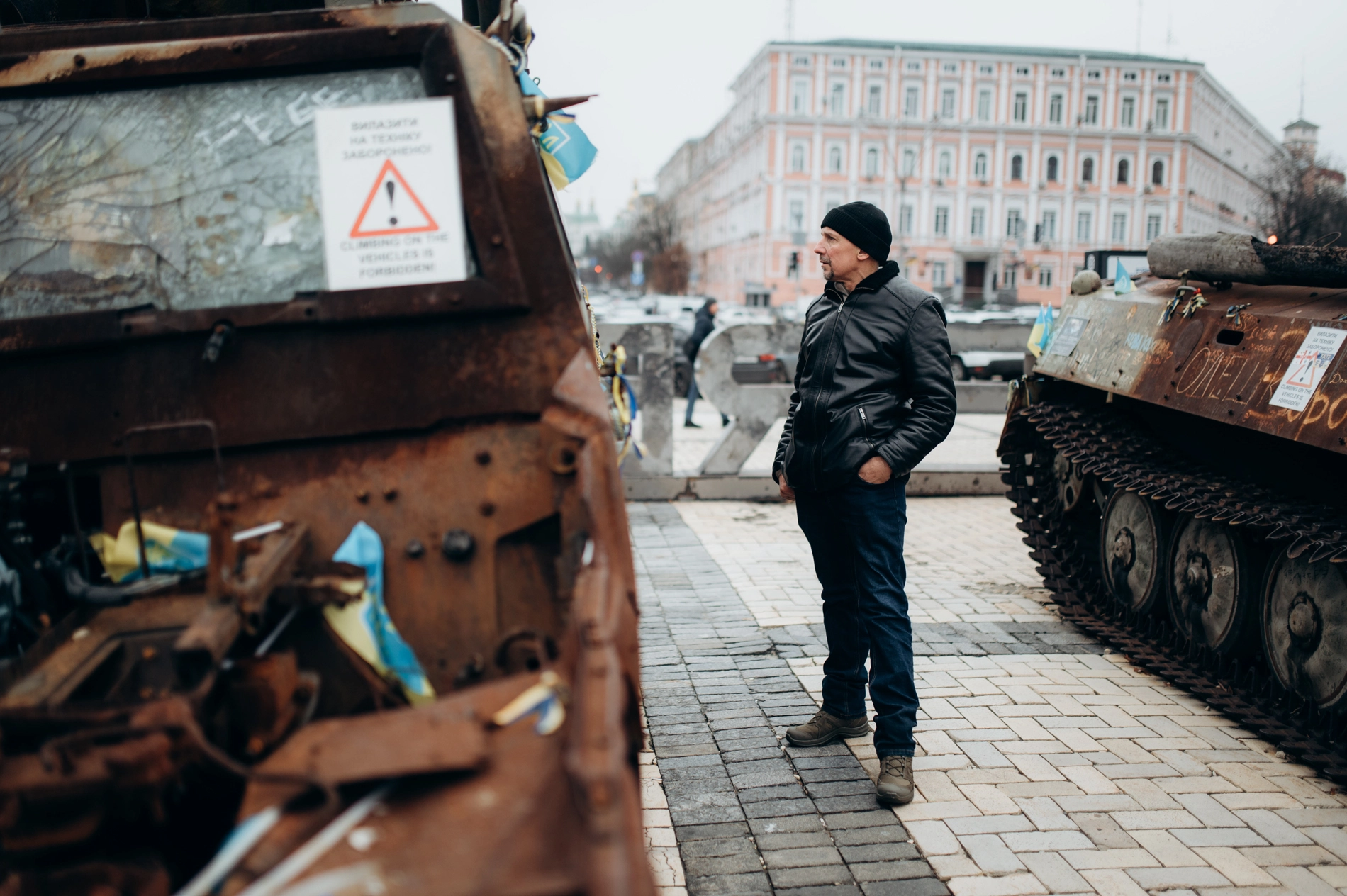
Dmytro Khilyuk and I were walking through St. Michael’s Square in Kyiv, where a burned-out Russian armored vehicle has stood for three years now. And while Kyiv residents and most visitors to the capital have long since grown accustomed to this “exhibition,” for Dmytro, in his own words, it feels like arriving from abroad for the first time.
— I was taken prisoner at the start of the war; I didn’t see it with my own eyes. Only during the first week of the occupation did I hear explosions; shells landed nearby several times. But I didn’t get to see that burned-out equipment back then, so I find it all very interesting!
After three years of complete isolation and Russian abuse, reintegration isn’t as easy for Dmytro as he’d like it to be. He admits that he thought nothing had changed, that he’d weathered this period well and even returned in perfect health. However, he later realized that things weren’t quite right, and his health wasn’t what it used to be.
Psychologically, Dmytro is also facing certain challenges. Although he worked as a journalist before his captivity, he’s finding it difficult to adapt, particularly because of the sheer volume of information available. Dmytro recalls how, in captivity, there was nothing: no personal belongings, no information to stimulate his mind. Here, on the other hand, there’s an immediate deluge of everything, and there’s nowhere to hide from it.
— It’s like when a person has been hungry for a long time and is suddenly offered a full meal—you can’t even eat it all, but you have to. It’s the same with information—there’s nowhere to hide from it.
How he was taken captive
Dmytro Khylyuk was abducted on March 4, 2022, in the village of Kozarovychi, north of Kyiv. At that time, there were already communication problems in the area, but Dmytro continued to send information to the UNIAN newsroom (in particular, it was thanks to him that Ukrainians learned about the blowing up of the Irpin dam).
On the day of his abduction, the journalist and his father were returning home from a neighbor’s house—but they hadn’t even walked 50 meters when they ran into a Russian patrol.
“They were coming toward us with their weapons at the ready. I think they were Buryats. They forced us to the ground, then, without any explanation, took us to an industrial warehouse, into a completely dark room where there were already several people. That’s how my captivity began.
Dmytro recalls that among the civilian hostages were both young people and people well over 60. The Russians kept them right on the floor, beat them, and tormented them in every way possible for no reason at all. They weren’t trying to extract any information; they were simply venting their rage.
—“You’re to blame because you’re a khokhol.” They raged: “How dare you? Why didn’t you surrender? Why didn’t you leave?” The Russians entered our land as “masters” and believed they could do whatever they wanted. And we were supposed to obey them. If you were a soldier, you had to lay down your arms. If you were a civilian, you had to leave your own home and flee, because the big “masters” had arrived.
Then Dmytro’s long and terrifying journey to Russian prisons began. First to Gostomel, which was occupied at the time; then to Belarus; and from there to a solitary confinement cell in a prison in Novozybkov, Bryansk Oblast, 170 km from Chernihiv.
He recalls that the “intake” at the first prison was very terrifying: the prisoners were pushed out of an army truck¹ and beaten with sticks on the back all the way from the vehicles to the exercise yards. There, the prisoners waited to be processed. The Russians set dogs on them and threw the prisoners to the ground. A dog bit Dmytro in the stomach. The journalist couldn’t see anything because their eyes were blindfolded. It was mentally very difficult. Dmytro spent his first 33 days in prison in complete isolation in a solitary confinement cell. To keep from falling completely into despair, he constantly paced the cell.
— I had a record—I walked 42 kilometers in the cell in a single day. I also used my steps to keep track of time: once I’d taken 8,000 steps, it would be time for breakfast. And I walked because it was unbearably cold.
A year later, he was transferred to the village of Pakino in the Vladimir Region, 200 km from Moscow. That’s where Penal Colony No. 7 is located, where Dmytro remained until his release. He says the conditions there were “utter squalor.” He had no personal belongings except for a toothbrush, toothpaste, and a bar of awful black soap.
“Once they gave us a bar of it, and it reeked of fish.” They also regularly handed out soap that stank of pig manure. I don’t know what it was made of, but the smell was like that of a pigsty. Plus a plastic cup and two bowls—one for the first course and one for the second. And all I had on me was a T-shirt, underwear, socks, a work uniform, and rubber slippers.
Dmytro’s first cell was designed for six people, but there were between nine and fifteen people in there at any given time. The second was designed for four, but held between six and eight prisoners.
Russian guards took the prisoners out for “walks” in a small courtyard surrounded by three-meter-high concrete walls topped with bars. They were let out in such a way that prisoners from different cells would not cross paths. They were allowed five to twenty minutes for a walk—depending on the guards’ mood.
Dmytro recalls that at first they stood above and taunted them, ordering them to sing Soviet songs or Russian pop from the ’90s, or to dance. And then they would simply walk around or sit on benches and watch. The taunting was a regular occurrence. Beatings and humiliation are an integral part of Russian prisons.
— They beat us with batons. In Novozybkov, they used a stun gun. The Russians wore gloves with plastic pads on the knuckles—they beat us with those, too. They would line us up and order us to stand in place for an hour, two, or three. Sometimes in a bent-over position. They tortured us with physical exercises—500 squats, 50 push-ups.
But the worst part was the hunger. Dmytro admits that the food was terrible everywhere: both in the first and second prisons. The food was watery. They gave us bland wheat or oat groats in meager portions. For lunch, there was some kind of soup with two potatoes floating in it. When an inspection came once every six months, they were fed a little better. At the same time, the Russians made no distinction between civilians and military personnel—they treated everyone equally horribly. What’s more, they always forbade us from looking at them and forced the prisoners to keep their heads down.
— They’re afraid of eye contact because they know they’re in the wrong and that the moral high ground isn’t on their side. They themselves understand that they’re committing a crime. And they’re afraid that people will recognize them later and come looking for them.
A Test of Hope and Health in Captivity
Back in March 2022, immediately after the abduction, the Russians employed yet another form of torture—false hope. Dmytro says that at that time, all the captives wrote exchange petitions addressed to Putin. At first, the Russians were so polite that they even allowed these petitions to be written in Ukrainian if the prisoner didn’t know Russian.
“We thought that since we’d already written a petition for exchange, maybe they’d exchange us by Easter. Then—maybe by Pentecost. Maybe by Independence Day. Then—the Feast of the Intercession.” Then—New Year’s. And when a year had passed, we realized this was going to be a long haul.
Still, Dmytro never lost hope, because he knew they couldn’t hold him forever. His only fear was dying before he was released. And the circumstances were quite conducive to that: both illnesses and the guards’ attitude. The journalist recalls that everyone there had health problems; one of the most common was scabies.
“If half the prison catches scabies, and there’s an inspection coming up—then maybe they’ll give out some ointment. Before that, people had been complaining for months to no avail. And for things like toothaches or headaches—they never gave out any painkillers.”
What helped him endure was the desire to return home and see his family. He had no contact with them: Dmytro and the other prisoners were held in complete isolation. Of all the letters his family and colleagues wrote to him, only one reached him—two years late. Dmytro didn’t know if his home was still standing or if his parents and friends were alive. He had no information on how the war was unfolding or whether the Russians had captured Kyiv.
— I was very surprised to learn that my father had traveled to Brussels and spoken at the European Parliament. He is now 77 years old.
Throughout all the years of Dmytro Khylyuk’s captivity, his colleagues at 1+1 Media made incredible efforts to secure his release. Every week, they held protests, organized campaigns, and reminded the world that our military personnel and civilians are still being held captive and must not be forgotten.
— We have to do this (remind people about the captives—ed.)! And it’s not just their families who should be doing this. Public attention is the only thing Russia fears. So that every time on the international stage, someone can rub it in their faces—why are you holding civilians captive? Why won’t you release them? Why did you kidnap them?” To generate this public outcry, the information needs to stay in the public eye at all times. So that it doesn’t become routine and so that the captives aren’t forgotten.
Author: Roman Stelmakh
“Public attention is the only thing Russia fears,” says journalist Dmytro Khilyuk, who was released from captivity. In his first few months of freedom, he managed to return to work, repair his beloved motorcycle, and even speak at the European Parliament. However, the euphoria gave way to reality: the health problems caused by his captivity worsened, he had to adapt to a different way of life, and he came to realize that more than three years had been lost.
On August 24, 2025, Ukraine’s Independence Day, another prisoner exchange took place—in addition to military personnel, eight civilians returned home. Among them was UNIAN journalist Dmytro Khilyuk, who had been held captive since March 2022. His colleague from 1+1 Media, Roman Stelmakh, spoke with him about how Dmytro is coping with his experience in captivity, how the flood of information overwhelms a person after isolation, and why it’s important to regularly remind people about the captives.
The Challenges of Readjustment
Dmytro Khilyuk and I were walking through St. Michael’s Square in Kyiv, where a burned-out Russian armored vehicle has stood for three years now. And while Kyiv residents and most visitors to the capital have long since grown accustomed to this “exhibition,” for Dmytro, in his own words, it feels like arriving from abroad for the first time.
— I was taken prisoner at the start of the war; I didn’t see it with my own eyes. Only during the first week of the occupation did I hear explosions; shells landed nearby several times. But I didn’t get to see that burned-out equipment back then, so I find it all very interesting!
After three years of complete isolation and Russian abuse, reintegration isn’t as easy for Dmytro as he’d like it to be. He admits that he thought nothing had changed, that he’d weathered this period well and even returned in perfect health. However, he later realized that things weren’t quite right, and his health wasn’t what it used to be.
Psychologically, Dmytro is also facing certain challenges. Although he worked as a journalist before his captivity, he’s finding it difficult to adapt, particularly because of the sheer volume of information available. Dmytro recalls how, in captivity, there was nothing: no personal belongings, no information to stimulate his mind. Here, on the other hand, there’s an immediate deluge of everything, and there’s nowhere to hide from it.
— It’s like when a person has been hungry for a long time and is suddenly offered a full meal—you can’t even eat it all, but you have to. It’s the same with information—there’s nowhere to hide from it.
How he was taken captive
Dmytro Khylyuk was abducted on March 4, 2022, in the village of Kozarovychi, north of Kyiv. At that time, there were already communication problems in the area, but Dmytro continued to send information to the UNIAN newsroom (in particular, it was thanks to him that Ukrainians learned about the blowing up of the Irpin dam).
On the day of his abduction, the journalist and his father were returning home from a neighbor’s house—but they hadn’t even walked 50 meters when they ran into a Russian patrol.
“They were coming toward us with their weapons at the ready. I think they were Buryats. They forced us to the ground, then, without any explanation, took us to an industrial warehouse, into a completely dark room where there were already several people. That’s how my captivity began.
Dmytro recalls that among the civilian hostages were both young people and people well over 60. The Russians kept them right on the floor, beat them, and tormented them in every way possible for no reason at all. They weren’t trying to extract any information; they were simply venting their rage.
—“You’re to blame because you’re a khokhol.” They raged: “How dare you? Why didn’t you surrender? Why didn’t you leave?” The Russians entered our land as “masters” and believed they could do whatever they wanted. And we were supposed to obey them. If you were a soldier, you had to lay down your arms. If you were a civilian, you had to leave your own home and flee, because the big “masters” had arrived.
Then Dmytro’s long and terrifying journey to Russian prisons began. First to Gostomel, which was occupied at the time; then to Belarus; and from there to a solitary confinement cell in a prison in Novozybkov, Bryansk Oblast, 170 km from Chernihiv.
He recalls that the “intake” at the first prison was very terrifying: the prisoners were pushed out of an army truck¹ and beaten with sticks on the back all the way from the vehicles to the exercise yards. There, the prisoners waited to be processed. The Russians set dogs on them and threw the prisoners to the ground. A dog bit Dmytro in the stomach. The journalist couldn’t see anything because their eyes were blindfolded. It was mentally very difficult. Dmytro spent his first 33 days in prison in complete isolation in a solitary confinement cell. To keep from falling completely into despair, he constantly paced the cell.
— I had a record—I walked 42 kilometers in the cell in a single day. I also used my steps to keep track of time: once I’d taken 8,000 steps, it would be time for breakfast. And I walked because it was unbearably cold.
A year later, he was transferred to the village of Pakino in the Vladimir Region, 200 km from Moscow. That’s where Penal Colony No. 7 is located, where Dmytro remained until his release. He says the conditions there were “utter squalor.” He had no personal belongings except for a toothbrush, toothpaste, and a bar of awful black soap.
“Once they gave us a bar of it, and it reeked of fish.” They also regularly handed out soap that stank of pig manure. I don’t know what it was made of, but the smell was like that of a pigsty. Plus a plastic cup and two bowls—one for the first course and one for the second. And all I had on me was a T-shirt, underwear, socks, a work uniform, and rubber slippers.
Dmytro’s first cell was designed for six people, but there were between nine and fifteen people in there at any given time. The second was designed for four, but held between six and eight prisoners.
Russian guards took the prisoners out for “walks” in a small courtyard surrounded by three-meter-high concrete walls topped with bars. They were let out in such a way that prisoners from different cells would not cross paths. They were allowed five to twenty minutes for a walk—depending on the guards’ mood.
Dmytro recalls that at first they stood above and taunted them, ordering them to sing Soviet songs or Russian pop from the ’90s, or to dance. And then they would simply walk around or sit on benches and watch. The taunting was a regular occurrence. Beatings and humiliation are an integral part of Russian prisons.
— They beat us with batons. In Novozybkov, they used a stun gun. The Russians wore gloves with plastic pads on the knuckles—they beat us with those, too. They would line us up and order us to stand in place for an hour, two, or three. Sometimes in a bent-over position. They tortured us with physical exercises—500 squats, 50 push-ups.
But the worst part was the hunger. Dmytro admits that the food was terrible everywhere: both in the first and second prisons. The food was watery. They gave us bland wheat or oat groats in meager portions. For lunch, there was some kind of soup with two potatoes floating in it. When an inspection came once every six months, they were fed a little better. At the same time, the Russians made no distinction between civilians and military personnel—they treated everyone equally horribly. What’s more, they always forbade us from looking at them and forced the prisoners to keep their heads down.
— They’re afraid of eye contact because they know they’re in the wrong and that the moral high ground isn’t on their side. They themselves understand that they’re committing a crime. And they’re afraid that people will recognize them later and come looking for them.
A Test of Hope and Health in Captivity
Back in March 2022, immediately after the abduction, the Russians employed yet another form of torture—false hope. Dmytro says that at that time, all the captives wrote exchange petitions addressed to Putin. At first, the Russians were so polite that they even allowed these petitions to be written in Ukrainian if the prisoner didn’t know Russian.
“We thought that since we’d already written a petition for exchange, maybe they’d exchange us by Easter. Then—maybe by Pentecost. Maybe by Independence Day. Then—the Feast of the Intercession.” Then—New Year’s. And when a year had passed, we realized this was going to be a long haul.
Still, Dmytro never lost hope, because he knew they couldn’t hold him forever. His only fear was dying before he was released. And the circumstances were quite conducive to that: both illnesses and the guards’ attitude. The journalist recalls that everyone there had health problems; one of the most common was scabies.
“If half the prison catches scabies, and there’s an inspection coming up—then maybe they’ll give out some ointment. Before that, people had been complaining for months to no avail. And for things like toothaches or headaches—they never gave out any painkillers.”
What helped him endure was the desire to return home and see his family. He had no contact with them: Dmytro and the other prisoners were held in complete isolation. Of all the letters his family and colleagues wrote to him, only one reached him—two years late. Dmytro didn’t know if his home was still standing or if his parents and friends were alive. He had no information on how the war was unfolding or whether the Russians had captured Kyiv.
— I was very surprised to learn that my father had traveled to Brussels and spoken at the European Parliament. He is now 77 years old.
Throughout all the years of Dmytro Khylyuk’s captivity, his colleagues at 1+1 Media made incredible efforts to secure his release. Every week, they held protests, organized campaigns, and reminded the world that our military personnel and civilians are still being held captive and must not be forgotten.
— We have to do this (remind people about the captives—ed.)! And it’s not just their families who should be doing this. Public attention is the only thing Russia fears. So that every time on the international stage, someone can rub it in their faces—why are you holding civilians captive? Why won’t you release them? Why did you kidnap them?” To generate this public outcry, the information needs to stay in the public eye at all times. So that it doesn’t become routine and so that the captives aren’t forgotten.
This is an automatic translation generated by DeepL.