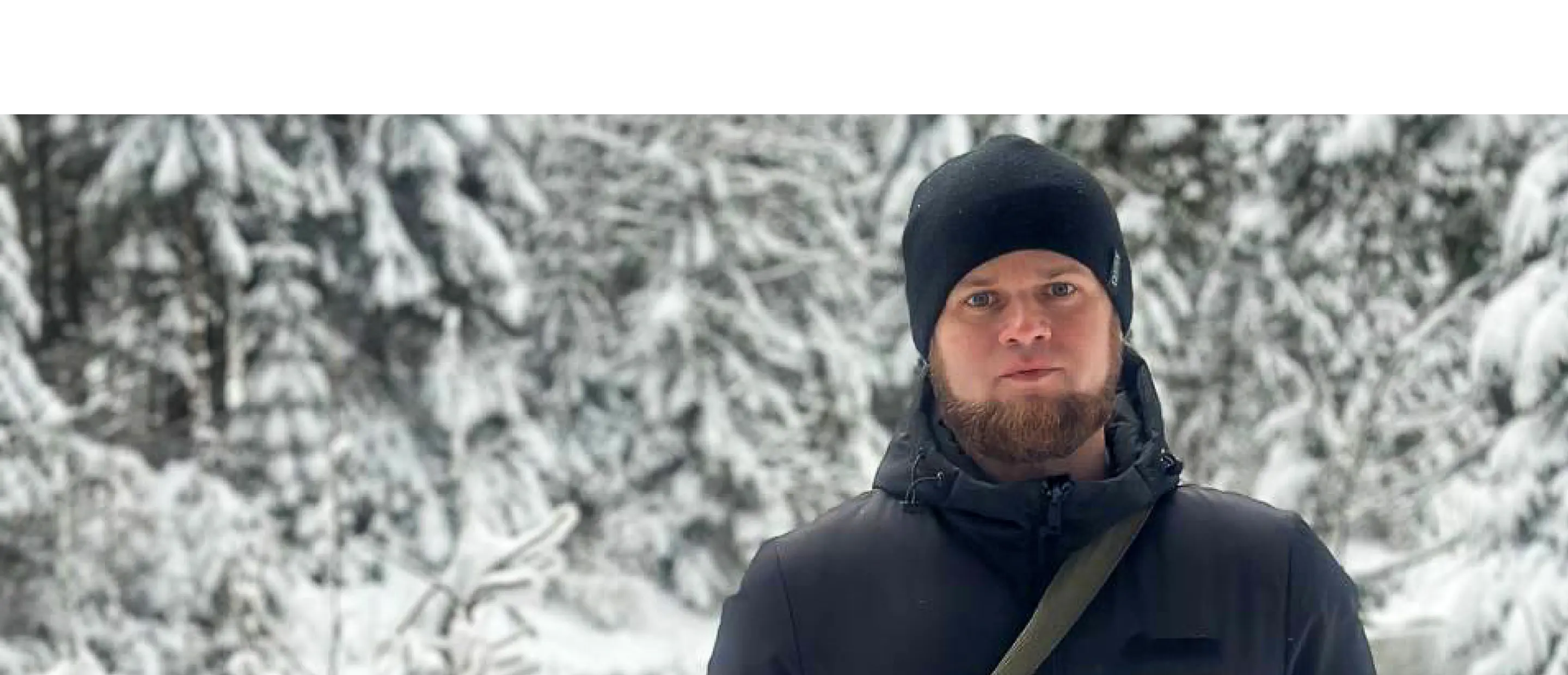
A soldier from the 108th Separate Guards Rifle Brigade was tortured while in Russian captivity to force him to confess to the murder of a civilian at his trial—how the Russian Investigative C
Source: Grati
Author: Tetiana Kozak
A court in Russian-occupied Luhansk sentenced prisoner of war Serhiy Boichuk, a mechanic and driver with the 108th Separate Mountain Assault Battalion of the 10th Separate Mountain Assault Brigade of the Armed Forces of Ukraine. When he was finally rescued from Russian captivity in October 2024, he described systematic torture and abuse, which were used to force him to take the blame for a war crime—the shelling of residential buildings and the killing of a civilian in the village of Mykolaivka in the Sieversk-Donetsk district of Luhansk Oblast. Ihor Lemeshev, another mechanic-driver from the same unit, and their company commander, Andriy Savchuk, were convicted on similar charges. Boychuk was captured along with them near the village of Spirne in Donetsk Oblast in July 2022.
“Grati” analyzed Boychuk’s verdict and explains how the Investigative Committee of the Russian Federation fabricated the case regarding the shelling of Mykolaivka.
Ambush near Spirne
A group of soldiers from the 108th Separate Mountain Assault Battalion was ambushed on July 14, 2022. Serhiy Boichuk, who was 29 at the time, recalls that he still had a week of leave remaining after his previous tour of duty, but he responded to a request to relieve his comrades at a position near the village of Spirne, 50 kilometers north of Bakhmut, almost on the border between Donetsk and Luhansk regions. Together with fellow mechanic-drivers Ihor Lemeshev, Maksym Sakhno, and company commander Andriy Savchuk, he set out for that location. They knew from other soldiers that the situation at those positions was extremely difficult.
“Someone had to be there anyway,” says Serhiy Boichuk.
Igor Lemeshev’s brother, Serhiy, recalls that he was supposed to go with them as well, but the day before, he had a severe headache, took some medicine, and fell asleep. In the morning, Igor didn’t wake his brother up; he just asked him to have a doctor examine him.
“The guys left without me,” says Serhiy Lemeshev.
When the jeep carrying the four Ukrainian soldiers pulled up to the position, it turned out that Russian soldiers were in the trenches there.
“They let us through. We drove in, started getting out of the vehicle—and they started shooting at us,” says Serhiy Boichuk.
He recalls that a bullet knocked his helmet off his head; he took a few steps forward to pick it up and then fell. Next, he remembers that he could neither breathe in nor breathe out: “I shouted to the guys that I was wounded.”
A battle ensued. The Ukrainian soldiers tried to retreat, but the enemy cut off their only escape route. The soldiers called for artillery support, but they didn’t have enough shells. There was no other reinforcements. When everyone ran out of ammunition, they were taken prisoner.
The Russians left the seriously wounded Sakhna at the position, while they took Boichuk, Savchuk, and Lemeshev with them.
Battalion Commander Volodymyr Bolekhan—who remained commander of the 108th Special Forces Battalion until December 2022 and was also stationed in that area at the time—says that the operational situation was changing rapidly, the Russians were actively advancing, and Ukrainian fighters had to engage in counterattacks in the woodlands.
He saw on drone footage how the Russians led his men into the basement of one of the private homes in Spirne. He says that until they were taken from there to Vrubivka, that house was not shelled so that the prisoners would not be buried under the rubble.
From the very first days of his captivity, Serhiy Boichuk remembers the pain from a wound in his back and the brutal torture he endured during interrogations. He recalls that he was wearing a ponytail at the time, and the Russians immediately cut it off. They beat him, choked him with a ration pack, held a knife to his neck or genitals, aimed a pistol at those areas, and then pulled the trigger to fire a blank. They interrogated his comrades in the same way.
“They chose which of us to shoot, [forcing] us to choose for ourselves. And since I had a wound, they even tore at it with their hands—that’s how they interrogated us. They dragged me out to be shot many times. Well, and then all I remember is that one of them told us to say goodbye to our families,” Serhiy says.
The soldiers were transported several times to various locations where Russian units were based, including Lysychansk, Rubizhne, and Sievierodonetsk, where, according to Serhiy Boichuk’s testimony, they continued to be interrogated and tortured. Between interrogations, the prisoners of war were forced to perform manual labor: in Rubizhne, for example, they were ordered to unload a truck carrying Ukrainian beer.
They were then held for two weeks at the Luhansk commandant’s office. From there, Boichuk was taken to a local hospital when his wound became infected. According to Serhiy, this was also a form of torture: the surgeons cleaned the wound with a scalpel without any pain relief. The wounded man was not given a full medical examination either, and—despite his condition and on the orders of the chief physician—he was not kept in the hospital; instead, he was discharged and sent back to the commandant’s office. Upon his return from captivity, Ukrainian doctors found metal fragments in Boichuk’s back and jaw, which were left over from a wound sustained in 2022.
On July 15, the Telegram channel of the 4th Brigade of the “LPR” group published a video of Andriy Savchuk’s interrogation and a report stating that fighters from the 14th “Prizrak” Battalion of that brigade had captured the company commander of the 108th Battalion. In the video, a voice-over asks, “Did anyone beat you?” Savchuk replies that no, “they helped me, gave me water and cigarettes.” It is clear that his hands are tied. Explosions can be heard in the background.
A few days later, on July 19, the Russian Telegram channel “War Criminals” published a video of the interrogation of Igor Lemeshev, in which he, among other things, calls on Ukrainian soldiers to surrender and assures them that the Russians treat prisoners well. The man looks emaciated and disoriented.
On August 2, three captured soldiers from the 108th Battalion were taken to the Luhansk pretrial detention center. Serhiy Boichuk spent the next year and a half there. Lemeshev and Savchuk were also held there until December 2022.
Confessions Under Torture
Serhiy Boichuk recalls that at the Luhansk pretrial detention center, the prisoners were beaten daily, especially severely during “intake,” when they were first brought to the facility.
“Twice a day, they would drive us out into the hallway for inspection. And when you ran out—hands behind your head—they’d beat you with those PR-73s—the PR-73 special-purpose device, a police rubber baton—and you’d have to squat against the wall. Once everyone has run out, they report how many people are in the cell, how many are wounded, and who needs medical attention. And when they call your last name, you state your first name and middle name and run back into the cell. “And they beat us with those batons just the same,” says Boichuk, describing the daily life of prisoners of war in the Luhansk pretrial detention center.
He says that 27 people were held in a five-by-six-meter cell under completely unsanitary conditions.
In mid-August 2022, Boichuk was summoned to the operatives’ office, where he was forced to sign a consent form to cooperate. Prior to that, the prisoner was tortured: three people beat him on the head with books, a wooden stick, and rubber batons, and used stun guns on him until they ran out of power.
“Then the head of the operations unit came in; a police officer took out another stun gun and struck me right under the heart with it. And he said, ‘Do you know what holiday it is today?’ I said, ‘Yes, I do.’ He said, ‘Well, you’re lucky that today is such a big holiday; we don’t want to shed any blood.’ It was Makoveya Day, August 14,” Serhiy recounts.
They placed a sheet of paper in front of him and told him to write down what they dictated. When he signed everything, they began threatening to slip that piece of paper to his cellmates to turn them against him.
“Then these Investigative Committee guys (representatives of the Investigative Committee—G) arrived and started putting pressure on us there. Well, psychologically, it was very [oppressive]. They beat us there. You’re standing with your back to the wall; one of them comes up and smacks your head against the wall. He’d say, ‘I don’t like you.’ Or he’d punch you in the kidneys,” recalls Boichuk.
According to him, it was the detention center staff who carried out the beatings, but likely on the orders of the investigators.
“I think they gave that order to put pressure on us, so we’d be afraid to refuse,” says Serhiy.
At the end of August, the detainees were lined up in the hallway and called one by one into an office where Russian investigators were waiting.
“One of these investigators told me that our Ukrainian authorities are putting their conscripts on trial, and they’re going to do the same—put us on trial,” says Boichuk.
The investigator told Serhiy that he allegedly had evidence that Serhiy had fired on civilians in Mykolaivka from his BMP-1, meaning he had committed a war crime. Serhiy tried to deny it, but quickly realized that the investigator wasn’t interested in his explanation. Under duress, he signed some documents. He says he didn’t even see the text he was signing because it was covered by another sheet of paper.
A few days later, Boychuk was summoned to the investigator again, and he learned that a criminal case had been opened against him.
In September 2022, the prisoner was taken to a reenactment so he could show where he had allegedly fired from.
“I just pointed my hand in that direction—sort of a general direction. It was just a regular spot by the road right in Luhansk,” says Serhiy.
Five months later, a representative of the Investigative Committee came again—with new documents to sign. And in June 2023, another reenactment was conducted with the prisoner—this time in occupied Mykolaivka itself. This time, Boychuk was taken along with Igor Lemeshev, the driver-mechanic of another BMP, who was also later accused of shelling the civilian population.
“We went into the very first house that had been destroyed there. And from above, so it would be clearly visible that the house was destroyed, we took some photos; I pointed it out with my finger,” Serhiy recalls.
He was charged with using prohibited methods of warfare under Part 1 of Article 356 of the Criminal Code of the Russian Federation and with murder committed in a manner posing a general danger, carried out by a group of individuals motivated by ideological hatred under subparagraphs “e,” “g,” and “l,” Part 2 of Article 105 of the Criminal Code of the Russian Federation.
The Ukrainian prisoner of war was accused of violating the Geneva Conventions in the zone where Russian forces were conducting a “special military operation,” although Russia has never recognized the fact of a war with Ukraine, but at the same time considers that after February 21, 2022—when Russia recognized the “LPR” and “DPR”—the conflict in the Luhansk and Donetsk regions acquired international status. In reality, however, Russia effectively occupied these territories as early as 2014, a fact confirmed, among others, by the European Court of Human Rights.
According to the investigation—the verdict is available to “Grat”—in early June 2022, their battalion command ordered its fighters to shell civilian homes and “public areas” in Mykolaivka, Popasna District, Luhansk Oblast, to prevent local residents from leaving the village and to use them as cover for military facilities. Therefore, the investigators considered those fighters who allegedly agreed to carry out this order to be accomplices in a crime committed by a group of individuals acting in prior conspiracy.
According to the Russian investigation, Senior Private Boichuk held a negative attitude toward residents of territories controlled by the “LPR” group (which investigators also classified as including civilians from Mykolaivka, even though the village was still under Ukrainian control until the end of June 2022), because he considered them pro-Russian, and he then formed a personal intent to kill them.
As stated in the case file, on June 2, a group of 26 Ukrainian Armed Forces soldiers allegedly advanced toward the village, among whom was Boichuk in a BMP-1 equipped with a 73-mm “Grim” smoothbore cannon. He was the first to arrive at the position at 2:00 p.m.
He stopped at a range suitable for precision fire, about one kilometer from the southern outskirts of the village, moved to the gunner’s position, and fired at least five high-explosive fragmentation rounds toward a residential building at 58 Myru Street, even though he could see people there. As a result of this shelling, Boris Degtyarenko, an elderly local man, was killed.
“The civilian population of Mykolaivka was being targeted so that Russian military personnel could be blamed for their deaths, thereby fostering [other] civilians to develop a negative attitude toward Russian servicemen, and so that the civilian population would subsequently carry out subversive activities on its own in the liberated territories,” the Russian investigation claimed.
And they forced the prisoner of war, Serhiy Boichuk, to agree to everything.
How Boris Degtyarenko Died
Mykolaivka was actually a small village: a few main streets and a road running straight through to the Bakhmut–Lysychansk highway, past private homes and the stone St. Nicholas Church. Before the full-scale invasion, according to the local administration, more than a hundred local residents lived there, along with summer cottage owners.
The village remained under Ukrainian control until June 24, 2022. Around April 10, the power went out in Mykolaivka, after which people gradually began evacuating in their cars. But some stayed behind and even planted vegetable gardens, hoping that things would calm down. Popasna had already been occupied, and volunteers delivering humanitarian aid there would leave it in Mykolaivka because they couldn’t drive any further. In May, heavy shelling began, so people continued to leave. By June, almost no one was left in the village—Ukrainian troops evacuated several families, as well as a wounded priest and several women from the church, after it came under fire.
Valentina Degtyarenko, 69, left with her family on May 30 amid heavy shelling. The day before, the village had also been shelled, and that was when Uncle Borya—83-year-old Boris Degtyarenko, Valentina’s husband’s uncle—was killed.
“It was impossible to get out of the cellar! I tried to climb out to take a look, but then the shelling started—and the shock wave threw me right back into the cellar from the top step,” the woman recalls of that day.
She bruised her shoulder then, and it still hurts. Her family feared she had died from the impact, but she was okay. That evening, they received word from acquaintances that her husband’s uncle had been killed.
Another local resident, Serhiy Zhuravel, who had come to visit Boris, witnessed his death; they had to take shelter in the cellar when the shelling began. He told the family that just as Degtyarenko had stepped outside to look at the damage from the shelling, a piece of shrapnel flew toward him and struck him in the head near his eye. Boris died instantly.
Valentina Degtyarenko recalls that she wanted to go to Boris, but was stopped because it was too dangerous.
“I cried at home because I couldn’t do anything to help him,” says Valentina.
Boris Degtyarenko was buried in his own yard. She doesn’t know the exact date, but it happened within a few days of his death. Valentina’s fellow villagers told her about it after she had already left. According to them, Ukrainian soldiers conducted the burial because local residents were afraid to walk around the village due to the shelling.
Valentina Degtyarenko is not Boris’s only relative. He also has a stepdaughter. She used to live in Sievierodonetsk; during the first months of the war, she came to visit her stepfather in Mykolaivka, but then left the Luhansk region.
From May through June 2022, according to estimates by the residents of Mykolaivka themselves, seven people from their village were killed, including Boris Degtyarenko. In mid-May, a car carrying five civilians from Mykolaivka came under fire near Soledar and burned to the ground along with its passengers. In mid-June, an 80-year-old woman also died; she was among those caught in the shelling at a church in the village. She was taken to a hospital in Bakhmut, but doctors were unable to save her—she died from her injuries. She was buried in a cemetery in Bakhmut.
It is currently impossible to reach Mykolaivka. Former residents, who have scattered in all directions, say that everything there has been completely destroyed.
The “LPR Supreme Court” in the Name of the Russian Federation
A hearing in the case of Serhiy Boichuk was scheduled for Ukraine’s Independence Day—August 24, 2023—at the so-called “LPR Supreme Court.” Serhiy Boychuk was transported to Luhansk from Colony No. 38 in occupied Sverdlovsk, where he had been suddenly transferred a month earlier.
At first, he was taken to a building across from the courthouse to record a video confession.
“I said that in court I would agree to plead guilty and admit that I did it. But I wouldn’t say that on video. However, they convinced me very quickly. They forced me to say it on video,” Serhiy says.
He recalls that during the recording, he got the date wrong: he said June 6 instead of the 2nd, because he actually didn’t know when, according to the Russians, he had allegedly shelled Mykolaivka.
This video was posted on the Investigative Committee’s Telegram page after the prisoner of war was sentenced. It shows a man in camouflage and a bulletproof vest bearing the inscription “Investigative Committee” standing with his back to the camera. Boychuk—wearing a black prison jumpsuit that’s clearly too big for him—has a shaved head and speaks Russian with difficulty.
“By then, my legs were already giving out. I could barely walk. I didn’t even weigh 50 kilograms back then. I’d also lost my eyesight; I couldn’t read at all. I had serious health problems back then,” Serhiy describes his condition.
After the video was recorded, the prisoner was taken to court in another building. The prosecution was represented by Andriy Dolgikh, a prosecutor with the military prosecutor’s office of the Joint Task Force—a unit based in Rostov-on-Don that was established in March 2023 to handle cases related to the war.
Before the hearing, Dolgikh approached Serhiy and advised him “not to make a scene,” not to “risk his health,” and to unquestioningly admit his guilt in court.
His attorney—who was supposedly supposed to defend his interests—also urged him to confess. This was the first time Boychuk had seen his defense attorney, even though the case file states that he had a lawyer both in court and during the pretrial investigation.
“I said to her, ‘Well, you do understand that I didn’t do this.’” She said she’d been handling cases like mine since 2017 and that it would be better for me to plead guilty. She said, ‘You’ll be convicted and released sooner,’” the man recalls.
Serhiy Boichuk heard the same rhetoric from some investigators at the pretrial detention center when they were forcing him to confess.
The trial lasted two days.
The hearings were held behind closed doors. The judge was Yevgen Reus, who had previously worked at the Ukrainian Court of Appeals in Luhansk Oblast but was dismissed from his post in 2017 for “facilitating the activities of the terrorist organization ‘LNR.’”
According to Serhiy Boichuk, at the beginning of the hearing, before reading out the case materials, the judge addressed him and said that he should not have taken up arms; on the contrary, he should have joined forces with Russia and Belarus and gone to war against NATO and Europe.
Reus also warned the prisoner of war that if he refused to testify at the hearing, the court would take into account what Boychuk had said during the investigation, and he would also face criminal charges for giving false testimony.
Serhiy Boichuk only learned the details of his case during the trial.
When the trial began, it became clear that the victim in the case was not the deceased Boris Degtyarenko, but another resident of Mykolaivka, Serhiy Merkulov.
“Grati” was able to confirm from other villagers that this man was a neighbor of the deceased. According to them, he did not have a job, begged for money, and was often seen intoxicated. Merkulov remained in Mykolaivka during the occupation, making a living by collecting scrap metal.
The case file included his testimony, as well as that of witnesses and an expert. These individuals did not appear in court in person; the prosecutor read their statements aloud.
Merkulov told investigators that Degtyarenko was a good friend of his. He noted that Degtyarenko was allegedly clearing debris from the building where he lived when the shelling began.
“A shell flew right past Degtyarenko’s head, causing his head to be severed from his torso and burn,” the prosecutor quoted him as saying.
Merkulov testified that he carried the victim’s body away from the building and laid it on the side of the road because there was no way to bury it, and volunteers took it from there.
According to the investigation, the term “volunteers” referred to employees of the “Vasilisa-Plus” funeral home, which had been engaged since April 2022 in “volunteer activities related to the burial and cremation of the bodies of civilian victims.” They transported the body to the central hospital in Sievierodonetsk on June 4 and reported that the cause of death was an explosive-induced injury.
A nurse at that hospital and the director of the “Vasilisa-Plus” funeral home testified in the case. They noted that they had indeed handled the body of an elderly man on June 4. However, their testimonies did not explain who identified him as Boris Degtyarenko or how this identification was made.
The nurse explained that in May–June 2022, due to the high number of civilian deaths in Sievierodonetsk and other settlements, she had additional responsibilities related to issuing death certificates, and she also collected data on the locations and causes of death of people brought to the hospital by various volunteer organizations.
According to the woman, she did not issue a death certificate for Degtyarenko because she lacked the technical means to do so. No autopsy was performed on the body that was brought in, and since the deceased’s relatives did not come forward, the body was cremated. She also did not know exactly where this took place, “because the influx of the deceased was very large, and there were also mobile cremation sites that were constantly moving.”
The director of the private funeral home “Vasilisa-Plus” confirmed that they had cremated the body in question.
The case also included a certificate from the occupation administration of the “Mykolaiv Rural Settlement” dated September 15, 2022, in which it confirmed the death of Boris Degtyarenko on June 2, 2022, but how and on what basis officials established the fact of death three months later without a formal death certificate and identified the deceased—who by that time had likely already been cremated—was not explained in court.
The prosecutor also read out the testimony of several Ukrainian prisoners of war who allegedly were held with Serhiy Boichuk in the pretrial detention center and heard from him that he had allegedly shelled residential buildings in Mykolaivka in June, although Boychuk himself claims that he was never in a cell with these people and did not communicate with them.
“Specialist R. A. Sorokin,” who trains personnel for Russian artillery units and was questioned by investigators, noted that Ukraine’s arsenal includes BMP-1 infantry fighting vehicles equipped with 73-mm “Grim” cannons, with a firing range of 1,300 meters, and that the destruction of buildings on the outskirts of Mykolaivka allegedly corresponded to the damage caused by a shell from such a gun. Therefore, he suggested that Boichuk could have fired from his position at a residential building.
The prosecutor noted that Boichuk himself had indicated on a map the location of the position from which he allegedly fired the shots. However, confusion arose regarding the circumstances of the case: the investigation erroneously claimed that the man had been taken prisoner a month earlier—on June 14—rather than in July, as was actually the case. The date, month, and year of the deceased’s birth were also incorrectly stated.
On August 28, 2023, the court handed down its verdict. In the name of the Russian Federation, prisoner of war Serhiy Boichuk was sentenced to 20 years of imprisonment in a maximum-security penal colony. Boichuk was also ordered to reimburse Russia for attorney’s fees in the amount of 13,244 rubles.
The man recalls: after the hearing, the prosecutor approached him and threatened him not to file an appeal, because “it will only get worse.”
“I knew they would exchange us. Sooner or later. But hearing about such a sentence was still very hard. I don’t even know how to describe it. Although I understood perfectly well that the war couldn’t go on for another twenty years either. Sooner or later, they’d exchange us. That’s exactly how it turned out,” says Serhiy.
Serhiy Boichuk Wasn’t Near Mykolaivka
The 108th Battalion entered the Popasna sector in mid-May and was still fighting there in June. Lieutenant Colonel Volodymyr Bolekhan, who was the battalion commander at the time, explains that initially, combat operations in the Luhansk region took place near Komyshuvakha; later, the Ukrainian Armed Forces had to retreat northwest toward Vrubivka, Mykolaivka—all the way to Spirne. The front line was closing in from several sides.
Russian units were advancing on Mykolaivka from the south: from the villages of Nyrkove, Lypove, and Viktorivka.
Ukrainian troops took up positions on high ground that had been fortified even before the full-scale invasion, as an air defense system was stationed there. From this stronghold, the 108th Battalion directed fire, while the Russians, in turn, heavily shelled this position and the village with heavy artillery. As Volodymyr Bolekhan notes, on June 4, in particular, they simultaneously fired 12 “Grad” rocket salvos; video footage of this shelling is available to “Grat.”
In addition, infantry advanced toward Mykolaivka.
“About a hundred men advanced each day. Our troops were on the outskirts, but we didn’t let them into the village,” says the commander.
Serhiy Lemeshev recalls that in May and June, he and his brother were stationed at different positions near Mykolaivka. Serhiy recalls that his brother was able to send him a birthday gift on June 6 via another mechanic-driver. There was no communication between them at the time.
At the same time, he insists that the BMPs driven by Ihor Lemeshev and Serhiy Boichuk were never used for firing in their company. They were mainly used to evacuate the wounded.
Serhiy Boychuk confirms this and notes that driver-mechanics weren’t even trained to fire the BMPs.
“My job is to drive the vehicle and keep an eye on it to make sure it’s in good working order. So that at any moment I can jump in the vehicle and drive wherever I’m needed, wherever I’m told to go,” he says.
According to Boichuk, on June 2, 2022, during the events for which the Russian investigation charged him, he was in the Donetsk region, 100 kilometers from Mykolaivka: first in Pokrovsk, and later in the village of Novoolenivka in the Kostiantynivka district.
On June 4, he paid with a bank card at one of the stores in Novoolenivka—this information was recorded in the online banking system; “Grati” saw this data.
“My BMP had just broken down at that time, and I was on repair duty with the repair platoon,” says Serhiy Boichuk.
Serhiy Lemeshev confirms that Boichuk was not with them near Mykolaivka—he joined them in late June in Pereizne, Donetsk Oblast.
“Igor (his brother) was still there with him, repairing the BMP in Pereizne. Serhiy [Boychuk] was gone for a long time: a month to a month and a half. His engine had seized up, so he headed to a repair battalion. The repair battalion was somewhere behind us, past Bakhmut,” recalls Lemeshev.
According to DeepState and a report by Serhiy Haidai, then-head of the Luhansk Regional Military Administration, Mykolaivka was occupied on June 24, 2022. During the same period, Russian units also captured Sieverskodonetsk and were advancing on Lysychansk. The 108th Battalion was fighting in the area of the Lysychansk Oil Refinery at the time.
Forced to Testify Against His Brothers-in-Arms
The Russians convicted all three prisoners of war from the 108th Battalion, who were captured on July 14, 2022, for war crimes they allegedly committed in Mykolaivka.
On August 21, 2023, a court in Luhansk sentenced Igor Lemeshev to 20 years in a maximum-security prison. The circumstances of the case were similar to those in the case of Serhiy Boichuk, except that the victim was a different civilian. Lemeshev was also forced to admit guilt.
And on November 18, 2023, a verdict was handed down to company commander Andriy Savchuk, who was accused of allegedly using a quadcopter in early June 2022 to direct “Grad” rocket fire at private homes in Mykolaivka. The court sentenced Savchuk to 16 years of imprisonment in a maximum-security prison.
In addition, on October 30, 2023, the Investigative Committee’s website published a statement regarding the in absentia conviction of battalion commander Volodymyr Bolekhan. He was accused of ordering the shelling of Mykolaivka with a “Gvozdika” 122-mm self-propelled artillery system and a “Grad” 122-mm multiple rocket launcher in early June 2022, resulting in damage to two private homes. The verdict notes that no civilians were injured because they managed to take shelter in the basement. The “LPR” Supreme Court sentenced Bolekhan to 20 years of imprisonment in a maximum-security prison. According to the Investigative Committee, the Ukrainian commander has been placed on an international wanted list.
Volodymyr Bolekhan was unaware of this verdict. When he learned from “Grat” that he had been convicted, he denied all charges and joked that he thought he would be sentenced to life in prison.
Serhiy Boichuk, among others, served as a witness in the case against both commanders, although he insists that he did not give such testimony during the investigation and was surprised when he was brought to court to testify.
“The prosecutor read out the testimony, and I just nodded my head. I didn’t even know what to say,” says Boichuk.
He recalls that during the trial, the accused company commander, Andriy Savchuk, said that the witness’s testimony was true word for word.
“They read out [in court] that I had heard negotiations between the battalion commander and the company commander over the radio. In fact, everyone knows perfectly well that their channels are secure, and there’s no way I could have heard their conversations over the radio. We had no communication with each other, let alone being able to hear what the company commander and the battalion commander were discussing,” Boychuk explains.
He also insists that, despite the fact that the court found Andriy Savchuk guilty, he didn’t even have a drone to direct fire. Volodymyr Bolekhan confirms that at the time, there were few drones in the units; they were operated by a single pilot who relayed data via radio to the battalion command. The company commander had no direct access to the drones.
One was released; two remain in captivity
After his sentencing, Serhiy Boichuk was held for another six months in the Luhansk pretrial detention center—until early February 2024. He was then transferred to the Vakhrushevo-2 penal colony in the Luhansk region. In October 2024, he was exchanged along with Maksym Butkevych—they were the first and remain the only prisoners of war from that penal colony to have been exchanged.
Andriy Savchuk and Ihor Lemeshev remain in captivity. According to the latest information, at the end of 2025, they were first taken to a penal colony in Bryanka in the occupied Luhansk region, and from there, in January 2026, they were transferred to various penal colonies in the Russian Federation.
Maksym Sakhno is considered missing in action. The body of a fallen soldier with the same groin wound that Sakhno sustained during combat, along with a fatal head wound, was later recovered from a position near Spirne. However, it has not yet been possible to positively identify him. It was impossible to conduct a DNA analysis because there was no one to compare the samples with.
Igor Lemeshev’s brother, Serhiy, was seriously wounded and lost his sight during one of the battles near Spirne in October 2022. He is undergoing rehabilitation abroad and, at the same time, is raising awareness about his brother’s story, hoping to expedite Igor’s return from captivity. He says that they have always been together, supporting one another, and that in February 2022, they returned together from abroad, where they had been working, to defend their homeland.
Serhiy Boichuk underwent rehabilitation after his captivity and returned to the military.
This article was prepared with the support of the International Renaissance Foundation. The views expressed in this article are those of the authors and do not necessarily reflect the views of the International Renaissance Foundation.
Author: Tetiana Kozak
A court in Russian-occupied Luhansk sentenced prisoner of war Serhiy Boichuk, a mechanic and driver with the 108th Separate Mountain Assault Battalion of the 10th Separate Mountain Assault Brigade of the Armed Forces of Ukraine. When he was finally rescued from Russian captivity in October 2024, he described systematic torture and abuse, which were used to force him to take the blame for a war crime—the shelling of residential buildings and the killing of a civilian in the village of Mykolaivka in the Sieversk-Donetsk district of Luhansk Oblast. Ihor Lemeshev, another mechanic-driver from the same unit, and their company commander, Andriy Savchuk, were convicted on similar charges. Boychuk was captured along with them near the village of Spirne in Donetsk Oblast in July 2022.
“Grati” analyzed Boychuk’s verdict and explains how the Investigative Committee of the Russian Federation fabricated the case regarding the shelling of Mykolaivka.
Ambush near Spirne
A group of soldiers from the 108th Separate Mountain Assault Battalion was ambushed on July 14, 2022. Serhiy Boichuk, who was 29 at the time, recalls that he still had a week of leave remaining after his previous tour of duty, but he responded to a request to relieve his comrades at a position near the village of Spirne, 50 kilometers north of Bakhmut, almost on the border between Donetsk and Luhansk regions. Together with fellow mechanic-drivers Ihor Lemeshev, Maksym Sakhno, and company commander Andriy Savchuk, he set out for that location. They knew from other soldiers that the situation at those positions was extremely difficult.
“Someone had to be there anyway,” says Serhiy Boichuk.
Igor Lemeshev’s brother, Serhiy, recalls that he was supposed to go with them as well, but the day before, he had a severe headache, took some medicine, and fell asleep. In the morning, Igor didn’t wake his brother up; he just asked him to have a doctor examine him.
“The guys left without me,” says Serhiy Lemeshev.
When the jeep carrying the four Ukrainian soldiers pulled up to the position, it turned out that Russian soldiers were in the trenches there.
“They let us through. We drove in, started getting out of the vehicle—and they started shooting at us,” says Serhiy Boichuk.
He recalls that a bullet knocked his helmet off his head; he took a few steps forward to pick it up and then fell. Next, he remembers that he could neither breathe in nor breathe out: “I shouted to the guys that I was wounded.”
A battle ensued. The Ukrainian soldiers tried to retreat, but the enemy cut off their only escape route. The soldiers called for artillery support, but they didn’t have enough shells. There was no other reinforcements. When everyone ran out of ammunition, they were taken prisoner.
The Russians left the seriously wounded Sakhna at the position, while they took Boichuk, Savchuk, and Lemeshev with them.
Battalion Commander Volodymyr Bolekhan—who remained commander of the 108th Special Forces Battalion until December 2022 and was also stationed in that area at the time—says that the operational situation was changing rapidly, the Russians were actively advancing, and Ukrainian fighters had to engage in counterattacks in the woodlands.
He saw on drone footage how the Russians led his men into the basement of one of the private homes in Spirne. He says that until they were taken from there to Vrubivka, that house was not shelled so that the prisoners would not be buried under the rubble.
From the very first days of his captivity, Serhiy Boichuk remembers the pain from a wound in his back and the brutal torture he endured during interrogations. He recalls that he was wearing a ponytail at the time, and the Russians immediately cut it off. They beat him, choked him with a ration pack, held a knife to his neck or genitals, aimed a pistol at those areas, and then pulled the trigger to fire a blank. They interrogated his comrades in the same way.
“They chose which of us to shoot, [forcing] us to choose for ourselves. And since I had a wound, they even tore at it with their hands—that’s how they interrogated us. They dragged me out to be shot many times. Well, and then all I remember is that one of them told us to say goodbye to our families,” Serhiy says.
The soldiers were transported several times to various locations where Russian units were based, including Lysychansk, Rubizhne, and Sievierodonetsk, where, according to Serhiy Boichuk’s testimony, they continued to be interrogated and tortured. Between interrogations, the prisoners of war were forced to perform manual labor: in Rubizhne, for example, they were ordered to unload a truck carrying Ukrainian beer.
They were then held for two weeks at the Luhansk commandant’s office. From there, Boichuk was taken to a local hospital when his wound became infected. According to Serhiy, this was also a form of torture: the surgeons cleaned the wound with a scalpel without any pain relief. The wounded man was not given a full medical examination either, and—despite his condition and on the orders of the chief physician—he was not kept in the hospital; instead, he was discharged and sent back to the commandant’s office. Upon his return from captivity, Ukrainian doctors found metal fragments in Boichuk’s back and jaw, which were left over from a wound sustained in 2022.
On July 15, the Telegram channel of the 4th Brigade of the “LPR” group published a video of Andriy Savchuk’s interrogation and a report stating that fighters from the 14th “Prizrak” Battalion of that brigade had captured the company commander of the 108th Battalion. In the video, a voice-over asks, “Did anyone beat you?” Savchuk replies that no, “they helped me, gave me water and cigarettes.” It is clear that his hands are tied. Explosions can be heard in the background.
A few days later, on July 19, the Russian Telegram channel “War Criminals” published a video of the interrogation of Igor Lemeshev, in which he, among other things, calls on Ukrainian soldiers to surrender and assures them that the Russians treat prisoners well. The man looks emaciated and disoriented.
On August 2, three captured soldiers from the 108th Battalion were taken to the Luhansk pretrial detention center. Serhiy Boichuk spent the next year and a half there. Lemeshev and Savchuk were also held there until December 2022.
Confessions Under Torture
Serhiy Boichuk recalls that at the Luhansk pretrial detention center, the prisoners were beaten daily, especially severely during “intake,” when they were first brought to the facility.
“Twice a day, they would drive us out into the hallway for inspection. And when you ran out—hands behind your head—they’d beat you with those PR-73s—the PR-73 special-purpose device, a police rubber baton—and you’d have to squat against the wall. Once everyone has run out, they report how many people are in the cell, how many are wounded, and who needs medical attention. And when they call your last name, you state your first name and middle name and run back into the cell. “And they beat us with those batons just the same,” says Boichuk, describing the daily life of prisoners of war in the Luhansk pretrial detention center.
He says that 27 people were held in a five-by-six-meter cell under completely unsanitary conditions.
In mid-August 2022, Boichuk was summoned to the operatives’ office, where he was forced to sign a consent form to cooperate. Prior to that, the prisoner was tortured: three people beat him on the head with books, a wooden stick, and rubber batons, and used stun guns on him until they ran out of power.
“Then the head of the operations unit came in; a police officer took out another stun gun and struck me right under the heart with it. And he said, ‘Do you know what holiday it is today?’ I said, ‘Yes, I do.’ He said, ‘Well, you’re lucky that today is such a big holiday; we don’t want to shed any blood.’ It was Makoveya Day, August 14,” Serhiy recounts.
They placed a sheet of paper in front of him and told him to write down what they dictated. When he signed everything, they began threatening to slip that piece of paper to his cellmates to turn them against him.
“Then these Investigative Committee guys (representatives of the Investigative Committee—G) arrived and started putting pressure on us there. Well, psychologically, it was very [oppressive]. They beat us there. You’re standing with your back to the wall; one of them comes up and smacks your head against the wall. He’d say, ‘I don’t like you.’ Or he’d punch you in the kidneys,” recalls Boichuk.
According to him, it was the detention center staff who carried out the beatings, but likely on the orders of the investigators.
“I think they gave that order to put pressure on us, so we’d be afraid to refuse,” says Serhiy.
At the end of August, the detainees were lined up in the hallway and called one by one into an office where Russian investigators were waiting.
“One of these investigators told me that our Ukrainian authorities are putting their conscripts on trial, and they’re going to do the same—put us on trial,” says Boichuk.
The investigator told Serhiy that he allegedly had evidence that Serhiy had fired on civilians in Mykolaivka from his BMP-1, meaning he had committed a war crime. Serhiy tried to deny it, but quickly realized that the investigator wasn’t interested in his explanation. Under duress, he signed some documents. He says he didn’t even see the text he was signing because it was covered by another sheet of paper.
A few days later, Boychuk was summoned to the investigator again, and he learned that a criminal case had been opened against him.
In September 2022, the prisoner was taken to a reenactment so he could show where he had allegedly fired from.
“I just pointed my hand in that direction—sort of a general direction. It was just a regular spot by the road right in Luhansk,” says Serhiy.
Five months later, a representative of the Investigative Committee came again—with new documents to sign. And in June 2023, another reenactment was conducted with the prisoner—this time in occupied Mykolaivka itself. This time, Boychuk was taken along with Igor Lemeshev, the driver-mechanic of another BMP, who was also later accused of shelling the civilian population.
“We went into the very first house that had been destroyed there. And from above, so it would be clearly visible that the house was destroyed, we took some photos; I pointed it out with my finger,” Serhiy recalls.
He was charged with using prohibited methods of warfare under Part 1 of Article 356 of the Criminal Code of the Russian Federation and with murder committed in a manner posing a general danger, carried out by a group of individuals motivated by ideological hatred under subparagraphs “e,” “g,” and “l,” Part 2 of Article 105 of the Criminal Code of the Russian Federation.
The Ukrainian prisoner of war was accused of violating the Geneva Conventions in the zone where Russian forces were conducting a “special military operation,” although Russia has never recognized the fact of a war with Ukraine, but at the same time considers that after February 21, 2022—when Russia recognized the “LPR” and “DPR”—the conflict in the Luhansk and Donetsk regions acquired international status. In reality, however, Russia effectively occupied these territories as early as 2014, a fact confirmed, among others, by the European Court of Human Rights.
According to the investigation—the verdict is available to “Grat”—in early June 2022, their battalion command ordered its fighters to shell civilian homes and “public areas” in Mykolaivka, Popasna District, Luhansk Oblast, to prevent local residents from leaving the village and to use them as cover for military facilities. Therefore, the investigators considered those fighters who allegedly agreed to carry out this order to be accomplices in a crime committed by a group of individuals acting in prior conspiracy.
According to the Russian investigation, Senior Private Boichuk held a negative attitude toward residents of territories controlled by the “LPR” group (which investigators also classified as including civilians from Mykolaivka, even though the village was still under Ukrainian control until the end of June 2022), because he considered them pro-Russian, and he then formed a personal intent to kill them.
As stated in the case file, on June 2, a group of 26 Ukrainian Armed Forces soldiers allegedly advanced toward the village, among whom was Boichuk in a BMP-1 equipped with a 73-mm “Grim” smoothbore cannon. He was the first to arrive at the position at 2:00 p.m.
He stopped at a range suitable for precision fire, about one kilometer from the southern outskirts of the village, moved to the gunner’s position, and fired at least five high-explosive fragmentation rounds toward a residential building at 58 Myru Street, even though he could see people there. As a result of this shelling, Boris Degtyarenko, an elderly local man, was killed.
“The civilian population of Mykolaivka was being targeted so that Russian military personnel could be blamed for their deaths, thereby fostering [other] civilians to develop a negative attitude toward Russian servicemen, and so that the civilian population would subsequently carry out subversive activities on its own in the liberated territories,” the Russian investigation claimed.
And they forced the prisoner of war, Serhiy Boichuk, to agree to everything.
How Boris Degtyarenko Died
Mykolaivka was actually a small village: a few main streets and a road running straight through to the Bakhmut–Lysychansk highway, past private homes and the stone St. Nicholas Church. Before the full-scale invasion, according to the local administration, more than a hundred local residents lived there, along with summer cottage owners.
The village remained under Ukrainian control until June 24, 2022. Around April 10, the power went out in Mykolaivka, after which people gradually began evacuating in their cars. But some stayed behind and even planted vegetable gardens, hoping that things would calm down. Popasna had already been occupied, and volunteers delivering humanitarian aid there would leave it in Mykolaivka because they couldn’t drive any further. In May, heavy shelling began, so people continued to leave. By June, almost no one was left in the village—Ukrainian troops evacuated several families, as well as a wounded priest and several women from the church, after it came under fire.
Valentina Degtyarenko, 69, left with her family on May 30 amid heavy shelling. The day before, the village had also been shelled, and that was when Uncle Borya—83-year-old Boris Degtyarenko, Valentina’s husband’s uncle—was killed.
“It was impossible to get out of the cellar! I tried to climb out to take a look, but then the shelling started—and the shock wave threw me right back into the cellar from the top step,” the woman recalls of that day.
She bruised her shoulder then, and it still hurts. Her family feared she had died from the impact, but she was okay. That evening, they received word from acquaintances that her husband’s uncle had been killed.
Another local resident, Serhiy Zhuravel, who had come to visit Boris, witnessed his death; they had to take shelter in the cellar when the shelling began. He told the family that just as Degtyarenko had stepped outside to look at the damage from the shelling, a piece of shrapnel flew toward him and struck him in the head near his eye. Boris died instantly.
Valentina Degtyarenko recalls that she wanted to go to Boris, but was stopped because it was too dangerous.
“I cried at home because I couldn’t do anything to help him,” says Valentina.
Boris Degtyarenko was buried in his own yard. She doesn’t know the exact date, but it happened within a few days of his death. Valentina’s fellow villagers told her about it after she had already left. According to them, Ukrainian soldiers conducted the burial because local residents were afraid to walk around the village due to the shelling.
Valentina Degtyarenko is not Boris’s only relative. He also has a stepdaughter. She used to live in Sievierodonetsk; during the first months of the war, she came to visit her stepfather in Mykolaivka, but then left the Luhansk region.
From May through June 2022, according to estimates by the residents of Mykolaivka themselves, seven people from their village were killed, including Boris Degtyarenko. In mid-May, a car carrying five civilians from Mykolaivka came under fire near Soledar and burned to the ground along with its passengers. In mid-June, an 80-year-old woman also died; she was among those caught in the shelling at a church in the village. She was taken to a hospital in Bakhmut, but doctors were unable to save her—she died from her injuries. She was buried in a cemetery in Bakhmut.
It is currently impossible to reach Mykolaivka. Former residents, who have scattered in all directions, say that everything there has been completely destroyed.
The “LPR Supreme Court” in the Name of the Russian Federation
A hearing in the case of Serhiy Boichuk was scheduled for Ukraine’s Independence Day—August 24, 2023—at the so-called “LPR Supreme Court.” Serhiy Boychuk was transported to Luhansk from Colony No. 38 in occupied Sverdlovsk, where he had been suddenly transferred a month earlier.
At first, he was taken to a building across from the courthouse to record a video confession.
“I said that in court I would agree to plead guilty and admit that I did it. But I wouldn’t say that on video. However, they convinced me very quickly. They forced me to say it on video,” Serhiy says.
He recalls that during the recording, he got the date wrong: he said June 6 instead of the 2nd, because he actually didn’t know when, according to the Russians, he had allegedly shelled Mykolaivka.
This video was posted on the Investigative Committee’s Telegram page after the prisoner of war was sentenced. It shows a man in camouflage and a bulletproof vest bearing the inscription “Investigative Committee” standing with his back to the camera. Boychuk—wearing a black prison jumpsuit that’s clearly too big for him—has a shaved head and speaks Russian with difficulty.
“By then, my legs were already giving out. I could barely walk. I didn’t even weigh 50 kilograms back then. I’d also lost my eyesight; I couldn’t read at all. I had serious health problems back then,” Serhiy describes his condition.
After the video was recorded, the prisoner was taken to court in another building. The prosecution was represented by Andriy Dolgikh, a prosecutor with the military prosecutor’s office of the Joint Task Force—a unit based in Rostov-on-Don that was established in March 2023 to handle cases related to the war.
Before the hearing, Dolgikh approached Serhiy and advised him “not to make a scene,” not to “risk his health,” and to unquestioningly admit his guilt in court.
His attorney—who was supposedly supposed to defend his interests—also urged him to confess. This was the first time Boychuk had seen his defense attorney, even though the case file states that he had a lawyer both in court and during the pretrial investigation.
“I said to her, ‘Well, you do understand that I didn’t do this.’” She said she’d been handling cases like mine since 2017 and that it would be better for me to plead guilty. She said, ‘You’ll be convicted and released sooner,’” the man recalls.
Serhiy Boichuk heard the same rhetoric from some investigators at the pretrial detention center when they were forcing him to confess.
The trial lasted two days.
The hearings were held behind closed doors. The judge was Yevgen Reus, who had previously worked at the Ukrainian Court of Appeals in Luhansk Oblast but was dismissed from his post in 2017 for “facilitating the activities of the terrorist organization ‘LNR.’”
According to Serhiy Boichuk, at the beginning of the hearing, before reading out the case materials, the judge addressed him and said that he should not have taken up arms; on the contrary, he should have joined forces with Russia and Belarus and gone to war against NATO and Europe.
Reus also warned the prisoner of war that if he refused to testify at the hearing, the court would take into account what Boychuk had said during the investigation, and he would also face criminal charges for giving false testimony.
Serhiy Boichuk only learned the details of his case during the trial.
When the trial began, it became clear that the victim in the case was not the deceased Boris Degtyarenko, but another resident of Mykolaivka, Serhiy Merkulov.
“Grati” was able to confirm from other villagers that this man was a neighbor of the deceased. According to them, he did not have a job, begged for money, and was often seen intoxicated. Merkulov remained in Mykolaivka during the occupation, making a living by collecting scrap metal.
The case file included his testimony, as well as that of witnesses and an expert. These individuals did not appear in court in person; the prosecutor read their statements aloud.
Merkulov told investigators that Degtyarenko was a good friend of his. He noted that Degtyarenko was allegedly clearing debris from the building where he lived when the shelling began.
“A shell flew right past Degtyarenko’s head, causing his head to be severed from his torso and burn,” the prosecutor quoted him as saying.
Merkulov testified that he carried the victim’s body away from the building and laid it on the side of the road because there was no way to bury it, and volunteers took it from there.
According to the investigation, the term “volunteers” referred to employees of the “Vasilisa-Plus” funeral home, which had been engaged since April 2022 in “volunteer activities related to the burial and cremation of the bodies of civilian victims.” They transported the body to the central hospital in Sievierodonetsk on June 4 and reported that the cause of death was an explosive-induced injury.
A nurse at that hospital and the director of the “Vasilisa-Plus” funeral home testified in the case. They noted that they had indeed handled the body of an elderly man on June 4. However, their testimonies did not explain who identified him as Boris Degtyarenko or how this identification was made.
The nurse explained that in May–June 2022, due to the high number of civilian deaths in Sievierodonetsk and other settlements, she had additional responsibilities related to issuing death certificates, and she also collected data on the locations and causes of death of people brought to the hospital by various volunteer organizations.
According to the woman, she did not issue a death certificate for Degtyarenko because she lacked the technical means to do so. No autopsy was performed on the body that was brought in, and since the deceased’s relatives did not come forward, the body was cremated. She also did not know exactly where this took place, “because the influx of the deceased was very large, and there were also mobile cremation sites that were constantly moving.”
The director of the private funeral home “Vasilisa-Plus” confirmed that they had cremated the body in question.
The case also included a certificate from the occupation administration of the “Mykolaiv Rural Settlement” dated September 15, 2022, in which it confirmed the death of Boris Degtyarenko on June 2, 2022, but how and on what basis officials established the fact of death three months later without a formal death certificate and identified the deceased—who by that time had likely already been cremated—was not explained in court.
The prosecutor also read out the testimony of several Ukrainian prisoners of war who allegedly were held with Serhiy Boichuk in the pretrial detention center and heard from him that he had allegedly shelled residential buildings in Mykolaivka in June, although Boychuk himself claims that he was never in a cell with these people and did not communicate with them.
“Specialist R. A. Sorokin,” who trains personnel for Russian artillery units and was questioned by investigators, noted that Ukraine’s arsenal includes BMP-1 infantry fighting vehicles equipped with 73-mm “Grim” cannons, with a firing range of 1,300 meters, and that the destruction of buildings on the outskirts of Mykolaivka allegedly corresponded to the damage caused by a shell from such a gun. Therefore, he suggested that Boichuk could have fired from his position at a residential building.
The prosecutor noted that Boichuk himself had indicated on a map the location of the position from which he allegedly fired the shots. However, confusion arose regarding the circumstances of the case: the investigation erroneously claimed that the man had been taken prisoner a month earlier—on June 14—rather than in July, as was actually the case. The date, month, and year of the deceased’s birth were also incorrectly stated.
On August 28, 2023, the court handed down its verdict. In the name of the Russian Federation, prisoner of war Serhiy Boichuk was sentenced to 20 years of imprisonment in a maximum-security penal colony. Boichuk was also ordered to reimburse Russia for attorney’s fees in the amount of 13,244 rubles.
The man recalls: after the hearing, the prosecutor approached him and threatened him not to file an appeal, because “it will only get worse.”
“I knew they would exchange us. Sooner or later. But hearing about such a sentence was still very hard. I don’t even know how to describe it. Although I understood perfectly well that the war couldn’t go on for another twenty years either. Sooner or later, they’d exchange us. That’s exactly how it turned out,” says Serhiy.
Serhiy Boichuk Wasn’t Near Mykolaivka
The 108th Battalion entered the Popasna sector in mid-May and was still fighting there in June. Lieutenant Colonel Volodymyr Bolekhan, who was the battalion commander at the time, explains that initially, combat operations in the Luhansk region took place near Komyshuvakha; later, the Ukrainian Armed Forces had to retreat northwest toward Vrubivka, Mykolaivka—all the way to Spirne. The front line was closing in from several sides.
Russian units were advancing on Mykolaivka from the south: from the villages of Nyrkove, Lypove, and Viktorivka.
Ukrainian troops took up positions on high ground that had been fortified even before the full-scale invasion, as an air defense system was stationed there. From this stronghold, the 108th Battalion directed fire, while the Russians, in turn, heavily shelled this position and the village with heavy artillery. As Volodymyr Bolekhan notes, on June 4, in particular, they simultaneously fired 12 “Grad” rocket salvos; video footage of this shelling is available to “Grat.”
In addition, infantry advanced toward Mykolaivka.
“About a hundred men advanced each day. Our troops were on the outskirts, but we didn’t let them into the village,” says the commander.
Serhiy Lemeshev recalls that in May and June, he and his brother were stationed at different positions near Mykolaivka. Serhiy recalls that his brother was able to send him a birthday gift on June 6 via another mechanic-driver. There was no communication between them at the time.
At the same time, he insists that the BMPs driven by Ihor Lemeshev and Serhiy Boichuk were never used for firing in their company. They were mainly used to evacuate the wounded.
Serhiy Boychuk confirms this and notes that driver-mechanics weren’t even trained to fire the BMPs.
“My job is to drive the vehicle and keep an eye on it to make sure it’s in good working order. So that at any moment I can jump in the vehicle and drive wherever I’m needed, wherever I’m told to go,” he says.
According to Boichuk, on June 2, 2022, during the events for which the Russian investigation charged him, he was in the Donetsk region, 100 kilometers from Mykolaivka: first in Pokrovsk, and later in the village of Novoolenivka in the Kostiantynivka district.
On June 4, he paid with a bank card at one of the stores in Novoolenivka—this information was recorded in the online banking system; “Grati” saw this data.
“My BMP had just broken down at that time, and I was on repair duty with the repair platoon,” says Serhiy Boichuk.
Serhiy Lemeshev confirms that Boichuk was not with them near Mykolaivka—he joined them in late June in Pereizne, Donetsk Oblast.
“Igor (his brother) was still there with him, repairing the BMP in Pereizne. Serhiy [Boychuk] was gone for a long time: a month to a month and a half. His engine had seized up, so he headed to a repair battalion. The repair battalion was somewhere behind us, past Bakhmut,” recalls Lemeshev.
According to DeepState and a report by Serhiy Haidai, then-head of the Luhansk Regional Military Administration, Mykolaivka was occupied on June 24, 2022. During the same period, Russian units also captured Sieverskodonetsk and were advancing on Lysychansk. The 108th Battalion was fighting in the area of the Lysychansk Oil Refinery at the time.
Forced to Testify Against His Brothers-in-Arms
The Russians convicted all three prisoners of war from the 108th Battalion, who were captured on July 14, 2022, for war crimes they allegedly committed in Mykolaivka.
On August 21, 2023, a court in Luhansk sentenced Igor Lemeshev to 20 years in a maximum-security prison. The circumstances of the case were similar to those in the case of Serhiy Boichuk, except that the victim was a different civilian. Lemeshev was also forced to admit guilt.
And on November 18, 2023, a verdict was handed down to company commander Andriy Savchuk, who was accused of allegedly using a quadcopter in early June 2022 to direct “Grad” rocket fire at private homes in Mykolaivka. The court sentenced Savchuk to 16 years of imprisonment in a maximum-security prison.
In addition, on October 30, 2023, the Investigative Committee’s website published a statement regarding the in absentia conviction of battalion commander Volodymyr Bolekhan. He was accused of ordering the shelling of Mykolaivka with a “Gvozdika” 122-mm self-propelled artillery system and a “Grad” 122-mm multiple rocket launcher in early June 2022, resulting in damage to two private homes. The verdict notes that no civilians were injured because they managed to take shelter in the basement. The “LPR” Supreme Court sentenced Bolekhan to 20 years of imprisonment in a maximum-security prison. According to the Investigative Committee, the Ukrainian commander has been placed on an international wanted list.
Volodymyr Bolekhan was unaware of this verdict. When he learned from “Grat” that he had been convicted, he denied all charges and joked that he thought he would be sentenced to life in prison.
Serhiy Boichuk, among others, served as a witness in the case against both commanders, although he insists that he did not give such testimony during the investigation and was surprised when he was brought to court to testify.
“The prosecutor read out the testimony, and I just nodded my head. I didn’t even know what to say,” says Boichuk.
He recalls that during the trial, the accused company commander, Andriy Savchuk, said that the witness’s testimony was true word for word.
“They read out [in court] that I had heard negotiations between the battalion commander and the company commander over the radio. In fact, everyone knows perfectly well that their channels are secure, and there’s no way I could have heard their conversations over the radio. We had no communication with each other, let alone being able to hear what the company commander and the battalion commander were discussing,” Boychuk explains.
He also insists that, despite the fact that the court found Andriy Savchuk guilty, he didn’t even have a drone to direct fire. Volodymyr Bolekhan confirms that at the time, there were few drones in the units; they were operated by a single pilot who relayed data via radio to the battalion command. The company commander had no direct access to the drones.
One was released; two remain in captivity
After his sentencing, Serhiy Boichuk was held for another six months in the Luhansk pretrial detention center—until early February 2024. He was then transferred to the Vakhrushevo-2 penal colony in the Luhansk region. In October 2024, he was exchanged along with Maksym Butkevych—they were the first and remain the only prisoners of war from that penal colony to have been exchanged.
Andriy Savchuk and Ihor Lemeshev remain in captivity. According to the latest information, at the end of 2025, they were first taken to a penal colony in Bryanka in the occupied Luhansk region, and from there, in January 2026, they were transferred to various penal colonies in the Russian Federation.
Maksym Sakhno is considered missing in action. The body of a fallen soldier with the same groin wound that Sakhno sustained during combat, along with a fatal head wound, was later recovered from a position near Spirne. However, it has not yet been possible to positively identify him. It was impossible to conduct a DNA analysis because there was no one to compare the samples with.
Igor Lemeshev’s brother, Serhiy, was seriously wounded and lost his sight during one of the battles near Spirne in October 2022. He is undergoing rehabilitation abroad and, at the same time, is raising awareness about his brother’s story, hoping to expedite Igor’s return from captivity. He says that they have always been together, supporting one another, and that in February 2022, they returned together from abroad, where they had been working, to defend their homeland.
Serhiy Boichuk underwent rehabilitation after his captivity and returned to the military.
This article was prepared with the support of the International Renaissance Foundation. The views expressed in this article are those of the authors and do not necessarily reflect the views of the International Renaissance Foundation.
This is an automatic translation generated by DeepL.