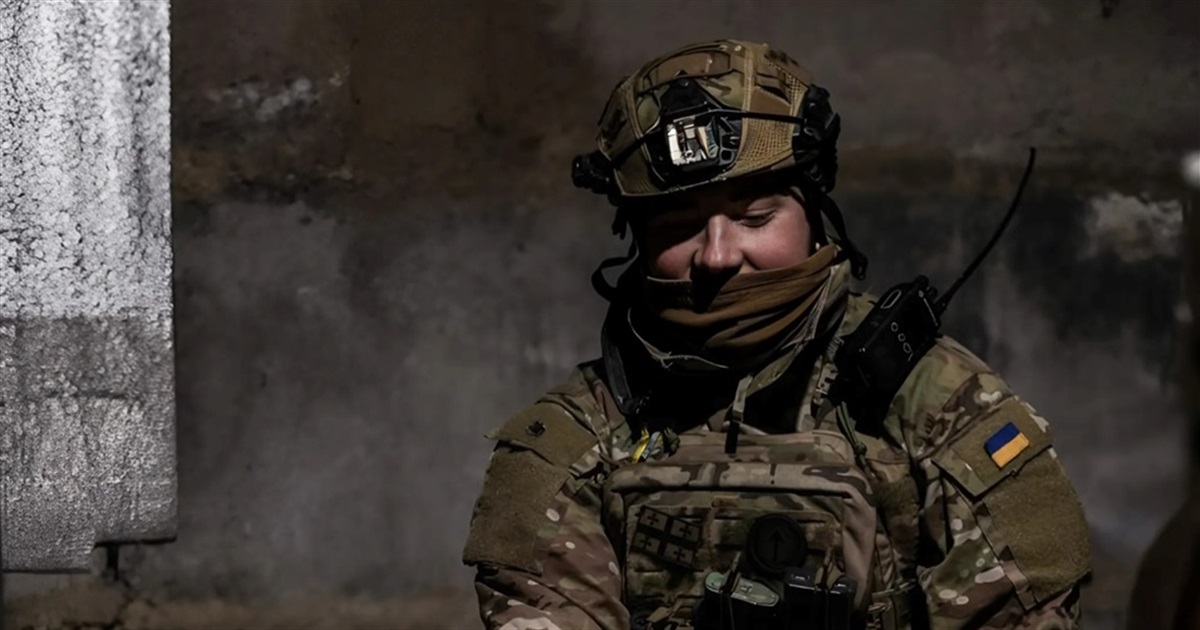
His family was killed in Mariupol. Bohdan Tsymbal asked the president to secure the release of his comrades from captivity

Source: Svoi.City
Author: Hanna KURTSANOVSKA

Bogdan Tsymbal currently serves as chief of staff of the brigade artillery group of the 12th Special Forces Brigade “Azov.” In the spring of 2022, in Mariupol, Bohdan lost his family—his loved ones were killed during the battles for the city. “Vog” was seriously wounded and evacuated by helicopter from Azovstal. Without completing his full course of rehabilitation, Bohdan headed to a training camp near the front lines. Today, he continues to defend his country as part of “Azov”—for himself and for his older brother who fell in Mariupol.

He joined “Azov” following his older brother’s
example Bogdan Tsymbal is a native of the village of Lebedynske, which is part of the Sartana village community in the Mariupol district. He studied at the Mariupol Vocational Lyceum. When he was finishing his third year, he joined the “Azov” regiment. Bohdan was 18 years old at the time.

From the very beginning, he was a highly motivated volunteer, having been born and raised in the territories that “Azov” had liberated. In an interview with Radio Liberty back in the summer of 2022, Bohdan explained why he chose this particular unit: “In 2015, the Azov Regiment carried out the Pavlopil-Shyrokyne offensive operation, during which the fighters liberated my hometown as well. That’s why I considered it my duty.”

Two years before Bogdan, his older brother had joined the ranks of “Azov.” Anton “Tasman” Kryl was an artilleryman.

He was seriously wounded and played dead in front of the Russians
At the start of the full-scale invasion, “Vog” commanded a crew, but when the battles for Mariupol were already underway, he was appointed platoon commander. The young man was only 20 years old at the time, with 22 fighters under his command.

On the morning of February 24, Bohdan Tsymbal and other “Azov” fighters were roused by an alarm. Ten minutes later, the soldiers were dispatched to Mariupol to carry out combat missions. On March 22, “Vog” sustained several wounds. This happened at the abandoned “Zhovten” rolling and stamping plant on Arkhip Kuindzhi Street.

“We were moving in a small group past a window that was covered with a sheet of metal. From there, I saw the muzzle of an assault rifle, rolled away, and was hit by bullets in my hand, shoulder, spine, and thigh. I lay there for about an hour and a half in the cold, losing a lot of blood. Then I heard people moving. From the way they spoke, I realized they were Russians. I had to play dead. They looked at my insignia. They said, ‘An Azov soldier.’ ‘200th Battalion.’ ‘Good, we won’t have to finish him off.’ And that’s all I heard. The group that had been with me came to drive them out. I saw a familiar face, started shouting and waving. They saw me and took me away.”

Evacuated from “Azovstal” by helicopter
His comrades carried the wounded “Vog” to the Azovstal steel plant. And at 3:00 a.m. on March 25, Bohdan was woken up and told to get ready for evacuation. By then, the first helicopters had already reached Mariupol. It was an airborne special operation—two crews broke through to Mariupol, which the Russian military had by then surrounded in a tight ring. This operation made it possible to extend the effective defense of the heroic Mariupol garrison at Azovstal for more than a month.

Bogdan Tsymbal refused to fly out, promising that he would rest for a few days, regain his strength, and then continue carrying out combat missions.

Evacuation of the Wounded

“And I went back to sleep. Then I felt them starting to dress me. All I remember is being loaded into a car, then—the ‘helicopter.’ They took the six of us who were in the worst condition.”

From March 21 to May 11, 2022, 15 helicopters and 45 crew members took part in nearly 30 rescue missions at Azovstal. They delivered Starlink satellites, ammunition, and medical supplies, and evacuated the wounded. Of the 15 helicopters that took part in the operations, three were shot down by the Russians.

He lost his entire family: his parents, brother, grandmother, and uncle
All of Bohdan’s relatives remained in Mariupol. His brother, mother, grandmother, and uncle were killed in the spring of 2022, when the Russians were mercilessly destroying the city along with its people.

“A tank fired at our apartment. My mother, grandmother, and uncle were killed instantly.”

The last time Bohdan spoke with them was on March 10, when he managed to stop by his parents’ house for literally just five minutes.

“They showed me a puppy that my dog had brought home, and that was it—I left.”

And on May 14, during the battles for the city, “Vog” lost his younger brother Anton, whose call sign was “Tasman”—it was Anton’s example that had led him to join “Azov” to serve side by side.

“I saw my older brother for the first time on March 12 at Azovstal. We served in the same unit, but were in different platoons. On May 14, he was online for the last time; I messaged him, but there was no reply.”

That same evening, Bogdan’s commander messaged him: “I’m sorry, my friend ‘Vog,’ they’ve fallen.” “Tasman” was killed at Azovstal.

Bogdan Tsymbal’s father was captured by Russian soldiers right in the middle of the filtration process. According to one account, once they found out he was the father of an “Azov” fighter, they began beating him. Others stepped in to defend him; gunfire broke out, the crowd was driven back, and “Vog’s” father was taken away in an unknown direction.

“My family remains in my memory and in my heart.”

At just 22 years old, “Vog” is a commander, mentor, and trusted comrade
Just a few months after being seriously wounded, the Azov fighter returned to the front lines. During the defense of Novosilka in the Zaporizhzhia sector, he carried out dozens of daring sabotage operations behind enemy lines. From September 2023 to September 2024 alone, he destroyed about a hundred Russian invaders, a tank, five artillery pieces, and nine military vehicles. He was wounded but resumed combat operations in the Serebryansky Forestry area just two months later.

According to the Azov press service, during the summer counteroffensive of 2023, “Vog” and his group carried out daring raids, eliminating dozens of enemy personnel, vehicles, and weapons.

His comrades know that when “Vog” is with them—even on the most difficult operations—everything will be under control. Despite his young age—Bogdan Tsymbal is now 22—to his subordinates, “Vog” is a commander, mentor, and trusted comrade. He continues his combat service in the unit and also serves as an instructor, training a new generation of “Azov” fighters.

The photo shows Bohdan with his wife; they recently became parents. In the background is “Azovstal,” and above the plant is his older brother “Tasman”

“The war will end only when we fully reclaim our territories. Absolutely everything. And when we bring back our prisoners of war.”

Speaking about his comrades who have been held in Russian prisons for nearly 2.5 years, Bohdan Tsymbal made this appeal during the ceremony where he was awarded the highest state honor—the title of “Hero of Ukraine.”

“Bring the guys back from captivity. That is the main goal,” “Vog” said to Volodymyr Zelenskyy during the ceremony.

Thousands of defenders from the Mariupol garrison remain in Russian captivity, including 700 members of the Azov Regiment.

This is an automatic translation generated by DeepL.