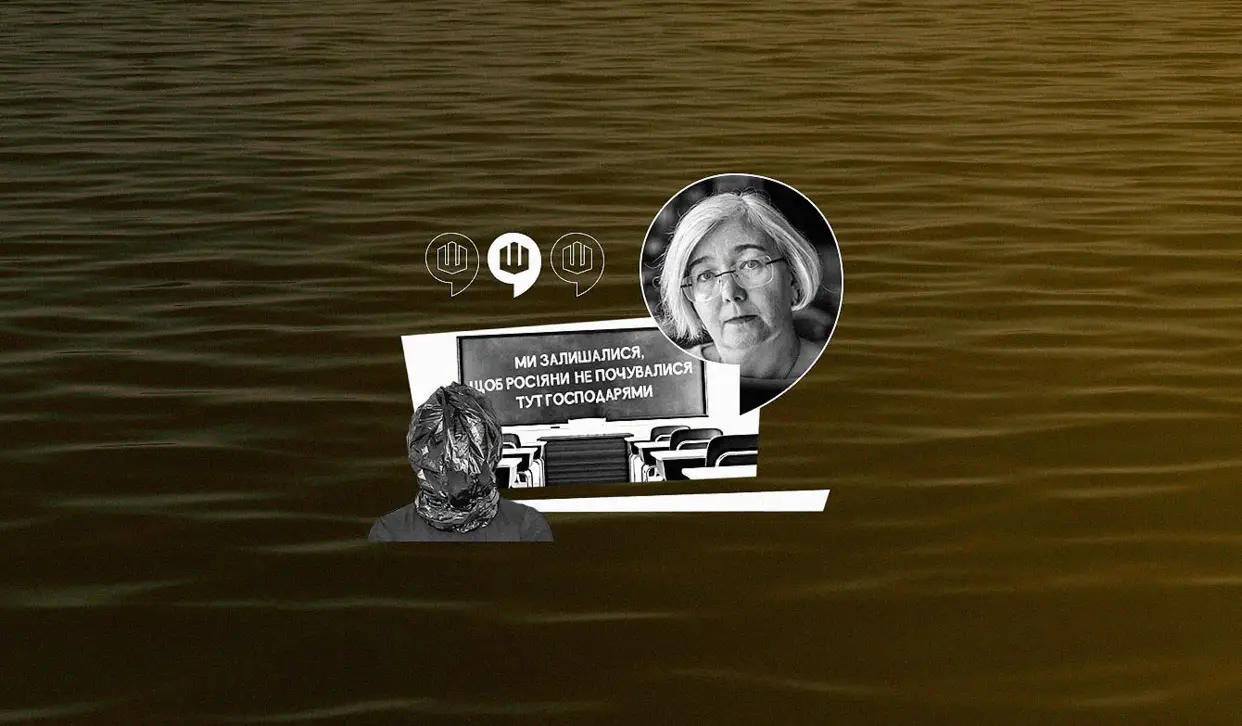
“We stayed so that the Russians wouldn’t feel like they owned the place.” How teacher Olga Melnichenko survived the occupation and captivity in Kherson without breaking
Source: Signal to Resist
Author: Sofia Panasyuk
Finding herself in Russian captivity for allegedly hiding her brother, a soldier—this was the fate that befell teacher Olga Melnychenko after the occupation of Kherson.
Olga spent over a month in a Russian torture chamber, where she heard the occupiers tormenting prisoners every day. However, the Russians failed to break her. Even during her very first interrogation, the teacher refused to call her brother as ordered by the invaders and, despite their threats, did not waver in her stance.
Olga Melnichenko told us why she didn’t leave Kherson, how she survived in a cramped cell in a Russian detention center with four other women, why she threw away her cell phone after her release, and how she walked across the entire city, not believing she would ever be released.
Olga Melnichenko’s entire life is tied to Kherson. She was born here, went to school here, earned her teaching degree, and got a job as an English teacher at Gymnasium No. 28.
“I’ve been working at this school for 28 years, ever since I graduated from college,” says Olga. “For me, Kherson has always been home—a calm, peaceful, and beloved place.”
Currently, 400 students attend the gymnasium—most of whom were already enrolled before the full-scale invasion began. Teachers and support staff are also mostly still in Kherson. Some of them were there during the shelling, when a shell landed on the school stadium—the crater left by it can still be seen from the school’s windows.
Although the high school did have a civil defense plan, Principal Tetyana Nadtochii recalls that no one expected hostilities.
“A week before February 24, some parents came and said, ‘We’re going to take our child’s documents from the school. There’s going to be a war.” I said, ‘That can’t be. It’s the 21st century—what war?’” the principal recalls her surprise. “But we prepared the documents, the parents came on February 23 and quickly picked them up. That day, we still had a general meeting of administrators; we were making plans, dreaming about what the future would hold, and what we would do next.”
However, that school year at Gymnasium No. 28 ended early, online, on April 30. Tetyana forbade teachers from coming to school for safety reasons. Only she, the facilities manager, and the security guards came to work.
By June, the principal had learned that the Russians were seizing the premises of other schools and abducting their administrators. So she hasn’t shown up for work since then.
“The so-called principal of Gymnasium No. 6 arrived with two Russian soldiers; our facilities manager was at the school,” Tetyana says. “They asked where the principal was. The facilities manager said the principal wasn’t there—she had left—and that only the technical staff were present. The Russians said they would be preparing the school for the new school year and offered for her to stay and work with them. The facilities manager said, ‘Neither I nor our staff will work with you.’ Then they asked her to leave the keys to the school.”
Neither Tetyana nor Olga nor any of the other staff members cooperated with the Russians; only the chemistry teacher agreed to their proposal. The occupiers never resumed classes at Gymnasium No. 28: they turned the building into barracks where Russian National Guard troops lived. After the de-occupation, Tetyana was surprised to find that not all the textbooks had been taken from the library:
“They must have been told to leave Kherson, and they fled in a hurry. Because when we came in here, everything was left behind: plates, sliced sausage, hard-boiled eggs. All that food was just left on the table.”
Since the de-occupation of Kherson on November 16, 2022, the school has been operating as a “resilience center” and a humanitarian aid headquarters, while the children are studying online.
“Russian soldiers are crawling around like cockroaches”
On February 24, 2022, Olga Melnichenko was walking home, thinking about the next workday and her plans for the weekend, wondering what to buy at the store and what to make for dinner. But at 5 a.m. the next day, she received a message from a colleague about Russian tanks in the Kherson region.
“I tried to focus; we didn’t know whether to go to work or not,” the teacher recalls. “The windows of my house look out onto Chornobaivka. And that morning, the Russians had already started bombing it. They hit flammable materials; everything was on fire, and black smoke hung in the air. My mom and I realized that the fighting was already right nearby.”
However, Olga was more worried about her daughter, who was in Kharkiv. The girl also woke up to the explosions and bought a train ticket to Kherson for February 26. But she was unable to return home. A few weeks later, she left on an evacuation train for students bound for Pochaiv in the Ternopil region.
The teacher did not see with her own eyes how the Russians entered the city, even though they were advancing from the area where she lives. But videos of the events quickly spread online: people were filming them from the windows of high-rise buildings.
“We couldn’t hear the fighting on Antonivsky Bridge very well. But those who lived closer—for example, on Perekopskaya Street—said that our forces were holding their ground, but almost the entire Kherson region had already been occupied. And we understood that. Russian soldiers were advancing very quietly, like cockroaches spreading everywhere,” Olga says with disgust.
After that, she often saw Russian troops moving around, but she didn’t encounter them personally. Public transportation was unreliable, and walking would have required passing through many checkpoints, so Olga tried to avoid going into the city center. On top of that, her mother needed constant care due to problems with her legs and blood pressure.
This also presented difficulties: her mother needed specific medication. It was impossible to obtain the Ukrainian drug, and there were simply no Russian equivalents. Olga tried not to use the occupiers’ money or buy their products. She first came face-to-face with Russian soldiers in May or June:
“There were two soldiers—specifically Russian ones, because there were many representatives of the ‘LPR/DPR,’ and they looked a little different. But these were armed and wearing masks. They were shopping at our local market. We had a good vegetable harvest back then, but the Russians wouldn’t let us take them anywhere, so the produce was cheap.”
During her next encounter, Olga had to interact with the Russian soldiers, as they were trying to break into her home.
“Why would he come here? So you could kill him?”
This happened on July 4, 2022. Olga remembers that from early in the morning, the occupiers had been trying to pry open the gate in the courtyard of the house where she lived with her mother.
“Around seven o’clock, we heard some movement,” the teacher recalls. “When I went to the kitchen windows, two soldiers had already climbed over the gate. A third was about to climb over and aimed a laser pointer at me. In total, there were five or six soldiers and two more FSB agents in black uniforms.”
Author: Sofia Panasyuk
Finding herself in Russian captivity for allegedly hiding her brother, a soldier—this was the fate that befell teacher Olga Melnychenko after the occupation of Kherson.
Olga spent over a month in a Russian torture chamber, where she heard the occupiers tormenting prisoners every day. However, the Russians failed to break her. Even during her very first interrogation, the teacher refused to call her brother as ordered by the invaders and, despite their threats, did not waver in her stance.
Olga Melnichenko told us why she didn’t leave Kherson, how she survived in a cramped cell in a Russian detention center with four other women, why she threw away her cell phone after her release, and how she walked across the entire city, not believing she would ever be released.
Olga Melnichenko’s entire life is tied to Kherson. She was born here, went to school here, earned her teaching degree, and got a job as an English teacher at Gymnasium No. 28.
“I’ve been working at this school for 28 years, ever since I graduated from college,” says Olga. “For me, Kherson has always been home—a calm, peaceful, and beloved place.”
Currently, 400 students attend the gymnasium—most of whom were already enrolled before the full-scale invasion began. Teachers and support staff are also mostly still in Kherson. Some of them were there during the shelling, when a shell landed on the school stadium—the crater left by it can still be seen from the school’s windows.
Although the high school did have a civil defense plan, Principal Tetyana Nadtochii recalls that no one expected hostilities.
“A week before February 24, some parents came and said, ‘We’re going to take our child’s documents from the school. There’s going to be a war.” I said, ‘That can’t be. It’s the 21st century—what war?’” the principal recalls her surprise. “But we prepared the documents, the parents came on February 23 and quickly picked them up. That day, we still had a general meeting of administrators; we were making plans, dreaming about what the future would hold, and what we would do next.”
However, that school year at Gymnasium No. 28 ended early, online, on April 30. Tetyana forbade teachers from coming to school for safety reasons. Only she, the facilities manager, and the security guards came to work.
By June, the principal had learned that the Russians were seizing the premises of other schools and abducting their administrators. So she hasn’t shown up for work since then.
“The so-called principal of Gymnasium No. 6 arrived with two Russian soldiers; our facilities manager was at the school,” Tetyana says. “They asked where the principal was. The facilities manager said the principal wasn’t there—she had left—and that only the technical staff were present. The Russians said they would be preparing the school for the new school year and offered for her to stay and work with them. The facilities manager said, ‘Neither I nor our staff will work with you.’ Then they asked her to leave the keys to the school.”
Neither Tetyana nor Olga nor any of the other staff members cooperated with the Russians; only the chemistry teacher agreed to their proposal. The occupiers never resumed classes at Gymnasium No. 28: they turned the building into barracks where Russian National Guard troops lived. After the de-occupation, Tetyana was surprised to find that not all the textbooks had been taken from the library:
“They must have been told to leave Kherson, and they fled in a hurry. Because when we came in here, everything was left behind: plates, sliced sausage, hard-boiled eggs. All that food was just left on the table.”
Since the de-occupation of Kherson on November 16, 2022, the school has been operating as a “resilience center” and a humanitarian aid headquarters, while the children are studying online.
“Russian soldiers are crawling around like cockroaches”
On February 24, 2022, Olga Melnichenko was walking home, thinking about the next workday and her plans for the weekend, wondering what to buy at the store and what to make for dinner. But at 5 a.m. the next day, she received a message from a colleague about Russian tanks in the Kherson region.
“I tried to focus; we didn’t know whether to go to work or not,” the teacher recalls. “The windows of my house look out onto Chornobaivka. And that morning, the Russians had already started bombing it. They hit flammable materials; everything was on fire, and black smoke hung in the air. My mom and I realized that the fighting was already right nearby.”
However, Olga was more worried about her daughter, who was in Kharkiv. The girl also woke up to the explosions and bought a train ticket to Kherson for February 26. But she was unable to return home. A few weeks later, she left on an evacuation train for students bound for Pochaiv in the Ternopil region.
The teacher did not see with her own eyes how the Russians entered the city, even though they were advancing from the area where she lives. But videos of the events quickly spread online: people were filming them from the windows of high-rise buildings.
“We couldn’t hear the fighting on Antonivsky Bridge very well. But those who lived closer—for example, on Perekopskaya Street—said that our forces were holding their ground, but almost the entire Kherson region had already been occupied. And we understood that. Russian soldiers were advancing very quietly, like cockroaches spreading everywhere,” Olga says with disgust.
After that, she often saw Russian troops moving around, but she didn’t encounter them personally. Public transportation was unreliable, and walking would have required passing through many checkpoints, so Olga tried to avoid going into the city center. On top of that, her mother needed constant care due to problems with her legs and blood pressure.
This also presented difficulties: her mother needed specific medication. It was impossible to obtain the Ukrainian drug, and there were simply no Russian equivalents. Olga tried not to use the occupiers’ money or buy their products. She first came face-to-face with Russian soldiers in May or June:
“There were two soldiers—specifically Russian ones, because there were many representatives of the ‘LPR/DPR,’ and they looked a little different. But these were armed and wearing masks. They were shopping at our local market. We had a good vegetable harvest back then, but the Russians wouldn’t let us take them anywhere, so the produce was cheap.”
During her next encounter, Olga had to interact with the Russian soldiers, as they were trying to break into her home.
“Why would he come here? So you could kill him?”
This happened on July 4, 2022. Olga remembers that from early in the morning, the occupiers had been trying to pry open the gate in the courtyard of the house where she lived with her mother.
“Around seven o’clock, we heard some movement,” the teacher recalls. “When I went to the kitchen windows, two soldiers had already climbed over the gate. A third was about to climb over and aimed a laser pointer at me. In total, there were five or six soldiers and two more FSB agents in black uniforms.”
Olga had no choice but to let the occupiers into her home. All the Russians were wearing masks, so she could only see their eyes. They immediately asked for Olga’s and her mother’s passports and cell phones. She realized the Russians were looking for her brother, a soldier.
“At first, I handed over my passport, and they exchanged glances—they weren’t sure they’d come to the right place,” she says. “Because my brother and I have different last names. But once I handed over my mother’s passport, they seemed to calm down.”
From 2014 to 2017, Olga’s brother served as a volunteer in the ATO/JFO. And immediately after the full-scale invasion began, he rejoined the ranks of the Ukrainian Armed Forces. So looking for him in the occupied territories was a futile endeavor. The Russians, however, thought he was in hiding and demanded that Olga call him.
“The condition was this: until my brother came, I would stay with the Russians,” Olga recalls. “They told me to get ready. Meanwhile, they searched the house, the summer kitchen, and the shed. They decided we were hiding him. In addition to our phones, they took the computer’s system unit because we had a separate folder there with my brother’s military photos, labeled ‘ATO.’ “They took it—they probably thought there was some kind of information in there.”
The Russians didn’t immediately send the woman “to the basement” or put a bag over her head, as they often did with prisoners. Instead, they drove her to the address where Olga’s family had lived 20 years ago. To her surprise, the occupiers knew exactly where to go and didn’t even ask the captive for any details. Other people had been living in that house for a long time, so the Russians found no traces of the soldier there either. Olga was taken to the Ostriv neighborhood:
“The occupiers knew there was an apartment belonging to my daughter-in-law—my brother’s wife—but they didn’t have the exact address. They forced me to show them the way. But I don’t remember the address. I said, ‘I don’t know this area well; I won’t be able to find it.’ And then I heard one of the soldiers say over the radio, ‘Maybe we should help the woman remember?’”
Olga knew that her brother’s family had left the occupied territory, so she tried to recall the address. At the correct apartment, the Russians broke down the door and took two laptops. Of course, they didn’t find the soldier. Olga herself wasn’t allowed into the apartment, and after the search, they took her to the car.
“They suggested calling my brother again,” she sighs. “I refused, saying, ‘Why should he come? So you can kill him?” They told me, “Then you’ll come with us.””
“We don’t have anyone by that name; file a missing person report.” Olga was taken to Teploenergetikov Street on the outskirts of Kherson. There, in the temporary detention center, the occupiers had set up one of their torture chambers. Once inside the facility, they took the teacher’s jewelry and house keys, and kept her phone.
They put a hood over the captive’s head so she couldn’t see anything, and led her to an interrogation conducted by the same two FSB officers. They went through the contacts on her cell phone, asking who was who. They wanted to know why Olga didn’t have a Russian SIM card and why she needed a VPN. Overall, the conversation centered on her brother, who is in the military.
“My brother’s life, his friends, his comrades—they had his entire life story, starting from kindergarten,” Olga says. “They didn’t yell or torture me; they spoke very calmly. At the end, they just tried to intimidate me and offered once again to call my brother. I refused. If they want him to come, let them call him themselves. Besides, how could anyone even get here, to the occupied territory? For some reason, they decided he was in Kherson.”
After the interrogation, Olga was taken to a women’s cell. Later, they took her away, took her fingerprints, photographed her, and returned her to her cellmates. It was the only interrogation she had undergone in over a month of Russian captivity.
Four other women were later placed in the cell with Olga, even though there was only room for three. Two of them were also being held because of relatives in the military, and another for her volunteer work. In addition, journalist Anzhela Slobodian, who had been reporting from occupied Kherson until the very end, was in the cell.
Her former cellmates still keep in touch. Unfortunately, Faina, with whom Olga was first placed in the cell, died after her Russian captivity—her body could not withstand the inhumane conditions of the torture chamber.
Olga remembers every detail of her captivity because it involved daily psychological pressure. She was lucky to avoid physical torture, but that didn’t make the conditions in the Russian detention center any better. The teacher recalls that prisoners were fed only in the morning, so they had to stretch their food to last the whole day:
“In the evening, they brought us only tea. For about two weeks, we were fed only buckwheat; then, for another two weeks, only vermicelli. It was a standard cell with three bunks. The cell had a toilet and running water. We weren’t allowed to bathe. They took us to the shower just once, and that was it.”
For the first two weeks, the guards were Russian military personnel, including Kadyrovites. During this time, the prisoners were taken out several times for walks in the detention center’s courtyard for about half an hour. According to Olga’s recollections, Kadyrovites would show up mainly at night to torment the detainees.
“They didn’t touch the women in our cell, but we heard everything,” she recalls. “The men were tortured very severely. And we heard the interrogations. Once, we were woken up by the sound of a young man being beaten in the neighboring cell at night because he had complained about something.”
The Russians also put psychological pressure on all the detainees. They forced some to learn the Russian national anthem, and others to shout “Glory to Russia” every time the cell door opened.
Once, they brought in huge speakers and blared Russian patriotic songs or propaganda films about World War II—or, as it’s called in Russia, the Great Patriotic War. For the occupiers, this was entertainment, just like the constant beatings.
The Russians did not provide medical care to the prisoners, even when they became ill. Impunity gave the occupiers free rein.
“We heard that at least one man was killed,” says Olga. “An interrogation was taking place above our cell; he was moaning. And then, when the guards were making their rounds, they said, ‘Someone went too far—we’ve probably got our 200th.’ And then there was this sound—like something being wrapped up with tape.”
At that very moment, the Russians were holding five Ukrainian soldiers in a solitary confinement cell at the detention center. Olga doesn’t know what happened to them afterward, but she recalls that two weeks later, the occupiers carried out a rotation; the Russian soldiers left and probably took the prisoners with them.
Instead, Russian National Guard troops arrived at the detention center. They were already trying to “accustom” the prisoners to the rules of Russian prisons: they took down the names of those present in the cell, and even read out to some the charges under which they would be tried.
Olga’s family did not know what was happening to her all this time. Her mother had already left Kherson to stay with her granddaughter in Pochaiv and had no way of contacting her daughter. Her brother submitted her name to the exchange lists, but the Russians did not acknowledge that she was in their custody.
Her cellmates came to the rescue: when one of them was released, she contacted Olga’s colleagues at the school. The teachers wanted to send her food, but they needed permission from the investigator to do so. They searched for him for nearly two weeks.
“No matter where they went, they were told everywhere: ‘We don’t have anyone like that here. File a missing person report,” the teacher recalls. “But what disappearance? You’re the ones who took me away.”
“Pack your things and leave”
Olga was released from the Russian torture chamber just as unexpectedly as she had been taken captive. It happened on August 6. At the time, the prisoner couldn’t understand what was happening, and instead of relief, she felt fear:
“The door just opened, my last name was called, and the guards said, ‘Get your things and leave.’ I asked if they were transferring me somewhere or releasing me. They replied, ‘We don’t know.’ They pulled a hood over my face, and I walked into the unknown. The only thing was—it seemed like we were heading in a different direction than when they took me for interrogation.”
When Olga left the cell, she was afraid they were transferring her to the left bank of the Kherson region, to Crimea, or somewhere in Russia—in which case, even the slightest chance of contacting her family would be cut off.
Fortunately, they took the captive to another room, returned her belongings, and released her. She got back the jewelry the Russians had taken during her arrest, but they never found the keys to her house.
Just as Olga was about to leave, an FSB officer came out, returned her phone, and asked her to say hello to her brother. The phone was fully charged, but Olga didn’t use it again.
“They didn’t delete anything from the phone; they didn’t even log into my PrivatBank account. But after the phone was in their hands, my VPN wouldn’t work. Or, among all the countries listed, I could only choose Russia,” the teacher says in surprise. “I’ve tried installing different ones, and it’s always the same story. I couldn’t even reset the phone to factory settings. I just threw it away, SIM card and all.”
Olga walked home from the detention center because she had no money. She had to make it to the other side of the city before curfew. At one of the bus stops, the teacher was lucky enough to meet a Ukrainian driver who agreed to give her a ride.
She didn’t make it home right away: Olga spent a few days at a neighbor’s house until she received the spare keys to her apartment.
After the month Olga spent in captivity, Kherson seemed like a different place to her. There were posters and banners everywhere reading “Russia is here forever”; the sense of psychological pressure intensified, and more Russians arrived—not only military personnel but also civilians.
By August 15, Olga had decided to leave Kherson to join her daughter and mother in Pochaiv. There, she was finally able to breathe a sigh of relief and rest.
“It was impossible to sleep in the detention center,” recalls the former captive. “At night, Russian troops would subject us to torture. On top of that, we always had to sleep two to a bunk, which isn’t very comfortable. And when they released me, I was afraid of being imprisoned again. That’s why, even at home, I could only fall asleep sometime between 2 a.m. and 5 a.m., when the cars started driving by again. Once I was back on territory controlled by Ukraine, I finally got a good night’s sleep.”
“There’s no place like home”
Olga heard the news of her hometown Kherson’s liberation while in Pochaiv. She recalls that there were many displaced people from the Kherson region there, so the joy spread quickly, and people celebrated together.
In a group chat for school staff, Olga also saw a photo of the principal with her colleagues: happy and free from the Russian occupation.
“There was such excitement!” the teacher recalls. “The joy is incredible, because not only captivity, but the occupation itself is a nightmare. It was very hard to survive—not buying Russian goods, getting cash, finding Ukrainian medicine—all without the internet or cell service.”
After Kherson was liberated, Olga waited for an opportunity to return home. That chance came in April 2023.
“When people asked us why we hadn’t left, I always said: so the Russians wouldn’t feel like they owned the place,” explains Olga. “Even during the occupation, in March and April, in our neighborhood, when the curfew began, the Ukrainian national anthem and ‘Chervona Kalyna’ would play—and the Russians were forced to listen to it.”
The teacher believes that the presence of residents who remained in Kherson prevented the occupiers from quickly establishing their own rules. For example, they themselves sometimes didn’t use the rubles they’d put into circulation and instead bought goods—such as Ukrainian cigarettes—with hryvnias.
“If everyone had left and no one had been here, they would probably have behaved differently,” the teacher speculates. “Even when I left in August, their rubles still hadn’t caught on. For example, at a pharmacy opened by the Russians, all the prices were in their currency. By that time, some pensioners were already receiving rubles. A couple walks into this pharmacy: ‘Can we buy medicine from you?’ And the saleswoman says, “Yes, but I won’t have any change.”»
Life in Kherson is dangerous right now, but for Olga, there’s nothing better than feeling at home. Her family is nearby, and her brother continues his military service despite having been wounded several times. Even though her house has been shelled more than once, and her neighbors’ roof and car were burned down, Olga chooses to stay in free, Ukrainian Kherson.
“There’s nothing more terrifying than occupation. It’s better at home; home is where my walls are—familiar and beloved. I think the enemy is trying to do everything it can to make us leave here, but it won’t succeed. So we’re holding on as best we can.”
“At first, I handed over my passport, and they exchanged glances—they weren’t sure they’d come to the right place,” she says. “Because my brother and I have different last names. But once I handed over my mother’s passport, they seemed to calm down.”
From 2014 to 2017, Olga’s brother served as a volunteer in the ATO/JFO. And immediately after the full-scale invasion began, he rejoined the ranks of the Ukrainian Armed Forces. So looking for him in the occupied territories was a futile endeavor. The Russians, however, thought he was in hiding and demanded that Olga call him.
“The condition was this: until my brother came, I would stay with the Russians,” Olga recalls. “They told me to get ready. Meanwhile, they searched the house, the summer kitchen, and the shed. They decided we were hiding him. In addition to our phones, they took the computer’s system unit because we had a separate folder there with my brother’s military photos, labeled ‘ATO.’ “They took it—they probably thought there was some kind of information in there.”
The Russians didn’t immediately send the woman “to the basement” or put a bag over her head, as they often did with prisoners. Instead, they drove her to the address where Olga’s family had lived 20 years ago. To her surprise, the occupiers knew exactly where to go and didn’t even ask the captive for any details. Other people had been living in that house for a long time, so the Russians found no traces of the soldier there either. Olga was taken to the Ostriv neighborhood:
“The occupiers knew there was an apartment belonging to my daughter-in-law—my brother’s wife—but they didn’t have the exact address. They forced me to show them the way. But I don’t remember the address. I said, ‘I don’t know this area well; I won’t be able to find it.’ And then I heard one of the soldiers say over the radio, ‘Maybe we should help the woman remember?’”
Olga knew that her brother’s family had left the occupied territory, so she tried to recall the address. At the correct apartment, the Russians broke down the door and took two laptops. Of course, they didn’t find the soldier. Olga herself wasn’t allowed into the apartment, and after the search, they took her to the car.
“They suggested calling my brother again,” she sighs. “I refused, saying, ‘Why should he come? So you can kill him?” They told me, “Then you’ll come with us.””
“We don’t have anyone by that name; file a missing person report.” Olga was taken to Teploenergetikov Street on the outskirts of Kherson. There, in the temporary detention center, the occupiers had set up one of their torture chambers. Once inside the facility, they took the teacher’s jewelry and house keys, and kept her phone.
They put a hood over the captive’s head so she couldn’t see anything, and led her to an interrogation conducted by the same two FSB officers. They went through the contacts on her cell phone, asking who was who. They wanted to know why Olga didn’t have a Russian SIM card and why she needed a VPN. Overall, the conversation centered on her brother, who is in the military.
“My brother’s life, his friends, his comrades—they had his entire life story, starting from kindergarten,” Olga says. “They didn’t yell or torture me; they spoke very calmly. At the end, they just tried to intimidate me and offered once again to call my brother. I refused. If they want him to come, let them call him themselves. Besides, how could anyone even get here, to the occupied territory? For some reason, they decided he was in Kherson.”
After the interrogation, Olga was taken to a women’s cell. Later, they took her away, took her fingerprints, photographed her, and returned her to her cellmates. It was the only interrogation she had undergone in over a month of Russian captivity.
Four other women were later placed in the cell with Olga, even though there was only room for three. Two of them were also being held because of relatives in the military, and another for her volunteer work. In addition, journalist Anzhela Slobodian, who had been reporting from occupied Kherson until the very end, was in the cell.
Her former cellmates still keep in touch. Unfortunately, Faina, with whom Olga was first placed in the cell, died after her Russian captivity—her body could not withstand the inhumane conditions of the torture chamber.
Olga remembers every detail of her captivity because it involved daily psychological pressure. She was lucky to avoid physical torture, but that didn’t make the conditions in the Russian detention center any better. The teacher recalls that prisoners were fed only in the morning, so they had to stretch their food to last the whole day:
“In the evening, they brought us only tea. For about two weeks, we were fed only buckwheat; then, for another two weeks, only vermicelli. It was a standard cell with three bunks. The cell had a toilet and running water. We weren’t allowed to bathe. They took us to the shower just once, and that was it.”
For the first two weeks, the guards were Russian military personnel, including Kadyrovites. During this time, the prisoners were taken out several times for walks in the detention center’s courtyard for about half an hour. According to Olga’s recollections, Kadyrovites would show up mainly at night to torment the detainees.
“They didn’t touch the women in our cell, but we heard everything,” she recalls. “The men were tortured very severely. And we heard the interrogations. Once, we were woken up by the sound of a young man being beaten in the neighboring cell at night because he had complained about something.”
The Russians also put psychological pressure on all the detainees. They forced some to learn the Russian national anthem, and others to shout “Glory to Russia” every time the cell door opened.
Once, they brought in huge speakers and blared Russian patriotic songs or propaganda films about World War II—or, as it’s called in Russia, the Great Patriotic War. For the occupiers, this was entertainment, just like the constant beatings.
The Russians did not provide medical care to the prisoners, even when they became ill. Impunity gave the occupiers free rein.
“We heard that at least one man was killed,” says Olga. “An interrogation was taking place above our cell; he was moaning. And then, when the guards were making their rounds, they said, ‘Someone went too far—we’ve probably got our 200th.’ And then there was this sound—like something being wrapped up with tape.”
At that very moment, the Russians were holding five Ukrainian soldiers in a solitary confinement cell at the detention center. Olga doesn’t know what happened to them afterward, but she recalls that two weeks later, the occupiers carried out a rotation; the Russian soldiers left and probably took the prisoners with them.
Instead, Russian National Guard troops arrived at the detention center. They were already trying to “accustom” the prisoners to the rules of Russian prisons: they took down the names of those present in the cell, and even read out to some the charges under which they would be tried.
Olga’s family did not know what was happening to her all this time. Her mother had already left Kherson to stay with her granddaughter in Pochaiv and had no way of contacting her daughter. Her brother submitted her name to the exchange lists, but the Russians did not acknowledge that she was in their custody.
Her cellmates came to the rescue: when one of them was released, she contacted Olga’s colleagues at the school. The teachers wanted to send her food, but they needed permission from the investigator to do so. They searched for him for nearly two weeks.
“No matter where they went, they were told everywhere: ‘We don’t have anyone like that here. File a missing person report,” the teacher recalls. “But what disappearance? You’re the ones who took me away.”
“Pack your things and leave”
Olga was released from the Russian torture chamber just as unexpectedly as she had been taken captive. It happened on August 6. At the time, the prisoner couldn’t understand what was happening, and instead of relief, she felt fear:
“The door just opened, my last name was called, and the guards said, ‘Get your things and leave.’ I asked if they were transferring me somewhere or releasing me. They replied, ‘We don’t know.’ They pulled a hood over my face, and I walked into the unknown. The only thing was—it seemed like we were heading in a different direction than when they took me for interrogation.”
When Olga left the cell, she was afraid they were transferring her to the left bank of the Kherson region, to Crimea, or somewhere in Russia—in which case, even the slightest chance of contacting her family would be cut off.
Fortunately, they took the captive to another room, returned her belongings, and released her. She got back the jewelry the Russians had taken during her arrest, but they never found the keys to her house.
Just as Olga was about to leave, an FSB officer came out, returned her phone, and asked her to say hello to her brother. The phone was fully charged, but Olga didn’t use it again.
“They didn’t delete anything from the phone; they didn’t even log into my PrivatBank account. But after the phone was in their hands, my VPN wouldn’t work. Or, among all the countries listed, I could only choose Russia,” the teacher says in surprise. “I’ve tried installing different ones, and it’s always the same story. I couldn’t even reset the phone to factory settings. I just threw it away, SIM card and all.”
Olga walked home from the detention center because she had no money. She had to make it to the other side of the city before curfew. At one of the bus stops, the teacher was lucky enough to meet a Ukrainian driver who agreed to give her a ride.
She didn’t make it home right away: Olga spent a few days at a neighbor’s house until she received the spare keys to her apartment.
After the month Olga spent in captivity, Kherson seemed like a different place to her. There were posters and banners everywhere reading “Russia is here forever”; the sense of psychological pressure intensified, and more Russians arrived—not only military personnel but also civilians.
By August 15, Olga had decided to leave Kherson to join her daughter and mother in Pochaiv. There, she was finally able to breathe a sigh of relief and rest.
“It was impossible to sleep in the detention center,” recalls the former captive. “At night, Russian troops would subject us to torture. On top of that, we always had to sleep two to a bunk, which isn’t very comfortable. And when they released me, I was afraid of being imprisoned again. That’s why, even at home, I could only fall asleep sometime between 2 a.m. and 5 a.m., when the cars started driving by again. Once I was back on territory controlled by Ukraine, I finally got a good night’s sleep.”
“There’s no place like home”
Olga heard the news of her hometown Kherson’s liberation while in Pochaiv. She recalls that there were many displaced people from the Kherson region there, so the joy spread quickly, and people celebrated together.
In a group chat for school staff, Olga also saw a photo of the principal with her colleagues: happy and free from the Russian occupation.
“There was such excitement!” the teacher recalls. “The joy is incredible, because not only captivity, but the occupation itself is a nightmare. It was very hard to survive—not buying Russian goods, getting cash, finding Ukrainian medicine—all without the internet or cell service.”
After Kherson was liberated, Olga waited for an opportunity to return home. That chance came in April 2023.
“When people asked us why we hadn’t left, I always said: so the Russians wouldn’t feel like they owned the place,” explains Olga. “Even during the occupation, in March and April, in our neighborhood, when the curfew began, the Ukrainian national anthem and ‘Chervona Kalyna’ would play—and the Russians were forced to listen to it.”
The teacher believes that the presence of residents who remained in Kherson prevented the occupiers from quickly establishing their own rules. For example, they themselves sometimes didn’t use the rubles they’d put into circulation and instead bought goods—such as Ukrainian cigarettes—with hryvnias.
“If everyone had left and no one had been here, they would probably have behaved differently,” the teacher speculates. “Even when I left in August, their rubles still hadn’t caught on. For example, at a pharmacy opened by the Russians, all the prices were in their currency. By that time, some pensioners were already receiving rubles. A couple walks into this pharmacy: ‘Can we buy medicine from you?’ And the saleswoman says, “Yes, but I won’t have any change.”»
Life in Kherson is dangerous right now, but for Olga, there’s nothing better than feeling at home. Her family is nearby, and her brother continues his military service despite having been wounded several times. Even though her house has been shelled more than once, and her neighbors’ roof and car were burned down, Olga chooses to stay in free, Ukrainian Kherson.
“There’s nothing more terrifying than occupation. It’s better at home; home is where my walls are—familiar and beloved. I think the enemy is trying to do everything it can to make us leave here, but it won’t succeed. So we’re holding on as best we can.”
This is an automatic translation generated by DeepL.