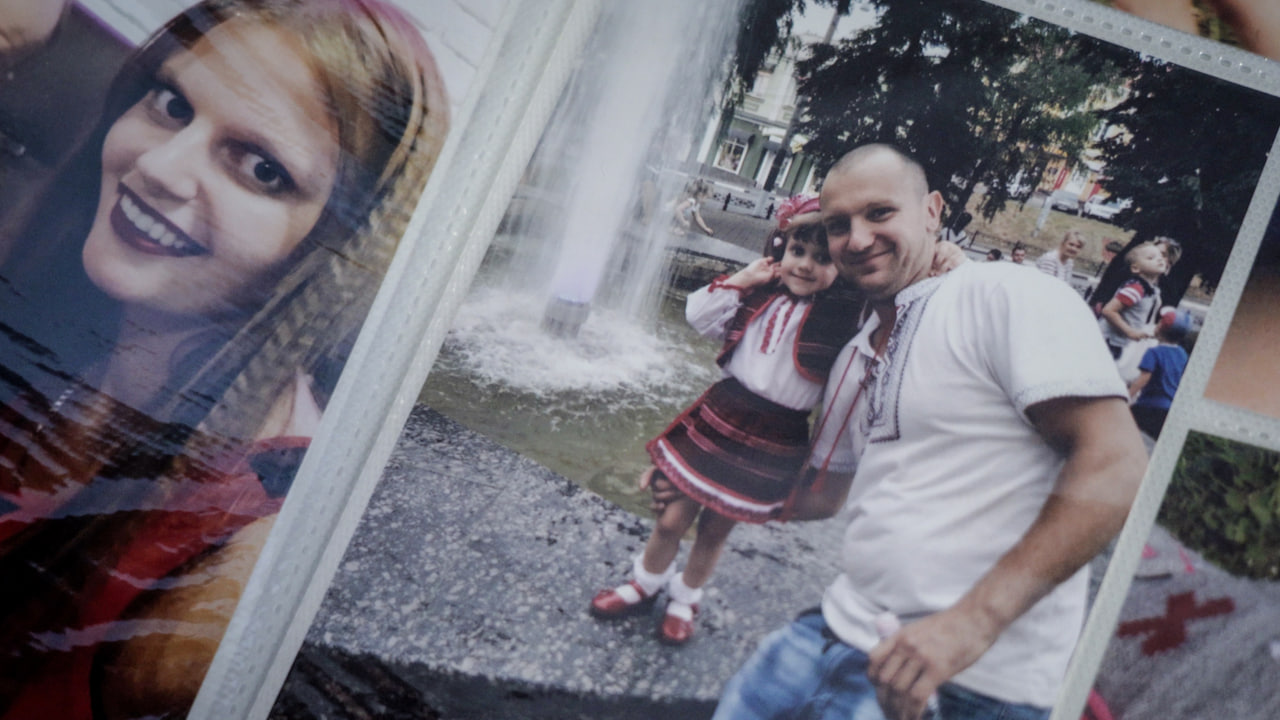
“When Andriy saw a photo of his son, everyone in the room was in tears.” How two families have been waiting four years for their civil partners to return from Russian captivity
Source: Life in War
Author: Anna Mamonova
Photo: Anna Tsygima
The Sumy region was under Russian occupation for about a month. During that time, Russian troops took 140 civilians captive. Twenty-six have not yet returned home. Among them are Andriy Okhrimenko and Oleksiy Melnyk, whom the Russians took from their homes and are holding in Russian prisons without any charges. Their wives and children have been waiting for them at home for four years. Their stories are told in this report by Hanna Mamonova and Anna Tsygima.
If you prefer to watch the video with subtitles in another language, go to YouTube Settings → Subtitles → Auto-translate and select the language of your choice.
Author: Anna Mamonova
Photo: Anna Tsygima
The Sumy region was under Russian occupation for about a month. During that time, Russian troops took 140 civilians captive. Twenty-six have not yet returned home. Among them are Andriy Okhrimenko and Oleksiy Melnyk, whom the Russians took from their homes and are holding in Russian prisons without any charges. Their wives and children have been waiting for them at home for four years. Their stories are told in this report by Hanna Mamonova and Anna Tsygima.
If you prefer to watch the video with subtitles in another language, go to YouTube Settings → Subtitles → Auto-translate and select the language of your choice.
The most precious item in Olena Melnyk’s home is a letter from her husband while he was in Russian captivity—a sheet of paper containing a declaration of love. “How are you? I’m doing fine,” he writes to his wife in Russian. He couldn’t write in Ukrainian—it’s forbidden in the Russian prison camp. Four years ago, in March 2022, Russian soldiers came to the home of Olena and her husband, Oleksiy, in the village of Bratske in the Sumy region. Without offering any explanation, the soldiers took Oleksiy away to an unknown destination. He has been held in Russia ever since. For the past year, he has been in a maximum-security prison in the Tula region. The Russian authorities have not charged him with anything, but they have not released him either. At home, Oleksiy’s daughter Zlata is growing up—she was 4 years old when her father was captured. When the International Red Cross showed him a photo of her, he did not recognize her. The girl is now 8 years old.
The Start of the Occupation
The full-scale invasion of the Sumy region began at 4:00 a.m. on February 24, 2022. Russian troops crossed the border and advanced toward Sumy from several directions at once. Russia supported its troops’ advance through the Sumy region with airstrikes and artillery fire. Residents of the region learned of the start of the invasion when they were awakened by explosions.
Oleksiy Melnyk worked as a driver at a bakery in Sumy. By 5 a.m., he was already at work—loading trucks with freshly baked bread. By 11 a.m., he had delivered it to the stores and rushed home. His wife Olena and daughter Zlata were waiting for him with their bags packed.
The family decided to leave Sumy and go to his parents’ home in the village of Bratske. It’s a few kilometers from the regional center, but the family felt it would be safer there. They reasoned that the Russians would bomb Sumy but would bypass the small village.
Bratske has only two streets and 50 residents. The family didn’t realize that one of the Russians’ main routes to Sumy would run through there.
The first few days in Bratske were quiet, but by early March, the village had been occupied. Olena and Oleksiy didn’t leave the house. They couldn’t return to Sumy—Russian military vehicles were everywhere. The family “saved every piece of bread” and feared every creak of the gate, Olena recalls. The Melnyks heard from their neighbors that the Russians were going door to door—checking phones and searching for government officials, law enforcement officers, and ATO veterans. Oleksiy was neither a member of parliament nor a soldier.
A Torture Chamber in the Middle of the Village
On March 14, 2022, Russian soldiers came to the Melniks’ home to conduct a search, which ended with Oleksiy being forced onto an armored personnel carrier and taken away to an unknown destination.
“They came in with assault rifles—about seven people in military uniforms. They talked to Oleksiy for a long time in the yard and then took him away. With Zlata in my arms, I rushed toward them: ‘Where are you taking my husband?’ They said he’d be home soon. Four years have passed since then,” says Olena.
Over the years of waiting, she has pieced together, bit by bit, what happened to her husband. On March 13, 2022, Russian soldiers took only her husband, Oleksiy, from Bratske, and three other men from the neighboring village of Hrebenivka: former police officer Anatoliy Yarosh, his relative Oleksandr, and village head Oleksiy Vynnychenko. The men were held for two days in Boromlia on the grounds of one of the enterprises.
The Russians tied the men’s hands with duct tape and threw them into a small metal shed. Before that, the captives were beaten with kicks and a stun gun. It was freezing outside, and there was no heating in the shed. The captives were given nothing to eat or drink. A Russian soldier sat guard at the shed and fired shots into the air if any of the captives began to move. Over the course of several days, several more hostages were thrown into the booth, and then all of them were loaded onto a military truck and taken to an unknown location. There, someone interrogated them. Oleksiy was allowed to call his wife, but he couldn’t get through to Olena. Oleksiy called his friend and said that he had been taken to Russia and was being held captive.
“We were looking for him until Lesha called,” Olena recalls. — “We walked to Boromlia—the Russians had their headquarters there. Some military guy, either a Russian or a DNR fighter, [with the call sign] Medved was in charge there and said that they were checking on Lesha.”
In late March 2022, the Armed Forces of Ukraine liberated the Sumy region from Russian occupation. Olena and her daughter returned to Sumy and began searching for her husband. They contacted law enforcement and wrote dozens of letters to the International Red Cross. Everywhere the family heard only one answer: “Wait.”
A Letter from Her Husband
In 2023, Olena received two pieces of news about her husband at once. The International Red Cross confirmed that he was alive. And Ukrainian soldier Yuriy Chaplyuk, who had returned from Russian captivity, said he had been held in the same cell as Oleksiy at a penal colony in the Belgorod region.
Yuriy found Olena because the wives of prisoners of war had created a private group on social media. In the group, they support one another and share news about their husbands.
“One day, a woman from that group called me and said that an acquaintance of hers was looking for me,” Olena recalls. “I was jumping around the whole house with joy. Until then, we didn’t know if my husband was alive.”
Recently, the Red Cross asked Olena to record a voice message for Oleksiy. They were on their way to visit him at the prison. Olena said she would wait for Oleksiy no matter what. Along with the message, she sent Oleksiy a photo of Zlata. In response, Olena received a letter from her husband. On a sheet of A4 paper, Oleksiy wrote by hand the most important thing: that he loves them and is constantly worried about how they’re getting by without him—whether they have enough money and a place to live.
“He didn’t recognize Zlata in the photo—that’s how much she’s grown without him. They took him away before she even started school, and now she’s a little princess, finishing second grade,” says Olena.
On Christmas in 2025, another soldier who had been released from captivity came to visit Olena. He told her that for the past year, Oleksiy has been held at Maximum Security Colony No. 1 in the city of Donskoye, Tula Oblast. The Russian authorities haven’t charged him with anything, but they aren’t exchanging him either. Once, he was beaten in the prison—his kidneys were injured. He was passing blood when he went to the bathroom.
The soldier came to visit Olena and Zlata with gifts. Oleksiy had asked him to bring his daughter a teddy bear.
“I don’t understand why they’re holding him. They exchange military personnel, but not civilians,” says Olena in despair. — “I used to count the minutes and days without Oleksiy; now I count the years.”
Four years of waiting have worn the family down. Olena often cries; Zlata hardly ever talks about her father. Once at school, the children were talking about what their dads do for a living. Zlata quietly said, “My dad is a prisoner of war.”
The family lives in a dormitory in Sumy. They rent a small room. Olena works as a lab technician at a hospital—“we have to make a living somehow.” Her daughter is often home alone—her classes are online.
“When the shelling starts, our neighbor takes Zlata to the bomb shelter. My daughter calls me, crying; she’s scared. I run to her amid the shelling,” says Olena.
She’s lucky to have people around her who can support her at any time—both at work and at home. Her friend Yulia Shkryoba, whose husband has also been held captive by Russia for four years, does not have that kind of support.
Friends in Misfortune
Yulia Shkryoba and her husband, Andriy Okhrimenko, lived in the village of Boromlya, 40 km from Sumy. On February 24, 2022, they didn’t have time to flee the war. It is no more than 30 km from their home to the Russian border. Russian troops quickly covered that distance and entered Boromlia around 10 a.m.
At first, the Russians occupied industrial buildings; later, they began evicting people from their homes and moving in themselves. The Russians destroyed the center of Boromlia with airstrikes and artillery.
The Russians set up checkpoints throughout the village. They did not allow locals to leave the occupied area and went from house to house conducting searches.
In early March, a shell struck Olena and Andriy’s house. The family miraculously survived because they were hiding elsewhere. On March 13, Andriy went to the bombed-out house to see what condition it was in. Russian soldiers were standing in the yard. They detained him, and he never returned home. Later, Olena learned that her husband had been held in an iron shed along with Olena Melnyk’s husband and other residents of the Boromlia community.
“When they took Andriy away, I took my son Sasha—he was two years old at the time—and went to the Russians. It was freezing. I went to the Russian checkpoint and said I was looking for my husband. There was a soldier there with the call sign Medved. He said Andriy would be released soon,” Yulia recalls.
On March 26, 2022, the Armed Forces of Ukraine liberated Boromlia from Russian occupation. Yulia would run out into the yard at every rustle—hoping her husband had been released. But the miracle didn’t happen.
“Other residents of our community who had been taken captive by the Russians were freed. The Russians released them before they fled the village,” Yulia says.
But three men—Andriy Okhrimenko, Oleksiy Melnyk, and Oleksiy Vynnychenko, the village head of Hrebenykivka—were taken by the Russians to Russia. Two years ago, in March 2024, Vinnichenko died in one of the Russian penal colonies. His body was returned to Ukraine during the repatriation process.
“After Vinnichenko’s death, there are two civilians from the entire Boromlia community still held captive in Russia—my husband and Olen’s husband,” says Yulia. — “Over the years, Olena has become my closest friend—misfortune has brought us together.”
Love is—waiting for him to return from captivity
Olena and Yulia talk whenever they get the chance. They consult each other on how to raise their children and explain why their father isn’t returning from captivity. Yulia also managed to send a message and a photo of her son to Andriy in the penal colony through the Red Cross and received a reply from her husband.
“In his letter, he asked about our son: ‘How’s Bubba?’ Only Andriy calls Sasha that—it’s short for ‘bubochka.’ That’s how I knew it was definitely Andriy who wrote it,” says Yulia.
Soldiers who have crossed paths with Andriy in Russian prisons tell Yulia that her husband constantly talks about their son.
“When Andriy saw the photo of Sasha, the whole cell was in tears,” she says.
Yulia regrets that Andriy can’t see their child—the one he’d dreamed of his whole life—growing up. The couple married late in life. Yulia has an older son, while this is Andriy’s first child.
In November 2025, Sasha turned six, and he has already forgotten his father’s voice, since he last saw him when he was two. But Sasha’s pain hasn’t gone away, says Yulia. He dreams of becoming a police officer “to punish criminals and Russians.”
Yulia and Sasha are waiting for Andriy at home in Boromlia. Yulia’s older son helped rebuild their destroyed house, but he lives in Kharkiv and doesn’t visit often. All the hard work around the house falls on her.
“I chop wood myself; if something breaks, there’s no one to turn to. Recently, the water pump broke down. I stood there, crying, and fixed it myself,” says Yulia.
Every corner of her house is decorated with dried flowers, postcards, and porcelain figurines. In the most prominent spot in the living room is a large family portrait—Yulia and Andriy embracing—with the inscription below: “Love is waiting for him to return from captivity for as long as it takes, despite the tears and pain.”
This publication was prepared with the support of the “Partnership for a Strong Ukraine” Program. The content of this publication is the sole responsibility of the NGO “Laboratory of Public Interest Journalism” and does not necessarily reflect the position of the Program and/or its financial partners.
The Start of the Occupation
The full-scale invasion of the Sumy region began at 4:00 a.m. on February 24, 2022. Russian troops crossed the border and advanced toward Sumy from several directions at once. Russia supported its troops’ advance through the Sumy region with airstrikes and artillery fire. Residents of the region learned of the start of the invasion when they were awakened by explosions.
Oleksiy Melnyk worked as a driver at a bakery in Sumy. By 5 a.m., he was already at work—loading trucks with freshly baked bread. By 11 a.m., he had delivered it to the stores and rushed home. His wife Olena and daughter Zlata were waiting for him with their bags packed.
The family decided to leave Sumy and go to his parents’ home in the village of Bratske. It’s a few kilometers from the regional center, but the family felt it would be safer there. They reasoned that the Russians would bomb Sumy but would bypass the small village.
Bratske has only two streets and 50 residents. The family didn’t realize that one of the Russians’ main routes to Sumy would run through there.
The first few days in Bratske were quiet, but by early March, the village had been occupied. Olena and Oleksiy didn’t leave the house. They couldn’t return to Sumy—Russian military vehicles were everywhere. The family “saved every piece of bread” and feared every creak of the gate, Olena recalls. The Melnyks heard from their neighbors that the Russians were going door to door—checking phones and searching for government officials, law enforcement officers, and ATO veterans. Oleksiy was neither a member of parliament nor a soldier.
A Torture Chamber in the Middle of the Village
On March 14, 2022, Russian soldiers came to the Melniks’ home to conduct a search, which ended with Oleksiy being forced onto an armored personnel carrier and taken away to an unknown destination.
“They came in with assault rifles—about seven people in military uniforms. They talked to Oleksiy for a long time in the yard and then took him away. With Zlata in my arms, I rushed toward them: ‘Where are you taking my husband?’ They said he’d be home soon. Four years have passed since then,” says Olena.
Over the years of waiting, she has pieced together, bit by bit, what happened to her husband. On March 13, 2022, Russian soldiers took only her husband, Oleksiy, from Bratske, and three other men from the neighboring village of Hrebenivka: former police officer Anatoliy Yarosh, his relative Oleksandr, and village head Oleksiy Vynnychenko. The men were held for two days in Boromlia on the grounds of one of the enterprises.
The Russians tied the men’s hands with duct tape and threw them into a small metal shed. Before that, the captives were beaten with kicks and a stun gun. It was freezing outside, and there was no heating in the shed. The captives were given nothing to eat or drink. A Russian soldier sat guard at the shed and fired shots into the air if any of the captives began to move. Over the course of several days, several more hostages were thrown into the booth, and then all of them were loaded onto a military truck and taken to an unknown location. There, someone interrogated them. Oleksiy was allowed to call his wife, but he couldn’t get through to Olena. Oleksiy called his friend and said that he had been taken to Russia and was being held captive.
“We were looking for him until Lesha called,” Olena recalls. — “We walked to Boromlia—the Russians had their headquarters there. Some military guy, either a Russian or a DNR fighter, [with the call sign] Medved was in charge there and said that they were checking on Lesha.”
In late March 2022, the Armed Forces of Ukraine liberated the Sumy region from Russian occupation. Olena and her daughter returned to Sumy and began searching for her husband. They contacted law enforcement and wrote dozens of letters to the International Red Cross. Everywhere the family heard only one answer: “Wait.”
A Letter from Her Husband
In 2023, Olena received two pieces of news about her husband at once. The International Red Cross confirmed that he was alive. And Ukrainian soldier Yuriy Chaplyuk, who had returned from Russian captivity, said he had been held in the same cell as Oleksiy at a penal colony in the Belgorod region.
Yuriy found Olena because the wives of prisoners of war had created a private group on social media. In the group, they support one another and share news about their husbands.
“One day, a woman from that group called me and said that an acquaintance of hers was looking for me,” Olena recalls. “I was jumping around the whole house with joy. Until then, we didn’t know if my husband was alive.”
Recently, the Red Cross asked Olena to record a voice message for Oleksiy. They were on their way to visit him at the prison. Olena said she would wait for Oleksiy no matter what. Along with the message, she sent Oleksiy a photo of Zlata. In response, Olena received a letter from her husband. On a sheet of A4 paper, Oleksiy wrote by hand the most important thing: that he loves them and is constantly worried about how they’re getting by without him—whether they have enough money and a place to live.
“He didn’t recognize Zlata in the photo—that’s how much she’s grown without him. They took him away before she even started school, and now she’s a little princess, finishing second grade,” says Olena.
On Christmas in 2025, another soldier who had been released from captivity came to visit Olena. He told her that for the past year, Oleksiy has been held at Maximum Security Colony No. 1 in the city of Donskoye, Tula Oblast. The Russian authorities haven’t charged him with anything, but they aren’t exchanging him either. Once, he was beaten in the prison—his kidneys were injured. He was passing blood when he went to the bathroom.
The soldier came to visit Olena and Zlata with gifts. Oleksiy had asked him to bring his daughter a teddy bear.
“I don’t understand why they’re holding him. They exchange military personnel, but not civilians,” says Olena in despair. — “I used to count the minutes and days without Oleksiy; now I count the years.”
Four years of waiting have worn the family down. Olena often cries; Zlata hardly ever talks about her father. Once at school, the children were talking about what their dads do for a living. Zlata quietly said, “My dad is a prisoner of war.”
The family lives in a dormitory in Sumy. They rent a small room. Olena works as a lab technician at a hospital—“we have to make a living somehow.” Her daughter is often home alone—her classes are online.
“When the shelling starts, our neighbor takes Zlata to the bomb shelter. My daughter calls me, crying; she’s scared. I run to her amid the shelling,” says Olena.
She’s lucky to have people around her who can support her at any time—both at work and at home. Her friend Yulia Shkryoba, whose husband has also been held captive by Russia for four years, does not have that kind of support.
Friends in Misfortune
Yulia Shkryoba and her husband, Andriy Okhrimenko, lived in the village of Boromlya, 40 km from Sumy. On February 24, 2022, they didn’t have time to flee the war. It is no more than 30 km from their home to the Russian border. Russian troops quickly covered that distance and entered Boromlia around 10 a.m.
At first, the Russians occupied industrial buildings; later, they began evicting people from their homes and moving in themselves. The Russians destroyed the center of Boromlia with airstrikes and artillery.
The Russians set up checkpoints throughout the village. They did not allow locals to leave the occupied area and went from house to house conducting searches.
In early March, a shell struck Olena and Andriy’s house. The family miraculously survived because they were hiding elsewhere. On March 13, Andriy went to the bombed-out house to see what condition it was in. Russian soldiers were standing in the yard. They detained him, and he never returned home. Later, Olena learned that her husband had been held in an iron shed along with Olena Melnyk’s husband and other residents of the Boromlia community.
“When they took Andriy away, I took my son Sasha—he was two years old at the time—and went to the Russians. It was freezing. I went to the Russian checkpoint and said I was looking for my husband. There was a soldier there with the call sign Medved. He said Andriy would be released soon,” Yulia recalls.
On March 26, 2022, the Armed Forces of Ukraine liberated Boromlia from Russian occupation. Yulia would run out into the yard at every rustle—hoping her husband had been released. But the miracle didn’t happen.
“Other residents of our community who had been taken captive by the Russians were freed. The Russians released them before they fled the village,” Yulia says.
But three men—Andriy Okhrimenko, Oleksiy Melnyk, and Oleksiy Vynnychenko, the village head of Hrebenykivka—were taken by the Russians to Russia. Two years ago, in March 2024, Vinnichenko died in one of the Russian penal colonies. His body was returned to Ukraine during the repatriation process.
“After Vinnichenko’s death, there are two civilians from the entire Boromlia community still held captive in Russia—my husband and Olen’s husband,” says Yulia. — “Over the years, Olena has become my closest friend—misfortune has brought us together.”
Love is—waiting for him to return from captivity
Olena and Yulia talk whenever they get the chance. They consult each other on how to raise their children and explain why their father isn’t returning from captivity. Yulia also managed to send a message and a photo of her son to Andriy in the penal colony through the Red Cross and received a reply from her husband.
“In his letter, he asked about our son: ‘How’s Bubba?’ Only Andriy calls Sasha that—it’s short for ‘bubochka.’ That’s how I knew it was definitely Andriy who wrote it,” says Yulia.
Soldiers who have crossed paths with Andriy in Russian prisons tell Yulia that her husband constantly talks about their son.
“When Andriy saw the photo of Sasha, the whole cell was in tears,” she says.
Yulia regrets that Andriy can’t see their child—the one he’d dreamed of his whole life—growing up. The couple married late in life. Yulia has an older son, while this is Andriy’s first child.
In November 2025, Sasha turned six, and he has already forgotten his father’s voice, since he last saw him when he was two. But Sasha’s pain hasn’t gone away, says Yulia. He dreams of becoming a police officer “to punish criminals and Russians.”
Yulia and Sasha are waiting for Andriy at home in Boromlia. Yulia’s older son helped rebuild their destroyed house, but he lives in Kharkiv and doesn’t visit often. All the hard work around the house falls on her.
“I chop wood myself; if something breaks, there’s no one to turn to. Recently, the water pump broke down. I stood there, crying, and fixed it myself,” says Yulia.
Every corner of her house is decorated with dried flowers, postcards, and porcelain figurines. In the most prominent spot in the living room is a large family portrait—Yulia and Andriy embracing—with the inscription below: “Love is waiting for him to return from captivity for as long as it takes, despite the tears and pain.”
This publication was prepared with the support of the “Partnership for a Strong Ukraine” Program. The content of this publication is the sole responsibility of the NGO “Laboratory of Public Interest Journalism” and does not necessarily reflect the position of the Program and/or its financial partners.
This is an automatic translation generated by DeepL.